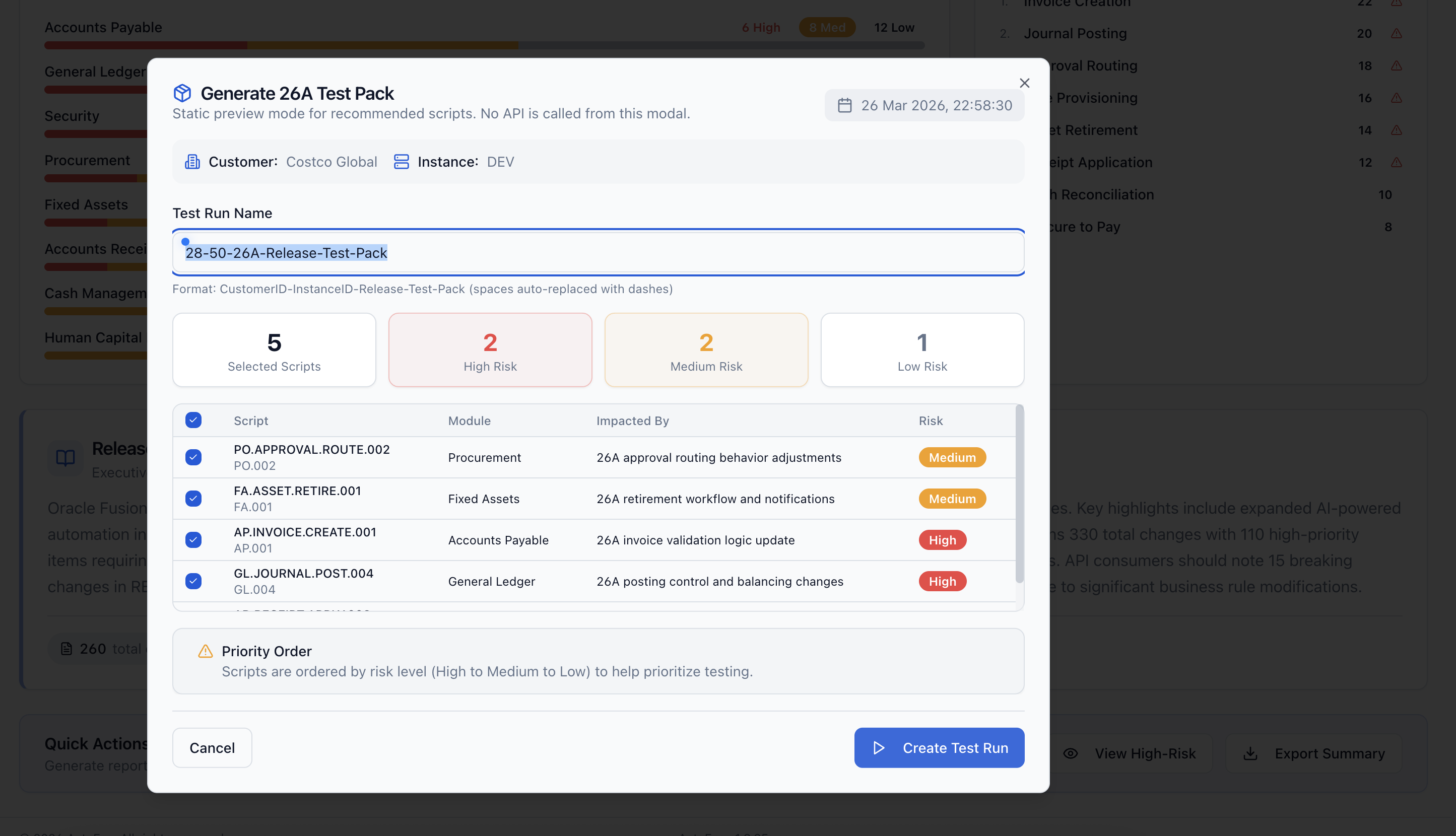
The Oracle UAT cycle in most organisations follows a predictable and painful pattern. Business requirements are documented. QA engineers interpret those requirements and write test scripts. Business users review the test scripts and often find they do not match the actual business process. Test scripts are revised. Then the UAT cycle begins — with business users executing tests manually, recording results in spreadsheets, and raising defects through a tool that QA manages and business does not fully understand.
This cycle consumes weeks of elapsed time and significant labour from both QA teams and business teams. And because the test scripts are written by QA engineers translating business requirements, there is always a gap between what is tested and what the business actually does.
SyntraFlow breaks this cycle. Its zero-code Oracle testing approach lets business users — AP team members, HR administrators, supply chain planners — create, execute, and manage their own Oracle test cases without depending on a QA engineering function.
How Zero-Code Oracle Testing Works in SyntraFlow
SyntraFlow's test authoring interface presents Oracle business processes in business language. An AP team member creating a test for the Oracle invoice matching process sees: invoice scenario (PO-matched, non-PO, duplicate), expected matching result, payment terms, and supplier type — not CSS selectors, XPath expressions, or programming variables.
Behind this business-language interface, SyntraFlow's AI engine handles all the technical complexity: navigating Oracle's Redwood UI, entering data in the correct Oracle fields, verifying Oracle's outputs, and producing a test result with full evidence capture (screenshots, data values, pass/fail assertions). The business user sees a process-language test case. The automation engine handles everything else.
The Business User Testing Advantage
Test cases reflect actual business process. When a GCC payroll administrator writes a test for UAE WPS SIF file generation in SyntraFlow, the test reflects exactly how the UAE payroll process works in their organisation — not a QA engineer's interpretation of a requirements document. The test fidelity is higher, and the compliance gaps that QA-engineer-written tests miss are caught.
UAT cycles are faster. Because business users can create and execute their own tests — rather than waiting for QA to write scripts and then waiting again for QA to execute them — UAT cycles are dramatically shorter. SyntraFlow customers consistently report 40-60% reductions in Oracle UAT cycle time after adopting zero-code testing.
QA teams focus on higher-value work. With business users handling process-level UAT, QA engineers can focus on what they do best: complex integration testing, compliance validation, performance testing, and security testing. The QA team becomes a centre of excellence rather than a test execution factory.
Coverage expands naturally. Business users will identify and test edge cases that QA engineers would never discover — the unusual invoice type, the exceptional payroll scenario, the rare supply chain situation that only comes up in a specific business context. Zero-code testing means these business-context edge cases are covered without requiring QA engineering to document and implement them.
Comparison with Competitor Approaches
Tricentis Tosca offers a no-code interface, but its no-code capability is aimed at QA engineers and functional consultants — not business users. The learning curve for Tosca's test design interface is significant, and business users without testing methodology background typically struggle with it.
Opkey also markets no-code testing, but its interface is built around its pre-defined test case library — business users can run and modify Opkey's existing Oracle test cases, but creating genuinely new test cases requires understanding Opkey's test structure, which is not truly business-user-friendly.
SyntraFlow's zero-code approach is genuinely process-first. Business users author tests by describing the business scenario they want to validate, selecting the Oracle process from a menu, and defining the expected outcome in business terms. The platform handles the technical translation.
Getting Started with Zero-Code Oracle Testing
For organisations currently running manual UAT with spreadsheet test management, the transition to zero-code Oracle testing with SyntraFlow typically takes 2-4 weeks: one week to configure the Oracle connection and validate the integration; one week for business user onboarding training; and one to two weeks for business users to build their initial test library from the SyntraFlow pre-built template library.
After the transition, most organisations eliminate the QA bottleneck from their Oracle UAT cycle within the first quarterly update cycle. The QA team's time is freed for compliance testing and integration validation — the work that genuinely requires technical expertise.
Contact SyntraFlow to schedule a zero-code Oracle testing demonstration for your business users. Bring your AP manager, your payroll administrator, and your supply chain lead — we will show them how to create an Oracle test case in under ten minutes without any technical assistance.