Selenium is the foundation of web test automation. Free, open-source, supported by every major programming language, and backed by a massive community — it is the natural first choice for any team that needs to automate browser-based testing. So why are Oracle Fusion teams, one by one, walking away from it?
The answer is not that Selenium is bad. It is that Oracle Fusion is not a standard web application, and testing Oracle with Selenium is like using a general-purpose screwdriver on a precision-engineered bolt. It technically fits — but the experience is painful, the results are unreliable, and the maintenance cost is brutal.
The Five Structural Problems with Selenium for Oracle Fusion
Problem 1: Oracle's dynamic DOM destroys Selenium selectors. Oracle Fusion's frontend — particularly the Redwood UI — is built on Oracle's JET framework, which renders UI components dynamically. Element IDs, CSS classes, and DOM structures change between Oracle quarterly updates and sometimes between page renders. A Selenium test that worked in December will fail in January because Oracle changed the component ID structure in the quarterly update. Your QA team then spends weeks fixing Selenium scripts instead of testing Oracle.
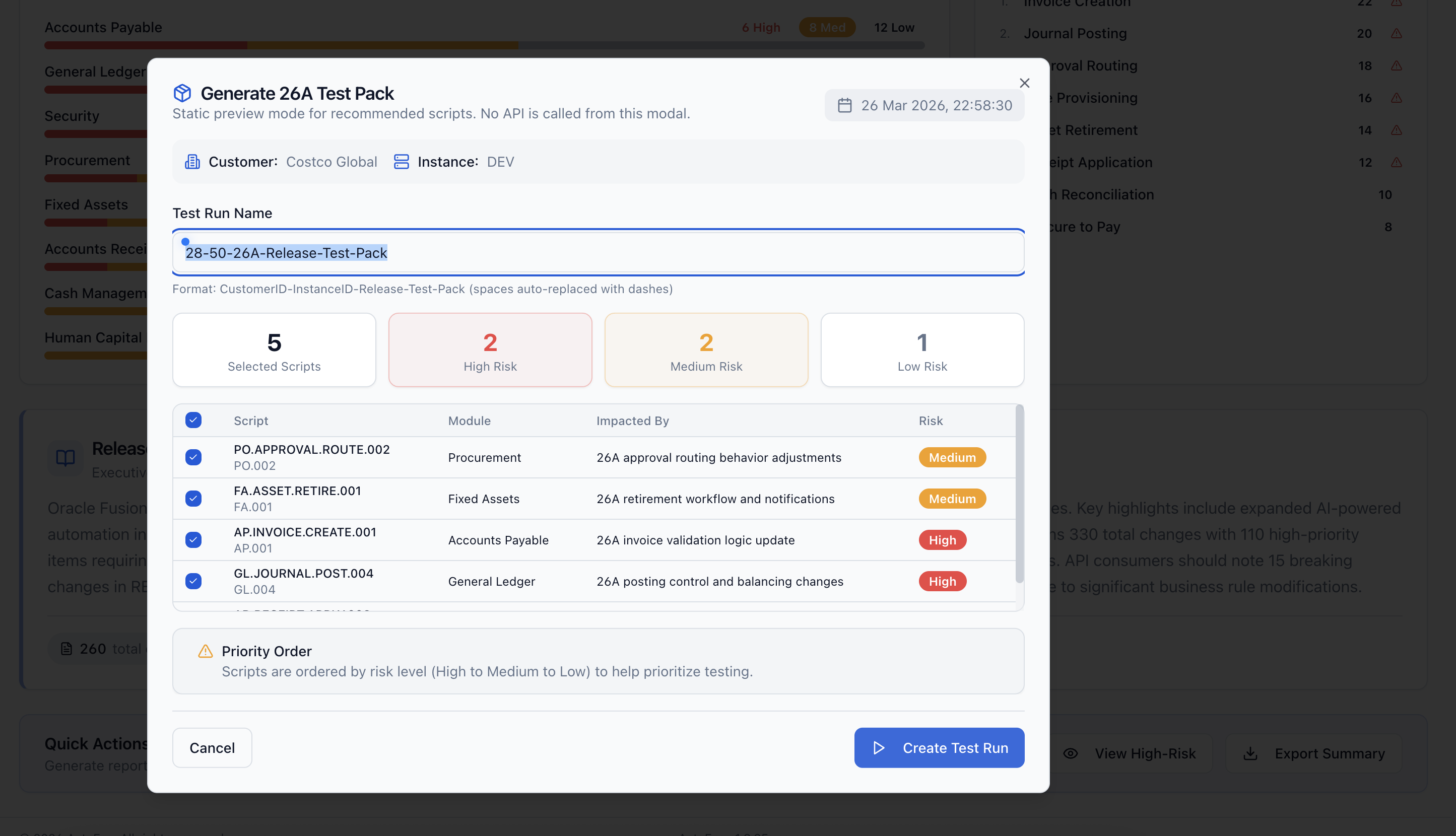
SyntraFlow's AI-driven engine uses Oracle-semantic element identification — it understands Oracle JET components natively, locating elements by what they are in Oracle's data model rather than by their DOM attributes. When Oracle changes the DOM, SyntraFlow's engine adapts automatically.
Problem 2: Selenium has no Oracle domain knowledge. Selenium knows how to click buttons and fill form fields. It has no concept of Oracle business processes, Oracle module structure, Oracle compliance requirements, or Oracle release cycles. Your team must build every test from scratch — not just the automation framework, but the domain knowledge of what to test, what the correct expected outcome is, and which Oracle scenarios represent compliance risk.
SyntraFlow ships with a pre-built Oracle test library covering hundreds of Oracle Fusion business processes, compliance scenarios, and integration tests. The domain knowledge is built in.
Problem 3: Oracle's scale kills Selenium test suites. A typical Oracle Fusion enterprise deployment covers 10-20 modules with thousands of testable scenarios. Building a Selenium test suite with meaningful coverage of Oracle Financials, HCM, SCM, and Procurement requires a sustained engineering investment that most Oracle QA teams simply cannot afford. The result is thin test coverage — fast to build, but insufficient to catch the compliance-critical issues that Oracle quarterly updates can introduce.
Problem 4: No Oracle release intelligence. When Oracle ships a quarterly update, a Selenium-based team must manually review Oracle's release notes, identify which tests might be affected, and update or re-run them. There is no automated connection between Oracle's release changes and your Selenium test library. This manual process consumes 3-5 days of QA engineering time per quarter.
SyntraFlow's Release Intelligence automatically maps Oracle quarterly update changes to affected test cases — giving your team a prioritised update list within hours of Oracle's release note publication.
Problem 5: Zero compliance awareness. Oracle compliance testing — ZATCA e-invoice clearance for Saudi Arabia, HMRC Making Tax Digital for the UK, SOX journal entry controls for US public companies — requires knowing the right compliance scenarios, the correct expected outcomes under current legislation, and the specific Oracle configuration that each compliance test depends on. Selenium has none of this. Your team must build it all, maintain it all, and update it all when compliance requirements change.
The SyntraFlow Alternative: Lightweight, AI-Driven, Oracle-Native
SyntraFlow is not a heavyweight enterprise testing platform. It does not require a six-month implementation, a dedicated testing CoE, or an enterprise contract negotiation. It is a lightweight, SaaS-delivered Oracle test automation platform that is operational in weeks — not months.
The AI-driven core means that when Oracle changes, SyntraFlow adapts. When compliance requirements update, SyntraFlow's test library is updated. When a new Oracle agentic application launches, SyntraFlow's testing approach evolves to cover it.
For Oracle teams currently running Selenium and experiencing the maintenance treadmill, the question is not whether to switch — it is how quickly you can make the switch before the next Oracle quarterly update arrives.
Contact SyntraFlow for a free Oracle test automation assessment — we will analyse your current test coverage, identify the highest-risk gaps, and show you exactly what SyntraFlow's Oracle test library covers out of the box.