QA Strategy
15 min read
Best Oracle Fusion Testing Tools in 2026: Complete Buyer's Guide
By Vaneet Gupta
April 2, 2026
Choosing the right testing tool for Oracle Fusion Cloud is one of the most consequential decisions an Oracle QA team will make. The wrong tool wastes budget, slows releases, and leaves critical business processes exposed to regression failures after every quarterly update.
This guide evaluates the leading Oracle Fusion testing tools available in 2026, explains what capabilities matter most, and provides a side-by-side comparison to help you make an informed decision.
Oracle Fusion Cloud is not a typical SaaS application. It presents testing challenges that generic test automation platforms were never designed to handle.
Oracle ships quarterly updates (26A, 26B, 26C, 26D) that are mandatory. Unlike other enterprise SaaS platforms, you cannot skip or defer them. Each update can modify page layouts, workflow behaviour, API endpoints, and Redwood UI components. Your testing tool must keep pace with this cadence or your regression coverage degrades every quarter.
Oracle Fusion processes span multiple modules. A Procure-to-Pay flow touches Procurement, Payables, General Ledger, and Cash Management. A Hire-to-Retire flow crosses HCM, Payroll, Benefits, and Absence Management. Testing these flows in isolation misses the integration failures that cause real production incidents.
Oracle Fusion test environments share a single data layer. Creating realistic test data -- suppliers with bank accounts, employees with payroll configurations, items with costing rules -- requires deep Oracle domain knowledge. Most testing tools leave data setup entirely to your team, adding days to every test cycle.
Many Oracle teams still rely on manual testing for quarterly updates. Manual cycles typically take four to six weeks, consume entire QA teams, and still miss regressions because coverage is limited by time and headcount. The result is either delayed go-lives or production defects that erode business confidence in the QA function.
Before comparing specific tools, establish the evaluation criteria that matter for Oracle Fusion environments.
The tool should understand Oracle Fusion's page architecture, including Redwood UI components, Oracle JET elements, and ADF-based pages. Generic web automation frameworks treat Oracle pages as arbitrary HTML, leading to fragile selectors and high maintenance overhead.
You need the ability to run comprehensive regression testing across ERP, HCM, and SCM modules within days, not weeks. This means pre-built test coverage for standard Oracle business processes, not just a framework for building tests from scratch.
Look for automated test data provisioning that creates valid Oracle business objects -- suppliers, customers, employees, items -- with all required dependencies. Manual test data creation is the hidden bottleneck in most Oracle QA programmes.
The tool should analyse each quarterly update and identify which of your configured business processes are affected. This lets you focus regression testing on impacted areas rather than retesting everything blindly.
Cross-module business process validation is essential. Your tool must support flows that span Oracle Fusion ERP, Oracle HCM Cloud, and Oracle SCM Cloud in a single test execution.
Oracle's quarterly updates change UI elements frequently. Self-healing test automation that adapts to UI changes without manual script updates is no longer a nice-to-have -- it is a requirement for sustainable Oracle test automation.
Tricentis Tosca is a well-established enterprise test automation platform with broad ERP coverage. It supports Oracle Fusion through its web testing engine and offers model-based test design.
Strengths: Mature platform with large enterprise install base. Supports multiple ERPs beyond Oracle. Model-based test design reduces some scripting effort. Strong SAP testing heritage.
Limitations for Oracle Fusion: Tosca is not Oracle-native. Its selectors are generic web selectors, which means Redwood UI changes frequently break tests. Test data management for Oracle requires significant custom configuration. Quarterly patch analysis is not built in -- teams must manually assess update impact. Licensing costs are enterprise-tier, and implementation timelines typically run three to six months. Learn more in our SyntraFlow vs Tricentis Tosca comparison.
Several multi-ERP testing platforms offer Oracle Fusion support alongside SAP, Workday, and other enterprise applications. These platforms aim to provide a single testing solution across your ERP landscape.
Strengths: Multi-ERP coverage for organisations running Oracle alongside SAP or Workday. Some offer pre-built Oracle test accelerators. Cloud-based deployment reduces infrastructure setup.
Limitations for Oracle Fusion: Oracle is one of many platforms these tools support, which means Oracle-specific depth is often limited. Redwood UI support can lag behind Oracle's quarterly release schedule. Test data automation tends to be basic, requiring manual data setup for complex Oracle business objects. Patch impact analysis, where available, may not cover Oracle-specific configuration layers like Flexfields, Lookups, and Profile Options.
Selenium is the most widely used open-source web automation framework. Many Oracle teams start here because it is free and familiar to developers.
Strengths: Free and open source. Large community and extensive documentation. Maximum flexibility for custom test frameworks. Integrates with virtually any CI/CD pipeline.
Limitations for Oracle Fusion: Selenium has no Oracle awareness whatsoever. Every test must be built from scratch. Oracle's dynamic page elements, lazy loading, and asynchronous UI updates cause chronic test instability. Redwood UI transitions require complete test rewrites. There is no test data management, no patch analysis, no pre-built business process coverage. Teams using Selenium for Oracle Fusion typically spend 60-80% of their time maintaining existing tests rather than expanding coverage.
SyntraFlow is built exclusively for Oracle Fusion Cloud testing. It is listed on Oracle Cloud Marketplace and operates as an Authorized Oracle Channel Partner.
Oracle-Native Architecture: SyntraFlow's test engine is designed specifically for Oracle Fusion's page structure, including Redwood UI, Oracle JET components, and ADF pages. Semantic test anchors locate elements by functional role rather than brittle technical attributes, which means tests survive quarterly UI changes without maintenance.
DataVault -- Automated Test Data: SyntraFlow's DataVault creates complete Oracle business objects automatically -- suppliers with bank accounts and payment terms, employees with payroll configurations, items with costing rules. Test data that previously took days to prepare is available in minutes.
Config Copy: SyntraFlow can replicate your Oracle configuration from production to test environments, ensuring that your test environment accurately reflects your live setup. This eliminates the configuration drift that causes false test failures.
AI Test Pack: Before each quarterly update, SyntraFlow's Release Intelligence engine analyses Oracle's release notes and maps changes to your specific configuration. It generates a targeted regression pack covering only the business processes affected by the update -- so your team tests what matters, not everything.
End-to-End Validation: SyntraFlow supports cross-module flows spanning ERP, HCM, and SCM. A Procure-to-Pay test can start in Procurement, flow through Payables, validate GL postings, and confirm bank payment file generation -- all in a single automated execution.
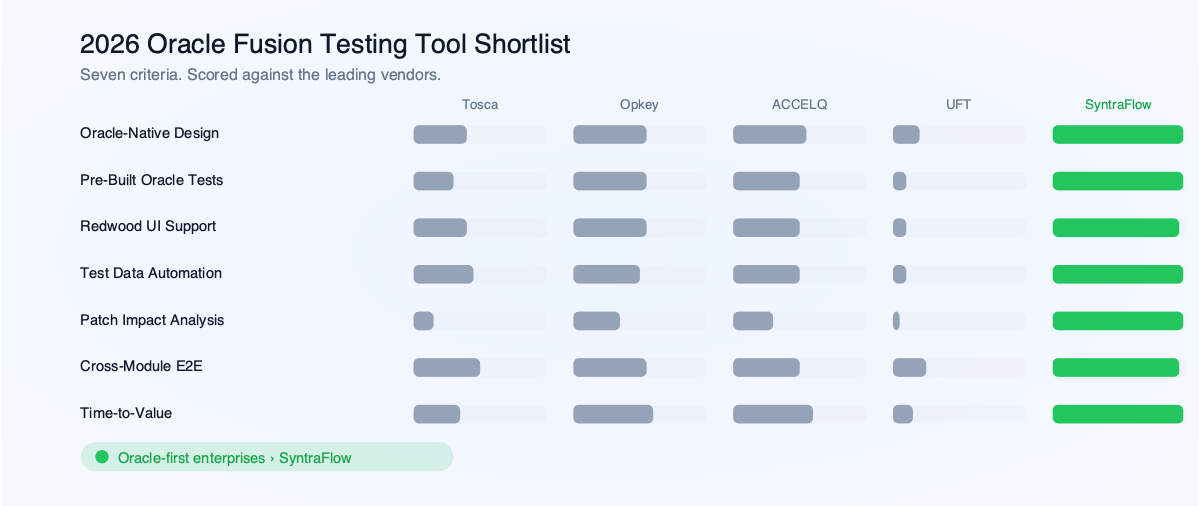
| Capability | Tricentis Tosca | Multi-ERP Platforms | Selenium | SyntraFlow |
| --- | --- | --- | --- | --- |
| Oracle-Native Design | No -- generic web | Partial | No | Yes -- built for Oracle |
| Pre-Built Oracle Test Cases | Limited accelerators | Some | None | 25,000+ |
| Redwood UI Support | Manual updates needed | Varies by vendor | Manual rewrites | Self-healing selectors |
| Test Data Automation | Requires custom config | Basic | None | DataVault -- full automation |
| Quarterly Patch Analysis | Not built in | Limited | None | AI-powered Release Intelligence |
| End-to-End Cross-Module | Requires integration work | Partial | Custom build required | Native ERP + HCM + SCM |
| Config Copy | No | No | No | Yes |
| Self-Healing Tests | Limited | Varies | No | AI-powered semantic anchors |
| Time to First Value | 3-6 months | 2-4 months | 6+ months | 2-4 weeks |
| Oracle Cloud Marketplace | No | Varies | No | Yes -- listed |
The pattern we see across enterprise Oracle teams is consistent: organisations start with a generic tool or Selenium, spend six to twelve months building a test framework, achieve partial coverage, and then watch that coverage erode with each quarterly update as test maintenance consumes the team's capacity.
The root cause is that generic tools treat Oracle Fusion as just another web application. Oracle Fusion is not a generic web application. Its dynamic UI, complex data model, mandatory quarterly updates, and cross-module business processes require a testing platform that understands Oracle at a structural level.
Oracle-native testing tools like SyntraFlow eliminate the translation layer between your testing tool and Oracle's architecture. The result is faster test creation, lower maintenance, broader coverage, and shorter regression cycles -- which translates directly to faster, safer quarterly updates.
If your organisation runs Oracle Fusion as its primary ERP, the testing tool decision should prioritise Oracle-native capabilities over broad multi-platform coverage. The questions to ask during evaluation are:
• How quickly can we achieve regression coverage for our configured Oracle business processes?
• What happens to our tests when Oracle ships the next quarterly update?
• How does the tool handle test data for complex Oracle business objects?
• Can the tool analyse quarterly patch notes and identify impact on our specific configuration?
• Does the tool support end-to-end flows across ERP, HCM, and SCM?
• What is the total cost of ownership over three years, including maintenance effort?
SyntraFlow was built to answer each of these questions. Schedule a demo to see how SyntraFlow's Oracle-native architecture, DataVault, Config Copy, and AI Test Pack deliver comprehensive Oracle test automation in weeks rather than months.
For detailed pricing information, visit our pricing page or contact our team for a personalised quote based on your Oracle module footprint.