Know exactly what every Oracle release changes in your tenant.
Generic tools read Oracle's release notes and email you a summary. SyntraFlow Release Intelligence connects to your live Oracle Fusion instance and analyses each quarterly update and security patch across 10 critical pillars — then hands back a tenant-specific impact statement and the exact tests to run. No one else does this.
Connect your tenant. The engine does the rest.
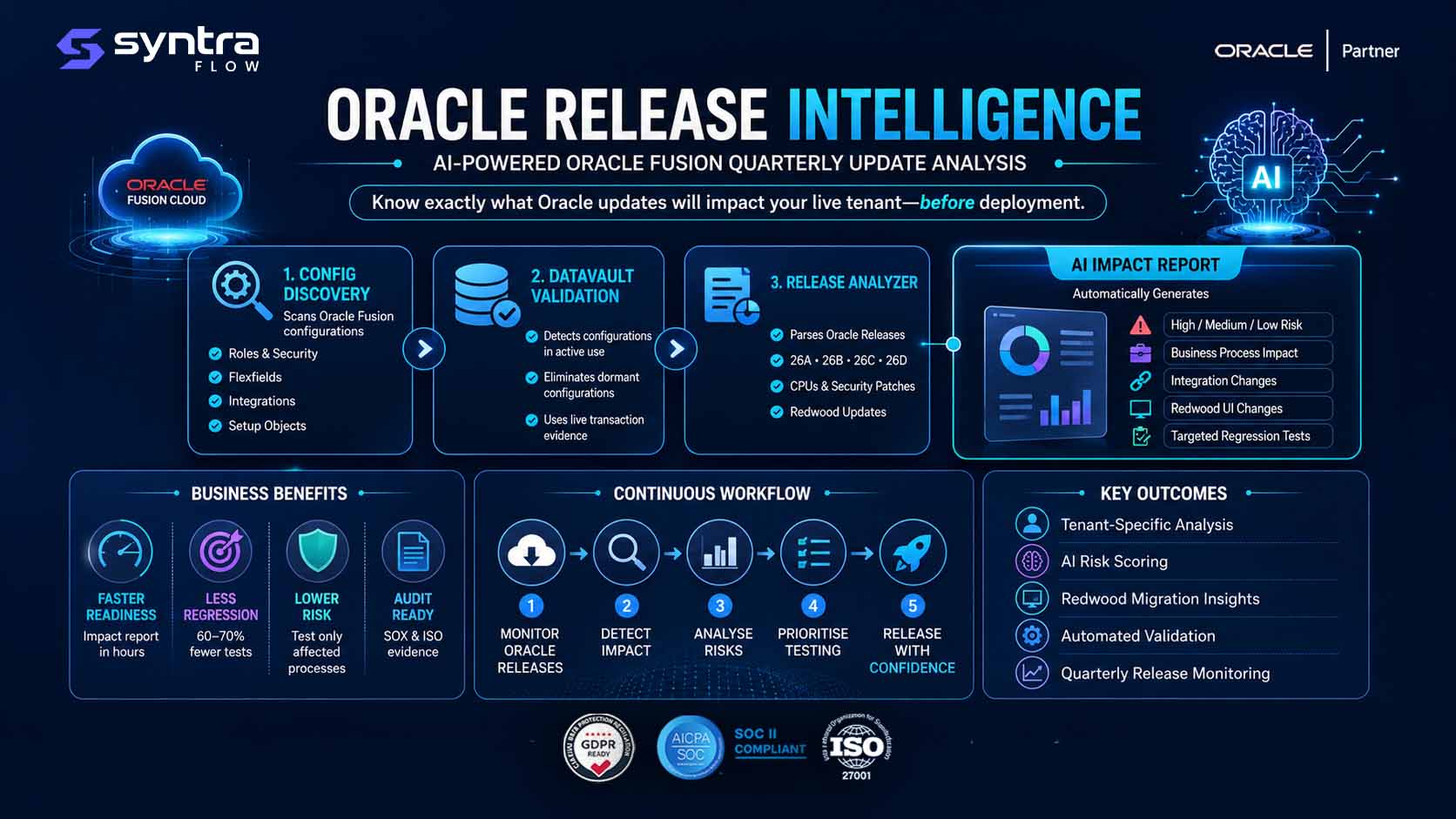
You give SyntraFlow a secure, read-only connection to your Oracle Fusion instance. From there it is fully automated — no manual exports, no spreadsheets, no generic checklists. The engine runs in three steps and reports back across ten pillars.
Your live Oracle instance
A secure, read-only connection to your Oracle Fusion tenant. That is the only setup you do — the rest is automatic.
Setup, data, jobs & integrations
Auto-scripts pull your FSM setup, capture critical data into DataVault, and read your ESS jobs, custom reports and web services.
Across 10 pillars → impact statement
The incoming release is cross-referenced against your tenant across all 10 pillars — down to the privilege, job or integration that changed — with the tests to run.
10 critical pillars, every release
A change in any one of these can break a business process, an integration or a user's access. SyntraFlow checks all ten against your tenant — not generic Oracle documentation.
Role, duty and privilege changes mapped to your named users — who gains or loses access, and where segregation-of-duties is affected.
FSM setup tasks, profile options and flexfields checked against the release for changed defaults, retirements and new required setup.
Your scheduled Enterprise Scheduler jobs checked for deprecated parameters, changed outputs and behaviour shifts.
Oracle Integration Cloud flows assessed for endpoint, payload and schema changes that could silently break interfaces.
SOAP and REST services your integrations depend on, checked for version changes, deprecations and contract changes.
Your analytics and reports assessed for subject-area changes, data-model shifts and layout impacts that affect outputs.
Page personalizations and sandboxes checked for conflicts with Redwood changes and new page structures.
Approval rules and workflow configurations assessed for changes to routing, tasks and rule behaviour.
Which of your pages and flows move to Redwood in the release, so you can plan UI change management and user training.
Transaction and data-model metadata compared release-over-release to surface structural changes affecting extracts and controls.
The value isn't ten separate scans — it's correlating them into one impact statement for your tenant, with the tests that prove it.
- ✗Parse Oracle release notes only
- ✗No idea which configs you actually have
- ✗No idea which users a change affects
- ✗Same generic report for every customer
- ✗Manual triage required to filter false positives
- ✓Connects to your live tenant — read-only
- ✓Analyses 10 pillars of your real environment
- ✓Names the exact users a privilege change affects
- ✓Impact statement unique to your tenant
- ✓Fully automated · no manual triage
Release Advisory: connect your tenancy, we do the rest
This is the service most Oracle teams have been asking for and no vendor delivers: you connect your Oracle Fusion instance, and SyntraFlow returns a tenant-specific impact statement for every release — the privileges that changed, the users affected, the integrations at risk, and the exact tests to run before you update.
- One connection, zero manual work — read-only access to your instance is the only setup.
- Named-user impact — not "something changed in Payables", but "these 14 users lose invoice approval".
- Pre-scoped regression tests — ready to run before your cohort's update window.
Oracle Quarterly & Security Releases Tracked
Every Oracle Fusion quarterly update and Critical Security Patch — past and upcoming. Click to drill into release intelligence for each.
Go deeper into Oracle Release Intelligence
Seven dedicated guides — quarterly updates, release readiness, impact analysis, testing, regression, Redwood and AI — each with executive-grade depth.
Oracle Quarterly Updates
Continuous intelligence for 26A, 26B, 26C, 26D — release timelines, modules impacted, Redwood & AI evolution.
ExploreRelease Readiness
Be release ready before every Oracle Fusion quarterly update — risk visibility, impact analysis, Redwood readiness.
ExploreRelease Impact Analysis
AI-powered Oracle change intelligence — every release change mapped to your tenant, risk-scored before production.
ExploreOracle Update Testing
Validate Oracle Fusion updates faster with release-aware automation and AI-driven testing intelligence.
ExploreOracle Regression Testing
Risk-scored, change-aware regression testing — cut quarterly regression effort by 70% without losing coverage.
ExploreRedwood Migration Impact
Track Redwood UI transitions, workflow impacts, personalization risks and automation stability per release.
ExploreOracle AI Release Changes
Monitor embedded AI, assistants, recommendations and agentic workflows evolving every quarterly Oracle release.
ExploreCritical Security Patches (CSPU + CPU)
NEW · MONTHLYOracle's new monthly Critical Security Patch Update cadence (CSPU) launches May 28, 2026 — track every CSPU and quarterly CPU release, with tenant-specific impact analysis and security regression validation.
Explore CSPU HubTesting concepts every Oracle ERP team should master in 2026
Practical guides — written for US, UK and EU Oracle Fusion Cloud and E-Business Suite teams.
What Is Regression Testing? The Complete Guide for Oracle ERP Teams
Why Oracle's quarterly updates make regression critical — and how to automate it.
UAT Testing for Oracle Fusion Cloud: The 2026 Playbook
Process, sample scripts and automation strategy for Oracle UAT.
SIT Testing Explained: System Integration Testing for Oracle ERP
How Oracle teams test OIC flows, REST APIs, EDI partners and file integrations.
Integration Testing in 2026: Oracle Fusion Integrations
Patterns for OIC, REST, SOAP, EDI and FBDI integration testing.
Types of Software Testing: A 2026 Reference for Oracle Teams
14 testing types explained with Oracle-specific guidance.
Performance Testing Oracle Fusion Cloud: Complete Guide
Load, stress, batch throughput and OIC performance strategy.
CI/CD Pipelines for Oracle Fusion: Continuous Testing
How modern Oracle teams build CI/CD around quarterly releases and CSPUs.
Test Data Management for Oracle: Strategy + Tools
Synthetic generation, GDPR masking and refresh patterns for Oracle.
Test Case Management: An Oracle-Focused Guide
Structure, versioning, audit-grade execution at Oracle scale.
Oracle quarterly updates create continuous risk
Oracle pushes updates every quarter — but most enterprises still rely on manual analysis and reactive testing. Silent risk compounds with every release.
Mandatory quarterly updates
26A, 26B, 26C, 26D every year — non-negotiable, all customers, no opt-out.
Pages of release notes
Each quarterly drop contains 1,000+ pages of Readiness material teams cannot manually parse in time.
UI & AI changes
Redwood UX rollouts and embedded AI agents shift behaviour silently — breaking automation and training.
Integration failures
OIC adapters, REST/SOAP endpoints and FBDI templates change without prominent release-note coverage.
Regression overload
Without an impact map, teams default to retesting everything — burning 80% of effort on tests that didn't need to run.
Production disruption
Missed impacts surface as period-close failures, payroll defects or revenue leakage — discovered after go-live.
Eight capabilities, one continuous engine
Surface every meaningful Oracle Fusion change, score its business risk and tell your team exactly what to validate before each quarterly release reaches production.
Release Impact Analysis
Tenant-specific impact map across scripts, pages, roles, integrations and end-to-end flows for every 26A/B/C/D release.
AI Change Detection
LLMs trained on every Fusion release since 23A parse release notes, What's New and Readiness PDFs — surfacing buried changes.
Redwood Transition Insights
Detects which pages flipped to Redwood, what selectors moved and where personalisation drift creates UI risk.
Regression Risk Scoring
Risk-rank every change High / Medium / Low against your business-criticality model so teams test only what matters.
Automated Validation Handoff
One-click handoff of the targeted regression set to SyntraFlow ERP Test Automation with evidence capture.
Quarterly Monitoring
Continuous monitoring of Oracle Readiness, Critical Patch Updates and What's New — instant alerts when your tenant is affected.
Process-Level Intelligence
Ripple-effect analysis across P2P, O2C, R2R, Hire-to-Retire and Period Close so upstream changes propagate visibly.
Integration Stability Checks
OIC flows, REST/SOAP endpoints, FBDI templates and BI Publisher reports validated against each release's deltas.
How Oracle Release Intelligence works
A continuous, AI-driven pipeline that turns every Oracle Fusion release into a ranked, actionable readiness report — without manual review cycles.
Oracle quarterly releases
Continuous monitoring of Oracle Readiness, What's New and Critical Patch Updates. AI parses the moment Oracle publishes.
Impacted business processes
Cross-reference every release change against your tenant's discovered config, scripts, roles, integrations and flows.
Redwood & AI changes
Deep analysis of Redwood UI transitions, embedded AI agents, integration deltas and security shifts — risk-scored.
Testing & release readiness
Auto-compose a targeted regression plan, generate a readiness score and hand off to automated execution.
Coverage across every Oracle Fusion application
Release intelligence, update analysis and regression impact scoring — Financials, SCM, HCM, CX and beyond.
Stay ahead of Redwood and AI changes
Oracle continues accelerating Redwood UX and AI-powered workflows across Fusion applications. Each release shifts more pages, more behaviour and more automation surface — quietly.
-
Redwood migration impactPer-release map of pages flipped to Redwood, selector deltas and personalisation drift.
-
UI personalisation changesSandbox-level diff for layout, fields, dynamic flexfields and conditional logic.
-
AI workflow changesTrack Oracle's embedded AI agents — summarisation, drafting, prediction — quarter over quarter.
-
Automation stability risksPredictive stability score flagging scripts likely to break on the next Redwood rollout.
A tenant-specific scorecard before every go-live
Quantified outcomes for global Oracle programs
Reduce regression testing effort
Run only the impacted scripts. Skip the rest with confidence.
Faster quarterly validation
From 1–2 weeks of planning to hours of AI-assisted decisioning.
Lower production risk
Unplanned post-release defects across the first three quarterly cycles.
Improved Oracle visibility
Continuous, executive-grade view of every Oracle change across the estate.
Accelerated readiness
Stakeholder-ready impact briefings within a day of Oracle publication.
Better business continuity
Audit-ready release governance for SOX, ISO 27001 and global compliance.
Frequently asked questions
What is Oracle Release Intelligence?
How do Oracle quarterly updates impact enterprises?
How does release impact analysis work?
What is Redwood migration readiness?
How can Oracle regression testing be reduced?
How frequently are Oracle Fusion updates analysed?
Which Oracle modules are supported?
How does the AI work?
Be ready for every Oracle quarterly update
Book a 30-minute walkthrough and see your next Oracle quarterly release scored against your live tenant.
How SyntraFlow Release Intelligence Works
Release Intelligence is a SyntraFlow module that is licensed and priced separately from the core SyntraFlow test automation platform. It pinpoints exactly what each Oracle Fusion quarterly release or critical patch will affect in your tenant — and produces the test scenarios needed to validate it. The workflow runs in five connected steps:
- Connects to your Oracle Fusion environment. A secure read-only connection to your live Oracle Fusion tenant ingests setup data, security model, and live transactions — no manual exports, no spreadsheets.
- Scans your complete configuration with Config Intelligence. Config Intelligence snapshots every setup object (FSM tasks, profile options, BPM rules, descriptive flexfields, security policies) and compares it against the incoming release.
- Reads master & transaction data via DataVault. DataVault profiles your real master data and live transactions so impact analysis is grounded in what your business actually runs — not generic Oracle samples.
- Produces a detail-level Impact Map. Cross-references the release notes against your configuration and data to highlight which features, flows, integrations, and reports are at risk — down to the line-level setting or seeded role that changed. See Release Impact Analysis.
- Generates test scenarios & remediation report. Outputs ready-to-execute test cases targeting each impacted area, plus a remediation report with the exact steps to update your setup or data so the patch goes live with minimum disruption. Run them with Patch Testing Automation.
Licensing note: Release Intelligence is a standalone SyntraFlow module available as its own subscription, or as an add-on to the SyntraFlow test automation platform. Pricing is separate from the core platform — contact us for module pricing and bundling options.