The ERP access intelligence and license optimization layer for Oracle Fusion and EBS.
Identify inactive users, rationalize roles, optimize Oracle license tiers, and govern provisioning across the full ERP user lifecycle. Built for CIOs, IT Finance, ERP admins, and audit teams who need a single pane of glass on Oracle access.
Oracle Fusion License Optimization & User Provisioning Intelligence
Optimize Oracle ERP licensing costs, streamline user provisioning, identify inactive users, and improve access governance across Oracle Fusion and Oracle EBS environments. Built for CIOs and IT Finance teams who can't keep paying for licenses nobody uses.
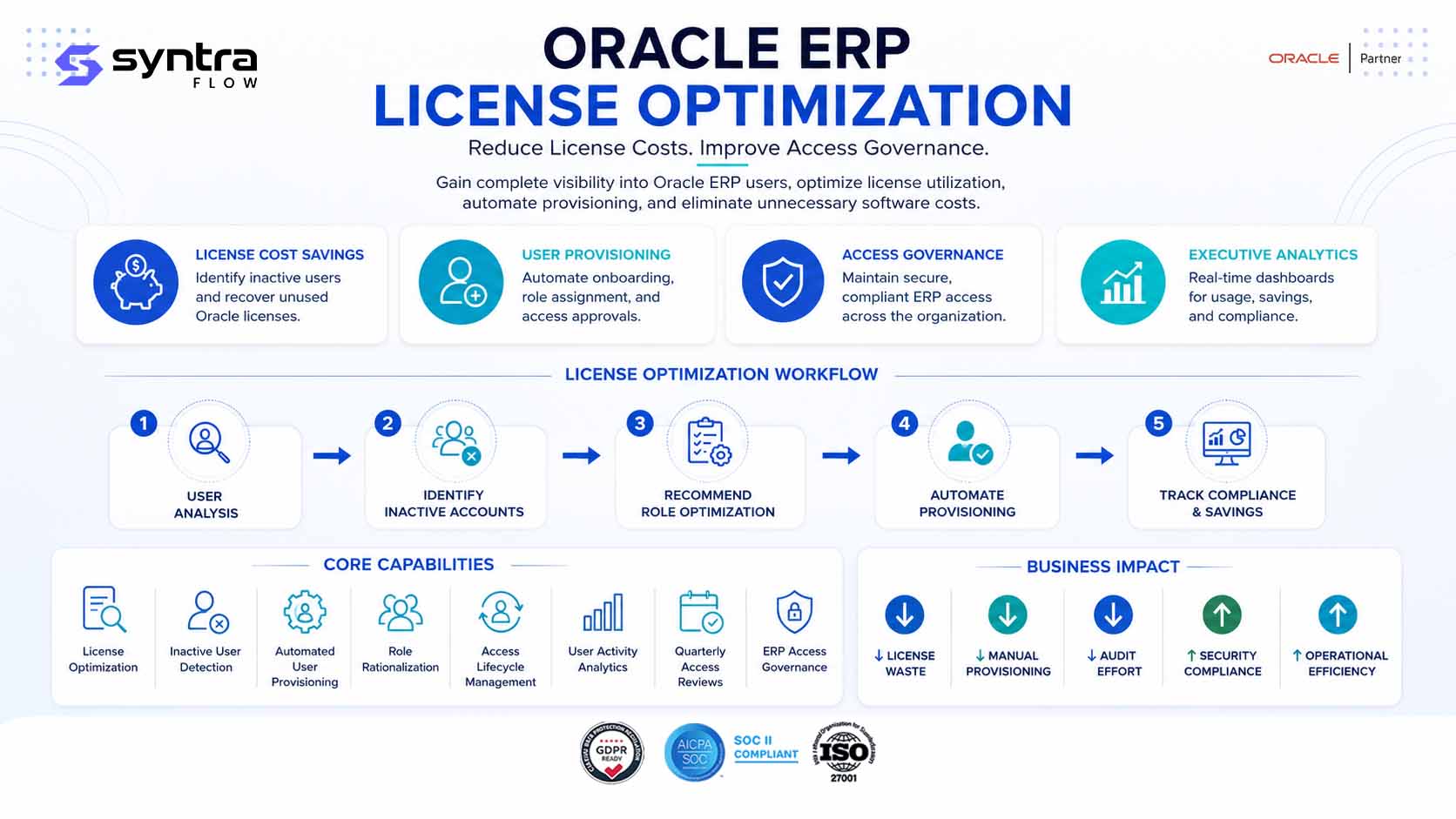
Optimize Oracle ERP license utilization
Active vs inactive vs dormant accounts, duplicate access, over-provisioned users, license consumption trends — all surfaced with executive-ready visualizations.
Automate Oracle ERP user provisioning & access governance
Six controlled stages from new-user request to audit. No more "the new hire is waiting on access" tickets.
New User Request
Triggered automatically from Workday, SuccessFactors, or any HRIS. New hire data, job role, BU, and location captured upfront — no manual ticket entry.
Role Recommendation
SyntraFlow's role engine inspects peers in the same job, BU, and location and recommends the minimum-privilege Oracle role bundle. Avoids role explosion.
Approval Workflow
Slack / Teams / ServiceNow / email approvers receive the request with the SoD pre-check result already attached. Approve, modify, or deny in one click.
Provisioning
Automated provisioning into Oracle Fusion via REST APIs — roles assigned, data security policies applied, BI privileges configured. Average SLA: under 4 minutes.
Access Validation
Validates the new user can actually log in, access expected pages, and run intended business processes. Flags broken provisioning before the user opens a Day-1 ticket.
Audit Tracking
Every step timestamped, attributable, and immutable. Drop-in evidence for SOX walkthroughs, ISO 27001 audits, and quarterly access certification reviews.
Identify unused & dormant ERP accounts
Every user ranked by activity score with a specific optimization recommendation. Review, deactivate, or reduce access — backed by 90 days of login & transaction telemetry.
| User | Last Login | Roles | License Type | Activity Score | Recommendation | Annual Saving |
|---|---|---|---|---|---|---|
JM john.miller@acme.com |
214 days ago | 8 roles | Fusion Full Use | 5 |
Deactivate | $2,400 |
SP sarah.peters@acme.com |
187 days ago | 12 roles | Fusion Full Use | 8 |
Deactivate | $2,400 |
RK raj.kumar@acme.com |
96 days ago | 15 roles | Fusion Full Use | 32 |
Downgrade | $1,600 |
EM emily.morris@acme.com |
147 days ago | 6 roles | Fusion Full Use | 12 |
Deactivate | $2,400 |
DL david.lee@acme.com |
62 days ago | 22 roles | Fusion Full Use | 48 |
Reduce Access | $0 * |
AT alex.thomas@acme.com |
128 days ago | 9 roles (4 dup) | Fusion Full Use | 71 |
Merge Roles | $0 * |
NK nina.khan@acme.com |
88 days ago | 4 roles | Fusion Full Use | 24 |
Downgrade | $1,600 |
MG maria.garcia@acme.com |
71 days ago | 17 roles | Fusion Full Use | 38 |
Reduce Access | $0 * |
Twelve capabilities for the full Oracle ERP user lifecycle
From hire to promotion to departure — every access decision optimized, governed, and evidenced.
Oracle License Optimization
Surface every dormant license, duplicate access, and over-tier user. Dollarize the savings opportunity per user, per department, per Oracle product.
Inactive User Detection
Detect users who haven't logged in (or transacted) for 30 / 60 / 90 / 180 / 360 days. Configurable thresholds per role tier.
User Provisioning Automation
From HRIS event to active Oracle user in under 4 minutes. Approval-routed, SoD-pre-checked, fully automated provisioning.
Access Lifecycle Mgmt
Joiner / mover / leaver flows. When someone changes roles or departments, access automatically adjusts — and old roles are revoked.
Role Rationalization
Detect duplicate, redundant, and overlapping custom roles. Recommend consolidations that cut role count 30–50% with no access loss.
ERP Access Analytics
Dashboards by role, BU, department, and location. High-privilege user heatmaps. Role explosion analysis. Trend lines that finally make sense to a CIO.
License Cost Analysis
CIO-ready cost dashboards with breakdown by Oracle product, license tier, and department. Annual savings projections at the user level.
User Activity Intelligence
Login frequency, page views, transactions executed, BI queries run. Activity scores per user that distinguish "logs in" from "actually uses Oracle."
Role Recommendation Engine
For new hires, ML-suggested role bundles based on peer access patterns. For existing users, "you have access you don't need" recommendations.
Access Certification
Quarterly access reviews delivered to managers as one-click "approve / reduce / remove" decisions. Replaces multi-week spreadsheet certification cycles.
Quarterly User Review
SOX-aligned quarterly review packs auto-generated. Reviewers see dollarized savings opportunities, not just role lists.
Oracle Access Governance
Pre-built understanding of every Oracle Fusion seeded role, privilege, data security policy, and BI subject area. No mapping project required.
Reduce ERP role complexity
Most Oracle Fusion tenants accumulate hundreds of duplicate, overlapping, and orphaned custom roles. SyntraFlow finds them and shows you what to consolidate.
- 23% outright duplicate roles (different name, identical privileges)
- 38% overlapping privileges across roles
- 68 orphan roles (no active users)
- Quarterly access reviews take 4–6 weeks
- Most users carry 12+ roles they don't all need
- 0% duplicate roles (all 112 duplicates merged)
- 8% remaining overlap (intentional shared privileges)
- 0 orphan roles (all 68 deactivated)
- Quarterly access reviews take 2 days
- Average user carries 5 roles — minimum-privilege by design
Built for Oracle ERP governance & operations teams
Oracle Fusion User Provisioning
From HRIS event to live Oracle access in under 4 minutes. Replaces ServiceNow ticket queues.
ERP License Optimization
CIO-ready savings analysis with per-user dollarization. Average $420K reclaimed annually.
Quarterly User Access Reviews
SOX-aligned access certification packs auto-generated and routed to managers in one click.
Dormant User Cleanup
Identify, validate, and deactivate every Oracle user inactive 90+ days — with audit trail.
ERP Role Rationalization
Cut custom-role count 30–50% by merging duplicates and retiring orphans — without breaking access.
Oracle SaaS Cost Optimization
Validate Oracle subscription renewal counts. Negotiate renewals from data, not vendor pressure.
User Access Governance
Joiner / mover / leaver lifecycle automation across Oracle Fusion, EBS, and integrated systems.
Oracle ERP Compliance Prep
Always-current evidence for SOX ITGC, ISO 27001, and Oracle license true-up walkthroughs.
How SyntraFlow connects to Oracle ERP & identity systems
Cloud-native, no on-premise agents. Reads Oracle Fusion / EBS, integrates with HRIS and identity providers via standard protocols.
Why CIOs and IT Finance choose SyntraFlow over generic IAM
Built specifically for Oracle Fusion & EBS
Pre-built understanding of every Oracle seeded role, privilege, data security policy, BI subject area, and license tier. SailPoint and Saviynt require months of custom Oracle modeling.
ERP-native access intelligence
Activity scores based on Oracle business transactions executed — not just login frequency. "Did this user actually use Oracle this quarter" gets a real answer.
Live in 5 days, not 5 months
SailPoint and Saviynt deployments often take 6–12 months. SyntraFlow's Oracle-native architecture means a live license-optimization dashboard in under a week.
Cost-aware, not just risk-aware
Generic IGA platforms talk in roles and risks. SyntraFlow talks in dollars — every recommendation has a per-user, per-quarter, per-year savings number attached.
Integrated with the SyntraFlow Suite
Provisioning decisions get pre-validated by SyntraFlow SoD for conflict checks. Role changes flow through Config Copy for environment sync. Quarterly Oracle release security drift triggers from Release Intelligence.
Auditor-grade lifecycle evidence
Every joiner / mover / leaver event captured immutably. Quarterly access reviews, SOX walkthroughs, and Oracle license true-up cycles run on SyntraFlow data — replacing spreadsheets entirely.
Trusted by Oracle Fusion CIOs and IT Finance teams
Including healthcare leaders HCA Healthcare, Catholic Healthcare, and Huggins Hospital.
SyntraFlow surfaced 1,240 inactive Oracle users we'd been paying for. Within one quarter we negotiated our renewal down by $420K — and gave finance a defensible model going forward.
We had Saviynt deployed for 18 months and never got the Oracle-specific insights we needed. SyntraFlow was live in a week and within the first month had cut our role count by 36%.
Frequently asked questions
What is Oracle Fusion license optimization and what does SyntraFlow do?
▼
Oracle Fusion license optimization is the practice of identifying licensed Oracle users who don't actually use Oracle — inactive accounts, dormant users, over-tier license assignments, and duplicate access — so you can deactivate, downgrade, or reduce them at the next Oracle subscription renewal. SyntraFlow connects to your Oracle Fusion (or EBS) tenant via REST APIs and audit logs, scores every user's actual activity (not just login frequency, but business transactions executed), and produces a CIO-ready dashboard with per-user dollarized recommendations. Average customer recovers $420K per Oracle tenant per year.
How is SyntraFlow different from SailPoint, Saviynt, or Oracle Identity Cloud Service?
▼
SailPoint, Saviynt, and Oracle IDCS are general-purpose identity governance platforms — they treat Oracle as one of many connected systems and require 6–12 months of consulting to model Oracle's seeded role hierarchy, data security policies, and license tiers. SyntraFlow ships pre-built understanding of Oracle Fusion and EBS out of the box: live in 5 days, dollarized cost recommendations, and ERP-native activity scoring (transactions executed, not just login telemetry). Most enterprises run both — generic IGA for the broader application landscape, SyntraFlow as the Oracle-specific intelligence layer that delivers the savings and provisioning automation IGA platforms can't match for Oracle.
How does activity scoring work? What does "actually used Oracle" mean?
▼
Activity scoring goes beyond simple login telemetry — that's the trap most license-management tools fall into ("they logged in once last week, must be active!"). SyntraFlow combines login frequency, page navigation depth, business transactions executed (invoices created, journals posted, POs approved, expense reports submitted), BI queries run, and report-export volume into a 0–100 activity score. A user who logs in weekly to "check something" but never transacts shows up as score 12 — clearly downgrade or deactivate material. A user who hasn't logged in for 30 days but heavily transacted in the prior 90 still scores 78 — keep active. The scoring is configurable per role tier.
Does SyntraFlow handle automated user provisioning, or just analytics?
▼
Both. SyntraFlow runs the full joiner / mover / leaver lifecycle automatically. New hires from Workday or SuccessFactors trigger automated Oracle Fusion provisioning with role recommendations from peer access patterns, SoD pre-checks (via SyntraFlow SoD), routed approvals (Slack / Teams / ServiceNow), and post-provisioning access validation. Average SLA from HRIS event to live Oracle user is under 4 minutes. Departures and role changes are equally automated — old access is revoked the same day. The analytics side (license optimization, role rationalization) and the operational side (provisioning automation) share one Oracle-native data model.
How does SyntraFlow handle quarterly user access reviews for SOX?
▼
Quarterly access certifications run as automated review packs: every manager receives a list of their direct reports' Oracle access with a one-click "approve / reduce / remove" decision per user. Reviewers see dollarized savings opportunities ("approve this user keeps $2,400 / yr seat alive — last logged in 187 days ago"), making the certification a real risk-and-cost decision rather than a rubber-stamp exercise. The full review trail is timestamped, attributable, and exportable as SOX evidence — replacing the multi-week spreadsheet certification cycles most enterprises maintain. Customers typically compress quarterly reviews from 4–6 weeks to 2 days.
What ROI do CIOs and IT Finance teams see?
▼
Reported outcomes from SyntraFlow License Optimization customers: $420K average annual Oracle subscription savings per tenant (range $180K–$1.4M based on Oracle footprint), 28% of licensed users identified as inactive or dormant, 36% reduction in custom-role count via rationalization, 92% reduction in quarterly access-review effort, and provisioning SLA dropped from 5+ days to under 4 minutes. Most enterprises see payback within the first Oracle renewal cycle — often within 3 months of go-live. CIO buyers typically use the savings to fund the rest of the SyntraFlow Suite deployment.
Optimize Oracle ERP
access & licensing
Reduce ERP licensing costs, streamline user provisioning, and improve governance across Oracle Fusion and Oracle EBS. Live walkthrough on your real Oracle tenant — leave with a dollarized savings analysis.