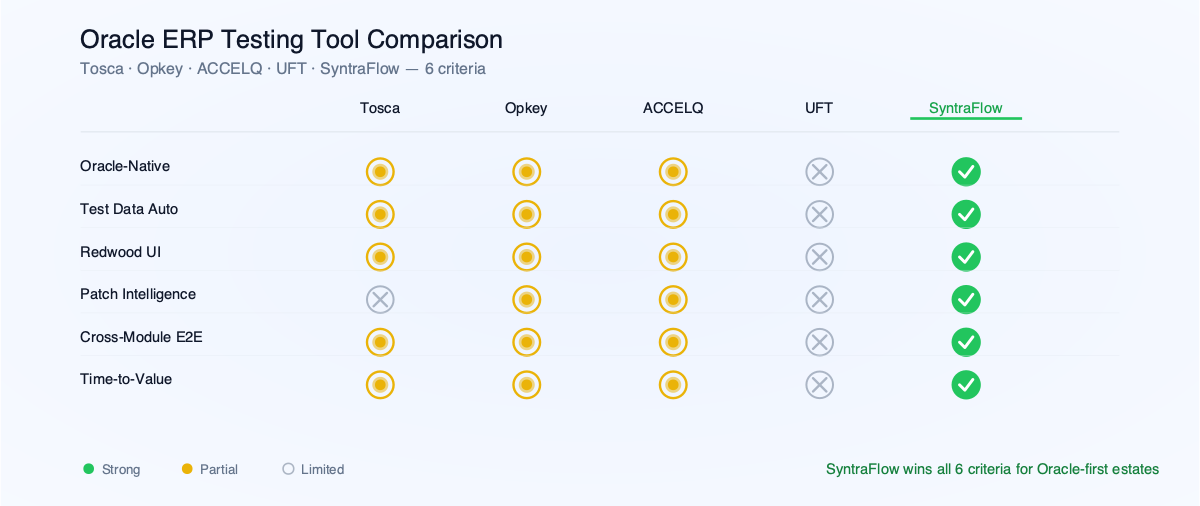
If you are evaluating an Oracle ERP testing tool in 2026, five names show up on almost every shortlist: Tricentis Tosca, Opkey, ACCELQ, UFT (Micro Focus / OpenText) and SyntraFlow. This post is the definitive side-by-side comparison across fifteen criteria that matter for Oracle Fusion customers — with clear verdicts by use case.
We have pulled the data from detailed comparison pages on each vendor — see SyntraFlow vs Tricentis Tosca, SyntraFlow vs Opkey, SyntraFlow vs ACCELQ and SyntraFlow vs UFT — and supplemented it with hands-on experience from Oracle customer POCs. If you want the underlying buyer's framework, start with our 2026 Oracle ERP testing tool buyer's guide.
How We Scored Each Tool
Every criterion below gets one of three ratings: Strong, Partial or Limited/None. We based ratings on what each vendor can demonstrate against an actual Oracle Fusion Cloud environment — not marketing decks. The criteria are grouped into five themes: Oracle depth, automation quality, process coverage, release management and commercial fit.
The 15-Criteria Comparison Matrix
| Criterion | Tosca | Opkey | ACCELQ | UFT | SyntraFlow |
|---|---|---|---|---|---|
| 1. Oracle-native architecture | Limited — generic web engine | Partial | Partial | Limited | Strong — built for Oracle |
| 2. Pre-built Oracle test library | Limited accelerators | Mid-size | Some | None | 25,000+ |
| 3. Redwood UI support | Manual updates | Varies by release | Varies | Manual rewrites | Semantic anchors, self-healing |
| 4. Self-healing selectors | Limited | Partial | Partial | None | AI-powered |
| 5. Test data automation | Requires custom config | Basic | Basic | None | DataVault full automation |
| 6. Quarterly patch impact analysis | Not built-in | Limited | Limited | None | Release Intelligence |
| 7. Cross-module E2E (ERP + HCM + SCM) | Integration work | Partial | Partial | Manual build | Native |
| 8. Oracle Cloud Marketplace listing | No | Varies | No | No | Yes — listed |
| 9. AI-assisted test authoring | Some | Some | Some | None | Strong |
| 10. Compliance evidence (SOX / ZATCA / GCC) | Partial | Partial | Partial | Partial | Strong — built-in |
| 11. Integration testing depth | Partial | Partial | Partial | Limited | Strong — API + UI + data |
| 12. Time-to-first-value | 3–6 months | 2–4 months | 2–4 months | 6+ months | 2–4 weeks |
| 13. Maintenance effort per quarter | High | Medium | Medium | Very high | Low |
| 14. Pricing model | Per-user enterprise | Per-user | Per-user | Per-user, very high | Consumption / outcome |
| 15. Multi-platform (SAP, Workday) | Strong | Partial | Partial | Strong (legacy) | Oracle-focused |
Each rating is explained in detail below.
Criterion-by-Criterion Breakdown
1. Oracle-Native Architecture
Oracle Fusion is not a generic web application. It uses Redwood UI with Oracle JET, shadow DOM and dynamic attributes, alongside older ADF pages. An Oracle-native tool understands these structures; a generic tool treats every page as arbitrary HTML.
- Tosca: built as a multi-platform web engine; Oracle pages are treated generically. Expect selector drift each quarter.
- Opkey / ACCELQ: partial Oracle awareness through accelerators; quality varies by module.
- UFT: legacy desktop automation origins; Oracle Fusion support is retrofitted.
- SyntraFlow: purpose-built for Oracle; semantic anchors identify elements by functional role rather than brittle paths. See how an Oracle ERP testing tool actually works for the technical deep-dive.
Verdict: SyntraFlow wins decisively for Oracle-first estates. Tosca remains credible only if SAP is the primary workload.
2. Pre-Built Oracle Test Library
The number of ready-to-run, Oracle-specific business-process tests.
- Tosca / ACCELQ / Opkey: limited to mid-size Oracle accelerator libraries. Expect to build a significant portion yourself.
- UFT: no meaningful Oracle library.
- SyntraFlow: 25,000+ pre-built Oracle business-process tests across Oracle Fusion ERP, Oracle HCM Cloud, Oracle SCM Cloud and cross-module flows like Procure-to-Pay, Order-to-Cash and Record-to-Report.
3. Redwood UI Support
Oracle is progressively migrating every page to Redwood UI. This is where generic tools break most visibly.
- Tosca / Opkey / ACCELQ: support exists but tends to lag Oracle's release cadence; tests require frequent updates.
- UFT: manual rewrites every release.
- SyntraFlow: semantic anchors abstract away DOM changes; self-healing rebinds to renamed components automatically.
4. Self-Healing Selectors
Does the tool automatically adapt to DOM changes, or do you rewrite tests after every patch?
- Tosca / UFT: limited or none.
- Opkey / ACCELQ: partial; effective on some changes, fragile on others.
- SyntraFlow: AI-powered self-healing with human-in-the-loop review for ambiguous cases. See self-healing features for detail.
5. Test Data Automation
Can the tool create complete Oracle business objects — supplier with bank + payment terms, employee with payroll + benefits, item with costing — with all dependencies?
- Tosca / Opkey / ACCELQ / UFT: basic or requires custom integration. Most teams end up creating test data manually, which is the number-one bottleneck in Oracle QA programmes.
- SyntraFlow: DataVault generates complete Oracle business objects automatically. Review our test data automation capabilities and sample AP invoice scenarios at AP invoice testing scenarios.
6. Quarterly Patch Impact Analysis
Before each Oracle quarterly release, does the tool analyse Oracle's release notes, map changes to your specific configuration and generate a targeted regression pack?
- All generic tools: not built-in. You retest everything or guess. Either way, the effort is high and the coverage is uneven.
- SyntraFlow: Release Intelligence does exactly this and outputs a change-aware regression pack scoped to your configuration. See the Oracle release calendar to plan quarterly cycles and patch testing automation for the full workflow.
7. Cross-Module End-to-End Coverage
Can a single test execution span Procurement → Payables → GL → Cash Management, validating data at each hop?
- Tosca / Opkey / ACCELQ: partial; requires integration work.
- UFT: manual build.
- SyntraFlow: native E2E across ERP, HCM and SCM. See inventory-to-GL testing and revenue flow testing for real-world examples.
8. Oracle Cloud Marketplace Listing
An Oracle Cloud Marketplace listing is a third-party signal that Oracle has validated the tool against its platform. SyntraFlow is listed; most others are not.
9. AI-Assisted Test Authoring
Natural-language test generation, visual test mapping, automated scenario expansion — all now standard AI affordances.
- Tosca / Opkey / ACCELQ: offer some AI features, mostly at test-authoring time.
- UFT: limited.
- SyntraFlow: AI across authoring, execution, healing and release analysis. See autonomous vs automation testing for the positioning difference.
10. Compliance Evidence
For SOX, ZATCA, WPS, PACI, GCC payroll and related mandates, your tool must produce audit-grade evidence.
- All generic tools: partial; compliance templates exist but require customisation.
- SyntraFlow: built-in coverage for SOX testing, ZATCA e-invoicing, GCC payroll, SoD testing and audit testing. Evidence captures are auditor-ready.
11. Integration Testing Depth
Oracle runs inside a landscape of Oracle Integration Cloud, BIP extracts, REST APIs, UCM files and external systems. Integration testing depth matters.
- Tosca / Opkey / ACCELQ / UFT: UI-strong, API-partial, data-validation-partial.
- SyntraFlow: unified API + UI + data validation, including Oracle Integration Cloud testing and API testing.
12. Time-to-First-Value
How long from contract signature to first automated regression cycle.
- Tosca: 3–6 months typical.
- Opkey / ACCELQ: 2–4 months.
- UFT: 6+ months for Oracle from scratch.
- SyntraFlow: 2–4 weeks thanks to the pre-built Oracle library and Oracle-native design.
13. Maintenance Effort Per Quarter
Ongoing cost of keeping tests green through Oracle's release cycle.
- Tosca / UFT: high — tests break frequently on Redwood.
- Opkey / ACCELQ: medium.
- SyntraFlow: low — self-healing absorbs most changes; Release Intelligence scopes what actually needs attention.
14. Pricing Model
- Tosca: per-user enterprise licensing; high floor; scales poorly for contributor growth.
- Opkey / ACCELQ: per-user; mid-enterprise.
- UFT: per-user; among the highest on the market.
- SyntraFlow: consumption / outcome-based; aligns cost to value. Contact us for a quote.
15. Multi-Platform (SAP, Workday, Dynamics)
- Tosca: strong multi-ERP; historically SAP-focused.
- UFT: broad legacy coverage.
- Opkey / ACCELQ: some multi-platform; Oracle depth varies.
- SyntraFlow: Oracle-focused by design. Oracle-first customers benefit; multi-ERP estates should combine best-of-breed.
Verdict by Use Case
Oracle-First SMB or Mid-Market
Winner: SyntraFlow. Time-to-value, Oracle depth and consumption pricing align with how mid-market Oracle programmes actually operate. Tosca is usually over-spec for this segment.
Large Enterprise Oracle-First
Winner: SyntraFlow. Depth on Redwood, test data, patch impact and cross-module E2E matter most at scale. Tosca and Worksoft compete here if there is significant SAP alongside.
Multi-ERP Estate (Oracle + SAP / Workday)
Tie / Hybrid. Two credible approaches:
- Multi-platform generalist (Tosca, Worksoft) with Oracle depth gap accepted.
- Best-of-breed per ERP — SyntraFlow for Oracle, specialist tool for SAP. Higher ceiling, lower Oracle risk.
Compliance-Heavy (SOX / ZATCA / GCC Payroll)
Winner: SyntraFlow. Built-in compliance evidence and regional coverage shorten audit cycles and reduce rework.
Migrating from Selenium or Spreadsheets
Winner: SyntraFlow. The pre-built Oracle library closes the coverage gap in weeks, not months. See also why Selenium fails Oracle Fusion testing and Oracle testing spreadsheets: five reasons they're failing.
Migrating from UFT / Tricentis Tosca
Review hidden costs of UFT for Oracle Fusion testing and Oracle testing tool switch from Tricentis to SyntraFlow for migration playbooks.
What to Do Next
If you are at the shortlist stage:
- Restrict your POC to two or three tools maximum. Three is already a stretch — each POC takes 2–4 weeks to run properly.
- Build the POC around your Oracle modules and your business processes, not the vendor's sandbox.
- Score each tool against the 15 criteria above, weighting by what matters for your estate.
- Calculate three-year TCO including quarterly maintenance effort. Use the ROI calculator for a starting point; see Oracle ERP testing tool ROI case studies for benchmark data from real switchers.
To shortcut the evaluation, schedule a SyntraFlow demo on your own Oracle environment. We regularly run live POCs covering authoring, test data, patch analysis and E2E execution in a single 45-minute session. For deeper reading, explore features, case studies, use cases and FAQ.