Understand Oracle Fusion Impact Before Production
AI-powered Oracle release impact analysis for quarterly updates, Redwood UI changes, integrations and business processes — across your entire Fusion footprint.
Why Impact Analysis Matters
Oracle changes don't surface in release notes — they surface in production incidents.
Hidden Release Changes
Oracle's What's New documents thousands of updates — but the changes that actually break your tenant are buried in REST deltas, FBDI templates and silent UI rewrites.
Unknown Downstream Effects
A field rename in HCM Core can cascade into Payroll, Absence, Benefits, OIC integrations and BI reports. Manual analysis misses 80% of the chain.
Customisation Exposure
Every VBCS extension, ADF customisation, BPM workflow and custom security role is a hidden break-point at each Oracle release.
Integration Risks
OIC, ICS, third-party middleware and external systems silently misalign when Oracle APIs change. Failures surface days after go-live.
What SyntraFlow Analyses
Seven impact dimensions, every Oracle quarterly release.
Business Processes
End-to-end flows: O2C, P2P, R2R, H2R, plus industry-specific processes.
Oracle Modules
Financials, SCM, HCM, CX, PPM, Procurement — every module, every release.
Redwood UI Changes
Every page flip, selector change and component swap mapped to your scripts.
Integrations
OIC, ICS, REST/SOAP, FBDI, HDL, ADFdi — full inbound and outbound coverage.
Reports
BIP, OTBI, FRS, Smart View — flagged when underlying subject areas change.
Automations
Custom workflows, approval rules, BPM, scheduled processes and AI agents.
Security Roles
Role and privilege deltas across data security, function security and ABAC.
Five Outputs from Every Oracle Quarterly Release
Point Release Intelligence at Oracle's 25A, 25B, 25C, or 25D release notes. Within minutes you get a ranked impact map across five dimensions plus an auto-composed regression test plan — exactly what Release Managers need to brief stakeholders and execute with confidence.
Impacted scripts
Every automation script in your library is cross-checked against the new release. SyntraFlow flags scripts whose underlying Fusion pages, fields, or APIs have changed — so you fix selectors before they break in CI.
Impacted pages
Page-level diff of every Fusion screen — UI selector changes, new fields, removed buttons, layout shifts. Useful for both regression planning and end-user training updates.
Impacted roles
Detects every role whose seeded privileges, data security policies, or BI access changed in the release. Stops the silent post-go-live "I lost access" tickets that always seem to surface at month-end.
Impacted flows
Traces ripple effects across end-to-end business flows — P2P, O2C, R2R, payroll, period close. A single Payables config change shows up wherever it propagates downstream.
Auto regression recommendation
SyntraFlow composes a tenant-specific regression test plan that covers exactly the High and Medium risk impacts — typically 30–40% of your full suite. Each item ships with the recommended pre-built script, expected runtime, Oracle Data Vault test data, and a sign-off checkpoint. One click to execute, full audit trail at the end.
Every impact item is risk-ranked
Breaking change. Must test before go-live.
Behavioral shift. Test recommended.
Cosmetic. Skip unless paranoid.
AI-Powered Change Detection
Detect Changed Flows
AI inspects your production flows against new release behavior to surface deltas no human would catch.
Compare Release Behavior
Pre/post comparison of UI, API responses, data transformations and process outputs across releases.
Analyze Risk Hotspots
Machine learning models flag concentration of risk by module, process or customisation cluster.
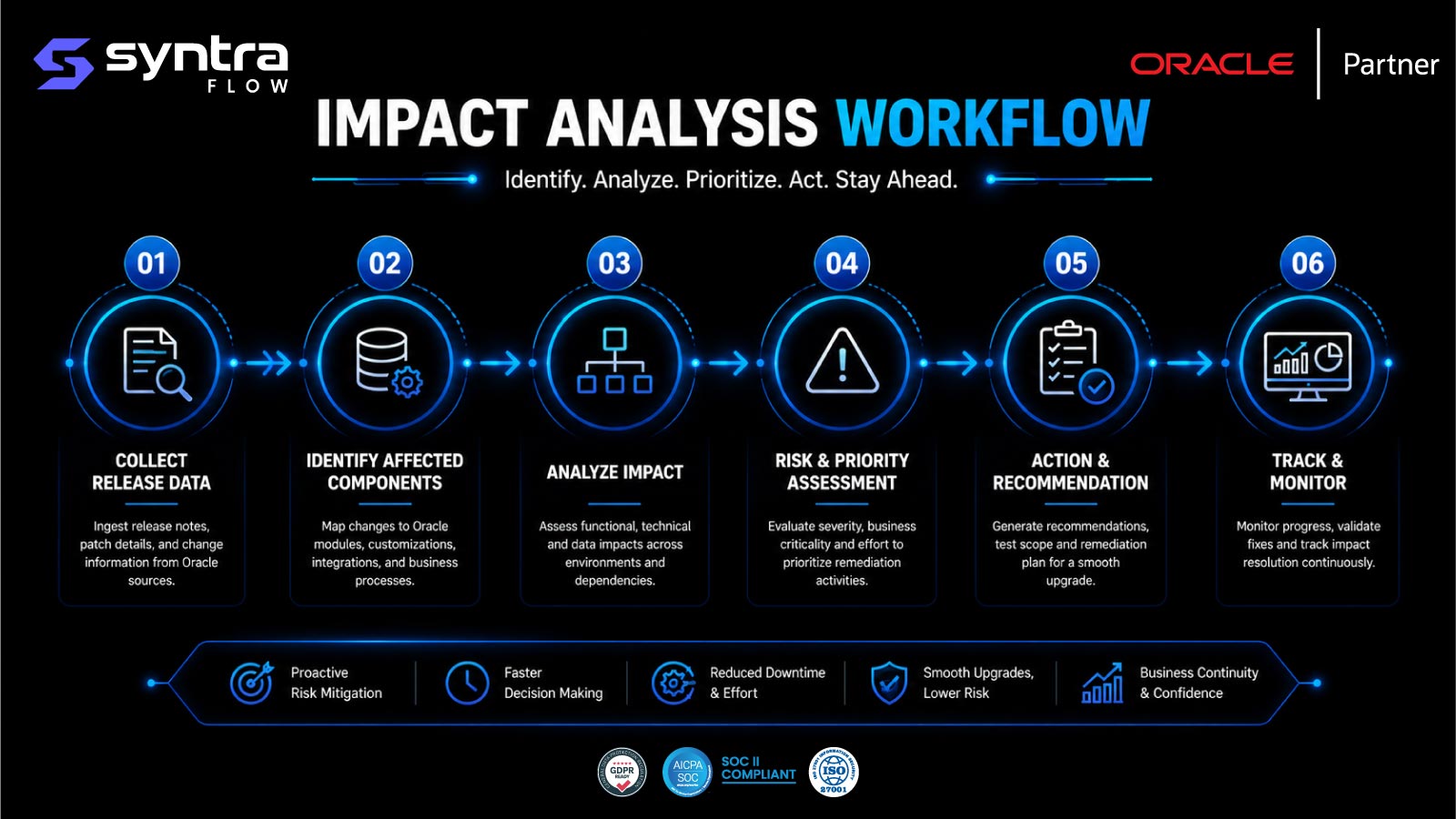
Quarterly Update Impact Workflow
Monitor Release
Continuous ingestion of Oracle Readiness portal, REST OpenAPI specs, release notes and tenant telemetry.
Detect Changes
AI parses every change and correlates it to your specific Oracle Fusion footprint.
Prioritise Risks
Risk-scored heatmap ranks impact by criticality, blast radius and regression likelihood.
Recommend Validations
Auto-generated, ranked validation plan delivered straight to QA, release and CoE teams.
Business Benefits
Reduction in post-release outages
Better release planning accuracy
Faster readiness sign-off per release
Built for Release Managers and IT Directors
Release Intelligence is positioned for the buyer who owns the quarterly Oracle release cycle: Release Managers, IT Directors, and Oracle PMOs who can't afford a missed defect or an over-tested release.
- Quarterly Oracle update planning — Brief stakeholders within 24 hours of Oracle publishing 25A/B/C/D Readiness materials.
- Pre-release risk assessment — Quantify exposure across scripts, pages, roles, and flows before a single regression test runs.
- Targeted Oracle regression testing — Cut quarterly regression effort 60–70% by running only what actually changed.
- Critical Patch Update response — Get an emergency CPU impact report in under 24 hours instead of triaging by hand.
- Audit-ready release evidence — Generate documented release-impact assessments that satisfy SOX, ISO 27001, and internal-audit release-control requirements.
- Multi-tenant release rollout planning — For Oracle service partners managing dozens of tenants, run impact analysis across the full estate at once.
Frequently Asked Questions
What is Oracle release impact analysis?
What does SyntraFlow flag as impacted — scripts, pages, roles, or flows?
How does the auto regression recommendation work?
How does SyntraFlow detect changes Oracle doesn't document?
Can it analyse impact on our custom integrations?
Does SyntraFlow Release Intelligence work with our existing Oracle ERP testing tools?
What ROI do enterprises see from Oracle release impact analysis automation?
How early can we see release impact?
See Your Oracle Impact Map
Get a tenant-specific impact analysis for the next Oracle quarterly release.
Request DemoHow SyntraFlow Release Intelligence Works
Release Intelligence is a SyntraFlow module that is licensed and priced separately from the core SyntraFlow test automation platform. It pinpoints exactly what each Oracle Fusion quarterly release or critical patch will affect in your tenant — and produces the test scenarios needed to validate it. The workflow runs in five connected steps:
- Connects to your Oracle Fusion environment. A secure read-only connection to your live Oracle Fusion tenant ingests setup data, security model, and live transactions — no manual exports, no spreadsheets.
- Scans your complete configuration with Config Intelligence. Config Intelligence snapshots every setup object (FSM tasks, profile options, BPM rules, descriptive flexfields, security policies) and compares it against the incoming release.
- Reads master & transaction data via DataVault. DataVault profiles your real master data and live transactions so impact analysis is grounded in what your business actually runs — not generic Oracle samples.
- Produces a detail-level Impact Map. Cross-references the release notes against your configuration and data to highlight which features, flows, integrations, and reports are at risk — down to the line-level setting or seeded role that changed. See Release Impact Analysis.
- Generates test scenarios & remediation report. Outputs ready-to-execute test cases targeting each impacted area, plus a remediation report with the exact steps to update your setup or data so the patch goes live with minimum disruption. Run them with Patch Testing Automation.
Licensing note: Release Intelligence is a standalone SyntraFlow module available as its own subscription, or as an add-on to the SyntraFlow test automation platform. Pricing is separate from the core platform — contact us for module pricing and bundling options.