Oracle Payables Testing Tool
The Oracle Payables Testing Tool from SyntraFlow gives Oracle ERP, QA and finance teams a single, autonomous way to validate Oracle Fusion Cloud Payables — from supplier invoice entry and matching through payments, prepayments, tax, and subledger accounting — on every quarterly release. Payables (Oracle's official name for Accounts Payable, or AP) is where money leaves the enterprise, so a single untested change can produce a duplicate payment, a mis-posted journal, or a broken approval chain that surfaces only at month-end close.
Testing Oracle Payables is hard precisely because it is so interconnected: invoices touch suppliers, purchase orders, receipts, tax, payment formats, banks, and the general ledger, and Oracle changes all of it four times a year. This page is the master hub for every Oracle Payables testing topic — it explains the discipline, maps full coverage, and links you to the dedicated pages for each scenario rather than repeating them.
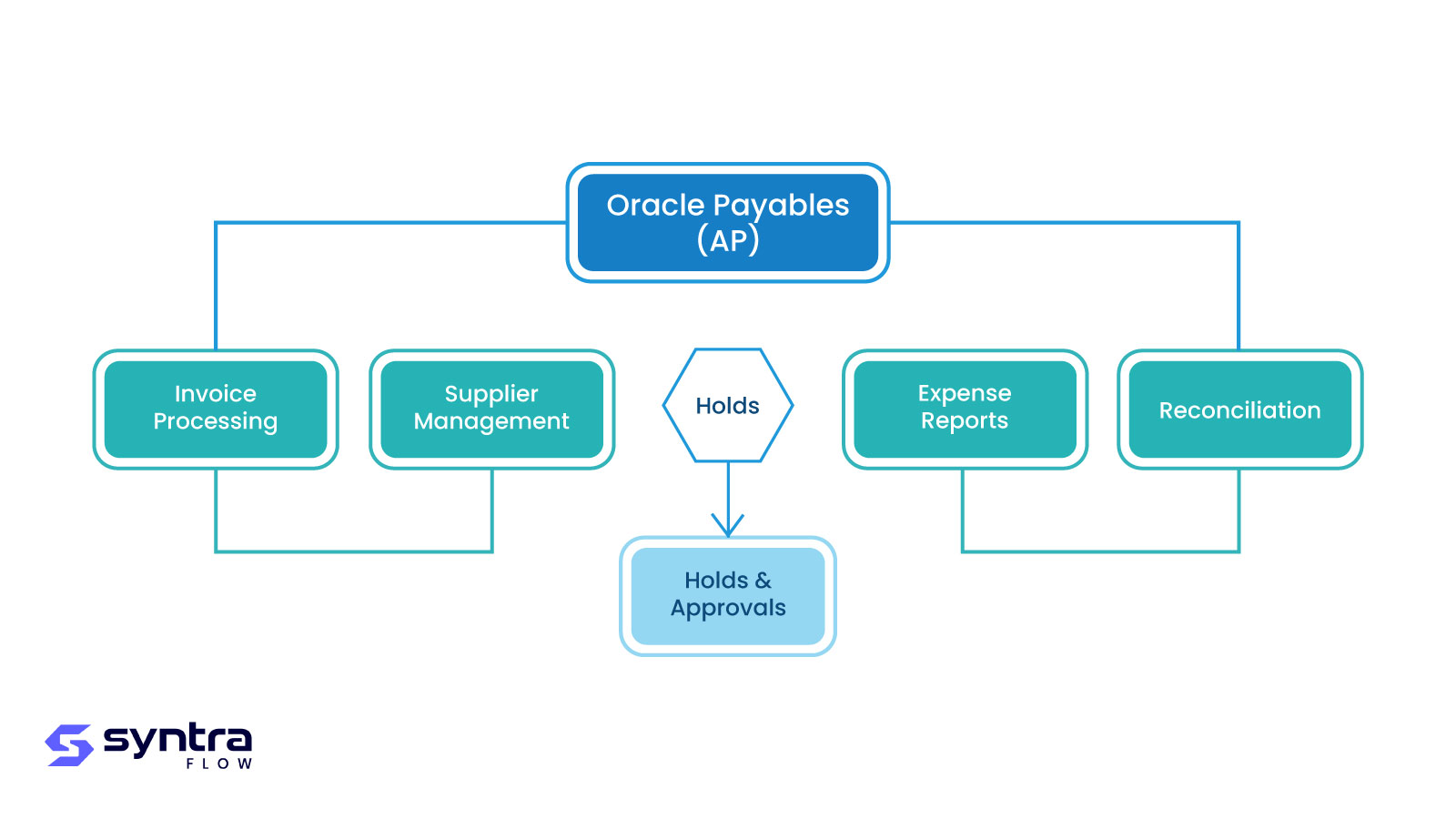
What Is Oracle Payables Testing?
Oracle Payables testing is the structured validation of the Accounts Payable module inside Oracle Fusion Cloud ERP — confirming that the module records, approves, pays, and accounts for supplier liabilities exactly as the business, its controls, and its auditors require. Oracle Payables is not a single screen; it is a set of tightly coupled processes that carry a transaction from a supplier invoice all the way to a posted general-ledger entry and a cleared bank payment.
A complete Payables testing scope covers every one of those processes:
Supplier invoices
Standard, credit memo, prepayment, and interest invoices entered manually, via spreadsheet, or through supplier portal and integration.
Invoice matching
Two-, three-, and four-way matching against purchase orders and receipts, including tolerances and match exceptions.
Invoice approvals
Approval routing through Oracle's workflow and BPM rules — the control most likely to break silently after a release.
Payments
Payment process requests, batches, disbursements, payment formats, and bank integration.
Tax & withholding
Transaction tax calculation, recoverable and non-recoverable tax, and withholding at invoice and payment.
Subledger accounting
The accounting entries Payables generates and posts to the general ledger through Subledger Accounting (SLA).
Prepayments
Prepayment creation, application to standard invoices, and unapplication — a frequent source of accounting errors.
Period close
Sweeping unaccounted transactions, reconciling the Payables-to-GL trial balance, and closing the AP period cleanly.
Done properly, Payables testing proves four things every finance organisation depends on: that there are no financial errors in calculated amounts, tax, or currency; that there are no duplicate payments to suppliers; that approval routing works and enforces the delegation of authority; and that accounting entries remain accurate and reconcile to the general ledger.
The Accounts Payable lifecycle
Every arrow above is a hand-off where a configuration change, a new Oracle feature, or an integration update can break behaviour. Payables testing validates the transitions, not just the screens.
Why Oracle Payables Is One of the Most Critical Oracle Modules
Payables sits on the enterprise's cash. Unlike a reporting or self-service module, an error in AP does not merely inconvenience a user — it moves real money to the wrong place, misstates the balance sheet, or fails an audit. That is why Payables is consistently the first module regulated and audited enterprises insist on regression-testing before any Oracle change reaches production. The failure modes are concrete and expensive:
| Risk | How it happens in Oracle Payables | Business impact |
|---|---|---|
| Duplicate payment | Duplicate-invoice checks weakened by a config change or a new integration path | Direct cash loss; difficult supplier recovery |
| Incorrect supplier payment | Wrong bank account, supplier site, or payment method selected at disbursement | Funds to the wrong party; fraud exposure |
| Tax calculation error | Tax rules or rates changed by a release, or recovery rate mis-applied | Under/over-payment of tax; compliance penalties |
| Invoice approval failure | Approval rules silently reset or re-routed after a workflow change | Broken delegation of authority; SOX control failure |
| Bank integration break | Payment file format or transmission changed by a Redwood or format update | Rejected payment files; missed supplier deadlines |
| Accounting mismatch | SLA rules produce entries that no longer reconcile to the GL | Trial-balance breaks; restatement risk |
| Audit & month-end close | Unaccounted transactions or reconciliation gaps discovered at close | Delayed close; audit findings; overtime cost |
The financial impact is asymmetric. The cost of testing an Oracle Payables change is measured in hours of QA effort. The cost of not testing it — a single duplicate payment run, a mis-stated tax position, or a delayed close — is measured in tens or hundreds of thousands of dollars and in audit exposure. This asymmetry is why AP regression is non-negotiable for enterprises running Oracle Fusion at scale.
Why Traditional Oracle Testing Falls Short
Most Oracle Payables testing today is done one of three ways — and all three struggle against Oracle Fusion's quarterly cadence and the depth of AP configuration.
Manual testing and Excel
Analysts re-key invoices and tick spreadsheet checklists every cycle. It is slow, unrepeatable, and impossible to scale to the hundreds of AP scenarios a full regression demands. Evidence is screenshots pasted into documents — weak for auditors and lost between cycles.
Selenium and generic automation
Selenium and similar tools were built for stable web apps, not Oracle Fusion's dynamic, deeply nested Redwood UI. Scripts bind to selectors that Oracle rewrites between releases, so the suite spends more time being repaired than being run.
Maintenance and configuration drift
Even a working suite decays. Quarterly updates, Redwood UI changes, and configuration drift across environments mean last quarter's scripts quietly stop matching this quarter's tenant — and the business-process complexity of AP (matching, tolerances, approvals, tax) makes each break expensive to diagnose.
The common thread is that these approaches are reactive: they test what was scripted, not what Oracle actually changed, and they break exactly when the business most needs them — right after a release. Closing that gap is what SyntraFlow was built to do.
How SyntraFlow Tests Oracle Payables
SyntraFlow replaces brittle scripts with an AI testing platform purpose-built for Oracle Fusion. Each capability below applies directly to the AP scenarios that matter most.
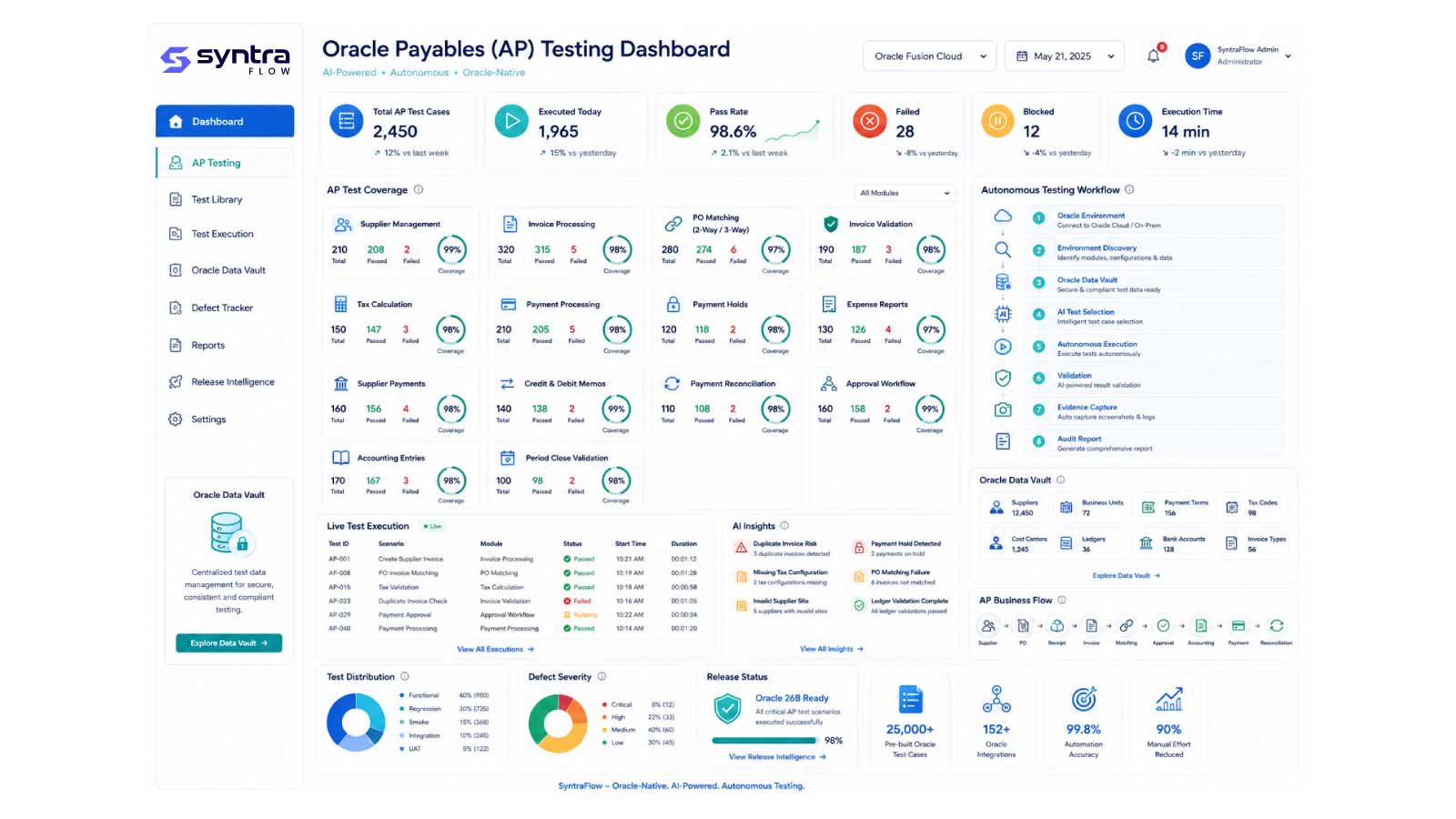
AI Test Generation
Generates Oracle Payables test cases from your configuration and business processes — invoice types, match rules, approval paths — instead of hand-scripting each one.
Self-Healing
When Oracle changes a Redwood selector or page, SyntraFlow re-anchors automatically so the AP suite keeps running instead of failing on the first UI shift.
Oracle Data Vault
Supplies context-aware AP test data — valid suppliers, POs, receipts, tax codes — so invoice and payment tests run with realistic, compliant data. Learn more →
Regression Suite
A reusable, autonomous AP regression pack covering invoices, matching, payments, tax and accounting — executed in hours, not weeks. Regression testing →
Release Intelligence
Maps each Oracle quarterly release to the AP components it actually touches in your tenant, so you test what changed. Release Intelligence →
Configuration Intelligence
Detects AP configuration drift — approval rules, flexfields, tolerances — across environments before it corrupts a test result. Configuration Intelligence →
Process Mining
Reveals how invoices and payments actually flow through your tenant, so testing prioritises the real high-volume AP paths. Process Mining →
End-to-End Automation
Runs full Procure-to-Pay chains — supplier to PO to receipt to invoice to payment to GL — not just isolated AP screens.
REST API Validation
Validates Payables REST and integration payloads directly, catching interface breaks the UI cannot see.
Evidence Capture
Every step is captured as timestamped, audit-grade evidence — screenshots, data, and accounting results — ready for SOX and external audit.
Reporting & Dashboards
Executive dashboards show AP coverage, pass/fail trends, and release readiness at a glance for QA and finance leadership.
Quarterly Update Testing
Purpose-built for Oracle's 24D–26C cadence, re-validating AP the moment Oracle publishes readiness content. Quarterly patch testing →
Oracle Payables Testing Coverage
SyntraFlow covers the full Payables footprint. The matrix below shows automation depth and AI support across every AP business area.
| Business area | Coverage | Automation | AI support |
|---|---|---|---|
| Supplier management | Full | ●●● | Yes |
| Invoice entry | Full | ●●● | Yes |
| Invoice validation | Full | ●●● | Yes |
| Invoice approval | Full | ●●● | Yes |
| Invoice matching | Full | ●●● | Yes |
| Payments | Full | ●●● | Yes |
| Prepayments | Full | ●●○ | Yes |
| Credit memo | Full | ●●○ | Yes |
| Tax | Full | ●●● | Yes |
| Accounting (SLA) | Full | ●●● | Yes |
| Reporting | Core | ●●○ | Yes |
| Month-end close | Full | ●●● | Yes |
Illustrative coverage indicators. ●●● full autonomous execution · ●●○ automation with guided steps. Actual coverage is scoped to your tenant configuration during assessment.
End-to-End Procure-to-Pay Testing
Payables never operates in isolation. An invoice that matches cleanly still depends on the purchase order, the receipt, and the supplier record created upstream — and it only ends when the payment clears and the entry lands in the general ledger. Testing AP in isolation misses the breaks that live in the hand-offs. SyntraFlow validates the whole Procure-to-Pay chain:
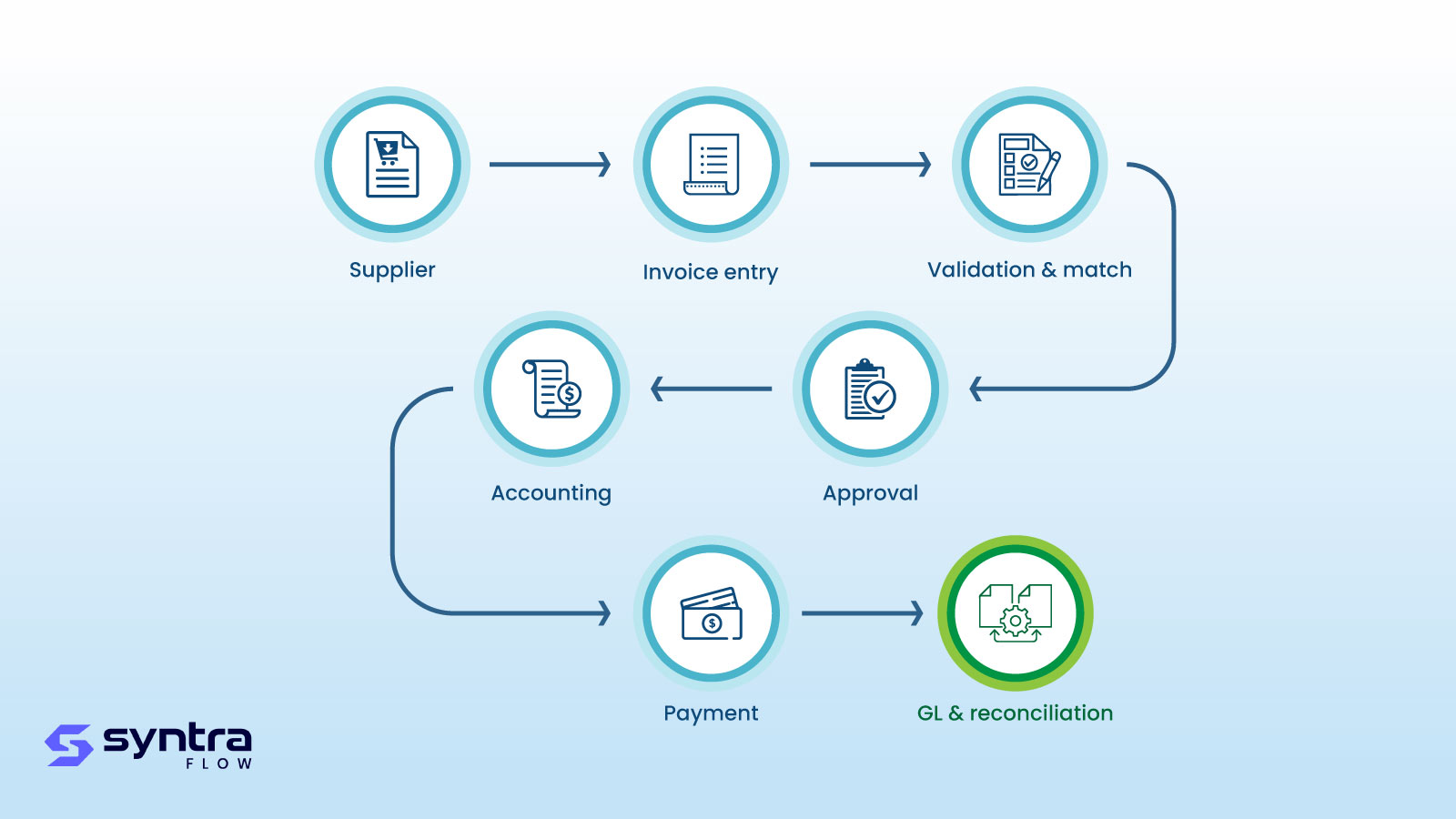
Testing is required at every hand-off — a receipt-quantity mismatch, a tax-code change, or an approval re-route each breaks the chain downstream. The upstream half of that chain — sourcing, requisitions, agreements, purchase orders and receiving — is covered by the Oracle Procurement Testing Tool, and the full cross-module flow on the dedicated Oracle P2P End-to-End Testing page.
Oracle Payables Test Scenarios
Each Payables scenario below has its own dedicated page with detailed test cases and coverage. This hub introduces them — follow the links to go deep on any one.
Invoice testing
Standard, credit memo, prepayment and interest invoices across entry channels, with validation and holds.
Read more →Invoice matching
Two-, three-, and four-way matching, tolerances, and match-exception handling against PO and receipt.
Read more →Supplier testing
Supplier and site creation, bank accounts, tax registration, and the master-data controls AP depends on.
Read more →Payment processing
Payment process requests, batches, disbursements and bank-file generation, end to end.
Read more →Payments & formats
Payment formats, positive pay, and disbursement validation across payment methods.
Read more →Approval workflow
Invoice approval routing, delegation of authority, and BPM rule validation after every change.
Read more →Accounting & period close
Subledger accounting entries, GL reconciliation, and clean AP period close.
Read more →Oracle Quarterly Release Testing for Payables
Oracle Fusion Cloud delivers four updates a year, and each one can change Payables behaviour — new invoice features, altered tax handling, Redwood UI redesigns, or updated payment formats. Quarterly updates continuously introduce new functionality and changes that require regression validation, whether or not your team asked for them.
Testing every AP scenario on every release is wasteful; testing none is dangerous. SyntraFlow's Release Intelligence narrows testing to the components actually affected in the customer's tenant — mapping each release note to the specific invoices, payments, and accounting rules it touches, then auto-composing the exact AP regression pack to run. See how the impact map is built on the Release Impact Analysis page.
Oracle Redwood Testing for Payables
Oracle's Redwood user experience is progressively replacing the classic Fusion pages, including the invoice workbench and payment screens AP teams use daily. Redwood rebuilds page structure and component identifiers, which is precisely what breaks selector-based automation. What is a cosmetic improvement to a user is a suite-wide failure to a traditional testing tool.
Traditional tools
- Bind to Redwood selectors that Oracle rewrites each release
- Break silently on the first page redesign
- Require manual re-scripting of every affected AP screen
- Fail exactly when a release ships — the worst moment
SyntraFlow AI
- Understands Redwood structure semantically, not by fixed selectors
- Self-heals and re-anchors when pages change
- Keeps AP invoice and payment tests running through UI redesigns
- Flags genuinely changed behaviour instead of false failures
See the dedicated Oracle Redwood UI Testing page for how self-healing works across the Fusion interface.
Oracle Configuration Intelligence for Payables
A Payables test is only trustworthy if the configuration behind it is known. AP behaviour is driven by extensive setup — and when that setup drifts between environments or changes unnoticed, tests pass against the wrong reality. SyntraFlow's Configuration Intelligence tracks the AP configuration that determines how invoices and payments behave:
Configuration drift
Detects when AP setup diverges between test and production tenants before it corrupts results.
Functional Setup Manager (FSM)
Tracks Payables options, tolerances, and setup tasks that govern invoice and payment processing.
Flexfields
Monitors descriptive and key flexfields on invoices and distributions that feed accounting.
Approval rules
Surfaces changes to AP approval and delegation rules — the controls auditors scrutinise most.
Security & roles
Tracks role and privilege changes that affect who can enter, approve, and pay invoices.
Segregation of duties
Confirms enter/approve/pay separation stays intact after any role or rule change.
Configuration Intelligence is a full SyntraFlow product in its own right — explore it on the Oracle Configuration Intelligence page.
AI-Powered Oracle Payables Testing
AI is not a feature bolted onto SyntraFlow — it is how the platform decides what to test, builds the tests, and keeps them running. Applied to Payables, it turns a manual, reactive process into an autonomous one.
AI testing agent
An agent that understands Oracle Payables processes and drives execution end to end. Oracle AI testing →
Test generation
Generates AP test cases from configuration and process — including edge cases teams routinely miss.
Self-healing
Repairs tests automatically when Oracle changes AP pages, keeping the suite green through releases.
Risk-based testing
Prioritises the highest-risk AP flows — payments, tax, accounting — over low-impact screens.
Regression selection & impact analysis
Selects exactly the AP regression set a given release or config change requires — nothing more.
Autonomous testing
Runs, evaluates, and reports on AP suites with minimal human effort and full audit evidence.
Customer Success
A global manufacturing enterprise running Oracle Fusion Cloud across 4,200 users and 14 legal entities was spending most of every quarterly-update cycle manually regression-testing Payables — invoices, three-way matching, payment batches, tax, and accounting — across multiple ledgers and currencies.
Payables, Payments and Tax brought under autonomous AP coverage first
Reduction in AP regression testing effort per quarterly release
Quarterly AP release validation cut from two weeks to two days
By pairing SyntraFlow's autonomous AP regression suite with Release Intelligence, the team stopped re-testing everything "just to be safe" and began testing only what each Oracle release actually changed in their tenant. Duplicate-payment and approval-routing checks that were previously sampled by hand are now executed in full on every cycle, with timestamped evidence retained for audit. Figures are representative of enterprise deployments and anonymised.
Why Enterprises Choose SyntraFlow
How SyntraFlow compares to the ways Oracle Payables is tested today.
| Capability | SyntraFlow | Generic automation | Manual / Excel | Selenium | Low-code tools |
|---|---|---|---|---|---|
| Oracle-native AP knowledge | Yes | Partial | Manual | No | Partial |
| AI test generation | Yes | No | No | No | Limited |
| Self-healing on Redwood | Yes | No | N/A | No | Limited |
| Release-aware regression | Yes | No | No | No | No |
| Built-in AP test data | Yes | Partial | Manual | No | Partial |
| Audit-grade evidence | Yes | Partial | Weak | Weak | Partial |
| Maintenance burden | Low | High | Very high | Very high | Medium |
The Complete Oracle Payables Testing Cluster
Every Payables function has a dedicated testing guide. They are organised below along the AP lifecycle — from invoice processing and configuration through accounting, plus the test-asset resources that tie the suite together.
Invoice processing & controls
Invoice Validation Testing
The control gate that decides whether an invoice can be accounted and paid. Covers holds, distribution balancing, tax and tolerance checks across every quarterly release.
Explore invoice validation testing →Invoice Holds Testing
The full invoice-hold lifecycle — how holds are applied, classified, released and audited. Covers system and manual holds, release authority and hold ageing.
Explore invoice holds testing →Credit Memo Testing
Negative supplier adjustments and their effect on balances, tax and accounting. Covers matched and unmatched credits, corrections and reversals.
Explore credit memo testing →Prepayment Testing
The prepayment lifecycle from creation and payment through application and reversal. Covers availability, partial application, balances and prepayment accounting.
Explore prepayment testing →Supplier & invoice configuration
Supplier Site Testing
Supplier-site configuration, business-unit assignments and pay/purchasing controls. Covers site defaults, payment methods, tax and role-based access.
Explore supplier site testing →Payment Terms Testing
How due dates, discounts and instalments are calculated and defaulted. Covers term setup, supplier and site defaults, and payment eligibility.
Explore payment terms testing →Invoice Distribution Testing
Invoice distribution inputs — account combinations, allocations and project/asset attributes. Covers distribution sets, balancing and validation before accounting.
Explore invoice distribution testing →Accounting & reconciliation
Testing resources
AP Invoice Processing Scripts
Full step-by-step test scripts for invoice entry, starting with Create Standard Invoice — test data, steps and expected results.
Browse the test script library →Oracle AP Test Cases
A structured AP test-case catalogue spanning suppliers, invoices, matching, tax, payments and accounting. Use it to plan or benchmark your Payables test suite.
Explore the AP test-case library →Oracle AP UAT Checklist
A UAT planning and sign-off resource with RACI, entry/exit criteria and a grouped readiness checklist. Use it to run a controlled, auditable Payables acceptance cycle.
Explore the AP UAT checklist →Explore the SyntraFlow platform
Frequently Asked Questions
What is Oracle Payables testing?
▼
Oracle Payables testing is the validation of the Accounts Payable module in Oracle Fusion Cloud — confirming that supplier invoices, matching, approvals, payments, tax, prepayments and subledger accounting all behave correctly and reconcile to the general ledger. It proves there are no financial errors, no duplicate payments, that approvals route correctly, and that accounting stays accurate.
What is the Oracle Payables Testing Tool?
▼
SyntraFlow's Oracle Payables Testing Tool is an AI-powered platform that autonomously generates, executes and maintains AP test cases across Oracle Fusion Cloud. It self-heals through Redwood UI changes, narrows regression to what each quarterly release actually changed, and captures audit-grade evidence for every run.
How do you automate Oracle AP testing?
▼
SyntraFlow generates AP test cases from your tenant configuration and business processes, runs them autonomously against invoices, matching, payments and accounting, and self-heals when Oracle changes the UI. Test data comes from the Oracle Data Vault, and results are captured as timestamped evidence — no hand-scripting required.
How often should Oracle Payables be tested?
▼
At minimum, on every Oracle quarterly update (four times a year), plus after any configuration change to AP setup, approval rules, tax, or payment formats. Because SyntraFlow narrows regression to affected components, testing every release becomes practical rather than a two-week manual effort.
Does SyntraFlow support Oracle Redwood?
▼
Yes. SyntraFlow understands Redwood pages semantically rather than by fixed selectors, so AP invoice and payment tests keep running through Redwood redesigns. Its self-healing re-anchors automatically when Oracle changes page structure.
Can AI generate Oracle test cases?
▼
Yes. SyntraFlow's AI generates Oracle Payables test cases directly from your configuration and business processes, including edge cases teams commonly miss — unusual match tolerances, prepayment applications, or withholding scenarios — rather than requiring analysts to author each case by hand.
Can SyntraFlow validate accounting entries?
▼
Yes. SyntraFlow validates the subledger accounting (SLA) entries Payables generates and confirms they reconcile to the general ledger — catching accounting mismatches before they break the trial balance or surface at close.
How do you test invoice approvals?
▼
SyntraFlow drives invoices through Oracle's approval workflow and BPM rules, verifying routing, delegation of authority, and holds release. It confirms approval controls still enforce policy after any release or configuration change. See the Approval Workflow Testing page for detail.
What is regression testing in Oracle Payables?
▼
Oracle Payables regression testing re-validates that existing AP functionality — invoices, matching, payments, tax, accounting — still works after an Oracle update or configuration change. SyntraFlow makes it release-aware, running only the regression the change actually requires. See Regression Testing.
How do you test quarterly Oracle updates?
▼
SyntraFlow's Release Intelligence parses each Oracle release (24D through 26C and beyond) and maps it to the specific AP components affected in your tenant, then auto-composes the exact regression pack to run — so you validate what changed without re-testing everything.
Can SyntraFlow generate test data?
▼
Yes. The Oracle Data Vault supplies context-aware AP test data — valid suppliers, purchase orders, receipts, and tax codes — so invoice and payment tests run with realistic, compliant data instead of hand-built fixtures.
How does SyntraFlow prevent duplicate payments?
▼
SyntraFlow runs dedicated test scenarios against Oracle's duplicate-invoice and duplicate-payment controls on every cycle — including after releases that could weaken them — so a configuration change never silently opens the door to paying the same invoice twice.
Does it test three-way matching?
▼
Yes. SyntraFlow validates two-, three-, and four-way matching against purchase orders and receipts, including tolerances and match-exception handling. See Invoice Matching Testing.
Can it test prepayments and credit memos?
▼
Yes. SyntraFlow covers prepayment creation, application and unapplication, and credit-memo processing — both frequent sources of AP accounting errors — validating the resulting entries against the general ledger.
How does it help with month-end close?
▼
SyntraFlow validates that AP transactions are fully accounted, that no unaccounted items remain, and that the Payables-to-GL reconciliation holds — surfacing close-blocking issues days before the period actually closes rather than during it.
Does SyntraFlow work with our existing testing tools?
▼
Yes. SyntraFlow runs alongside existing tools and exports results and regression recommendations to Jira, ServiceNow and common test-management systems, so you gain AP coverage without ripping out current tooling.
Is the evidence audit-ready?
▼
Yes. Every AP test run produces timestamped, immutable evidence — steps, data, and accounting results — designed to satisfy SOX and external audit as primary control evidence, replacing pasted screenshots.
Who uses the Oracle Payables Testing Tool?
▼
Oracle ERP and QA managers, functional consultants, test leads, CIOs, Oracle support teams and system integrators — anyone accountable for AP correctness across Oracle Fusion quarterly releases.
Make Oracle Payables Testing Autonomous
See how the Oracle Payables Testing Tool validates every invoice, payment, and accounting entry across your Oracle Fusion quarterly releases — with audit-grade evidence and a fraction of the effort. This page is your hub; the next step is a working demo against scenarios like yours.