Oracle Procurement Approval Workflow Testing
Approval workflows are the control gate that decides whether a procurement document can proceed. When a requisition, purchase order, or agreement is submitted, Oracle's BPM approval rules evaluate amount, category, and hierarchy, then route the document to the right approvers in serial or parallel. If those rules are mis-configured or silently changed by a quarterly update, documents route to the wrong approver, skip an authority level, or stall in a queue that blocks the buying cycle.
This page is a practical guide to testing procurement-document approvals — requisition, PO, agreement, negotiation/award, and change-order routing, delegation, escalation, and re-approval. It sits under the Oracle Procurement Testing Tool hub and focuses only on procurement-document approval routing.
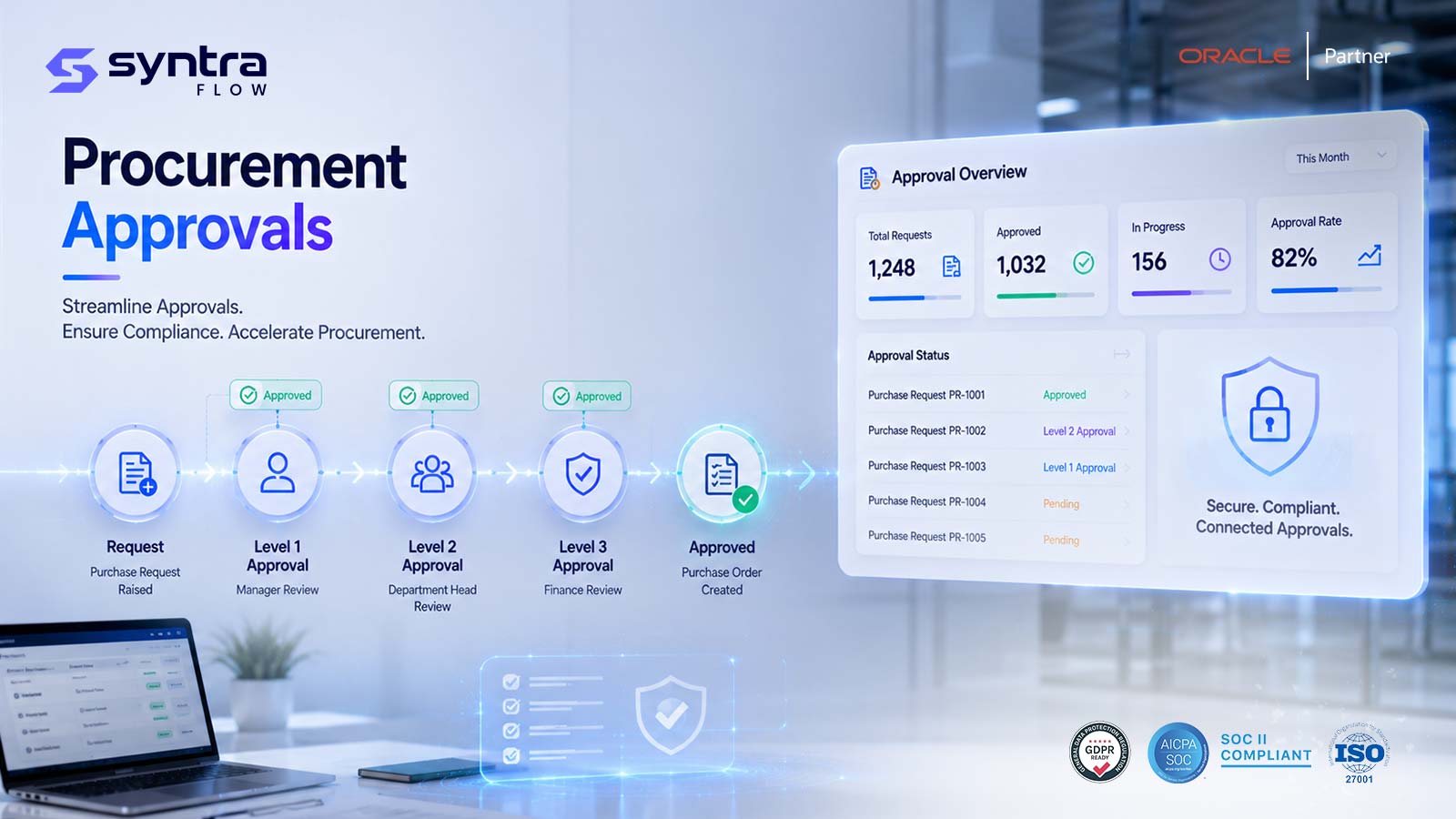
What Are Procurement Approval Workflows in Oracle?
A procurement approval workflow is the Oracle process that routes a procurement document for authorization before it can be actioned. It runs when a requisition is submitted, when a purchase order is created or resubmitted, when a purchase agreement (blanket or contract) is approved, when a negotiation award is finalized, or when a change order is raised. Approval rules built in BPM (Business Process Management) evaluate each document against amount thresholds, category, charge account, and organizational hierarchy, then generate an approval list.
Routing can be serial (one approver after another up a supervisory or position hierarchy) or parallel (several approvers or approval groups act at the same level at once). Rules can add FYI participants for notification-only, apply first-responder-wins voting, and honour delegation, vacation rules, and reassignment. Each approver can approve, reject, or request more information; timeouts trigger escalation. Only once the approval list is fully satisfied does the document reach Approved and become eligible to be ordered, communicated, or awarded.
The teams that depend on this behaving correctly are requesters and buyers who submit documents, approvers and managers who act on notifications, procurement functional consultants who own the BPM rules and approval groups, and the finance and audit teams who rely on approval as a spend-authorization control. Its upstream dependencies are the requester, supervisory/position hierarchy, approval groups, and the document amount; its downstream dependencies are ordering, supplier communication, and receipt and invoicing.
Scope note. This page covers approval workflows for procurement documents — requisitions, purchase orders, agreements, negotiation awards, and change orders. It does not cover invoice approval routing in Payables; that is the AP-focused Oracle Approval Workflow Testing page. If your test concerns who approves an invoice for payment, use that page. If it concerns who approves the requisition, PO, or agreement that precedes the invoice, you are in the right place.
Why Testing Procurement Approvals Matters
Approval routing is a spend-authorization control, so a defect here is not cosmetic — it either lets a document proceed without the right authority or freezes legitimate documents in an approval queue. Both outcomes carry real cost. The risks specific to procurement approvals:
| Risk | Example | Potential impact | Testing response |
|---|---|---|---|
| Authority level skipped | High-value PO approved below its limit | Unauthorized spend commitment | Amount-based routing tests per limit |
| Wrong approver routed | Rule points to a stale supervisor | Invalid approval; audit exception | Assert the exact approver list generated |
| Auto-approval too broad | Threshold widened, more auto-approves | Spend escapes review | Boundary tests at the auto-approve limit |
| Change order not re-approved | Total increased but no re-route | Uncontrolled value increase | Re-approval tests on total change |
| Parallel branch lost | One parallel approver not notified | Approval completes without a vote | Assert all parallel participants present |
| Escalation fails | Timeout does not escalate | Document stalls indefinitely | Timeout and escalation-path tests |
| Delegation mis-routes | Vacation rule ignored or looped | Approval sits with an absent user | Delegation and vacation-rule tests |
| Data security breach | Approver sees a document across BU | Segregation-of-duties weakness | Role and data-security approval tests |
| Silent behaviour change | Quarterly update alters a BPM rule | Undetected routing drift | Release-aware regression on approvals |
| Integration document unapproved | Imported PO skips the workflow | Control bypassed on the API path | Test approval on imported documents |
The Procurement Approval Process Flow
Approval is triggered when a procurement document is submitted — manually, from a self-service requisition, or through an integration or import. Once triggered, Oracle evaluates the approval rules and routes the document to the generated approver list.
Approval sequence
- Trigger: submit of a requisition, PO, agreement, negotiation award, or change order — from the UI, self-service, or an import/integration.
- Rule evaluation: BPM rules assess amount, category, charge account, and business unit, then build the approver list from supervisory or position hierarchy and approval groups.
- Routing: serial up a hierarchy, parallel across a level, first-responder-wins, or FYI-only, per rule; auto-approval applies below the configured threshold.
- Decision point: each approver approves, rejects, or requests more information; a rejection or withdrawal returns the document to the requester.
- Exceptions: timeout triggers escalation; delegation, vacation rules, and reassignment redirect the task to an alternate approver.
- Downstream impact: only an approved document can be ordered, communicated to the supplier, or awarded; a change to the total can re-trigger approval.
Suggested visual: a swimlane process diagram of the approval sequence with serial, parallel, and escalation branches, for the web team to produce (see visual recommendations).
Testing Scope & Coverage Matrix
The dimensions a complete procurement approval test suite must cover, with automation suitability and priority.
| Test area | What must be validated | Example scenario | Automation | Priority |
|---|---|---|---|---|
| Functional (approve) | Clean document routes and approves | Requisition within a manager's limit | High | High |
| Amount-based routing | Correct approvers by document value | PO above a limit adds a level | High | High |
| Boundary | Behaviour at exact threshold limits | Amount = auto-approve limit vs +0.01 | High | High |
| Serial routing | Sequential approval up a hierarchy | Two supervisory levels in order | High | High |
| Parallel routing | Concurrent approvers at one level | Two groups notified simultaneously | High | High |
| Change order | Total change re-triggers approval | Increase pushes into a new level | High | High |
| Reject / resubmit | Rejection returns to requester | Approver rejects, requester resubmits | High | High |
| Delegation / reassign | Task redirects to an alternate | Vacation rule delegates approval | Medium | High |
| Escalation | Timeout escalates up the chain | No action within SLA escalates | Medium | High |
| Role / data security | Only entitled roles see and act | Cross-BU visibility blocked | Medium | High |
| FYI notifications | FYI participant informed, no gate | FYI recipient cannot block | High | Medium |
| Integration / API | Imported documents still route | API-submitted PO enters workflow | High | Medium |
| Regression / release | Routing unchanged after an update | Re-run pack after 26x update | High | High |
| Redwood UI | Approve action on Redwood pages | Approval from mobile notification | High | Medium |
| History / evidence | Approval history captured for audit | Approver, action, time retained | High | Medium |
Oracle Procurement Approval Test Scenarios
A representative set of 34 Oracle Fusion procurement-approval scenarios — happy path, routing rules, delegation and escalation, security, integration, and regression. Test IDs use the PR-AWF prefix.
| ID | Scenario | Preconditions | Expected result | Pri | Auto |
|---|---|---|---|---|---|
| PR-AWF-001 | Requisition approval within limit | Amount below manager's authority | Approved at first level | H | Y |
| PR-AWF-002 | Requisition above limit adds a level | Amount exceeds first approver's limit | Routes to next authority level | H | Y |
| PR-AWF-003 | Auto-approval below threshold | Amount under auto-approve limit | Approved with no approver | H | Y |
| PR-AWF-004 | Auto-approve boundary at exact limit | Amount = configured threshold | Auto-approved (boundary pass) | H | Y |
| PR-AWF-005 | Auto-approve boundary one cent over | Amount = threshold + 0.01 | Routed for approval | H | Y |
| PR-AWF-006 | Purchase order approval | PO submitted for approval | Routes and approves per rules | H | Y |
| PR-AWF-007 | Blanket/contract agreement approval | Agreement submitted | Agreement approver list correct | H | Y |
| PR-AWF-008 | Negotiation / award approval | Award recommendation finalized | Award routed for approval | M | Y |
| PR-AWF-009 | Change order re-approval on increase | Approved PO total increased | Re-triggers approval | H | Y |
| PR-AWF-010 | Change order no re-approval (minor) | Non-value change per rule | No re-approval required | M | Y |
| PR-AWF-011 | Serial routing up supervisory chain | Rule uses job-level hierarchy | Approvers acted in sequence | H | Y |
| PR-AWF-012 | Parallel routing across a level | Rule uses parallel participants | All notified concurrently | H | Y |
| PR-AWF-013 | First-responder-wins voting | Parallel group, any-approver rule | First approval completes level | M | Y |
| PR-AWF-014 | Multiple approvers same level (all) | Consensus rule at one level | All must approve to advance | M | Y |
| PR-AWF-015 | Approval group routing | Rule references an approval group | Group members routed correctly | H | Y |
| PR-AWF-016 | Position-hierarchy routing | Rule uses position hierarchy | Approvers by position, not person | M | Y |
| PR-AWF-017 | Approval limit / authority enforced | Approver limit below document total | Escalates beyond their authority | H | Y |
| PR-AWF-018 | FYI notification only | Rule adds an FYI participant | Informed; cannot block approval | M | Y |
| PR-AWF-019 | Request more information | Approver requests info | Returns to requester, then resumes | M | Y |
| PR-AWF-020 | Reject and resubmit | Approver rejects the document | Returned; resubmit re-routes | H | Y |
| PR-AWF-021 | Withdraw during approval | Requester withdraws in-flight | Workflow cancelled; status reset | M | Y |
| PR-AWF-022 | Delegation via vacation rule | Approver has a vacation rule set | Task delegates to alternate | H | P |
| PR-AWF-023 | Manual reassignment | Approver reassigns the task | New assignee can act | M | P |
| PR-AWF-024 | Escalation on timeout | No action within SLA window | Escalates to next approver | H | P |
| PR-AWF-025 | Cross-business-unit approval | Requester and buyer in different BUs | Routes per BU rules and access | M | Y |
| PR-AWF-026 | Role / data security on visibility | Approver lacks BU data access | Document not visible / not routable | H | P |
| PR-AWF-027 | Mobile / Redwood approval action | Redwood notification UI enabled | Approve works; status updates | M | Y |
| PR-AWF-028 | Approval history / audit trail | Document fully approved | History shows each approver/action | M | Y |
| PR-AWF-029 | Integration-submitted document | PO created via REST/OIC | Enters workflow like UI submit | M | Y |
| PR-AWF-030 | Imported requisition approval | Requisition loaded via import | Approval rules applied on import | M | Y |
| PR-AWF-031 | Rule change effect on routing | BPM rule edited | Same document routes as expected | H | Y |
| PR-AWF-032 | Document total change re-triggers | Total edited before final approval | Re-evaluates and re-routes | H | Y |
| PR-AWF-033 | Redwood page selector regression | Redwood approval UI redesigned | Assertions self-heal and pass | M | Y |
| PR-AWF-034 | Quarterly-update regression pack | Post-update tenant | All prior routing reproduces | H | Y |
Pri = priority (H/M/L). Auto = automation candidate (Y suitable · P partly, needs role/data setup). Steps summarised; full step detail ships in the downloadable test pack.
Procurement Documents & Their Approvals
Each procurement document type has its own approval task, rule set, and re-approval behaviour. A complete suite tests the routing that belongs to each.
| Document | Approval task | Typical routing driver | Re-approval trigger | Related page |
|---|---|---|---|---|
| Requisition | Requisition approval | Amount, category, hierarchy | Line/amount change before order | Requisition Testing |
| Purchase order | Document approval | Order total, buyer, BU | Total increase / change order | Purchase Order Testing |
| Purchase agreement | Agreement approval | Agreement amount, category | Amendment to terms/amount | Purchase Agreement Testing |
| Negotiation / award | Award approval | Award value, category manager | Revised award recommendation | Procurement hub |
| Change order | Change order approval | Delta value, changed attributes | Any value/term change per rule | PO change orders |
Common Approval Errors & Defects
| Error / defect | Likely cause | Business impact | Recommended test |
|---|---|---|---|
| Authority level skipped | Amount rule or limit mis-set | Unauthorized spend | PR-AWF-002, PR-AWF-017 |
| Over-broad auto-approval | Threshold set too high | Spend escapes review | PR-AWF-003 to 005 |
| Wrong approver in list | Stale hierarchy or group | Invalid approval; audit gap | PR-AWF-011, PR-AWF-015, PR-AWF-016 |
| Change order not re-approved | Re-approval rule missing | Uncontrolled value increase | PR-AWF-009, PR-AWF-032 |
| Parallel participant dropped | Rule builds incomplete list | Approval without a required vote | PR-AWF-012, PR-AWF-014 |
| Escalation not firing | Timeout / expiry mis-configured | Document stalls in queue | PR-AWF-024 |
| Delegation loop / dead end | Vacation rule points to absentee | Approval never completes | PR-AWF-022, PR-AWF-023 |
| Reject does not return | Return-to-requester misrouted | Requester cannot correct | PR-AWF-019, PR-AWF-020 |
| Cross-BU visibility leak | Data-security role too broad | SoD / confidentiality risk | PR-AWF-025, PR-AWF-026 |
| Imported document bypasses workflow | Import flagged pre-approved | Control bypassed on API path | PR-AWF-029, PR-AWF-030 |
| Approval history incomplete | Delegated action not logged | Weak audit evidence | PR-AWF-028 |
| Redwood action fails | UI redesign breaks selectors | Approvers cannot act | PR-AWF-027, PR-AWF-033 |
How SyntraFlow Automates Approval Testing
SyntraFlow submits each procurement document, drives the approval across UI, notification, and API, then asserts the exact approver list and outcome — not just that the page loaded.
Pre-built approval cases
A starter pack of routing, delegation, and escalation scenarios you extend to your rules and limits — no scripting from zero.
AI test generation
Generates approval variants — amount boundaries, serial and parallel paths, change-order re-approvals — from your BPM rules.
Self-healing execution
Playwright-based runs that re-anchor when Oracle changes the procurement or Redwood approval pages, so assertions keep working.
Data Vault documents & approvers
The Oracle Data Vault provisions requisitions, POs, agreements, and the approver hierarchy each routing test needs.
Role-based execution
Runs the same document as different approvers to confirm who can and cannot approve, protecting segregation of duties.
Approver-list assertions
Verifies the exact approvers, order, and level — not just that a workflow started — the difference between a real and hollow test.
UI + API execution
Submits documents through the UI and via REST/OIC and confirms both enter the same workflow, closing the integration gap.
Evidence capture
Timestamped screenshots, approval history, and execution traces retained as audit-grade evidence for every run.
Release & configuration intelligence
Runs the approval subset a given release or rule change actually affects, scoped to your configuration.
A note on capability. Pre-built cases, self-healing execution, role-based UI/API execution, and evidence capture are current platform capabilities. Coverage scoped to your specific BPM rules, approval groups, hierarchies, and delegation setup is configurable during onboarding. Any tenant-specific extension is confirmed at assessment rather than assumed here.
When to Re-Test Procurement Approvals
Approval routing depends on configuration and hierarchy data, so any change to either is a regression trigger. Retest when these events occur:
| Change event | Risk to approvals | Recommended regression scope |
|---|---|---|
| Oracle quarterly update | BPM or routing logic changes | Full approval pack, release-scoped |
| Redwood rollout | Approve action / notification UI changes | UI + mobile approval cases |
| Approval rule change | Routing or thresholds shift | Amount, serial, and parallel cases |
| Approval limit change | Authority boundaries move | Boundary + auto-approve cases |
| Hierarchy / position change | Approver chain reshaped | Supervisory / position routing cases |
| Approval group edit | Group membership changes | Group and parallel-vote cases |
| Security-role change | Who can see/approve changes | Role / data-security cases |
| New BU / ledger / legal entity | Setup gaps mis-route | Cross-BU + config cases |
| Delegation / vacation setup | Redirection behaviour changes | Delegation, reassign, escalation cases |
| Integration / API change | Imported documents skip routing | API + import approval cases |
| Production defect fix | Fix may regress adjacent routing | Targeted + smoke approval pack |
Procurement Approvals & Oracle Quarterly Releases
Oracle's quarterly updates can change approval routing without any action on your part — through feature opt-ins, Redwood redesigns of the approval and notification pages, new or altered BPM behaviour, or deprecated routing options. Because approval is a spend-authorization control, a silent change is exactly the kind you must catch before it reaches production.
Rather than re-testing every approval scenario on every release, SyntraFlow Release Intelligence narrows the work to what actually changed in your tenant:
- 1.Analyses the Oracle release notes for changes touching procurement approvals and BPM.
- 2.Maps those changes to your configuration — rules, limits, hierarchies, and groups.
- 3.Identifies the document types and routing paths affected.
- 4.Recommends the specific approval test cases to run.
- 5.Prioritises regression execution by risk.
- 6.Tracks approval evidence for audit and sign-off.
See how the impact map is built on the Release Impact Analysis page.
Configurations That Drive Approval Routing
An approval test is only trustworthy if the configuration behind it is known and stable. These setups determine whether a document auto-approves, routes serially, or fans out in parallel — and when they drift between environments, tests pass against the wrong reality.
| Configuration area | Testing impact | Example failure | Recommended validation |
|---|---|---|---|
| BPM approval rules | Govern routing and conditions | Rule differs between envs | Rule-driven routing cases |
| Approval limits / authority | Set who can approve what value | Limit differs from prod | Boundary cases per limit |
| Supervisory / job hierarchy | Drives serial routing chain | Stale manager assignment | Serial routing cases |
| Position hierarchy | Routes by position, not person | Vacant position breaks chain | Position routing cases |
| Approval groups | Define parallel participants | Membership out of sync | Group and parallel cases |
| Auto-approve thresholds | Set the no-approver limit | Threshold widened in test | Auto-approve boundary cases |
| Delegation & escalation | Timeout and redirect behaviour | Expiry differs between envs | Escalation / delegation cases |
| Security & data roles | Who sees and acts on a document | Role grant drift across BUs | Role / data-security cases |
SyntraFlow's Configuration Intelligence compares these setups across environments and flags drift before it corrupts an approval test result — so a passing test means the routing configuration was correct, not just present.
Approval Integration Points
Approval reads from upstream data and gates downstream procurement steps. These are the connections an approval test must respect:
| Integration | Data exchanged | Key test | Failure risk |
|---|---|---|---|
| Self-Service Procurement | Requisition submit | Requisition routes on submit | Wrong approver list |
| Purchasing | PO / change order | Order and change re-approval | Change escapes re-approval |
| Sourcing / Negotiations | Award recommendation | Award approval routing | Award actioned unapproved |
| HCM / hierarchy | Supervisor, position, job | Hierarchy resolves to approver | Stale chain mis-routes |
| BPM Worklist | Task, delegation, reassign | Delegation and escalation | Task dead-ends |
| OIC / REST APIs | Document submit calls | API submit enters workflow | Workflow bypassed |
| Import (FBDI / bulk) | Bulk requisition / PO loads | Imported documents route | Pre-approved flag skips routing |
| Notifications / mobile | Approve / reject actions | Redwood / mobile approval | Action fails on redesign |
For the full cross-module flow from requisition to payment, see Oracle P2P End-to-End Testing.
Procurement Approval Testing Best Practices
Assert the exact approver list, order, and level — not just that a workflow started.
Test every amount threshold at, below, and above its limit — boundaries are where defects hide.
Cover serial and parallel routing separately, including first-responder and consensus rules.
Prove change orders re-trigger approval when the total crosses a rule boundary.
Test reject, request-info, and withdraw paths, not only the happy approval path.
Exercise delegation, reassignment, and timeout escalation with realistic setups.
Run documents under different roles to protect segregation of duties and data security.
Cover each document type — requisition, PO, agreement, award, and change order.
Validate that integration- and import-submitted documents still enter the workflow.
Capture approval history and evidence automatically for audit and sign-off.
Use production-like hierarchies, limits, and groups, not simplified test config.
Re-run the approval pack on every quarterly update, scoped by release impact.
Manual vs Generic Automation vs SyntraFlow
For procurement approval testing specifically.
| Capability | Manual | Generic automation | SyntraFlow |
|---|---|---|---|
| Approver-list awareness | Manual | No | Yes |
| Pre-built approval cases | No | No | Yes |
| Role-based execution | Manual | No | Yes |
| Self-healing on Redwood | N/A | No | Yes |
| Release-impact analysis | No | No | Yes |
| Configuration awareness | Manual | No | Yes |
| UI + API execution | Partial | Partial | Yes |
| Audit-grade evidence | Weak | Partial | Yes |
| Reusability | Low | Medium | High |
The Oracle Procurement Approval Test Pack
A ready-to-use starting point for approval coverage. The pack maps each procurement document type to the routing it should follow, so your team can validate authority end to end rather than rebuild scenarios from scratch. It includes:
- •Document types — requisitions, purchase orders, agreements, negotiation awards, and change orders.
- •Routing scenarios — serial, parallel, first-responder, FYI, delegation, and escalation paths.
- •Authority limits — amount thresholds and auto-approve boundaries to test at, below, and above.
- •Expected approvers — the approver list, order, and level each scenario should generate.
- •Evidence & sign-off — approval history and audit-ready proof for each run.
Related Oracle Procurement Pages
Approvals connect to the rest of the procurement suite. Go deeper on adjacent topics:
Oracle Procurement Testing Tool ⭐
The procurement testing hub.
Requisition Testing →
Requisition creation and submit.
Purchase Order Testing →
PO creation and change orders.
Purchase Agreement Testing →
Blanket and contract agreements.
Approval Workflow Testing (Invoice) →
AP invoice approval routing.
P2P End-to-End Testing →
Requisition-to-pay across modules.
Frequently Asked Questions
What does procurement approval workflow testing cover?
▼
It covers the approval routing of procurement documents — requisitions, purchase orders, purchase agreements, negotiation awards, and change orders. That includes how BPM rules build the approver list, serial and parallel routing, approval groups and hierarchies, delegation and escalation, and re-approval when a document total changes.
How is this different from invoice approval workflow testing?
▼
This page owns the approval of procurement documents — the requisition, PO, or agreement that authorizes a commitment. Invoice approval, which decides who authorizes an AP invoice for payment, is covered separately on the Approval Workflow Testing page. They use similar BPM mechanics but different documents, rules, and approvers.
What routing types should the test suite include?
▼
At minimum: serial routing up a supervisory or position hierarchy, parallel routing across a level, first-responder-wins and consensus voting, approval-group routing, FYI notifications, and auto-approval below a threshold. Each should be tested for the correct approver list and the correct order.
How do you test amount-based approval routing?
▼
Submit documents whose totals sit at, below, and above each authority limit and assert the approver list that results. The highest-value cases are boundaries — an amount exactly at the auto-approve limit should auto-approve, one cent over should route. These boundary tests catch the mis-set thresholds that let spend escape review.
Do change orders re-trigger approval?
▼
They should, when the changed attribute or new total crosses a rule boundary. Testing must prove that a value increase re-routes for the right authority, while a minor non-value change follows the configured no-re-approval path. A change order that escapes re-approval is an uncontrolled increase in commitment.
How do you test delegation and vacation rules?
▼
Set a vacation or delegation rule on an approver, route a document that would reach them, and assert the task redirects to the alternate — who can then act. Also test manual reassignment and confirm the delegated action is recorded in approval history. These paths depend on role and worklist setup, so they often need role-based execution.
How is escalation on timeout tested?
▼
Route a document to an approver, let the configured expiry window elapse without action, and assert the task escalates up the chain per the rule. Because timeouts are time-based, these cases usually need a controlled clock or an expedited expiry in the test environment, which is why they are partial-automation candidates.
Can approvals be tested through the API?
▼
Yes. Documents submitted through REST or an OIC integration should enter the same approval workflow as a UI submit. A complete suite submits both ways and confirms the routing matches, because imported and integration-created documents are a common path where the approval control is accidentally bypassed.
How do you test role and data security in approvals?
▼
Run the same document under different roles and business-unit access and assert who can see and act on it. An approver without data access to a BU should not receive or be able to approve that BU's document. These cases protect segregation of duties and become critical after any security-role change.
Does Redwood change approval testing?
▼
Redwood redesigns the approval and notification pages, which breaks selector-based automation even when the routing logic is unchanged. SyntraFlow understands Redwood pages semantically and self-heals, so approve, reject, and history assertions keep running through UI redesigns and mobile approvals rather than failing on the first page change.
Which configurations most affect approval routing?
▼
BPM approval rules, authority limits, supervisory and position hierarchies, approval groups, auto-approve thresholds, delegation and escalation setup, and security and data roles. Configuration Intelligence compares these across environments so a passing test reflects correct routing configuration rather than a coincidental match.
How often should procurement approvals be regression tested?
▼
On every Oracle quarterly update, and after any change to approval rules, limits, hierarchies, approval groups, delegation setup, or security roles. Because approval is a spend-authorization control, testing it after these events protects against silent routing drift that would otherwise surface only when an unauthorized document proceeds.
What test data does approval testing need?
▼
Each test needs a document engineered to hit a specific rule — an amount that crosses a limit, a category that triggers a group, a total change that forces re-approval — plus a valid approver hierarchy. SyntraFlow's Oracle Data Vault provisions the documents and approver data so tests route reliably instead of relying on hand-built fixtures.
Does approval testing produce audit evidence?
▼
Yes. Every run retains the approver list, each action and timestamp, and the final status as approval history — timestamped screenshots and execution traces included. This gives auditors proof that the right authority approved each document type, which is exactly what a spend-authorization control review looks for.
Strengthen Your Oracle Procurement Approval Coverage
Identify gaps in your approval routing, automate high-risk authority and change-order scenarios, and prepare for Oracle quarterly updates with SyntraFlow. See it run against approval rules like yours.