Oracle Purchase Agreement Testing
A purchase agreement is the negotiated commercial framework that governs how you buy from a supplier over time. In Oracle Fusion Procurement, a Blanket Purchase Agreement (BPA) holds negotiated prices, price breaks, and controls that releases draw against, while a Contract Purchase Agreement (CPA) captures terms that standard purchase orders reference. When agreement pricing, controls, or effective dates are mis-configured — or silently changed by a quarterly update — downstream requisitions and POs default the wrong price, releases breach amount limits, or valid buys stall against an expired agreement.
This page is a practical guide to testing purchase agreements themselves — the header and lines, price breaks, agreement controls, approval, releases against a BPA, and amendments — and how those agreements default into transactions. It sits under the Oracle Procurement Testing Tool hub and focuses on agreements, not individual purchase orders.
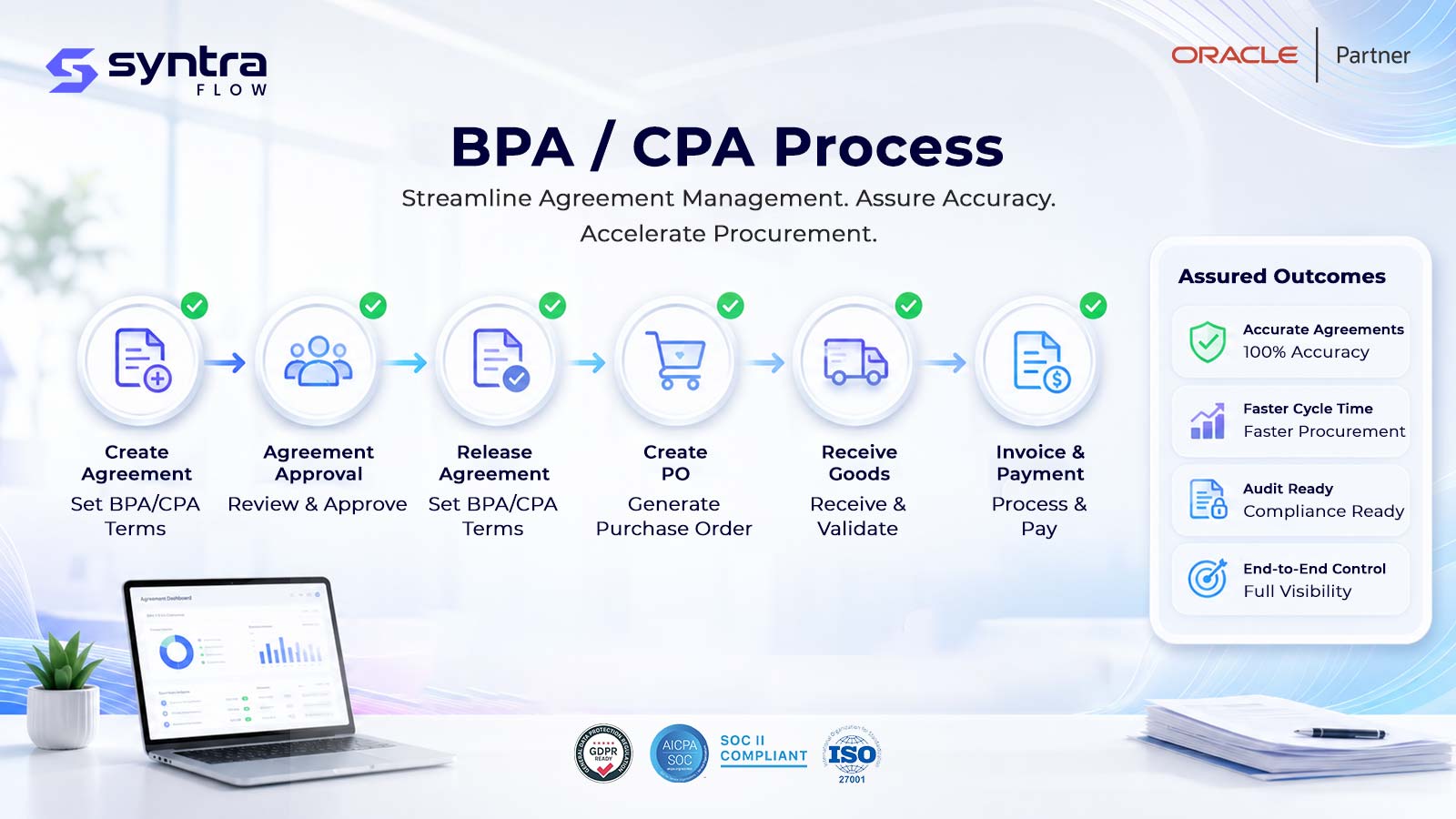
What Is a Purchase Agreement in Oracle Procurement?
A purchase agreement is a long-term buying arrangement negotiated with a supplier and stored in Oracle Fusion Purchasing. It carries an agreement header — supplier, supplier site, buyer, currency, effective and expiration dates, and an agreed amount — plus agreement lines that hold negotiated items, prices, and price breaks. Agreement controls set the guardrails: minimum and maximum release amounts, an amount limit for the whole agreement, and whether releases are approved automatically or routed for approval.
Oracle supports two agreement types. A Blanket Purchase Agreement is transactional: buyers and requesters create releases against it, and each release consumes part of the agreed amount. A Contract Purchase Agreement is referential: it records terms and an amount commitment, but standard purchase orders reference it rather than releasing against it. Both can default pricing and terms into requisitions and purchase orders, and both move through their own approval and amendment lifecycle.
The teams that depend on agreements behaving correctly are category buyers who negotiate and maintain them, requesters and approvers whose requisitions default agreement pricing, and finance and audit teams who rely on agreement controls as a spend guardrail. Upstream, agreements are often the award of a negotiation in Oracle Sourcing; downstream, they feed requisitions, purchase orders, and releases. Get an agreement wrong and the error multiplies across every transaction that defaults from it.
Scope note. This page covers purchase agreements — BPAs and CPAs, their lines, price breaks, controls, approval, releases, and amendments. Individual standard purchase orders and their change orders are covered on the Oracle Purchase Order Testing page, and negotiation-to-award mechanics live on the Oracle Sourcing Testing page. Here we focus on the agreement as the framework and how it defaults into those transactions.
Blanket vs Contract Purchase Agreements
The two agreement types behave differently, and a test suite must treat them separately. Releases, pricing, and consumption apply to a BPA; terms and PO referencing apply to a CPA.
| Characteristic | Blanket Purchase Agreement (BPA) | Contract Purchase Agreement (CPA) |
|---|---|---|
| Primary purpose | Negotiated pricing and items bought repeatedly | Negotiated terms and spend commitment |
| Holds agreement lines | Yes — items, prices, price breaks | No item lines; terms only |
| How it is consumed | Blanket releases draw against it | Standard POs reference it |
| Price breaks | Quantity / amount price breaks supported | Not applicable (no line pricing) |
| Defaults to requisition | Yes — item, price, break tier | Indirectly, via referencing PO terms |
| Amount controls | Agreed amount, min/max release, amount limit | Agreed amount / amount limit |
| Catalog enablement | Can be catalog-enabled for self-service | Typically not catalog-facing |
| Testing emphasis | Pricing, breaks, releases, consumption | Terms defaulting, PO reference, approval |
Why Testing Purchase Agreements Matters
An agreement is a spend control and a pricing source at the same time, so a defect here is not isolated — it propagates into every requisition, PO, and release that defaults from it. The risks specific to agreements:
| Risk | Example | Potential impact | Testing response |
|---|---|---|---|
| Wrong price defaults | Requisition pulls stale agreement price | Overpayment; margin leakage | Assert defaulted price equals agreement line |
| Price break mis-applied | Quantity crosses a break, price unchanged | Missed volume discount | Boundary test each break tier |
| Amount limit not enforced | Release exceeds agreed amount, no block | Uncontrolled spend; control gap | Negative test at and beyond the limit |
| Expired agreement used | Release created after expiration date | Off-contract purchasing | Date-boundary test on effective/expiry |
| Approval bypassed | Agreement or release skips required routing | Unauthorised commitment | Assert approval path per amount/type |
| Amendment regresses pricing | Revision changes one line, breaks another | Wrong price on existing releases | Re-test defaulting after each revision |
| Min release not enforced | Release below minimum still processes | Fragmented, uneconomic buys | Boundary test the minimum release amount |
| Consumption mis-tracked | Released amount not deducted from agreed | False remaining balance | Reconcile released vs agreed after releases |
| Tax / UOM defaults wrong | Agreement line defaults wrong tax or UOM | Downstream match and tax errors | Assert tax and UOM on defaulted lines |
| Silent behaviour change | Quarterly update alters defaulting or controls | Undetected pricing/control drift | Release-aware regression on agreements |
| Cross-BU access gap | Shared agreement not usable in a BU | Buyers forced off-contract | Test agreement access per BU setup |
| Import defect | Loaded agreement lines are incomplete | Broken catalog; failed defaulting | Validate imported lines against source |
The Oracle Purchase Agreement Lifecycle
An agreement moves through a defined lifecycle from creation to consumption. Each stage changes how the agreement defaults, what it permits, and which controls apply — so each is a distinct test surface.
Agreement lifecycle
- Create: a buyer creates a BPA or CPA with supplier, site, currency, buyer, effective and expiration dates, and an agreed amount.
- Lines & price breaks: for a BPA, negotiated items, prices, UOM, and quantity/amount price breaks are entered; a CPA carries terms without item lines.
- Approve: the agreement routes through approval; controls (min/max release, amount limit, auto-release) take effect once approved.
- Release / reference: blanket releases draw against a BPA and consume the agreed amount; standard POs reference a CPA for its terms.
- Amend / revise: price, control, or date changes create a new revision that must re-approve and re-default correctly.
- Consume / expire: the agreement is drawn down, put on hold, cancelled, or reaches expiration and is closed — after which new releases must be blocked.
Suggested visual: a swimlane lifecycle diagram with release and amendment branches, for the web team to produce (see visual recommendations).
Testing Scope & Coverage Matrix
The dimensions a complete purchase agreement test suite must cover, with automation suitability and priority.
| Test area | What must be validated | Example scenario | Automation | Priority |
|---|---|---|---|---|
| Agreement creation | Header saves with valid supplier/site/dates | Create BPA and CPA | High | High |
| Lines & pricing | Item, price, UOM stored correctly | Multi-line BPA with distinct prices | High | High |
| Price breaks (boundary) | Correct tier applied at each threshold | Qty at, below, above a break | High | High |
| Agreement controls | Amount limit, min/max release enforced | Release beyond amount limit blocked | High | High |
| Effective dates | Usable only within effective window | Release after expiry blocked | High | High |
| Approval | Correct routing per type and amount | Agreement routes to buyer manager | Medium | High |
| Releases (BPA) | Release draws down and consumes amount | Blanket release against BPA | High | High |
| Automatic release | Auto-created releases price correctly | Requisition auto-sources to release | High | Medium |
| Amendments / revisions | Revision re-approves and re-defaults | Price change on one line | High | High |
| Defaulting to req/PO | Item, price, terms flow to transaction | Requisition defaults BPA price | High | High |
| Catalog enablement | Agreement items appear in self-service | Catalog-enabled BPA searchable | Medium | Medium |
| Currency & tax | Currency fixed; tax defaults correct | Foreign-currency agreement | High | Medium |
| Cross-BU access | Shared agreement usable per BU setup | Agreement used across two BUs | Medium | Medium |
| Role / access | Only buyers create/amend agreements | Requester cannot edit agreement | Medium | High |
| Integration / import | REST/FBDI create agreements correctly | Imported agreement lines validated | High | Medium |
| Regression / release | Behaviour unchanged after an update | Re-run pack after quarterly update | High | High |
| Evidence capture | Result and pricing captured for audit | Screenshot + release log retained | High | Medium |
Oracle Purchase Agreement Test Scenarios
A representative set of 34 Oracle Fusion purchase agreement scenarios — creation, pricing and price breaks, controls, releases, amendments, defaulting, integration, and regression. Test IDs use the PR-PA prefix.
| ID | Scenario | Preconditions | Expected result | Pri | Auto |
|---|---|---|---|---|---|
| PR-PA-001 | Create Blanket Purchase Agreement | Active supplier, site, buyer | BPA saved in draft with header | H | Y |
| PR-PA-002 | Create Contract Purchase Agreement | Supplier, terms, agreed amount | CPA saved; no item lines required | H | Y |
| PR-PA-003 | Add multiple agreement lines | BPA in draft | Lines saved with item, price, UOM | H | Y |
| PR-PA-004 | Define quantity price breaks | BPA line with tiered pricing | Break tiers stored per quantity | H | Y |
| PR-PA-005 | Price break applied at boundary | Order qty equals break threshold | Correct tier price applied | H | Y |
| PR-PA-006 | Price break below threshold | Order qty one unit below break | Prior tier price retained | H | Y |
| PR-PA-007 | Amount limit enforced on release | Release value > agreement amount limit | Release blocked / error raised | H | Y |
| PR-PA-008 | Minimum release amount control | Release below min release amount | Release blocked / warning | M | Y |
| PR-PA-009 | Maximum release amount control | Single release exceeds max release | Release blocked at max limit | M | Y |
| PR-PA-010 | Supplier & site on agreement | Purchasing site assigned | Site stored; defaults to releases | M | Y |
| PR-PA-011 | Effective / expiration dates set | Start and end date entered | Agreement usable only in window | H | Y |
| PR-PA-012 | Expired agreement blocks new release | Date past expiration | Release creation prevented | H | Y |
| PR-PA-013 | Agreed vs released amount tracking | Several releases posted | Released total deducts from agreed | H | Y |
| PR-PA-014 | Agreement approval routing | Agreement submitted for approval | Routed per approval rules; approved | H | P |
| PR-PA-015 | Agreement amendment / revision | Approved agreement edited | New revision created; re-approves | H | Y |
| PR-PA-016 | Create blanket release against BPA | Approved BPA with lines | Release created at agreement price | H | Y |
| PR-PA-017 | Blanket release approval | Release above auto-approve limit | Release routes for approval | M | P |
| PR-PA-018 | Automatic release from requisition | Auto-release enabled, req sourced | Release auto-created and priced | M | Y |
| PR-PA-019 | Agreement defaults to requisition | Requisition for agreement item | Price and source default from BPA | H | Y |
| PR-PA-020 | Agreement defaults to standard PO | PO references CPA terms | Terms default onto the PO | M | Y |
| PR-PA-021 | Catalog-enabled agreement | BPA flagged for catalog | Items searchable in self-service | M | Y |
| PR-PA-022 | Foreign-currency agreement | Non-ledger currency, rate present | Currency fixed; conversion correct | M | Y |
| PR-PA-023 | Tax defaults on agreement line | Taxable item, tax rules set | Correct tax defaults to release/PO | M | Y |
| PR-PA-024 | Unit of measure on line | Line UOM differs from base | UOM stored and defaults correctly | M | Y |
| PR-PA-025 | Renegotiation of agreement pricing | New negotiated prices agreed | Revision updates prices; re-approves | M | Y |
| PR-PA-026 | Place agreement on hold | Approved agreement | New releases blocked while on hold | M | Y |
| PR-PA-027 | Cancel agreement line | Line with no open releases | Line cancelled; unavailable to source | M | Y |
| PR-PA-028 | Final close agreement | Fully consumed / expired agreement | Closed; no further releases allowed | M | Y |
| PR-PA-029 | Cross-business-unit agreement | Agreement shared to second BU | Usable per BU access setup | M | Y |
| PR-PA-030 | Agreement from sourcing award | Negotiation awarded to agreement | Agreement created with awarded prices | M | Y |
| PR-PA-031 | Role access to agreements | Non-buyer role attempts edit | Create/amend denied by privilege | H | P |
| PR-PA-032 | Agreement created via REST API | Integration posts agreement | API result matches UI-created data | M | Y |
| PR-PA-033 | Imported agreement lines (FBDI) | Bulk line load file processed | Lines match source; defaulting works | M | Y |
| PR-PA-034 | Agreement vs PO price precedence | Manual PO price vs agreement price | Correct price wins per policy | H | Y |
| PR-PA-035 | Agreement reporting / balances | Multiple agreements and releases | Report shows correct consumed amounts | L | Y |
| PR-PA-036 | Quarterly-update regression pack | Post-update tenant | All prior results reproduce | H | Y |
Pri = priority (H/M/L). Auto = automation candidate (Y suitable · P partly, needs role/approval setup). Steps summarised; full step detail ships in the downloadable test pack.
Common Agreement Errors & Defects
| Error / defect | Likely cause | Business impact | Recommended test |
|---|---|---|---|
| Wrong price defaults to req/PO | Stale or superseded agreement line | Overpayment; margin leakage | PR-PA-019, PR-PA-034 |
| Price break not applied | Break tier or quantity mis-set | Missed volume discount | PR-PA-004 to 006 |
| Amount limit not enforced | Control disabled or mis-configured | Uncontrolled spend | PR-PA-007 |
| Release against expired agreement | Expiration date not enforced | Off-contract purchasing | PR-PA-011, PR-PA-012 |
| Min/max release bypassed | Control not evaluated on release | Fragmented or oversized buys | PR-PA-008, PR-PA-009 |
| Consumption mis-tracked | Released amount not deducted | False remaining balance | PR-PA-013, PR-PA-035 |
| Amendment regresses pricing | Revision changes unintended lines | Wrong price on future releases | PR-PA-015, PR-PA-025 |
| Approval skipped | Routing rule gap or auto-approve | Unauthorised commitment | PR-PA-014, PR-PA-017 |
| Tax / UOM defaults wrong | Line setup or tax rule mismatch | Downstream match/tax errors | PR-PA-023, PR-PA-024 |
| Cross-BU agreement not usable | BU access assignment missing | Buyers forced off-contract | PR-PA-029 |
| Import produces bad lines | FBDI/REST mapping error | Broken catalog; failed defaulting | PR-PA-032, PR-PA-033 |
| Unauthorised agreement edit | Role privileges too broad | Control / SOD weakness | PR-PA-031 |
How SyntraFlow Automates Agreement Testing
SyntraFlow drives the full agreement lifecycle across the UI and REST, then asserts the exact price, control, and defaulting outcome — not just that a page saved.
Pre-built agreement cases
A starter pack of BPA and CPA scenarios — pricing, breaks, controls, releases — you extend to your categories, no scripting from zero.
AI test generation
Generates agreement variants — price-break boundaries, control limits, currency and tax cases — from your configuration.
Self-healing execution
Playwright-based runs that re-anchor when Oracle changes the agreement or Redwood pages, so price and control assertions keep working.
Data Vault agreement data
The Oracle Data Vault provisions the suppliers, sites, items, and tax codes each agreement and release test needs.
Price & control assertions
Verifies the exact defaulted price, applied break tier, and enforced amount limit — the difference between a real and a hollow test.
UI + API execution
Creates and amends agreements through the UI and REST and confirms both produce the same lines, prices, and controls.
Evidence capture
Timestamped screenshots, release logs, and execution traces retained as audit-grade evidence for every run.
Release-impact selection
Runs the agreement subset a given quarterly release or config change actually affects.
Configuration-aware testing
Ties each test to the controls, tolerances, and defaulting rules that drive it, so a config change re-points the right tests.
A note on capability. Pre-built cases, self-healing execution, UI/API execution, and evidence capture are current platform capabilities. Coverage scoped to your specific price breaks, agreement controls, and approval rules is configurable during onboarding. Any tenant-specific extension is confirmed at assessment rather than assumed here.
When to Re-Test Purchase Agreements
Agreements depend on configuration, pricing setup, and master data, so any change to those is a regression trigger. Retest when these events occur:
| Change event | Risk to agreements | Recommended regression scope |
|---|---|---|
| Oracle quarterly update | Defaulting or control logic changes | Full agreement pack, release-scoped |
| Redwood rollout | Agreement / release UI changes | UI creation, pricing, release cases |
| Price / price-break change | Wrong tier or defaulted price | Price break + defaulting cases |
| Agreement control change | Amount / release limits shift | Control-boundary cases |
| Approval rule change | Routing or auto-approve shifts | Agreement + release approval cases |
| Tax setup change | Tax defaults on lines change | Tax defaulting cases |
| Supplier / site change | Site inactive breaks releases | Supplier/site agreement cases |
| New BU / ledger / legal entity | Access gaps block shared agreements | Cross-BU + config cases |
| Security-role change | Who can create/amend changes | Role/access agreement cases |
| Integration / import change | API/FBDI creates bad agreements | API + import validation cases |
| Quarterly agreement renewal | Renegotiated prices regress defaults | Renegotiation + price-break cases |
Purchase Agreements & Oracle Quarterly Releases
Oracle's quarterly updates can change agreement behaviour without any action on your part — through feature opt-ins, Redwood redesigns of the agreement and release pages, altered defaulting or control logic, or tax and security changes. Because an agreement drives pricing and spend controls, a silent change is exactly the kind you must catch before it reaches production.
Rather than re-testing every agreement scenario on every release, SyntraFlow Release Intelligence narrows the work to what actually changed in your tenant:
- 1.Analyses the Oracle release notes for changes touching Purchasing agreements and releases.
- 2.Maps those changes to your configuration — price breaks, controls, approval and defaulting rules.
- 3.Identifies the categories and agreement types affected.
- 4.Recommends the specific agreement test cases to run.
- 5.Prioritises regression execution by spend risk.
- 6.Tracks agreement evidence for audit and sign-off.
See how the impact map is built on the Release Impact Analysis page.
Configurations That Drive Agreements
An agreement test is only trustworthy if the configuration behind it is known and stable. These setups determine how an agreement prices, controls, and defaults — and when they drift between environments, tests pass against the wrong reality.
| Configuration area | Testing impact | Example failure | Recommended validation |
|---|---|---|---|
| Agreement controls | Amount limit, min/max release enforcement | Limit differs from prod | Control-boundary cases |
| Price breaks & pricing | Tier thresholds drive applied price | Break tier out of sync | Boundary cases per break tier |
| Requisitioning / defaulting rules | How agreements source to req/PO | Sourcing rule mis-set | Defaulting cases per item |
| Approval rules | Routing for agreements and releases | Auto-approve threshold differs | Approval-path cases |
| Tax rules & rates | Drive tax defaults on lines | Rate/rule out of sync | Tax defaulting cases |
| Supplier & site setup | Active/valid site gates releases | Site inactive in test only | Supplier/site agreement cases |
| Business unit access | Which BUs can use the agreement | Access assigned in one env only | Cross-BU access cases |
| Catalog & content setup | Catalog-enabled items surface | Catalog flag differs | Catalog enablement cases |
SyntraFlow's Configuration Intelligence compares these setups across environments and flags drift before it corrupts an agreement test result — so a passing test means the configuration was correct, not just present.
The Oracle Purchase Agreement Test Pack
Turn this guide into an executable plan. The Oracle Purchase Agreement Test Pack packages the scenarios on this page into ready-to-run detail so your team can start testing agreements without building a suite from scratch. It covers:
- ·Both agreement types — BPA and CPA — with representative header and line data.
- ·Price-break scenarios at, below, and above each tier boundary.
- ·Release conditions — amount limits, min/max release, effective and expiration dates.
- ·Expected results for every case, so pass and fail are unambiguous.
- ·Evidence and sign-off templates for audit-ready regression cycles.
Related Oracle Procurement Pages
Agreements connect to the rest of the procurement suite. Go deeper on adjacent topics:
Oracle Procurement Testing Tool ⭐
The procurement testing hub.
Purchase Order Testing →
Standard POs and change orders.
Sourcing Testing →
Negotiations and award to agreement.
Requisition Testing →
Requisitions that default agreement pricing.
Supplier Testing →
Supplier and site master data.
P2P End-to-End Testing →
Agreement through to payment.
Frequently Asked Questions
What is a purchase agreement in Oracle Fusion Procurement?
▼
A purchase agreement is a long-term buying arrangement negotiated with a supplier. It carries a header — supplier, site, currency, buyer, effective and expiration dates, and an agreed amount — plus, for a blanket agreement, lines with negotiated prices and price breaks. Requisitions, purchase orders, and releases default pricing and terms from it.
What is the difference between a BPA and a CPA?
▼
A Blanket Purchase Agreement holds negotiated items, prices, and price breaks, and buyers create releases against it that consume the agreed amount. A Contract Purchase Agreement records negotiated terms and a spend commitment without item lines, and standard purchase orders reference it. A test suite treats them separately because their release and pricing behaviour differ.
How is agreement testing different from purchase order testing?
▼
Agreement testing covers the negotiated framework — the header, lines, price breaks, controls, approval, releases, and amendments — and how it defaults into transactions. Individual standard purchase orders and their change orders are covered on the Purchase Order Testing page. Agreements are the source; POs and releases are what draw from them.
How do you test price breaks on an agreement?
▼
Price breaks must be tested at the boundary — an order quantity exactly at a break threshold should pick up the new tier, one unit below should retain the prior tier. Because break tiers change during renegotiation and can differ between environments, boundary cases across each tier are among the highest-value agreement tests.
What agreement controls should testing cover?
▼
At minimum: the overall amount limit, the minimum and maximum release amounts, effective and expiration dates, and whether releases are auto-approved or routed. Each control should be tested both for allowing a valid transaction and for blocking one that breaches it — the block is the control, and an unenforced control is a spend gap.
How do you test a release against a blanket agreement?
▼
Create a blanket release against an approved BPA and assert three things: the release prices at the agreement line (including the correct break tier), the released amount is deducted from the agreed amount, and any amount-limit or min/max control is enforced. Release approval routing is tested as a separate case where it applies.
How do agreements default pricing into requisitions and POs?
▼
When a requester orders an item covered by a blanket agreement, Oracle sources it to that agreement and defaults the negotiated price, break tier, and terms. A test should assert the defaulted values match the agreement line exactly, and that manual overrides follow your price-precedence policy. Defaulting is where most agreement value is realised or lost.
How do you test agreement amendments and revisions?
▼
Amend an approved agreement — change a price, a control, or a date — and confirm a new revision is created, it re-routes for approval, and the change defaults correctly onto new transactions without regressing unrelated lines. Renegotiation and quarterly price refreshes are the most common amendment triggers and the most common source of pricing regressions.
Can agreements be tested through the REST API?
▼
Yes. Oracle exposes purchase agreements through REST, and lines can also be loaded via file-based import. A complete suite creates agreements through the UI, REST, and import, and confirms they produce the same lines, prices, and controls — because integrations and bulk loads rely on those paths, and any divergence is a defect that the UI alone won't reveal.
How often should purchase agreements be regression tested?
▼
On every Oracle quarterly update, and after any change to price breaks, agreement controls, approval rules, tax setup, or security roles — plus at each agreement renewal or renegotiation cycle. Because an agreement drives pricing and spend controls, testing after these events protects against silent drift that would otherwise surface only when a wrong price reaches a purchase order.
Does Redwood change agreement testing?
▼
Redwood redesigns the agreement and release pages, which breaks selector-based automation even when the underlying pricing and control logic is unchanged. SyntraFlow understands Redwood pages semantically and self-heals, so agreement creation, pricing, and release assertions keep running through UI redesigns rather than failing on the first page change.
How does a sourcing award become a purchase agreement?
▼
In Oracle, a negotiation in Sourcing can be awarded to a purchase agreement, carrying the awarded suppliers and prices into agreement lines. Testing should confirm the awarded prices and terms land correctly on the agreement. The negotiation and award mechanics themselves are covered on the Sourcing Testing page; this page picks up once the agreement exists.
What test data does agreement testing need?
▼
Each test needs data engineered to produce a specific outcome — an item with tiered price breaks, an agreement near its amount limit, an expired effective window, a cross-BU access setup. SyntraFlow's Oracle Data Vault provisions valid suppliers, sites, items, and tax codes so tests produce the intended result reliably instead of relying on hand-built fixtures.
Strengthen Your Oracle Procurement Test Coverage
Identify gaps in your purchase agreement test suite, automate high-risk pricing and control scenarios, and prepare for Oracle quarterly updates with SyntraFlow. See it run against agreement cases like yours.