Oracle Sourcing Testing
Oracle Fusion Sourcing runs the competitive events that decide who supplies your organisation and at what price. A negotiation — an RFI, RFQ, RFP, or reverse auction — invites suppliers, collects responses, scores them against weighted criteria, and produces an award that flows to an agreement or purchase order. If a cost factor, scoring rule, or award control is mis-configured or silently changed by a quarterly update, the wrong supplier wins, a price is miscalculated, or an award never reaches purchasing.
This page is a practical guide to testing the sourcing process itself — negotiation creation, supplier responses, scoring and evaluation, award, and the hand-off to an agreement or PO. It sits under the Oracle Procurement Testing Tool hub and focuses only on sourcing, not supplier onboarding or the agreements and orders that follow an award.
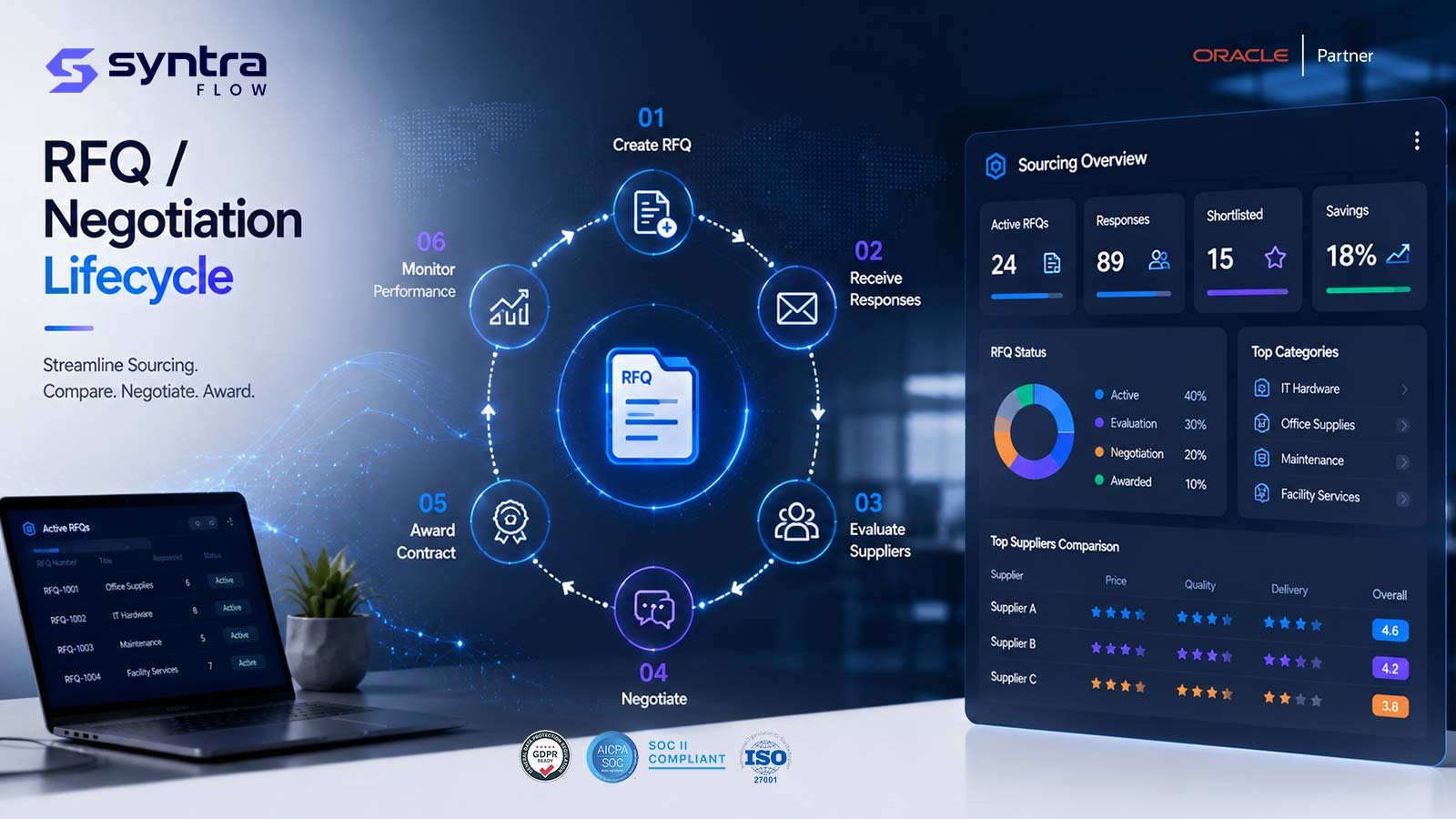
What Is Sourcing in Oracle Fusion Procurement?
Sourcing is the Oracle Fusion Procurement application that manages competitive negotiations with suppliers. A category manager creates a negotiation — an RFI to gather information, an RFQ or RFP to solicit priced offers, or a reverse auction to drive competitive bidding — defines the lines, lots, and cost factors, sets the scoring criteria and weights, invites suppliers, and opens the event. Suppliers register for the event, enter responses or quotes, and submit before the close date. The buyer then scores and evaluates responses, shortlists, and makes an award.
Sourcing sits before the buying documents it feeds. The negotiation itself is the priced competition; its output is an award decision that Oracle can turn into a blanket or contract purchase agreement, or directly into a purchase order. Between open and award, Oracle enforces the rules the buyer configured: response validation, sealed or two-stage disclosure, currency and tax handling, cost-factor arithmetic, and the scoring model that ranks suppliers.
The teams that depend on sourcing behaving correctly are category managers and buyers who run negotiations, the collaboration team members who evaluate and score, the suppliers who respond, and the procurement and audit functions that rely on a defensible, auditable award. Its upstream dependencies are the supplier and supplier-site master, categories, business units, and negotiation templates and styles; its downstream dependencies are purchase agreements and purchase orders. A defect in sourcing corrupts the award and everything it flows into.
Scope note. This page covers the sourcing negotiation lifecycle and award. Supplier registration, onboarding and qualification are covered on the Supplier Qualification Testing page, the blanket and contract agreements an award creates are covered on Purchase Agreement Testing, and requisition-to-order flows on Purchase Order Testing. Here we focus on what a negotiation does from creation through award.
Why Testing Oracle Sourcing Matters
Sourcing decides supplier selection and negotiated price, so a defect here is not cosmetic — it either awards the wrong supplier, miscalculates a competitive price, or breaks the audit trail a regulated procurement depends on. The risks specific to sourcing:
| Risk | Example | Potential impact | Testing response |
|---|---|---|---|
| Wrong supplier ranked first | Weighted score computes incorrectly | Award to a sub-optimal supplier | Assert computed score against expected weights |
| Cost factor mis-applied | Freight or duty factor not added to line | Understated landed price; bad decision | Verify cost-factor arithmetic per line |
| Sealed bid disclosed early | Responses visible before unseal | Fairness breach; audit finding | Negative test on sealed/two-stage visibility |
| Invalid response accepted | Required line or attribute left blank | Incomparable bids; re-work | Assert response validation blocks submit |
| Award never reaches purchasing | Award-to-agreement or PO fails | No buying document; supply gap | Verify award creates agreement/PO end to end |
| Late bid accepted | Response submitted after close | Process integrity failure | Test close-date enforcement and extensions |
| Currency mishandled | Multi-currency bids compared unconverted | Wrong ranking across currencies | Validate rate conversion in evaluation |
| Award approval skipped | Award routes without required approval | Control / SoD weakness | Assert approval routing before award release |
| Amendment loses responses | New round drops prior supplier data | Lost competition; rework | Test amendment/round with response carry-over |
| Silent behaviour change | Quarterly update alters scoring or award | Undetected process drift | Release-aware regression on sourcing |
The Oracle Sourcing Negotiation Process Flow
A negotiation moves through a defined sequence from creation to award. Each stage enforces its own rules, and each is a distinct point where a defect can enter.
Negotiation sequence
- Creation: buyer selects a negotiation style and template, defines lines and lots, adds cost factors, requirements and attachments, and sets scoring criteria and weights.
- Invitation: suppliers and supplier sites are invited; suppliers register for the event and gain access to respond.
- Response: suppliers enter quotes, respond to requirements, or decline (no-bid); response validation checks completeness before submit.
- Scoring & evaluation: automatic scoring computes weighted scores; the collaboration team evaluates, applies manual scores where configured, and shortlists.
- Award decision: the buyer awards by line or in full — including partial and split awards — subject to any award approval.
- Downstream output: the award creates a blanket/contract purchase agreement or a purchase order for the winning supplier(s).
Suggested visual: a swimlane diagram of the negotiation lifecycle with amendment/round and no-bid branches, for the web team to produce (see visual recommendations).
Sourcing Document Types
Oracle Sourcing supports several negotiation types, each with different disclosure, scoring, and award behaviour that testing must respect.
| Document type | Purpose | Priced? | Key testing focus |
|---|---|---|---|
| RFI | Gather supplier information and capability | No / optional | Requirement responses and scoring, no award to buying doc |
| RFQ | Solicit priced quotes for defined lines | Yes | Line pricing, cost factors, price breaks, award to PO/agreement |
| RFP | Evaluate priced proposals on price and criteria | Yes | Weighted scoring, requirement evaluation, two-stage disclosure |
| Auction (reverse) | Drive competitive downward bidding | Yes | Bid rank display, decrement rules, close/extend, real-time responses |
Testing Scope & Coverage Matrix
The dimensions a complete sourcing test suite must cover, with automation suitability and priority.
| Test area | What must be validated | Example scenario | Automation | Priority |
|---|---|---|---|---|
| Negotiation creation | RFI/RFQ/RFP/auction create with lines and lots | RFQ created from template | High | High |
| Cost factors & breaks | Factors and price breaks compute correctly | Freight cost factor added to line | High | High |
| Supplier invitation | Invited suppliers can register and access | Invite three suppliers to RFP | High | High |
| Response / quote entry | Suppliers submit valid, complete responses | Quote entered against all lines | High | High |
| Response validation | Incomplete responses blocked from submit | Missing required line rejected | High | High |
| Sealed / two-stage | Disclosure rules enforced until unseal | Bids hidden before unseal | Medium | High |
| Scoring & weights | Criteria and weights produce correct score | Weighted score matches expected | High | High |
| Evaluation & shortlist | Team evaluation and shortlist behave correctly | Shortlist top two suppliers | Medium | Medium |
| Award (line/full/split) | Award by line, in full, partial and split | Split award across two suppliers | High | High |
| Award to agreement / PO | Award creates the correct buying document | Award to blanket agreement | High | High |
| Amendment / round | Amendments and new rounds preserve data | New round retains prior bids | Medium | Medium |
| Currency & tax | Multi-currency and tax handled in evaluation | Bids converted for ranking | High | Medium |
| Approvals for award | Award routes through required approval | Award over threshold approved | Medium | High |
| Integration / API | Negotiations and responses via REST/import | Imported responses match UI | High | Medium |
| Regression / release | Behaviour unchanged after an update | Re-run pack after 26x update | High | High |
Oracle Sourcing Test Scenarios
A representative set of 34 Oracle Fusion sourcing scenarios — negotiation creation, supplier response, scoring and evaluation, award and hand-off, plus currency, approval and regression cases. Test IDs use the PR-SRC prefix.
| ID | Scenario | Preconditions | Expected result | Pri | Auto |
|---|---|---|---|---|---|
| PR-SRC-001 | Create RFI negotiation from template | RFI style & template available | RFI created with requirements | H | Y |
| PR-SRC-002 | Create RFQ with priced lines | Categories and items available | RFQ created, lines priced-for-response | H | Y |
| PR-SRC-003 | Create RFP with weighted criteria | Scoring criteria defined | RFP created with criteria and weights | H | Y |
| PR-SRC-004 | Create reverse auction | Auction style enabled | Auction created with bid rules | H | Y |
| PR-SRC-005 | Define negotiation lines and lots | RFQ in draft | Lines grouped into lots correctly | M | Y |
| PR-SRC-006 | Add cost factors to a line | Cost factors configured | Landed price includes cost factors | H | Y |
| PR-SRC-007 | Define price breaks by quantity | Line supports price breaks | Break tiers captured and evaluated | M | Y |
| PR-SRC-008 | Apply negotiation style / template rules | Style restricts controls | Restricted fields hidden/enforced | M | Y |
| PR-SRC-009 | Add requirements and attachments | RFP in draft | Requirements and files attached | M | Y |
| PR-SRC-010 | Add collaboration team members | Team users exist | Team assigned with evaluation access | M | P |
| PR-SRC-011 | Invite suppliers to negotiation | Active suppliers/sites exist | Suppliers invited and notified | H | Y |
| PR-SRC-012 | Supplier registers for event | Invited supplier user | Registration grants response access | H | Y |
| PR-SRC-013 | Supplier submits complete quote | Registered supplier, open event | Response submitted successfully | H | Y |
| PR-SRC-014 | Supplier submits no-bid | Registered supplier | No-bid recorded, excluded from award | M | Y |
| PR-SRC-015 | Response validation on incomplete bid | Required line/attribute blank | Submit blocked with validation error | H | Y |
| PR-SRC-016 | Sealed bid hidden before unseal | Sealed negotiation, bids in | Responses not visible pre-unseal | H | P |
| PR-SRC-017 | Two-stage technical then commercial | Two-stage RFP configured | Commercial locked until technical stage done | M | P |
| PR-SRC-018 | Automatic scoring of responses | Scored attributes, bids in | Weighted scores computed correctly | H | Y |
| PR-SRC-019 | Manual scoring by evaluator | Manual criteria, team member | Manual score applied and totalled | M | P |
| PR-SRC-020 | Scoring weight boundary check | Weights sum to defined total | Score reflects exact weighting | H | Y |
| PR-SRC-021 | Evaluate and shortlist suppliers | Scored responses | Shortlist reflects rank order | M | P |
| PR-SRC-022 | Award full negotiation to one supplier | Evaluation complete | Full award recorded to winner | H | Y |
| PR-SRC-023 | Award by line to different suppliers | Multi-line negotiation | Each line awarded to best line bid | H | Y |
| PR-SRC-024 | Partial award of a line quantity | Line allows partial award | Partial quantity awarded correctly | M | Y |
| PR-SRC-025 | Split award across two suppliers | Split award permitted | Quantity split per allocation | M | Y |
| PR-SRC-026 | Award requires approval over threshold | Award value above limit | Approval routed before release | H | P |
| PR-SRC-027 | Award creates purchase agreement | Award to agreement configured | Blanket/contract agreement generated | H | Y |
| PR-SRC-028 | Award creates purchase order | Award to PO configured | PO generated for awarded lines | H | Y |
| PR-SRC-029 | Amend negotiation / open new round | Open negotiation, bids in | Amendment issued, responses preserved | M | Y |
| PR-SRC-030 | Extend negotiation close date | Negotiation approaching close | Close extended, suppliers notified | M | Y |
| PR-SRC-031 | Multi-currency response evaluation | Bids in different currencies | Converted values ranked correctly | M | Y |
| PR-SRC-032 | Tax handling in negotiation lines | Taxable lines configured | Tax reflected in evaluated amount | M | Y |
| PR-SRC-033 | Cross-business-unit sourcing event | Procurement BU serves client BU | Award respects BU access and setup | M | Y |
| PR-SRC-034 | Integration-created negotiation & imported responses | REST/import feed available | API result matches UI negotiation | M | Y |
| PR-SRC-035 | Quarterly-update regression pack | Post-update tenant | All prior results reproduce | H | Y |
Pri = priority (H/M/L). Auto = automation candidate (Y suitable · P partly, needs role/data setup). Steps summarised; full step detail ships in the downloadable test pack.
Common Sourcing Errors & Defects
| Error / defect | Likely cause | Business impact | Recommended test |
|---|---|---|---|
| Incorrect weighted score | Criteria weights mis-configured | Wrong supplier ranked first | PR-SRC-018, PR-SRC-020 |
| Cost factor omitted | Factor not linked to line | Understated landed price | PR-SRC-006, PR-SRC-007 |
| Premature bid disclosure | Sealed/two-stage mis-set | Fairness breach; audit finding | PR-SRC-016, PR-SRC-017 |
| Invalid response accepted | Response validation weak | Incomparable bids; rework | PR-SRC-015 |
| Award not generating document | Award-to-agreement/PO fails | No buying document; supply gap | PR-SRC-027, PR-SRC-028 |
| Split/partial award error | Allocation logic misapplied | Over/under-committed quantity | PR-SRC-024, PR-SRC-025 |
| Late bid accepted | Close-date not enforced | Process integrity failure | PR-SRC-030 |
| Currency compared unconverted | Rate missing or ignored | Wrong cross-currency ranking | PR-SRC-031 |
| Amendment loses responses | Round handling defect | Lost competition data | PR-SRC-029 |
| Award approval bypassed | Approval rule gap | Control / SoD weakness | PR-SRC-026 |
| Supplier cannot register/respond | Invitation or access defect | Reduced competition | PR-SRC-011, PR-SRC-012 |
| API vs UI mismatch | Import validates differently | Inconsistent controls | PR-SRC-034 |
How SyntraFlow Automates Sourcing Testing
SyntraFlow drives the negotiation lifecycle across the buyer and supplier UIs and the REST layer, then asserts the exact score, award, and generated document — not just that a page loaded.
Pre-built sourcing cases
A starter pack of negotiation, scoring and award scenarios you extend to your styles and criteria — no scripting from zero.
AI-assisted generation
Generates negotiation variants — document types, cost-factor and scoring combinations, split and partial awards — from your configuration.
Self-healing execution
Playwright-based runs that re-anchor when Oracle changes the negotiation or Redwood pages, so scoring and award assertions keep working.
Dynamic test data
The Oracle Data Vault provisions suppliers and negotiations with the lines, cost factors and responses each test needs.
Score & award assertions
Verifies the exact computed score and award outcome — not just that evaluation "ran" — the difference between a real and a hollow test.
UI + API execution
Runs negotiations through the buyer UI, the supplier response UI, and REST, and confirms imported responses agree with the UI.
Evidence capture
Timestamped screenshots, scoring logs and execution traces retained as audit-grade evidence for every award decision.
Release-impact selection
Runs the sourcing subset a given quarterly release or config change actually affects.
Configuration-aware testing
Ties each test to the styles, cost factors and scoring rules that drive it, so a config change re-points the right tests.
A note on capability. Pre-built cases, self-healing execution, UI and API execution, and evidence capture are current platform capabilities. Coverage scoped to your specific negotiation styles, cost factors, scoring criteria, and award approvals is configurable during onboarding. Any tenant-specific extension is confirmed at assessment rather than assumed here.
When to Re-Test Oracle Sourcing
Sourcing depends on configuration and master data, so any change to either is a regression trigger. Retest when these events occur:
| Change event | Risk to sourcing | Recommended regression scope |
|---|---|---|
| Oracle quarterly update | Scoring or award logic changes | Full sourcing pack, release-scoped |
| Redwood rollout | Negotiation / response UI changes | UI creation, response and award cases |
| Negotiation style / template change | Available controls shift | Style-driven creation and control cases |
| Cost factor / price-break change | Landed price arithmetic shifts | Cost-factor and price-break cases |
| Scoring criteria / weight change | Ranking outcome changes | Scoring and evaluation cases |
| Award approval rule change | Award routing shifts | Award-approval and release cases |
| Tax / currency setup change | Evaluated amounts shift | Currency and tax evaluation cases |
| Security-role change | Who can award or evaluate changes | Role/SoD sourcing cases |
| New BU / procurement BU setup | Cross-BU sourcing gaps appear | Cross-BU negotiation and award cases |
| Integration / API change | Imported responses diverge from UI | API + imported-response cases |
| Production defect fix | Fix may regress adjacent flows | Targeted + smoke sourcing pack |
Sourcing & Oracle Quarterly Releases
Oracle's quarterly updates can change sourcing without any action on your part — through feature opt-ins, Redwood redesigns of the negotiation and supplier pages, new or altered scoring and award behaviour, or deprecated controls. Because a negotiation produces an auditable award, a silent change is exactly the kind you must catch before it reaches production.
Rather than re-testing every sourcing scenario on every release, SyntraFlow Release Intelligence narrows the work to what actually changed in your tenant:
- 1.Analyses the Oracle release notes for changes touching Sourcing negotiations, scoring and award.
- 2.Maps those changes to your configuration — styles, cost factors, scoring and award rules.
- 3.Identifies the negotiation types and categories affected.
- 4.Recommends the specific sourcing test cases to run.
- 5.Prioritises regression execution by risk.
- 6.Tracks award evidence for audit and sign-off.
See how the impact map is built on the Release Impact Analysis page.
Configurations That Drive Sourcing
A sourcing test is only trustworthy if the configuration behind it is known and stable. These setups determine how a negotiation scores and awards — and when they drift between environments, tests pass against the wrong reality.
| Configuration area | Testing impact | Example failure | Recommended validation |
|---|---|---|---|
| Negotiation styles & templates | Govern available controls and defaults | Style differs between envs | Style-driven creation cases |
| Cost factors & lists | Drive landed-price arithmetic | Factor list out of sync | Cost-factor evaluation cases |
| Scoring criteria & weights | Determine ranking outcome | Weight config differs from prod | Scoring and weight cases |
| Award approval rules | Gate award release | Threshold set differently | Award-approval routing cases |
| Supplier & site setup | Active supplier gates invitation | Site inactive in test only | Invitation and registration cases |
| Currency & conversion rates | Enable cross-currency ranking | Rate not loaded in env | Multi-currency evaluation cases |
| Tax setup | Affects evaluated line amounts | Rate/rule out of sync | Tax-in-negotiation cases |
| Procurement BU & access | Governs cross-BU sourcing | BU access differs from prod | Cross-BU award cases |
SyntraFlow's Configuration Intelligence compares these setups across environments and flags drift before it corrupts a sourcing test result — so a passing test means the configuration was correct, not just present.
The Oracle Sourcing Testing Pack
Teams that want a running start can request the Oracle Sourcing Testing Pack — a structured library that turns the scenarios on this page into ready-to-run tests. It covers the four negotiation types (RFI, RFQ, RFP and reverse auction), scoring scenarios spanning automatic and manual criteria with weight boundaries, and award test conditions including line, full, partial and split awards through to agreement and PO.
Each case ships with preconditions, step detail, expected results, and an evidence and sign-off template so an award decision is defensible in audit. The pack is delivered and tailored to your negotiation styles, cost factors, and scoring criteria during onboarding — request it alongside a walkthrough of how it runs against sourcing events like yours.
Request the Sourcing Testing Pack and a working demonstration against a representative negotiation.
Request the Sourcing Testing PackFor the full source-to-pay flow into agreements, orders and payment, see Oracle P2P End-to-End Testing.
Related Oracle Procurement Pages
Sourcing connects to the rest of the procurement suite. Go deeper on adjacent topics:
Oracle Procurement Testing Tool ⭐
The procurement testing hub.
Supplier Qualification Testing →
Onboarding and qualification flows.
Purchase Agreement Testing →
Blanket and contract agreements.
Purchase Order Testing →
Requisition-to-order and PO mechanics.
Supplier Testing →
Supplier master and site data.
P2P End-to-End Testing →
Full source-to-pay cross-module flow.
Frequently Asked Questions
What does Oracle Sourcing testing cover?
▼
It covers the negotiation lifecycle in Oracle Fusion Sourcing — creating RFIs, RFQs, RFPs and reverse auctions, inviting suppliers, collecting responses, scoring and evaluation, the award decision, and the hand-off to a purchase agreement or purchase order. It does not cover supplier onboarding or the agreements and orders themselves, which have their own pages.
How is sourcing testing different from supplier qualification testing?
▼
Sourcing testing focuses on competitive negotiations and awards. Supplier onboarding, registration approval, and qualification assessments are a separate concern covered on the Supplier Qualification Testing page. A supplier must exist and be able to register for an event, but qualifying that supplier is out of scope here.
Which negotiation types should a sourcing test suite include?
▼
All four: RFI for information gathering, RFQ for priced quotes, RFP for evaluated proposals, and reverse auction for competitive bidding. Each has different disclosure, scoring, and award behaviour, so a suite that tests only one document type leaves the others unverified.
How do you test scoring and evaluation?
▼
Enter known responses, then assert the computed weighted score against the value you expect from the configured criteria and weights. Test both automatic scoring and manual evaluator scoring, and check weight boundaries so a change in a single weight produces the ranking you intend rather than a silent tie or reversal.
Why do cost factors matter in testing?
▼
Cost factors — freight, duty, tooling and similar — turn a quoted unit price into a landed cost that the evaluation actually compares. If a factor is omitted or mis-applied, the ranking is based on the wrong number. Tests should verify cost-factor and price-break arithmetic per line, not just the raw bid price.
How do you test sealed and two-stage negotiations?
▼
With negative visibility tests: submit responses and assert they are not visible to the buyer before the unseal event, and for two-stage RFPs, that the commercial stage stays locked until the technical stage completes. Premature disclosure is a fairness and audit risk, so these cases are high priority even though they need role and timing setup.
What award scenarios need coverage?
▼
Full award to one supplier, award by line to different suppliers, partial award of a line quantity, and split award across suppliers. Each should be tested through to the generated document, because an award that scores correctly but fails to create the agreement or PO leaves purchasing with nothing to act on.
How is award-to-agreement different from award-to-PO?
▼
An award can create a blanket or contract purchase agreement for ongoing supply, or a purchase order for a specific buy. Both paths must be tested and confirmed to generate the correct document with the awarded lines, prices and supplier. The agreements themselves are covered in depth on the Purchase Agreement Testing page.
How do you test negotiation amendments and rounds?
▼
Amend an open negotiation or open a new round and confirm that prior supplier responses are preserved or re-solicited as configured, suppliers are notified, and the close date behaves correctly. A defect here can silently drop competition data, so amendment cases belong in every cycle that touches negotiation setup.
Does multi-currency affect sourcing testing?
▼
Yes. When suppliers bid in different currencies, evaluation must convert to a common basis before ranking. Tests should confirm the conversion rate is applied and the ranking reflects converted values — a missing rate or an unconverted comparison ranks the wrong supplier first.
How do you test award approvals?
▼
Create awards above and below the configured approval threshold and assert that the above-threshold award routes for approval before it can be released, while the below-threshold award proceeds per rule. This protects segregation of duties and becomes critical after any approval-rule or security-role change.
Can sourcing be tested through the REST API?
▼
Yes. Negotiations can be created and responses imported through REST and file-based import as well as the UI. A complete suite runs both and confirms an integration-created negotiation and imported responses behave the same as the UI, because bulk and integrated events rely on that path and any divergence is a control gap.
How often should Oracle Sourcing be regression tested?
▼
On every Oracle quarterly update, and after any change to negotiation styles, cost factors, scoring criteria, award approvals, tax or currency setup, or security roles. Because a negotiation produces an auditable award, testing after these events protects against silent drift that would otherwise surface only when the wrong supplier wins.
What test data does sourcing testing need?
▼
Each test needs suppliers able to register, a negotiation with the right lines, cost factors and scoring criteria, and responses engineered to produce a known score and award. SyntraFlow's Oracle Data Vault provisions suppliers and negotiations so tests produce the intended outcome reliably instead of relying on hand-built events.
Strengthen Your Oracle Procurement Test Coverage
Identify gaps in your sourcing test suite, automate high-risk scoring and award scenarios, and prepare for Oracle quarterly updates with SyntraFlow. See it run against negotiations like yours.