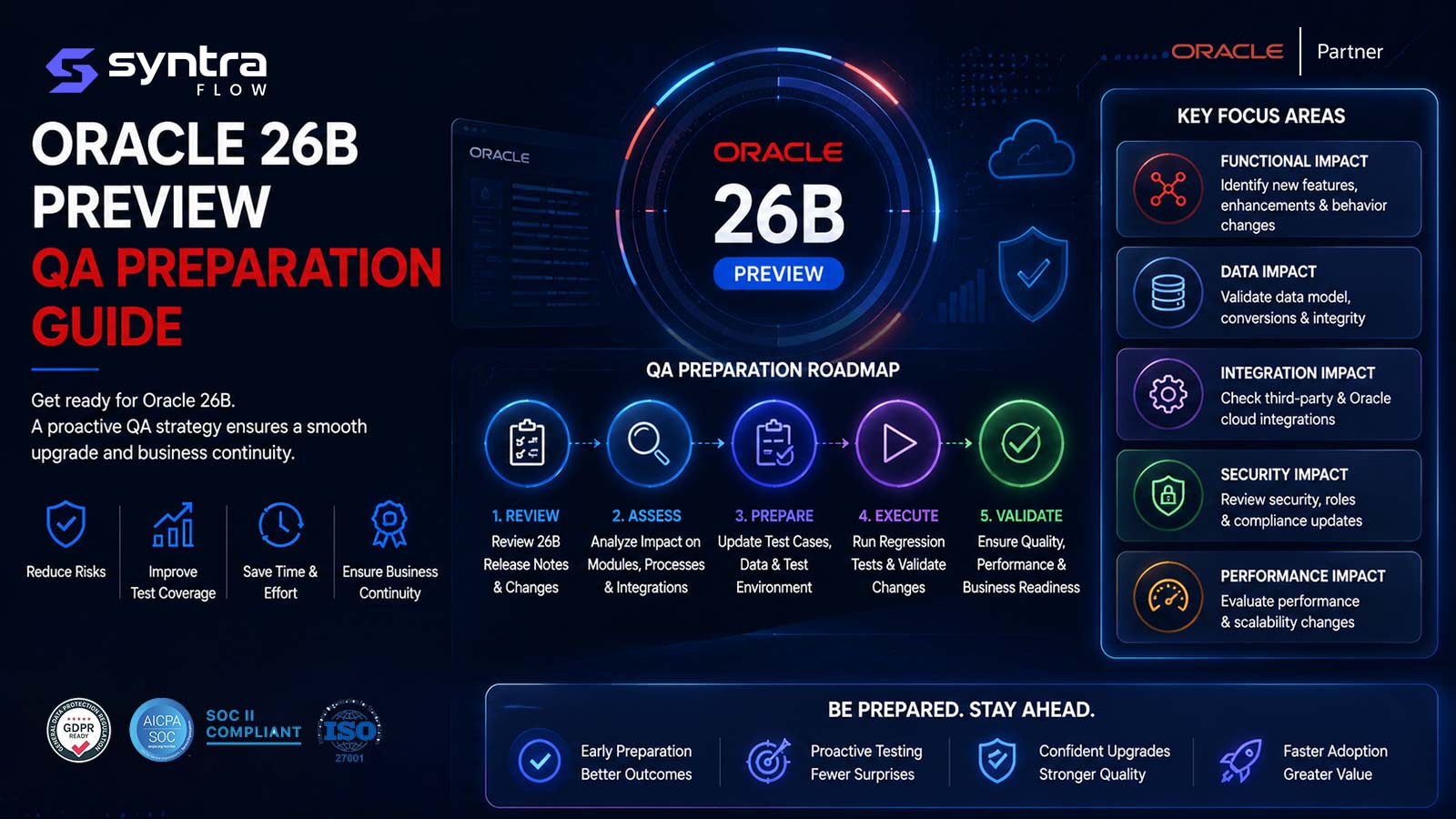
Oracle Fusion 26B is the release where agentic AI moves from preview into everyday Financials operations. The four Financials AI agents — Ledger, Payables, Payments, and Expenses — reach general availability in 26B, the broader Fusion Agentic Applications wave lands across the suite, and Document IO becomes the default gen-AI path for Payables invoice ingestion. For an Oracle QA or finance team, that means your 26B test cycle has to cover more than screens and calculations: it now has to validate autonomous agent decisions inside your own policies. This guide walks through what 26B brings and how to structure a quarter of preparation and testing around it.
What Oracle 26B actually brings
Before you plan testing, it helps to separate what is genuinely new in 26B from capability that shipped in earlier releases. Oracle's agentic story has been rolling out release by release, and 26B is the point where the Financials agents cross the general-availability line.
The four Financials AI agents reach GA
The Ledger, Payables, Payments, and Expenses agents become generally available in 26B. These are the concrete, named agents in the Financials family, and they are the headline reason this release matters to a finance QA team. Each one can take actions inside Oracle Fusion — proposing period-close steps, handling invoice exceptions, sequencing payments, or reviewing expense reports — while operating within your existing Fusion permissions, approval hierarchies, and policies. For background on how these agents are positioned, see our overview of the Oracle Financials AI agents.
It is worth being precise about the timeline, because a lot of secondhand commentary blurs it. Oracle AI Agent Studio has been generally available since release 25C. The plumbing that lets agents reach outside Fusion — MCP tools, external REST tools, REST-API access to agents, and Slack and Microsoft Teams channels — arrived in 26A. Agent2Agent (A2A) coordination is slated for 26C. What specifically hits GA in 26B is the set of Financials agents and the wider agentic applications wave. Keeping those dates straight matters when you scope what you can realistically test this quarter.
The Fusion Agentic Applications wave
Alongside the Financials agents, 26B advances Oracle's Fusion Agentic Applications — coordinated teams of specialized agents that operate across ERP, HCM, SCM, and CX within your existing permissions, policies, and approvals. Oracle's announcements describe more than 20 agentic applications spanning the suite. Outside Financials, much of this capability is named by function or workspace rather than by a single branded agent — for example, Oracle's announcements reference SCM capabilities such as Design-to-Source, the Sourcing Command Center, and the Cost Accounting Close, and an Applicant Screening AI Agent in HCM that shipped in 26A. If you are mapping the wider impact for your organization, our primer on Fusion Agentic Applications lays out the model. For anything beyond the confirmed agents and functions, confirm current details with Oracle rather than assuming a branded agent exists.
Document IO becomes the default for Payables invoice ingestion
The third change QA teams need on their radar is that Document IO — Oracle's generative-AI document understanding — becomes the default mechanism for Payables invoice ingestion in 26B. If your organization currently relies on integrated imaging, email-in invoices, or a specific OCR flow, the extraction and field-mapping behavior underneath your invoice intake may shift. This is not a cosmetic change: how header and line data get read off a supplier invoice feeds directly into matching, tolerances, and the Payables agent's exception handling. It deserves explicit test coverage, not an assumption that it works the same as before.
Why 26B testing is different
A normal quarterly Oracle update is a regression problem: confirm that the flows you rely on still behave the way they did last quarter. 26B keeps all of that and adds a second, unfamiliar problem — validating agents that make decisions rather than follow a fixed script. A traditional test asserts one expected output for one input. An agent, given the same invoice twice, can legitimately route it differently depending on context and configuration. That is a feature, not a defect, and it breaks the deterministic assert-exact-value habit that most Oracle test suites are built on.
The practical implication is that your 26B plan needs two tracks running in parallel: conventional regression on your core financial flows, and a distinct validation approach for agent decisions that checks whether an agent's action falls within the range your policy allows. We go deeper on that distinction in testing Oracle AI agents, and on why older frameworks struggle with it in the AI agent testing gap legacy tools cannot fill.
A quarter-long 26B preparation plan
Treat 26B as a five-stage program across the quarter rather than a single test pass. The stages below move from understanding the change to signing off with evidence.
1. Impact analysis
Start by reading the 26B readiness material for the modules you run and mapping each relevant change to the business processes it touches. For most finance teams the highest-impact areas are Payables invoice ingestion (Document IO), and any close, payment, or expense process where you intend to enable a Financials agent. Produce a short register: change, affected process, owner, and a first-pass risk rating. This register becomes the scope statement for everything that follows. Connecting release notes to a concrete test scope is exactly what Oracle release intelligence is designed to support.
2. Targeted regression
Run regression on the core financial flows in scope — invoice-to-pay, expense reporting, and period close — in a 26B-updated test environment. The goal is not to re-run your entire library blindly but to concentrate on the processes your impact analysis flagged, plus a stable baseline of critical paths. Pay particular attention to invoice ingestion, since the Document IO default can change extracted values that ripple into matching and posting. Structuring this well is the job of a disciplined Oracle regression testing approach.
3. AI-agent validation
This is the stage that is new for 26B. For each Financials agent you plan to enable, define the policy envelope — the set of actions that are acceptable for a given scenario — and validate that the agent stays inside it across a representative range of cases, including edge cases and deliberate exceptions. Test that the agent respects your approval hierarchy, that it escalates when it should, and that it does not act outside the permissions its user context grants. Because agent behavior can vary, single-case checks are not enough; you want enough scenarios to characterize behavior, not just observe one outcome. If you tested the 26A Payables preview, our 26A Payables agent testing guide is a useful companion for the GA cycle.
4. Configuration and security review
Agents inherit their reach from Fusion configuration, so the security review is not optional. Confirm which roles can invoke each agent, verify that agent actions honor segregation-of-duties constraints, and check that enabling an agent has not quietly widened what a given user context can do. Review the configuration around Document IO and any tolerances that feed agent decisions. Where 26A introduced external channels and REST access, confirm that only the integrations you intend are active. Treat every setting change as something to be validated, not assumed.
5. Sign-off
Close the cycle with documented evidence: regression results on core flows, agent-validation results against defined policy envelopes, the configuration and security review, and a clear record of anything you deferred or accepted as risk. Business process owners should sign off on agent behavior specifically, not just on screen-level regression, because an agent going live is a change to how decisions get made — not only to how a form looks.
Oracle 26B QA preparation checklist
Use the following as a working checklist across the quarter. Adapt the owners and timing to your own release calendar and non-production refresh schedule.
| Stage | Focus area | What to verify in 26B | Typical owner |
|---|---|---|---|
| Impact analysis | Scope mapping | Each 26B change mapped to affected processes and risk-rated; Financials agents and Document IO flagged | QA lead / Finance SME |
| Targeted regression | Invoice-to-pay | Payables ingestion under Document IO default; extracted fields, matching, tolerances, posting unchanged or expected | AP test analyst |
| Targeted regression | Close and expenses | Period-close steps, expense reporting, and payment runs behave correctly in the 26B environment | R2R / T&E analyst |
| AI-agent validation | Ledger & Payables agents | Agent actions fall inside the defined policy envelope; escalations and exceptions handled correctly across scenarios | QA lead / Process owner |
| AI-agent validation | Payments & Expenses agents | Payment sequencing and expense review stay within policy; approval hierarchy respected | Treasury / T&E owner |
| Config & security review | Roles & SoD | Agent-invoking roles reviewed; segregation-of-duties honored; no unintended widening of access | Security / Controls |
| Config & security review | Integrations & channels | Only intended external tools, REST access, and Slack/Teams channels (from 26A) are active | Integration owner |
| Sign-off | Evidence & approval | Regression, agent-validation, and security results documented; process owners approve agent go-live | QA lead / Finance leadership |
Common 26B preparation pitfalls
A few mistakes recur when teams first prepare for agentic releases. The first is treating agent validation as ordinary regression and asserting a single fixed outcome; that produces brittle tests you end up weakening until they prove nothing. The second is assuming invoice ingestion behaves identically after the Document IO default takes over. The third is enabling an agent without reviewing the configuration and roles that govern its reach. And the fourth is confusing the timeline — assuming, for instance, that features from 26A or capabilities planned for 26C are part of your 26B scope. Anchor your plan to what actually ships in 26B and confirm anything uncertain with Oracle.
If your 26B window overlaps a functional upgrade rather than a routine update, pair this guide with our Oracle Fusion Financials upgrade checklist so infrastructure and functional readiness stay in step with the QA plan.
How SyntraFlow helps
SyntraFlow can be configured to support both tracks of a 26B cycle. It helps organizations assess the impact of a quarterly Oracle update and connect that release intelligence directly to a targeted test plan, so regression concentrates where 26B actually changes behavior. For the Financials agents, SyntraFlow's Oracle ERP testing approach can be set up to validate agent decisions against the policy envelopes your team defines, rather than against a single expected output — which is the shift 26B demands. Oracle's agents make the decisions; SyntraFlow's testing engine helps you confirm those decisions stay inside your policies before and after go-live. As always with a new release, verify current 26B specifics against Oracle's own readiness material, and use SyntraFlow to turn that readiness into a repeatable, evidenced test cycle.