Oracle AI for Fusion Cloud
Oracle is embedding AI throughout Fusion Cloud Applications — as predictive and generative features inside existing pages, and as AI agents that can act inside business processes. This hub is a starting point for understanding what Oracle AI actually is across ERP, HCM, SCM and CX, and what it means for how you configure, govern and test it.
Use the sections below to orient yourself, then follow the links through to focused pages on agents, Agent Studio, readiness, testing, security and governance, release tracking, and adoption.
What Is Oracle AI?
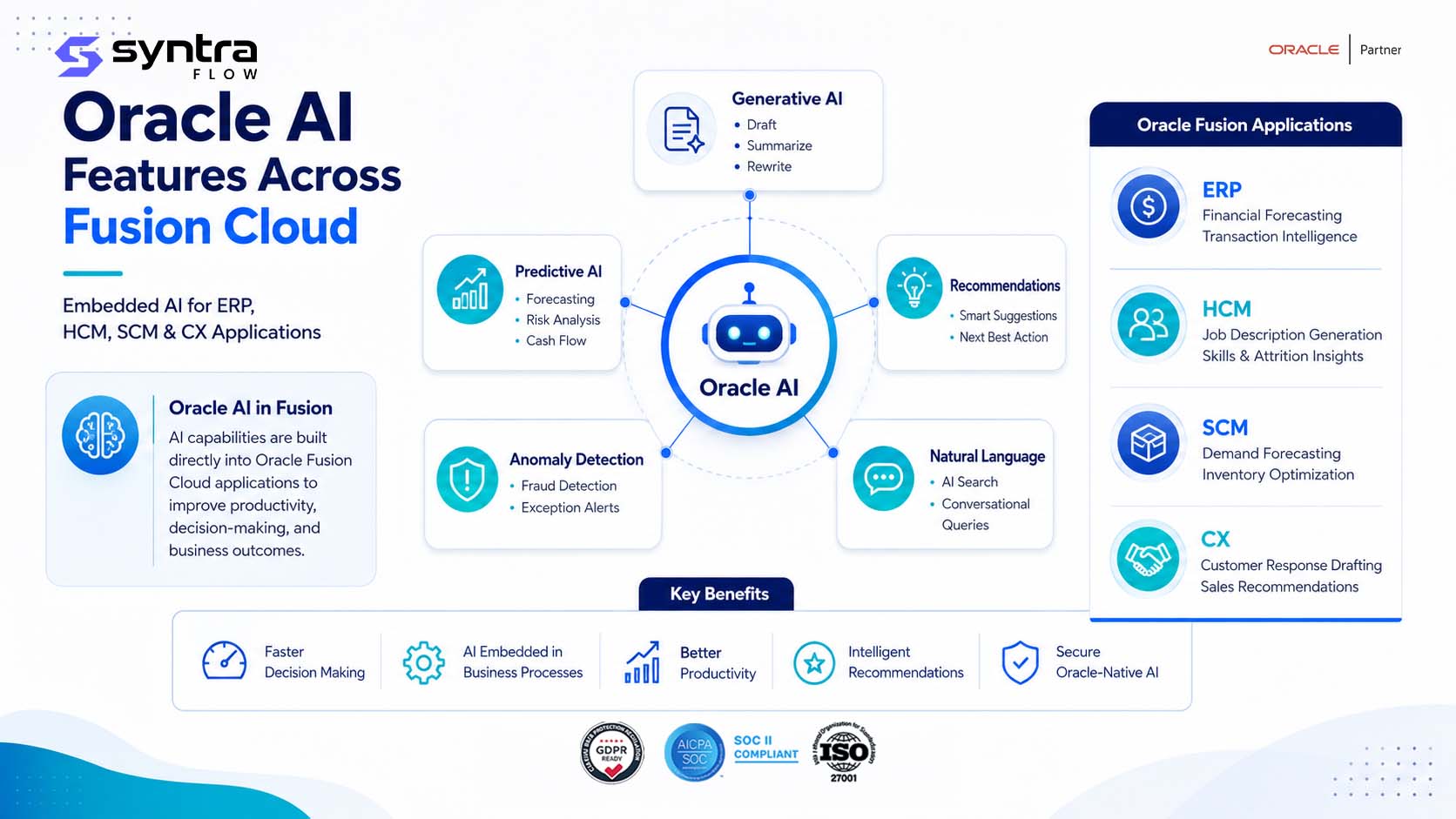
Oracle AI refers to the set of artificial intelligence capabilities Oracle now ships inside Fusion Cloud Applications. It spans three layers: embedded AI features baked into existing transactions and dashboards (prediction, classification, anomaly detection), generative AI that drafts text, summarizes records, or answers questions in natural language, and AI agents — a newer layer that can take action inside a business process rather than only surfacing a suggestion. Oracle configures and extends agent behavior through AI Agent Studio. All three layers ship inside the same Fusion Cloud pillars — ERP, HCM, SCM and CX — rather than as a separate product.
For customers, the practical implication is that "Oracle AI" is not one feature to switch on. It is a growing collection of capabilities that arrive on Oracle's own quarterly release cadence, each with its own configuration, licensing and risk profile. Understanding which layer a given capability belongs to — embedded suggestion, generative draft, or autonomous agent action — is the first step before deciding how to govern or test it.
Why this matters to your organization
As Oracle AI moves from suggesting to acting, the risk profile changes. An embedded prediction that is wrong produces a bad recommendation a human still has to approve; an AI agent that is wrong can create, update or submit a transaction directly. That shift is why AI inside Fusion Cloud needs the same rigor applied to any other control-sensitive change — governance, access review and validation — not just a one-time enablement decision.
- Accuracy of AI-driven actions — an agent acting on incomplete or stale data can propagate an error faster than a manual process would.
- Ungoverned access — an agent's effective permissions need the same segregation-of-duties scrutiny as a human role.
- Compliance and audit — regulated processes may need evidence of what an agent did and why, not only the transaction it produced.
- Release drift — Oracle can change agent behavior on its own quarterly cadence, so a validated configuration can shift without a change on your side.
Oracle AI Across Fusion Cloud Applications
Oracle is not rolling AI out as a single cross-application layer — each pillar of Fusion Cloud is getting a distinct set of capabilities on its own timeline. ERP is seeing AI agents and embedded features around invoice processing, reconciliation and close-related work. HCM is seeing agents and generative features around recruiting, transactions and employee-facing questions. SCM is seeing predictive and generative capability around planning and supply signals, and CX is seeing generative and agentic capability around service and sales interactions.
Because capability, maturity and configuration options differ by pillar, this hub keeps the application-specific detail on dedicated pages rather than repeating it here — see Oracle AI by application area below, or jump straight to a business process such as Process Mining to see where AI agents are likely to intersect with your existing Oracle Fusion process flows.
Oracle AI Agents
Oracle AI agents are a distinct capability from embedded prediction or a generative chat assistant: an agent is designed to carry out a step inside a business process — retrieving data, drafting or submitting a transaction, or routing an exception — rather than only answering a question. Agents are scoped to specific processes and typically operate with defined triggers, data access and guardrails rather than open-ended autonomy.
That combination of data access and the ability to act is exactly why agents change how you think about testing and oversight, not just configuration. For a closer look at how Oracle AI agents work and where they are appearing across Fusion Cloud, see Oracle AI Agents.
Oracle AI Agent Studio
AI Agent Studio is the platform Oracle provides for configuring, extending and managing agents inside Fusion Cloud — including built-in Oracle agents and, depending on the capability, customer- or partner-built agents. It is the administrative layer that sits behind agent behavior: where triggers, data sources, guardrails and permissions for an agent are set up and maintained.
Because Agent Studio controls what an agent is allowed to see and do, it is also where a large share of Oracle AI governance work will actually happen in practice. See Oracle AI Agent Studio for more on how the platform is structured.
Embedded and Generative AI Features
Not every Oracle AI capability is an agent. Embedded and predictive AI features — forecasting, classification, anomaly flags — surface a suggestion inside an existing page and leave the decision and the transaction to a human. Generative AI features draft content: a summary, an email, a job description, a response — again for a person to review before it is used. Agentic AI is the layer above both: it can carry the process forward on its own, within its configured scope.
The distinction matters for risk and testing effort. A wrong suggestion is caught by the human who reviews it; a wrong agent action may already be in the transaction system before anyone looks. See Oracle AI Features for a closer look at the embedded and generative layer specifically.
Oracle AI by Application Area
Oracle AI capability, licensing and maturity vary meaningfully between the four Fusion Cloud pillars. Each area below has its own page with the capability categories, process touchpoints and open questions specific to that pillar.
Oracle AI for ERP
Embedded, generative and agentic AI touching Payables, close, procurement and financial reporting processes.
Oracle AI for HCM
AI capability appearing across recruiting, core HR transactions and employee- and manager-facing interactions.
Oracle AI for SCM
Predictive and generative AI applied to planning signals, supply exceptions and inventory-related decisions.
Oracle AI for CX
Generative and agentic AI in service and sales interactions, including drafting and case-handling assistance.
Oracle AI Readiness
Turning on an Oracle AI capability is rarely the hard part — being ready for it is. Readiness spans data quality (an agent or generative feature is only as good as the records it draws on), security and role design, process fit (does the agent's scope match how your team actually works), and confirming the licensing position for the specific capability with Oracle. Configuration drift between environments is part of this too, since an agent validated in test can behave differently if the target configuration differs — an area Config Intelligence is built to surface.
A readiness assessment before enabling a new Oracle AI capability is a smaller investment than remediating a poorly-scoped agent after go-live. See Oracle AI Readiness for a fuller framework.
Oracle AI Testing and Validation
Testing Oracle AI is a different discipline from traditional Oracle functional testing. A functional test checks whether a known input produces a known output; an AI agent or generative feature can produce a reasonable but different response each time, so validation has to look at the behavior and boundaries of the capability — does the agent stay inside its intended scope, does it escalate appropriately, does a generative draft stay accurate — rather than asserting a single expected result.
Scope note. This is specifically about testing Oracle's AI behavior — agents, prompts and generative output. Broader Oracle Fusion functional test automation across ERP, HCM and SCM processes is covered by the Oracle ERP Testing Tool vertical. SyntraFlow's own AI-driven testing capability — including self-healing scripts and automated script selection used to test Oracle, described on the features page — is a separate thing from Oracle's AI and is one of the tools that can be applied to testing it.
See Oracle AI Testing for a deeper look at how agent and prompt validation differs from regression testing a standard Oracle transaction.
Oracle AI Security and Governance
Security and governance are related but separate concerns for Oracle AI. Security covers what an agent or AI feature can technically access — data sources, roles and permissions — and needs the same segregation-of-duties discipline applied to human users; an agent with excess access is an SoD gap in a new form, which is the kind of risk SoD Intelligence is designed to surface.
Governance is the broader layer above that: policies for which agents are approved for use, who owns their configuration, how their output is reviewed, and how exceptions are escalated.
Both need dedicated attention as Oracle AI adoption grows rather than being treated as a single checkbox. See Oracle AI Security and Oracle AI Governance for the two areas in more depth.
Oracle AI Quarterly Release Intelligence
Oracle ships AI changes on the same quarterly update cadence as the rest of Fusion Cloud — new agent capability, changes to existing agents, and new embedded or generative features can all appear in a given release. Because agents act rather than only suggest, an unreviewed change to agent behavior carries more downstream risk than a cosmetic UI change, which makes tracking Oracle's AI-related release notes a governance activity, not just an IT housekeeping task.
This is already a documented, shipping trend rather than a future promise — Oracle's own quarterly update notes have covered AI Agent Studio and ERP and HCM agent capability, for example in the 26A ERP agents update and the 26A HCM update.
General Oracle quarterly update tracking across all modules is covered by the Oracle Release Intelligence vertical; Oracle AI Release Intelligence narrows that same discipline specifically to AI-related changes.
Oracle AI Adoption Roadmap
Two different roadmaps are worth keeping separate here. Oracle's own product roadmap is where Oracle's AI capability is headed — which agents, features and Agent Studio functionality are planned or emerging across Fusion Cloud. SyntraFlow's adoption guide is a customer-facing view: a practical sequence for how an Oracle Fusion customer might evaluate, pilot and roll out Oracle AI capability internally, including the readiness, governance and testing steps covered elsewhere on this hub.
See Oracle AI Roadmap for where Oracle's capability is trending, and Oracle AI Adoption Guide for how to plan a rollout on your side.
Latest Oracle AI Resources
Further reading on Oracle AI and the practical gaps it creates for testing and governance.
Explore the Oracle AI Hub
Every topic introduced above has its own dedicated page. Use this map to go deeper on the area most relevant to you.
Discover
Oracle AI Agents
How Oracle AI agents work and where they act inside Fusion Cloud processes.
Read more →Oracle AI Agent Studio
The platform for configuring, extending and managing Oracle AI agents.
Read more →Oracle AI Features
Embedded and generative AI features across Fusion Cloud, distinct from agents.
Read more →🧩Applications
Oracle AI for ERP
AI capability across Payables, close and financial reporting processes.
Read more →Oracle AI for HCM
AI capability across recruiting, core HR and employee interactions.
Read more →Oracle AI for SCM
Predictive and generative AI applied to planning and supply chain signals.
Read more →Oracle AI for CX
Generative and agentic AI in service and sales interactions.
Read more →🛡️Test & Monitor
Oracle AI Readiness
Data, security, process and licensing readiness before enabling Oracle AI.
Read more →Oracle AI Testing
How validating agent and generative AI behavior differs from functional testing.
Read more →Oracle AI Security
Access, data exposure and role considerations specific to AI agents and features.
Read more →Oracle AI Governance
Policy, ownership and review practices for Oracle AI capability in use.
Read more →Oracle AI Release Intelligence
Tracking Oracle's quarterly AI-related changes across Fusion Cloud.
Read more →🗺️Adopt & Plan
Oracle AI Roadmap
Where Oracle's own AI capability is trending across Fusion Cloud.
Read more →Oracle AI Adoption Guide
SyntraFlow's guide to evaluating, piloting and rolling out Oracle AI.
Read more →Oracle AI Best Practices
Practical guidance for configuring, reviewing and monitoring Oracle AI.
Read more →SyntraFlow's Other Oracle Fusion Intelligence Capabilities
This hub focuses on understanding, governing and testing Oracle's own AI. It sits alongside SyntraFlow's broader Oracle Fusion quality capabilities rather than replacing them: the Oracle ERP Testing Tool for functional test automation, Release Intelligence for tracking quarterly Oracle changes generally, Config Intelligence for configuration drift and comparison, Process Mining for understanding how your Oracle processes actually run, SoD Intelligence for access and segregation-of-duties risk, and License Optimization for Oracle license spend. Oracle AI adoption tends to touch several of these at once — an agent change is a release event, a configuration change, and potentially an access-review event, all together.
Frequently Asked Questions
What is Oracle AI in Fusion Cloud Applications?
▼
Oracle AI is the collective term for embedded and predictive AI features, generative AI, and AI agents that Oracle now ships inside Fusion Cloud ERP, HCM, SCM and CX. It is not a single switch — different capabilities arrive on different timelines and in different pillars, each configured and licensed separately.
What is Oracle AI Agent Studio?
▼
AI Agent Studio is Oracle's platform for configuring, extending and managing AI agents inside Fusion Cloud, including built-in Oracle agents and, depending on the capability, agents built by customers or partners. See Oracle AI Agent Studio for more detail.
What is the difference between an Oracle AI agent and embedded or generative AI?
▼
Embedded AI surfaces a prediction or flag for a human to act on. Generative AI drafts content for a human to review. An AI agent is designed to carry out a step in the process itself — retrieving data, drafting or submitting a transaction, or routing an exception — within its configured scope, which is why agents warrant closer governance and testing attention.
Do I need to test Oracle AI agents differently from regular Oracle features?
▼
Yes, in an important respect. Traditional Oracle functional testing checks a known input against a known expected output. Agent and generative AI behavior can vary between runs, so validation needs to focus on scope, guardrails and boundary behavior — does the agent stay within its intended process and escalate appropriately — rather than a single expected result. See Oracle AI Testing.
Is Oracle AI included in my existing Oracle Fusion license?
▼
It varies by capability. Some embedded AI features are included with existing Fusion Cloud subscriptions, while some agent or generative capability may be licensed separately or require additional enablement. Licensing details change as Oracle's AI offering evolves, so confirm the specific position for each capability directly with Oracle or your account team rather than assuming inclusion.
How often does Oracle update its AI capability?
▼
On the same quarterly update cadence as the rest of Fusion Cloud. Oracle's quarterly release notes have already documented AI Agent Studio and agent-related changes for ERP and HCM — see the 26A ERP agents update and 26A HCM update as examples of what has already shipped.
What does "AI readiness" mean for an Oracle Fusion customer?
▼
Readiness covers whether your data, security roles, business processes and licensing position support a given Oracle AI capability before you enable it — not just whether the feature exists. See Oracle AI Readiness for the framework.
How does Oracle AI security and governance differ from traditional Oracle security?
▼
The underlying concerns — access control and segregation of duties — are the same, but an AI agent's effective access and behavior need explicit review as their own object, not an assumed extension of the role that configured them. Governance adds policy questions on top: which agents are approved, who owns their configuration, and how output is reviewed. See Oracle AI Security and Oracle AI Governance.
How does SyntraFlow help with Oracle AI?
▼
SyntraFlow helps organizations assess readiness, track Oracle's quarterly AI-related release changes, and think through governance and testing approaches for Oracle AI agents and features. SyntraFlow can be configured to connect release intelligence with test planning so AI-related changes get reviewed rather than missed, and its own AI-driven testing engine — described on the features page — is one of the tools that can be applied to validating Oracle, including its AI capability.
Get Ahead of Oracle AI in Your Fusion Environment
Understand what Oracle AI capability is already live in your tenant, what's coming next quarter, and where readiness, governance and testing gaps might be. Talk to SyntraFlow about your Oracle AI questions.