Oracle Agentic Applications
Oracle Agentic Applications are Fusion applications in which multiple AI agents coordinate across a business process — each handling a discrete step, then handing off to the next — rather than a single agent answering one prompt. Where a lone agent might summarise an invoice or draft a job description, an agentic application chains several agent capabilities so a whole flow, such as an order-to-cash or procure-to-pay cycle, moves forward with less manual stitching between steps.
This page explains what agentic applications are, how agents coordinate, where human approval gates sit, and why testing and governing a chain is harder than one agent. It is an orientation page in the Oracle AI hub, linking to Oracle AI Agents and Oracle AI Agent Studio for the building blocks.
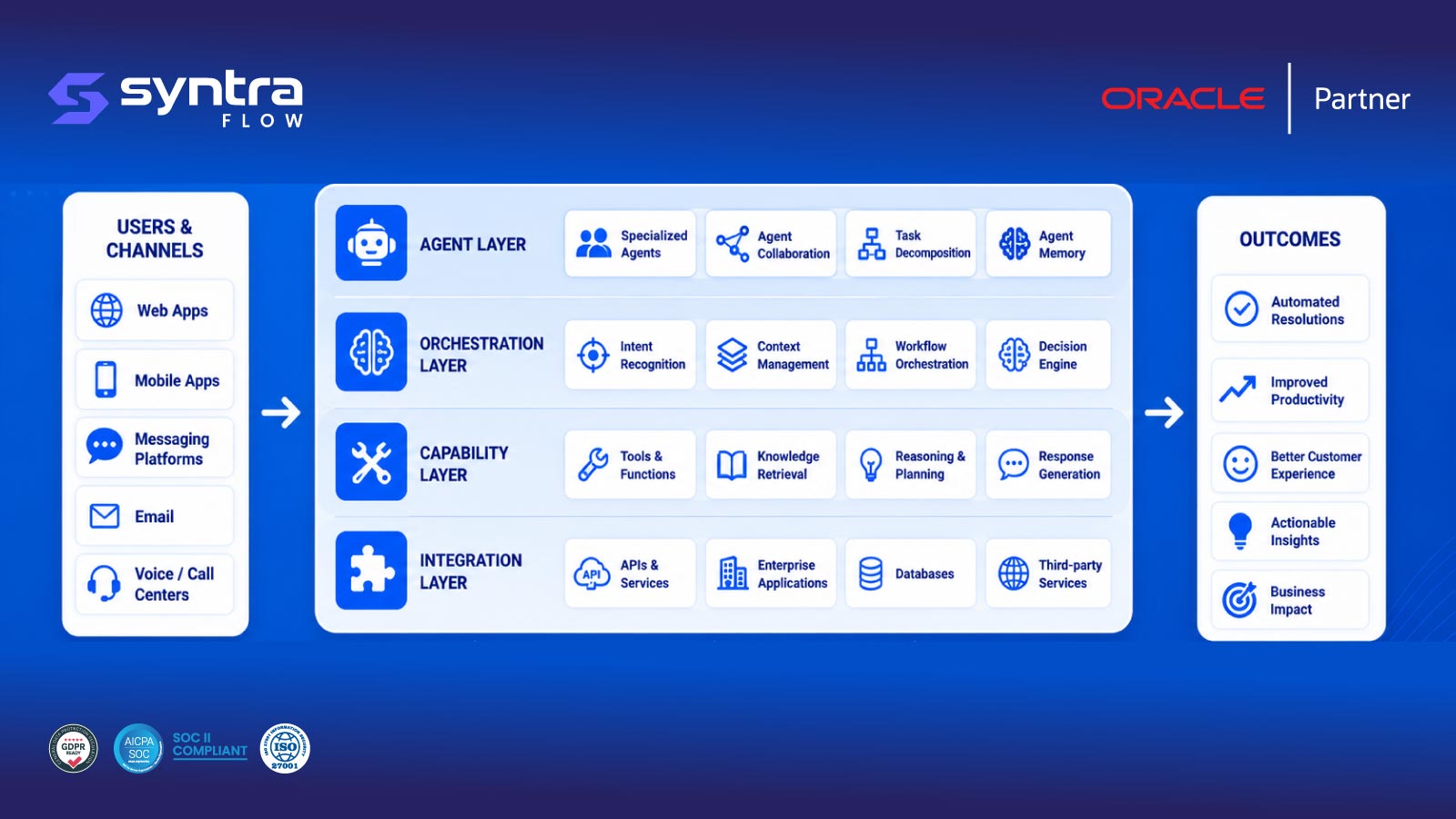
What Are Agentic Applications?
An agentic application is one where the work is carried out by a set of cooperating AI agents rather than a single request-and-response assistant. Each agent owns a bounded task — reading a document, proposing a value, checking a rule, calling a service — and the application coordinates them so the output of one becomes the input of the next. The user sees one end-to-end outcome.
The distinction that matters is single agent versus coordinated agents. A single agent answers a bounded question inside one screen or transaction. An agentic application spans a process: it gathers context from several Fusion objects, takes intermediate actions, pauses for a human decision, and resumes. Because it sits on the same agent runtime, it inherits the risks of individual agents — compounded across the chain — so governing and testing it differs from doing so one agent at a time.
| Dimension | Single AI agent | Agentic application (multi-agent) |
|---|---|---|
| Scope | One prompt, one step | A whole business process, many steps |
| Coordination | None — self-contained | Handoffs and orchestration between agents |
| State | Held for one interaction | Carried across steps and pauses |
| Human role | Reads or accepts one output | Approves at defined gates within the flow |
| Data access | Scoped to one task | Aggregated across every agent in the chain |
| Failure impact | Localised to that answer | Can propagate downstream through the process |
| Testing effort | Validate one input/output pair | Validate handoffs, state, and end-to-end result |
Multi-Agent Architecture: How Agents Hand Off and Coordinate
The core mechanic is the handoff: one agent finishes its task and passes control, with the relevant context, to another suited to the next step. Coordination relies on a few recurring patterns rather than one fixed design.
- Sequential handoff. Agents run in a defined order — gather, propose, validate, act — each step consuming the previous step's output. The common shape for a linear finance or HR process.
- Orchestrated coordination. A coordinating layer picks which agent runs next based on current state, allowing branches — such as routing an exception to a specialised agent — instead of a straight line.
- Parallel fan-out. Several agents work independently on parts of the same case and their results are merged before the process continues.
- Shared context and state. A carried context — transaction, documents, prior decisions — is passed between agents so later steps understand earlier ones.
- Tool and service calls. Agents reach Fusion data and actions through defined interfaces; Oracle's quarterly-update pages document REST API access and interoperability such as MCP and A2A, which lets an agent act rather than only advise.
The point for testing and governance is that a handoff is a boundary — where context can be dropped, a value misinterpreted, a permission widened, or an exception swallowed. A five-agent chain has more of these boundaries than a single agent, each needing explicit attention. The agents and studio behind these architectures are covered on Oracle AI Agents and Oracle AI Agent Studio.
Business-Process Orchestration Across Fusion
The clearest way to picture an agentic application is against a familiar Fusion process. The two flows below are generic, representative illustrations of how agent capabilities could chain — the labels are capability categories, not named Oracle products or shipped feature names.
Illustrative — Procure-to-Pay (P2P)
- 1. Intake agent — reads an incoming supplier invoice and extracts header and line data.
- 2. Matching agent — proposes a match to the purchase order and receipt.
- 3. Exception agent — explains a variance or a hold and suggests a resolution.
- ◆ Human gate — a person reviews the variance before release.
- 4. Action agent — records the approved outcome back into Payables.
Illustrative — Order-to-Cash (O2C)
- 1. Order agent — validates an incoming order against terms and credit.
- 2. Fulfilment agent — checks availability and proposes a schedule.
- 3. Billing agent — drafts the invoice from fulfilled lines.
- ◆ Human gate — a person confirms a pricing or credit exception.
- 4. Collections agent — flags overdue items and drafts follow-up.
In both flows, no single agent owns the process. The value — and the risk — comes from the chain: each agent advances the case, and the transaction completes through handoffs punctuated by human decisions. Because these flows touch subledger balances, credit exposure, and supplier payments, an error introduced early can travel the length of the chain before anyone sees it — which is why agentic applications need end-to-end validation.
Human Approval Within Multi-Agent Flows
Agentic applications are not meant to remove people from consequential decisions; they bring the decision to the right person with the context already assembled. The design question is where the approval gates sit — placing them well keeps an agentic application controllable.
- Before an irreversible action. Any step that moves money, changes a master record, or commits an external order — the agents prepare, a human authorises.
- At an exception or low-confidence point. When an agent cannot resolve a case cleanly, the flow routes to a person rather than guess and continue.
- At a segregation-of-duties boundary. Where policy requires a second party, the gate enforces that the approver is not the identity that prepared the work.
- On threshold breaches. Value, risk, or variance thresholds can force a gate even when the agents are confident.
A gate is only a control if it is tested. Two failure modes matter: a gate that can be bypassed, and a gate that fires but the downstream agent proceeds anyway. Both live at the boundary between agents and need explicit coverage, discussed under Oracle AI agent testing.
Representative Examples
Beyond the P2P and O2C flows above, the same pattern fits other Fusion processes — illustrative capability categories, not named products. A period-close support flow might chain reconcile → flag → explain → propose entry with a controller sign-off gate; a candidate-screening flow might chain parse → assess → shortlist → notify with a hiring-manager review gate.
On the confirmed side, Oracle's existing 26A quarterly-update pages reference an Agentic Applications Builder for composing agent-driven applications, alongside AI Agent Studio for configuring the agents themselves. A few specific agents are documented too, such as a Ledger Agent in ERP and an Applicant Screening AI Agent in HCM. Everything beyond that confirmed set is a capability category, not a promised product — see the 26A ERP AI agents update for what is actually itemised.
For a module-by-module view of which agents exist, the Oracle AI agent directory keeps a searchable catalogue and marks speculative entries clearly.
Security Across a Multi-Agent Chain
The defining security concern of an agentic application is compounded access. A single agent has bounded privileges; a chain holds the union of every member's access, and data flows across each handoff. Reasoning about "what could this application reach or do" means reasoning about the whole chain.
- Aggregated privilege. The chain can touch every object each agent can touch, so least-privilege must be evaluated end to end, not per agent.
- Context leakage across handoffs. Data passed to a later agent may exceed what it needs, widening exposure at each step.
- Widening blast radius. A prompt-injection or bad instruction reaching one agent can be carried into the actions of the next.
- API and interoperability surface. REST access and agent-to-agent interoperability expand what a chain can invoke, so those interfaces are part of the boundary.
- Audit across steps. Attribution must survive handoffs, so "which agent did what, under whose authority" stays answerable.
Agent-level access control — roles, privileges, business-object scope, and REST/MCP exposure for individual agents — is treated in depth on Oracle AI agent security. The point for agentic applications is that those controls must be assessed as a composed chain, because the risk is the sum, not any single link.
Testing Multi-Agent Flows
Testing a single agent is bounded: give it an input, check the output. Testing an agentic application is harder because you are validating the end-to-end behaviour of a chain — the handoffs, the carried state, the human gates, and how an early error propagates. A suite that only checks each agent in isolation can pass while the assembled flow fails.
| What to test | Why it is a multi-agent concern |
|---|---|
| Handoff integrity | Context passed between agents is complete and correctly interpreted. |
| State consistency | Carried state stays correct across steps, pauses, and resumes. |
| Human-gate enforcement | Approval gates cannot be bypassed and downstream agents honour the decision. |
| Error propagation | An early mistake is caught rather than carried to a committed action. |
| Exception routing | Branches to specialised agents fire on the right conditions. |
| End-to-end outcome | The completed transaction matches the expected result, not just each step. |
| Regression after updates | A quarterly change to one agent does not silently break the chain. |
The test types that apply specifically to agents — prompt, workflow, API, regression, security, human-approval, and response validation — are catalogued on Oracle AI agent testing, and the broader validation discipline sits on Oracle AI testing. The multi-agent lesson is that end-to-end coverage is not optional: the boundaries between agents are where the defects a per-agent test misses live.
Governance for Agentic Applications
Governance for an agentic application answers questions a single agent never raises: who owns the composed flow, who approved adding an agent to the chain, and how a change to one agent is reviewed for its effect on the rest. A chain no one owns end to end is a chain no one can be accountable for.
- Ownership of the flow. A named owner for the composed application, distinct from the owners of each agent.
- Change management across the chain. A process to review how altering, adding, or removing an agent affects downstream steps and controls.
- Approval to compose. Control over which agents may be assembled into a business-critical flow, and by whom.
- Inventory and lineage. A current record of which agents participate in which flows, so impact can be traced.
- Policy at the gates. Documented rules for where human approval is required, and evidence they hold.
Governing individual agents — their approval, ownership, and agent-level controls — is detailed on Oracle AI agent governance. For agentic applications, governance must also operate on the chain as a unit, because that is where the business outcome and the risk exist.
Release History and Observed Direction
Agentic capabilities in Fusion evolve quarter by quarter. To stay accurate, this page only itemises what is confirmed on-site for 26A and labels the rest as observed direction, not a committed roadmap.
| Release | What is referenced on-site | Status |
|---|---|---|
| 26A | AI Agent Studio, Agentic Applications Builder, REST API access for agents, MCP / A2A interoperability, LLM marketplace flexibility; specific agents including a Ledger Agent (ERP) and an Applicant Screening AI Agent (HCM) | Confirmed on-site |
| Later quarters | Broader agent coverage across more modules and richer multi-agent composition | Observed direction |
The confirmed 26A detail lives on the 26A ERP AI agents update. For the method of tracking and assessing what each quarter changes, see Oracle AI Release Intelligence. Treat any capability not itemised there as directional.
How SyntraFlow Helps
SyntraFlow helps organisations understand, govern, and validate Oracle's agentic applications as they adopt them, emphasising the multi-agent view — handoffs, gates, and end-to-end outcomes — rather than any single agent in isolation.
- Assessment. SyntraFlow helps organisations assess which Fusion processes are candidates for agentic composition and where the human gates and control boundaries should sit.
- End-to-end validation. SyntraFlow can be configured to exercise a multi-agent flow across its handoffs and gates, so a passing result reflects the whole chain.
- Release-aware regression. SyntraFlow can connect release intelligence with test planning, so a quarterly change to one agent triggers targeted re-validation of the flows that depend on it.
- Governance evidence. SyntraFlow's roadmap can support capturing evidence at each step and gate to help show a composed flow behaved as approved.
These are capabilities SyntraFlow can be configured toward as part of an Oracle AI assessment; scope is confirmed against your environment rather than assumed. SyntraFlow's own AI-driven testing engine — its self-healing, autonomous test-generation technology used to exercise Oracle — is a separate SyntraFlow product, not one of Oracle's agentic applications; the two should not be conflated.
Frequently Asked Questions
What is an Oracle agentic application?
▼
It is a Fusion application in which multiple AI agents coordinate across a business process — each handling one step and handing off to the next — rather than a single agent answering one prompt. The user gets an end-to-end outcome while several agent capabilities run underneath.
How is an agentic application different from a single Oracle AI agent?
▼
A single agent answers a bounded question inside one step. An agentic application spans a whole process, carries state across steps, pauses for human decisions, and coordinates several agents. It inherits the risks of individual agents, compounded across the chain. The individual agents are covered on Oracle AI Agents.
How do agents hand off to each other in a multi-agent flow?
▼
One agent finishes its task and passes control, with the relevant context, to the next. Coordination follows recurring patterns — sequential handoff, orchestrated routing, parallel fan-out — over a shared, carried state. Each handoff is a boundary where context can be dropped or a permission can widen, which is why boundaries need explicit attention.
Where do human approval gates sit in an agentic application?
▼
At consequential points: before an irreversible action, at exceptions or low-confidence outcomes, at segregation-of-duties boundaries, and on threshold breaches. A gate is only a control if it is tested for both bypass and for downstream agents honouring the decision.
Why is security harder across a chain of agents?
▼
Because access compounds. A chain effectively holds the union of every agent's privileges, and data travels across each handoff, so exposure and blast radius grow with the chain. Least-privilege must be assessed end to end. Agent-level access control is detailed on Oracle AI agent security.
Why is testing a multi-agent flow harder than testing one agent?
▼
Because you must validate the end-to-end chain — handoffs, carried state, human gates, and error propagation — not just each agent's input and output. A suite that checks agents in isolation can pass while the assembled flow fails. The test types are catalogued on Oracle AI agent testing.
Is "Agentic Applications Builder" a real Oracle capability?
▼
Yes — it is referenced on the site's existing 26A quarterly-update pages as a capability for composing agent-driven applications, alongside AI Agent Studio. The illustrative flows on this page, however, are generic capability categories, not named products. Confirmed detail is on the 26A ERP AI agents update.
How does SyntraFlow support agentic applications?
▼
SyntraFlow helps organisations assess candidate processes and can be configured to validate a multi-agent flow end to end across its handoffs and gates. It can connect release intelligence with test planning so a quarterly change to one agent triggers targeted re-validation. Scope is confirmed against your environment rather than assumed.
Assess Your Oracle Agentic AI Readiness
Understand where multi-agent flows fit your Fusion processes, where the human gates and control boundaries belong, and how to validate a chain of agents end to end. Start with an Oracle AI assessment from SyntraFlow.