Oracle AI Agent Testing
Oracle AI Agent Testing is the set of test types you run against an individual Oracle Fusion AI agent to prove it does the right thing before you let it act on live data. Unlike a traditional screen or API, an agent interprets a prompt, decides on a business action, calls Oracle services, and sometimes waits for a human to approve — so a complete suite has to check the prompt, the action, the API path, the approval gate, and the response as separate, verifiable things.
This page is a practical catalogue of those agent-specific test types — and how each maps to a failure mode you want to catch in a test rather than in production. It sits inside the Oracle AI hub and assumes you know what Oracle AI agents and Oracle AI Agent Studio are.
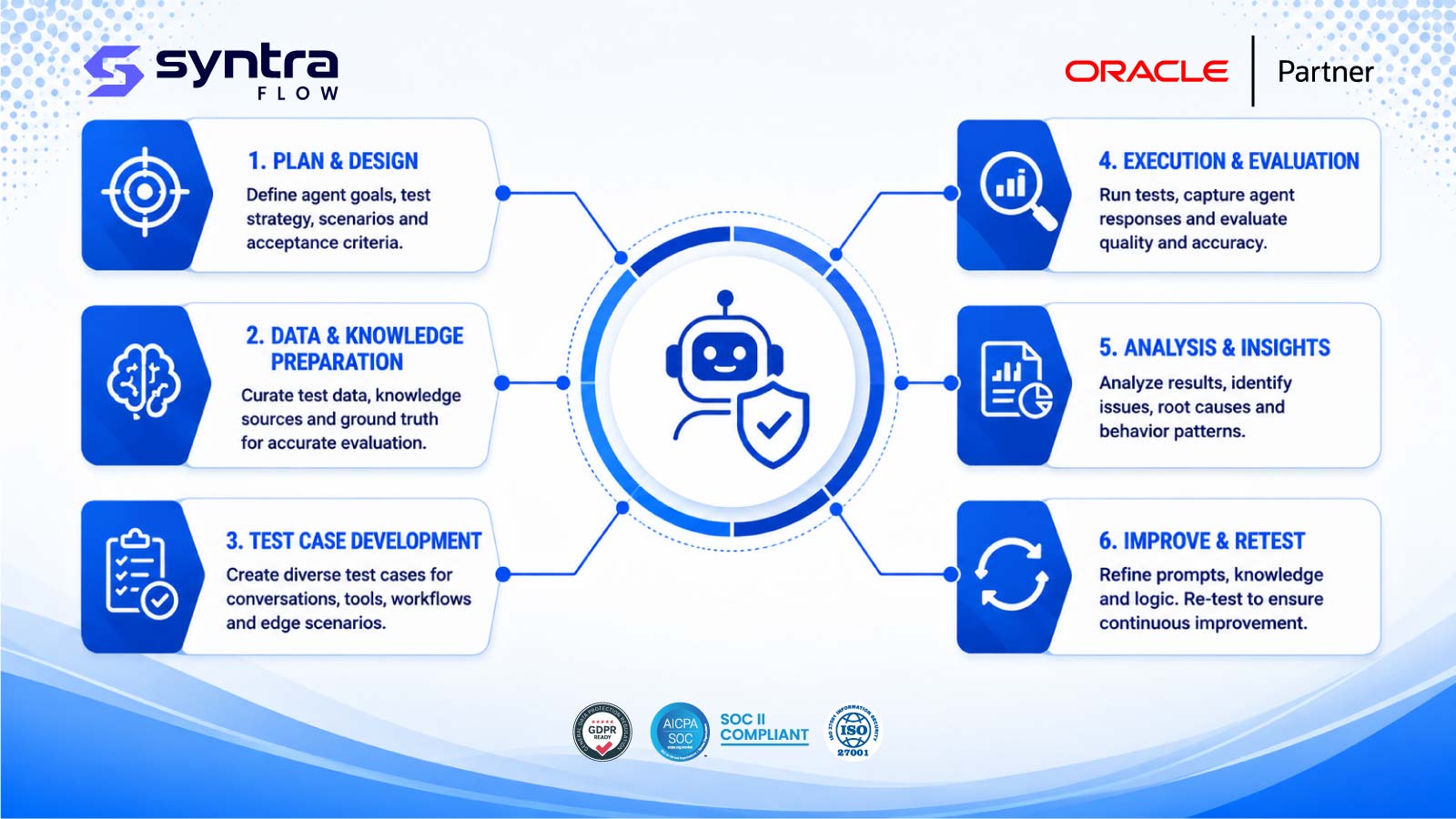
How this page relates to Oracle AI Testing. This is a focused page about the test types for agents specifically — the concrete techniques you apply to one agent at a time. The broader discipline of validating Oracle's AI — the overall strategy, what "correct" means for embedded and generative AI, and where AI validation fits in your quality program — lives on Oracle AI Testing.
Read that page when deciding whether and how to test Oracle AI at all; read this one when you have an agent in front of you and need to know which tests to write. Oracle AI Testing sets the discipline; this page enumerates the agent test types inside it.
What Makes Testing an Agent Different
A conventional Oracle transaction is deterministic — the same inputs produce the same result. An agent is different in three ways. It is non-deterministic: the same request, phrased many ways, produces different but still-correct responses, so exact-match assertions fail on valid variation. It is agentic: it takes an action against Oracle — creating a journal, screening a candidate, drafting a supplier communication. And it is composed: one agent may chain a prompt, a retrieval step, REST or MCP calls, and an approval gate, and any link can fail independently.
So agent testing is not one test — it is a family of test types, each aimed at a different layer: the prompt, the workflow, the API path, regression, security, the approval gate, and the final response. Skip any one and you have an untested surface. Oracle has already shipped concrete agents that make this real — a Payables-oriented Ledger Agent capability and an HCM Applicant Screening AI Agent are documented examples, and customers can build their own with the Agentic Applications Builder inside AI Agent Studio. Each needs the same test types below; for an inventory to work through, see the Oracle AI agent directory.
Prompt Testing
Prompt testing checks that the agent interprets user input the way you intend across the range of ways real users phrase things. An agent that behaves perfectly on the demo phrasing can misfire on a paraphrase, an ambiguous request, or an adversarial one. The goal is not to prove the model is clever — it is to prove the agent's configured instructions hold up under variation.
A practical prompt-test set covers four categories: canonical phrasings the agent must handle; paraphrase and synonym variants of those; out-of-scope requests the agent should politely decline rather than attempt; and edge and adversarial inputs — missing context, contradictory instructions, or attempts to talk the agent past its guardrails. For each, you assert on behaviour category (did it act, clarify, or decline) rather than on exact wording — varying the input to check routing, where response validation instead fixes the input and scores the output.
Workflow Testing — Did the Agent Take the Right Business Action?
Workflow testing separates agent testing from chatbot testing. A chatbot only has to say the right thing; an agent has to do the right thing in Oracle — take the correct action, against the correct object, with the correct data, and stop where it should. Consider a Payables invoice-handling agent capability: a good response ("I have placed this invoice on hold pending a price review") is worthless if the agent actually released the hold, acted on the wrong invoice, or created a duplicate. Workflow tests assert on the resulting Oracle state — not on the agent's narration. The two can diverge, and that divergence is exactly the defect you are hunting.
They should also cover the boundaries of authority: an out-of-scope request should be refused with no action taken, and a multi-step task should either complete fully or leave a clean, recoverable state rather than a half-finished transaction. Where an agent chains actions, test end to end and at each hand-off — a break in the middle is the hardest failure to detect afterward.
API Testing — The REST and MCP Endpoints the Agent Uses
Oracle agents reach the rest of the world through interfaces: REST API access to Oracle services, and MCP (Model Context Protocol) and A2A (agent-to-agent) interoperability for connecting to tools and other agents. Those interfaces are a test surface in their own right, independent of the natural-language layer above them. API-level testing checks that the agent calls the right endpoint with the right parameters, handles the response — errors, empty results, timeouts — sensibly, and honours its granted scope. When an agent exposes or consumes an MCP endpoint, that endpoint needs the same contract testing as any integration: schema conformance, authentication, error semantics, and behaviour under malformed or hostile input.
This layer matters because the natural-language surface can hide an integration defect: an agent might narrate a plausible answer while the underlying REST call silently failed, returned stale data, or was never made. Asserting at the API boundary — that the expected call happened, with the expected payload and effect — closes that gap between what an agent says conversationally and what it does programmatically.
Regression Testing — Agents Drift When Oracle Updates Them
Oracle delivers quarterly updates, and AI agents are part of what changes in them — new agent capabilities appear, existing agents are revised, underlying models and prompts are tuned, and behaviour you validated last quarter can shift without any change on your side. For a deterministic screen, an unchanged test either passes or fails cleanly. For an agent, "the same input now produces a subtly different action or a differently-worded refusal" is a real and easy-to-miss regression class.
Agent regression testing means re-running your prompt, workflow, API, and approval tests after each Oracle update against a captured baseline — not just that the agent still responds, but that it still takes the same correct actions, declines the same out-of-scope requests, and routes through the same approval gates. Because outputs vary, the baseline is usually expressed as behaviour categories and asserted Oracle-state, not exact text. Deciding which agents an update actually touches — rather than blindly re-running everything — is the job of release analysis. Oracle AI Release Intelligence covers how to read each quarter's AI changes and map them to the agents and tests they affect.
Security Testing
An agent inherits the ability to act, which makes its security posture a test target rather than an assumption. Security testing for agents asks a specific set of questions: can the agent be talked into an action outside its scope? Does it respect the data boundaries of the requesting user, or surface records that user should not see? Are its REST and MCP surfaces exposed only to authorised callers? Does a crafted prompt leak system instructions, credentials, or another tenant's data?
These tests are adversarial by design. You probe prompt-injection and jailbreak attempts, over-broad data access, privilege escalation through chained tool calls, and information leakage in responses. The pass condition is that the agent refuses, contains, or fails safely — never that it "usually" behaves. The access-control model behind all of this — agent roles and privileges, business-object scope, and how agent exposure through REST and MCP is governed — is covered on Oracle AI agent security. This section is about the tests that prove that model holds; that page is about the model itself.
Human-Approval Testing — Do the Gates Actually Stop the Agent?
Many Oracle agent designs put a human in the loop for consequential actions: the agent proposes, a person approves, and only then does the action commit. That approval gate is a control, and like any control it is only as good as the test that proves it fires — a gate present in the design but bypassable in practice is worse than no gate, because it creates false confidence.
Human-approval testing confirms three things. The gate holds: without approval, the action does not commit — assert on Oracle state, not on the agent saying it is "waiting." It routes correctly: approval requests reach the right approver, and someone without authority cannot approve. And it cannot be talked around: no phrasing, retry, or chained request lets the agent complete a gated action without the approval actually being granted. Test both paths — granted and denied — and confirm the denied path leaves no partial transaction behind. Where an agent handles high-value or irreversible actions, these are the highest-priority cases in the whole suite.
Response Validation — Grounding and Accuracy
Response validation checks the quality of what the agent produces: is the answer accurate, grounded in real Oracle data rather than invented, complete, and appropriate to the request? For generative and retrieval-augmented agents, the failure mode to catch is confident fabrication — a fluent, plausible response that the underlying records do not actually support.
Because responses vary in wording, response validation uses tolerant assertions rather than exact matches: checking that required facts are present and correct, that claimed figures reconcile to the source data, that no unsupported claims creep in, and that the response stays on-topic and within policy. This is the one agent test type where scoring — rather than pass/fail on a fixed string — is usually the right model. The scoring methods behind it — defining quality metrics, scoring grounding and accuracy at scale, and tracking scores over time — go deeper and are treated separately on Oracle AI agent evaluation. Use this section to know response validation is required; use that page for the scoring depth.
The Oracle AI Agent Test Types at a Glance
Each agent test type, what it verifies, and the failure mode it exists to catch.
| Test type | What it verifies | Example failure mode |
|---|---|---|
| Prompt testing | Input is interpreted correctly across phrasings, and out-of-scope requests are declined | Agent acts on a paraphrase it should have refused, or declines a valid request |
| Workflow testing | The correct business action is taken against the correct Oracle object with correct data | Agent narrates the right action but changes the wrong record or duplicates a transaction |
| API testing | REST and MCP calls use the right endpoint, payload, scope, and error handling | A REST call silently fails or returns stale data while the agent answers as if it succeeded |
| Regression testing | Behaviour is unchanged after an Oracle quarterly update, against a captured baseline | A retuned agent quietly takes a subtly different action for the same input |
| Security testing | The agent stays in scope, respects data boundaries, and resists prompt injection | A crafted prompt escalates privilege or leaks records the user should not see |
| Human-approval testing | Approval gates hold, route to the right approver, and cannot be bypassed | A gated action commits without an approval actually being granted |
| Response validation | Output is accurate, grounded in real data, complete, and on-policy | A fluent answer fabricates figures not supported by the underlying Oracle records |
A complete agent suite draws from every row; the mix and priority depend on the agent — a high-value transactional agent weights workflow, approval, and security, a read-only advisory agent weights prompt and response validation.
How SyntraFlow Helps
SyntraFlow can be configured to organise these agent test types into a single, repeatable plan rather than a scatter of one-off checks. The emphasis below is on how the platform can be applied — specifics are confirmed per tenant.
Structure the test types
Can be configured to organise prompt, workflow, API, regression, security, approval, and response tests into one plan you re-run each quarter.
Assert on Oracle state
Workflow and approval checks can be tied to the resulting Oracle record — assessing what the agent did, not just what it narrated.
Exercise REST and MCP paths
Can be configured to test the API surface an agent uses alongside its conversational surface, surfacing defects hidden behind fluent text.
Tolerant response assertions
Response checks can be expressed as required-fact and grounding assertions rather than exact strings, suiting non-deterministic output.
Release-aware regression
Can connect quarterly release intelligence with test planning, helping teams focus regression on the agents an update touched.
Evidence for governance
Runs can be captured as timestamped evidence, helping organisations assess agent behaviour for audit and sign-off.
A note on scope. Oracle's AI agents are a fast-moving surface, and the coverage SyntraFlow can provide for a specific agent depends on that agent's design, exposed interfaces, and your tenant configuration. The right first step is an assessment that maps your live and planned agents to the test types above and confirms what can be automated versus what stays a manual or human-approval check.
Frequently Asked Questions
How is this different from Oracle AI Testing?
▼
Oracle AI Testing is the broad discipline — the strategy, coverage model, and what "correct" means for Oracle's AI across embedded, generative, and agent features. This page is narrower: it enumerates the specific test types you apply to an individual agent — prompt, workflow, API, regression, security, human-approval, and response validation. Use Oracle AI Testing to decide how to approach AI validation overall; use this page when you have an agent in front of you and need to know which tests to write.
What are the core test types for an Oracle AI agent?
▼
Seven: prompt testing (is input interpreted correctly), workflow testing (was the right business action taken), API testing (are the REST and MCP calls correct), regression testing (has behaviour changed after an Oracle update), security testing (does the agent stay in scope and resist injection), human-approval testing (do approval gates actually stop the agent), and response validation (is the output accurate and grounded). A complete suite draws from all seven, weighted to the agent's risk.
Why can't I just reuse my existing Oracle regression tests?
▼
Traditional tests assume deterministic screens and exact-match assertions. An agent is non-deterministic, takes actions rather than returning values, and chains prompts, API calls, and approval gates. Exact-match assertions break on valid wording variation, and screen-level checks miss the API and approval layers entirely. Agent testing keeps the principle of regression but needs behaviour-category and Oracle-state assertions instead of fixed strings.
How do I test that a human-approval gate really works?
▼
Assert on Oracle state, not on the agent's words. Confirm that without approval the action does not commit, that approval requests route to an authorised approver and no one else, and that no phrasing, retry, or chained request lets the agent complete a gated action without approval actually being granted. Test both the approved and denied paths, and confirm the denied path leaves no partial transaction behind.
How often should I regression test my Oracle AI agents?
▼
At minimum on every Oracle quarterly update, because agents and their underlying models can be revised in those updates, and after any change you make to an agent's own configuration. Rather than re-running everything every time, use release analysis to identify which agents a given update touches. Oracle AI Release Intelligence covers how to map each quarter's changes to the affected agents and tests.
Where does response validation end and agent evaluation begin?
▼
Response validation, as a test type, confirms a given response is accurate, grounded, complete, and on-policy. Agent evaluation goes deeper into the scoring methods behind that — defining quality metrics, scoring grounding and accuracy at scale, and tracking scores over time. Use this page to know response validation is a required test type; see Oracle AI agent evaluation for the scoring depth.
Do custom agents built in AI Agent Studio need different tests?
▼
They need the same seven test types, but the emphasis shifts to what you configured. An agent built with the Agentic Applications Builder in Oracle AI Agent Studio reflects your own prompts, tools, and approval design, so your prompt, workflow, and security tests carry more weight than for an Oracle-supplied agent whose behaviour Oracle maintains. Either way, test against Oracle state and treat every configured action and gate as a case.
Generate an Oracle AI Agent Test Plan
Map your live and planned Oracle AI agents to the test types on this page — prompt, workflow, API, regression, security, human-approval, and response validation — and see how SyntraFlow can be configured to run them as one repeatable plan. Start with an assessment against agents like yours.