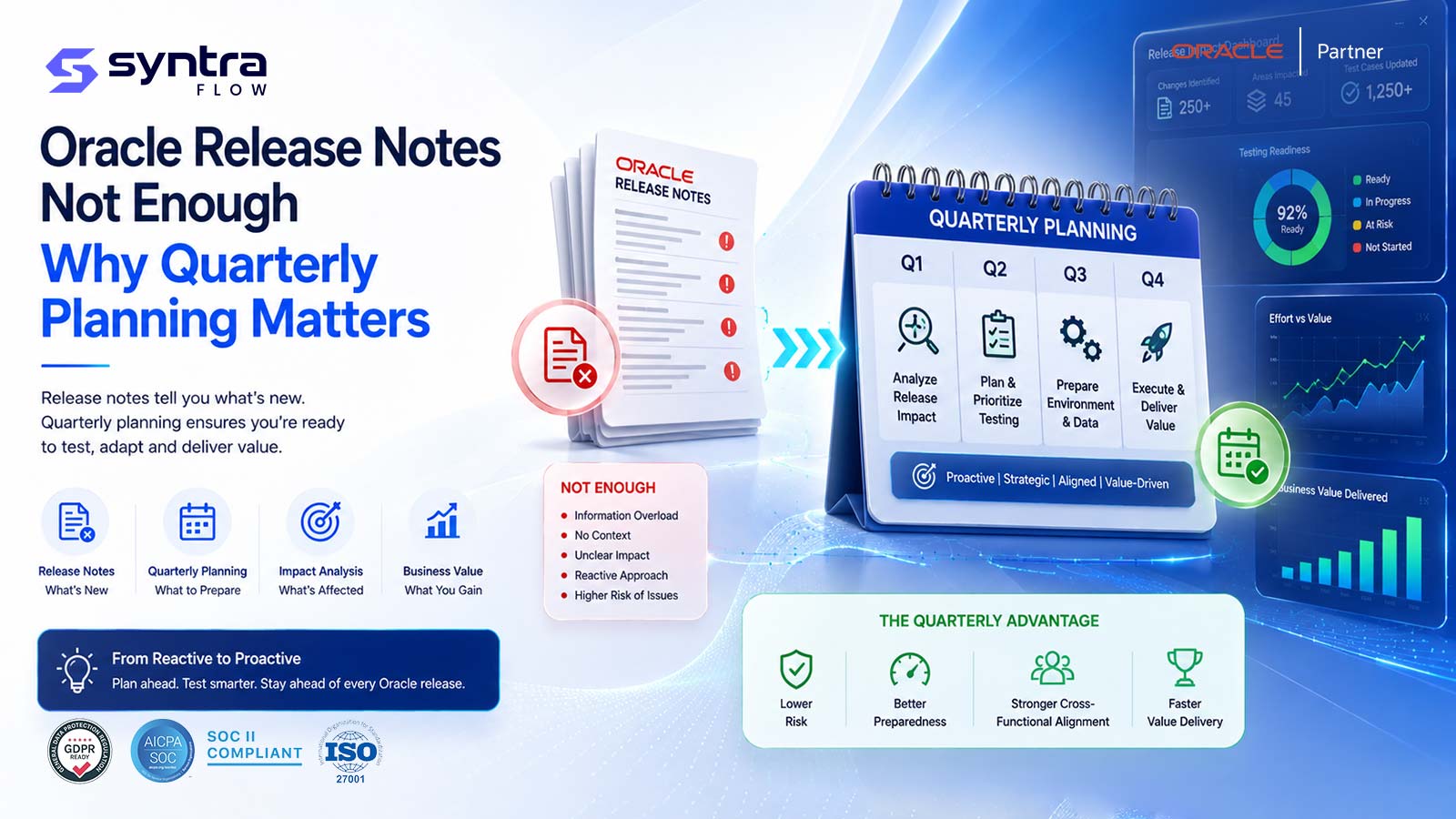
Oracle release notes tell you what changed in the product. They do not tell you what changed for you. That distinction is the single most important thing an Oracle Fusion release or QA manager can internalise before each quarterly update, because release notes describe a global feature list published for every customer on the same code line — while your actual risk lives in your configuration, your personalizations, your role design, your integrations, and the specific business processes your organisation runs. Planning a quarterly update from the readiness documents alone means testing against a generic map instead of your own territory, and that gap is exactly where the surprise defects, blocked go-lives, and post-update fire drills come from.
This guide explains precisely what Oracle release notes do and do not give you, why a "global change list" is not the same thing as "your risk," what it costs to plan from notes alone, and how a release intelligence approach closes the gap by mapping each announced change to your configuration, your roles, and your processes — and then to a targeted test plan. It is written for the person who owns the quarterly update: the release manager assembling a test scope, the QA lead deciding what to regress, and the functional owner signing off that the update is safe to promote to production.
Last reviewed: 19 July 2026
In this guide
- What Oracle release notes do give you (and their real value)
- The gap: what release notes cannot tell you
- Why a "global change list" is not "your risk" — a worked example
- The cost of planning from notes alone
- What closes the gap: release intelligence
- Release notes vs release intelligence — comparison table
- A risk-mapping framework you can run this quarter
- The release planning worksheet
- How SyntraFlow helps
What Oracle release notes do give you (and their real value)
Let us be clear up front: Oracle's readiness material is genuinely good, and this guide is not an argument for ignoring it. The Oracle Fusion Applications Readiness (What's New) documentation is the authoritative, first-party source of truth for every quarterly update, and any planning process that skips it is building on sand. Read it first, fully, and early. The point of this guide is that reading it is necessary but not sufficient.
Here is what the release notes and the wider readiness package reliably deliver:
- The complete inventory of what changed in the product. Every new feature, every changed behaviour, every retirement, organised by product pillar (Financials, HCM, SCM, CX) and by module. This is the raw material for any scoping exercise.
- Enablement classification. Oracle flags whether a feature is enabled automatically, requires opt-in, or is delivered but off by default. This is one of the most useful signals in the whole package, because "automatically enabled" changes are the ones that can alter your users' experience whether or not anyone on your team clicks a thing.
- Feature descriptions, screenshots, and business benefit. Enough functional detail to understand what a feature is meant to do and roughly how it behaves.
- Actions and considerations. Oracle often notes setup steps, role or privilege implications, and dependencies you should be aware of. These are hints toward impact — but they are written for the general customer, not for your tenant.
- Timing and the update calendar. Which release a feature lands in, the maintenance windows, and — critically — mandatory changes with hard deadlines, such as feature retirements you cannot defer.
All of that is real value. The release notes answer the question "what is Oracle changing?" with authority and completeness. The trouble begins the moment you try to use that answer to build a test plan, because a test plan has to answer a different question: "what will break, or need re-validating, in our environment?" Nothing in a global, customer-agnostic document can answer that, because the document has no knowledge of your tenant. It cannot — it is the same file every customer downloads.
The gap: what release notes cannot tell you
The gap between "what changed in Oracle" and "what changed for us" has five concrete dimensions. Each one is a category of information that exists only inside your environment and therefore can never appear in a release note. Together they define your actual, tenant-specific risk surface.
1. Your configuration and setup
Oracle Fusion is a configuration platform. Two organisations on the identical release can behave completely differently depending on how they have set up their enterprise structures, ledgers, business units, chart of accounts, payment terms, approval rules, descriptive and extensible flexfields, workflow configurations, tax setups, and thousands of other options. A release note that says "the Payables invoice approval workflow now supports an additional routing attribute" is neutral text — until you overlay it on your approval configuration, at which point it might be irrelevant, mildly useful, or a direct collision with a custom rule you built three years ago. The release note cannot know which, because it has never seen your configuration. Understanding that overlay is precisely the job of configuration intelligence — maintaining a live picture of how your tenant is actually set up so a change can be assessed against it.
2. Your personalizations and extensions
Page personalizations (Page Composer / VB Studio changes), sandboxes, custom objects, autocomplete rules, custom UI expressions, and integration-driven page behaviours are all yours, and none of them are visible to a release note. A change to an underlying page structure or a Redwood page redesign can silently invalidate a personalization or a custom validation. Oracle will tell you the page changed; it will not — and cannot — tell you that your specific personalization on that page now behaves differently, because it does not know your personalization exists. Personalizations are also the classic source of "it worked in the test note walkthrough but broke in our tenant" surprises.
3. Your roles and security
Quarterly updates frequently touch the security model: new duty roles, new privileges, changed privilege-to-duty mappings, retired aggregate privileges, and data security policy adjustments. Because most organisations run custom job roles built by copying and modifying Oracle's delivered roles, a change Oracle makes to a delivered role or privilege does not automatically flow into your copies — and sometimes it should. The release note describes the delivered-role change. It cannot tell you whether your custom "AP Manager – EMEA" role now over-grants or under-grants access as a result, whether a new privilege needs to be added to keep a function working, or whether a segregation-of-duties conflict has been introduced. That analysis depends entirely on your role inheritance, which lives only in your tenant.
4. Your integrations
Your inbound and outbound interfaces — payment file formats, bank integrations, tax engines, boundary applications, custom REST/SOAP consumers, BI Publisher extracts, FBDI/HDL loads, and OIC flows — sit at the seams of the application, and quarterly updates can change the fields, web service payloads, or file structures those integrations depend on. A release note may mention a web service enhancement in passing; it will not tell you that your specific outbound payment extract will now include a reordered column, or that a REST resource your middleware calls has a changed attribute. Integration regressions are especially dangerous because they often fail silently in the UI and only surface downstream, in a bank rejection or a reconciliation break, days after go-live.
5. Your specific business-process usage
Two customers can license the same modules and use them in radically different ways. One runs a high-volume, low-touch Procure-to-Pay flow with heavy automation; another runs a manual, approval-heavy process with three levels of review. A change to invoice matching tolerances, receipt accounting, or approval routing lands very differently on those two organisations. Release notes describe the feature; they cannot weight it by how central that process is to your operation, how much transaction volume flows through it, or how much a defect there would hurt. Materiality is a property of your business, not of the product.
And therefore: your actual risk
Risk is the product of all five dimensions above, and none of them are in the release notes. Your actual risk for a given quarterly update is a function of which announced changes intersect your configuration, personalizations, roles, integrations, and high-materiality processes. A release with two hundred line items might carry almost no risk for you if none of those items touch anything you use or have customised — or a release with only a handful of relevant items might be high-risk because one of them collides with your most business-critical, most-personalised, most-integrated process. The number of changes in the release note tells you nothing about your risk. Only the intersection does. That is why "read the notes and test the new features" is not a risk-based plan — it is a proxy that can easily over-test what does not matter and under-test what does.
Why a "global change list" is not "your risk" — a worked example
Let us make this concrete with an illustrative mapping. Imagine a single, plausibly-worded line from a quarterly readiness document for Payables:
"Invoice approval routing now supports an additional approver attribute, and the delivered Accounts Payable Manager role includes a new privilege to manage routing rules. Automatically enabled."
Read at face value, that is one feature. But watch what happens when you map that one line against a mid-sized organisation's actual environment. The single global change fans out into several distinct, tenant-specific risk items — none of which the release note could have predicted:
| Your environment fact | Why the "one" change actually matters here | Resulting risk item to test |
|---|---|---|
| You run a custom "AP Manager – EMEA" job role copied from the delivered role two years ago. | The new privilege is added to the delivered role, not your copy — so your managers may silently lack the new routing-rule capability. | Verify the custom role's privilege set; decide whether to add the new privilege; re-test AP Manager access. |
| You built a custom approval rule in AP that routes high-value invoices by cost centre. | A new routing attribute can interact with — or be overridden by — your existing rule logic in ways the note does not describe. | Regression-test the full approval routing matrix against representative invoices, not just the new attribute. |
| Your outbound approvals feed a middleware notification integration. | A changed routing/approval payload could alter or add a field your integration consumes. | Validate the approval notification integration end to end. |
| The AP approval page carries a Page Composer personalization hiding a field for one business unit. | "Automatically enabled" page changes can reset or conflict with personalizations. | Re-verify the personalization renders and behaves for the affected business unit. |
| Payables is your highest-volume, most business-critical process. | Materiality is high, so even a low-probability regression carries high impact — this deserves priority test coverage. | Elevate the whole item to high priority in the test plan and add extra scenario coverage. |
One line in the global change list became five tenant-specific risk items spanning roles, custom configuration, integrations, personalizations, and process materiality. Now the counterfactual: a different organisation on the identical release, using only delivered roles, with no custom approval rules, no relevant integration, no personalization on that page, and low Payables volume — for them, that same line is close to a non-event. Same release note, radically different risk. This is the whole argument in one example: the release note is the input, but your risk is a function of the mapping, and the mapping only exists in your environment. (The scenario above is illustrative — do not treat it as a description of any specific Oracle feature; confirm the actual behaviour of any change against Oracle's current readiness material.)
The cost of planning from notes alone
When the only input to your quarterly plan is the release notes, teams tend to fall into one of two failure modes, and both are expensive.
Failure mode one: over-testing. Anxious about the unknown, the team decides to "just regress everything." Full regression on every quarterly update sounds safe, but it is slow, costly, and — because it is undifferentiated — it buries the genuinely high-risk changes in a sea of low-value re-testing. It also does not scale: with four updates a year, a full-regression-every-quarter posture consumes an enormous share of the QA calendar and still may miss the personalization or integration edge case, because breadth is not the same as depth on the risky items.
Failure mode two: under-testing. Pressed for time, the team tests only the features Oracle flagged as new, assumes everything else is unchanged, and promotes to production. This is where the silent regressions live — the changed integration payload, the reset personalization, the custom role that quietly lost a privilege — none of which were "new features" to test, all of which were downstream consequences of changes the team read about but never mapped to their own environment.
The following figures are illustrative — planning placeholders to show the shape of the cost, not measured benchmarks or SyntraFlow performance claims. Substitute your own numbers before making any decision.
| Cost driver (illustrative) | Notes-only, over-test posture | Notes-only, under-test posture | Risk-mapped posture |
|---|---|---|---|
| Test effort per update | Very high — broad regression regardless of relevance | Low — only new features touched | Focused — effort concentrated on mapped, high-materiality risk |
| Chance of a silent regression reaching production | Moderate — breadth without depth on risky items | High — downstream impacts never tested | Lower — impacts traced to config, roles, integrations |
| Post-update firefighting | Occasional — but expensive scramble when it hits | Frequent — recurring surprises each quarter | Rare — surprises pre-identified as risk items |
| Confidence at sign-off | False confidence (tested a lot, but not the right things) | Low — hope-based sign-off | Evidence-based — coverage tied to identified risk |
The hidden cost in both notes-only postures is the same: effort is decoupled from risk. Over-testing spends effort where there is no risk; under-testing leaves risk where there is no effort. The goal is to make effort track risk — and that requires an input the release notes cannot provide. For a deeper treatment of why breadth-first regression specifically misses update risk, see our companion analysis of why traditional regression misses Oracle quarterly update risks.
What closes the gap: release intelligence
"Release intelligence" is the discipline of turning a generic release note into a tenant-specific test plan. It does not replace the release notes — it consumes them. It takes each announced change as an input and adds the one thing the notes lack: a model of your environment. The output is not "here is what Oracle changed," but "here is what changed for you, here is what it touches, and here is what to test." A mature Oracle release intelligence practice does four things the readiness documents cannot.
- Impact analysis mapped to your environment. Every relevant change is traced to the specific configuration, personalizations, custom roles, integrations, and business processes it could affect in your tenant — the intersection we discussed above, computed rather than guessed.
- Prioritisation by materiality, not by count. Changes are ranked by the combination of likelihood-of-impact and business criticality, so the team's finite time flows to the items that actually matter, not to whichever module happened to have the most release-note lines.
- Targeted regression. The impact map drives the test scope directly: only the affected areas are regressed, but they are regressed thoroughly, including the downstream integration and personalization checks that a feature-only plan would skip. This is the essence of Oracle quarterly patch testing done well, and it is where a purpose-built Oracle regression testing tool earns its keep.
- Evidence for sign-off. The output is auditable: a traceable line from each announced change, to the environment objects it touched, to the tests that validated them, to the results. That is what turns "we think it's fine" into a defensible release decision — and it doubles as your quarterly audit trail.
Increasingly, this analysis is accelerated with AI: parsing the readiness content, classifying changes, and proposing the likely impact map for a human to review. Our overview of AI-assisted release intelligence explains how that assistance works and — importantly — where a human release owner still has to make the call. And for a running, quarter-by-quarter view, the Release Advisory tracks what is changing and what to prepare for, including the current 26C quarterly update details.
Release notes vs release intelligence — comparison table
The two are not competitors; they are sequential. Release notes are the authoritative input, and release intelligence is the tenant-specific analysis layered on top. The table makes the division of labour explicit.
| Dimension | Oracle release notes (readiness) | Release intelligence |
|---|---|---|
| Question answered | What did Oracle change in the product? | What changed for us, and what must we test? |
| Scope | Global — identical for every customer | Tenant-specific — unique to your environment |
| Knows your configuration | No | Yes — mapped to your setup |
| Knows your personalizations | No | Yes — flags collisions and resets |
| Knows your custom roles | No — describes delivered roles only | Yes — traces impact into inherited custom roles |
| Knows your integrations | No | Yes — identifies affected interfaces |
| Prioritisation basis | Feature list, module grouping | Impact likelihood × business materiality |
| Output | Feature descriptions and enablement flags | A targeted, prioritised test plan with evidence |
| Supports audit sign-off | Partially — reference only | Yes — traceable change-to-test evidence |
A risk-mapping framework you can run this quarter
You do not need a platform to start thinking this way — you need a repeatable mapping. The framework below turns each release-note change into a test decision through a fixed chain: change → affected configuration / roles / process → test. Run every relevant change in the readiness document through these five steps.
- Filter for relevance. Discard changes to modules and features you do not license or use. Keep everything that touches a module you run — including "off by default" items, because you may choose to enable them, and especially "automatically enabled" items, because you may not get a choice.
- Map to environment objects. For each surviving change, ask: which of my configurations, personalizations, custom roles, integrations, and business processes could this touch? Write them down explicitly. If the answer is genuinely "none," record that too — a documented "no impact" is a valid, auditable outcome.
- Score impact and materiality. Rate each mapped item on two axes: likelihood the change affects it (low / medium / high) and business criticality of the affected process (low / medium / high). The product of the two is your priority.
- Derive the test. For each prioritised item, specify the test: the scenario(s), the data, the roles to test as, and the downstream checks (integration output, personalization render, SoD position). A change to a role implies a security re-test; a change near an integration implies an end-to-end interface test; a change to a process implies a business-flow regression.
- Capture evidence. Record the result against the change, so the finished artefact reads as a chain: this change, touched these objects, was validated by these tests, with these results. That artefact is your sign-off evidence and your audit trail.
| Change (from release note) | Affected config / role / process | Impact × materiality | Test to run |
|---|---|---|---|
| New privilege added to a delivered Financials role | Custom job roles inheriting from it; SoD ruleset | Med × High | Role/privilege diff; access re-test; SoD conflict check |
| Changed field on an outbound extract or REST resource | Middleware / boundary integration consuming it | High × High | End-to-end interface test with payload validation |
| Redwood page redesign for a transaction page | Page Composer / VB Studio personalizations on it | Med × Med | Personalization render + behaviour verification |
| Automatically-enabled change to an approval workflow | Custom approval rules; high-volume approval process | High × High | Full approval-matrix regression on representative data |
| New feature in a module you license but rarely use | Minimal — low-volume, no customisation | Low × Low | Single happy-path smoke test (or documented deferral) |
Notice what the framework does: it makes "no test needed" a deliberate, recorded decision rather than an oversight, and it makes "high priority" a consequence of the mapping rather than a gut feel. That is the difference between a plan and a to-do list. For a ready-made pre-flight version of this, pair the framework with our Oracle quarterly release readiness checklist.
The release planning worksheet
To help teams operationalise the framework above, we maintain a Release Planning Worksheet — a structured template that walks a release owner through the change → environment → priority → test → evidence chain for each item in a quarterly update, with columns for enablement type, mapped objects, the two-axis score, the derived test, and the sign-off result. It is designed to be filled in alongside the Oracle readiness document at the start of each quarter and to become the audit artefact at the end of it.
The worksheet is available on request — we do not host it as an anonymous download, because the most useful version is the one tailored to your modules and environment. If you would like a copy to adapt for your own quarterly process, request it via a short demo and we will walk through how to apply it to your last (or next) update.
How SyntraFlow helps
Everything above can be done by hand — and for a small, stable environment it may be enough. The reason teams reach for tooling is that the mapping is laborious to build and even harder to keep current as your configuration, roles, and integrations drift between updates. This is the specific gap SyntraFlow is built to help with.
SyntraFlow can be configured to connect the three layers this guide has kept separate: the release-note change, the impact on your configuration, roles, and processes, and the resulting test plan. In practice, that means it helps organisations assess each quarterly update against a live picture of their own tenant — using configuration intelligence to know what your setup actually is, release intelligence to map announced changes onto it, and the Oracle ERP testing engine to execute the targeted regression the map calls for. The output is intended to be evidence-bearing: a traceable link from change to impact to test to result.
A few deliberate cautions. SyntraFlow does not replace Oracle's readiness documentation — it consumes it, and you should always confirm the behaviour of any specific change against Oracle's current material. It does not automatically test every feature or guarantee that no regression escapes; no tool can, and any vendor that says otherwise is selling false confidence. What it can do is help a release owner move from a generic change list to a prioritised, tenant-specific, evidence-backed test plan far faster than a manual mapping allows — and keep Oracle's own AI capabilities (which live in your Fusion applications) distinct from the independent testing and analysis layer that validates them.
Oracle release notes are the right place to start every quarterly update. They are simply the wrong place to stop. The work that protects your production environment happens after the notes: in the mapping from a global change to your specific risk, and from that risk to a test plan you can sign off with evidence rather than hope. Turn Oracle release notes into a targeted test plan — schedule a demo to see the change-to-impact-to-test mapping applied to your environment, and to request the Release Planning Worksheet.
Official Oracle references
- Oracle Fusion Applications Readiness (What's New home) — the authoritative first-party source for every quarterly update.
- Oracle Fusion Applications AI — Oracle's own AI and agentic capabilities within Fusion.
- Oracle Fusion AI — key capabilities (Oracle documentation).