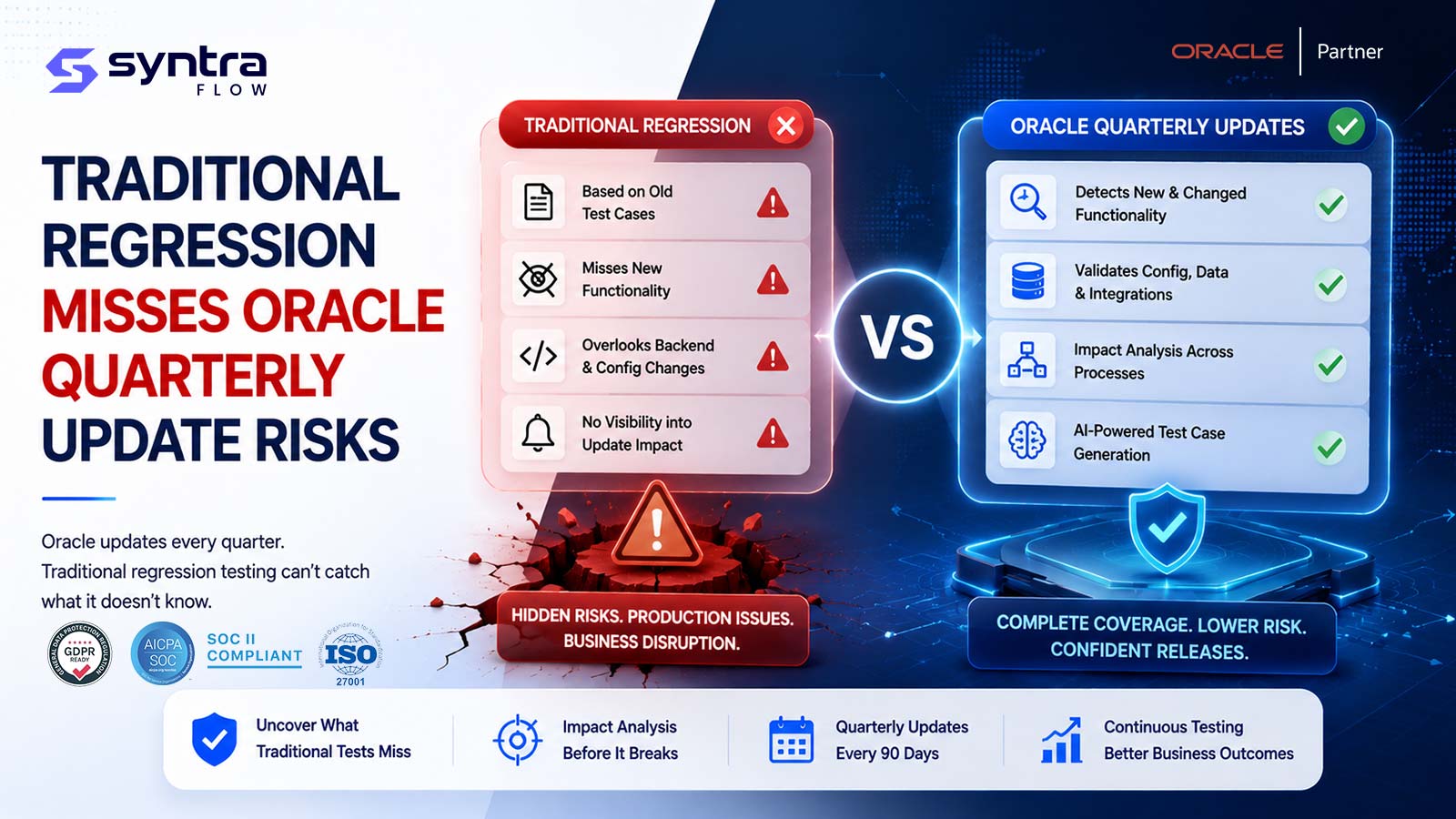
Traditional Oracle regression testing misses critical quarterly-update risks because it validates screens and scripts, not the layers where Oracle's quarterly releases actually change: configuration, AI agents, REST integrations, the Redwood interface, and scheduled background processes. A UI-recorded, script-based suite passes cleanly while a changed tax setup, a new agent action surface, a modified API contract, a re-generated Redwood selector, or an altered ESS job silently reshapes how transactions post. The gap is not that teams run bad tests; it is that the tests were designed for a world where the application changed once or twice a year, not one where Oracle ships four feature-bearing releases annually. This guide breaks down the five change categories a conventional regression approach systematically under-covers, what each one costs when it slips through, and how a configuration-aware, release-driven approach closes the gap.
Last reviewed: 19 July 2026
In this guide
- How traditional Oracle regression works today (and why it feels sufficient)
- The five blind spots traditional regression misses
- Risk matrix: change category to business impact
- The cost when it's missed: illustrative worked examples
- What closes the gap: config-aware, release-driven, risk-based regression
- How SyntraFlow works
If you are an Oracle QA lead or release manager who suspects your regression approach has blind spots, that suspicion is well-founded — and this pillar is written to help you locate them precisely rather than replace your program wholesale. It sits above two companion pieces you may already know: what regression testing means for Oracle ERP in 2026, which covers the fundamentals, and a continuous regression strategy built around quarterly updates, which covers the operating model. Rather than repeat either, this guide concentrates on one question: which categories of change slip past a conventional suite, and what does it cost you.
How traditional Oracle regression works today (and why it feels sufficient)
Most Oracle Fusion regression programs are built on one of three foundations, often a mix of all three. Understanding how each one works explains exactly where its coverage stops.
Script-based automation
A test engineer writes an automated script that drives a business process end to end — enter a supplier invoice, match it to a purchase order, approve it, confirm the accounting. The script encodes a fixed sequence of steps and a set of assertions about what the screen should show. It runs fast, runs unattended, and gives a green result when the flow behaves as recorded. The coverage boundary is the script author's imagination at the time of writing: the script exercises the paths someone chose to encode, under the configuration that existed when they encoded them.
UI-recorded playback
A recorder captures a user clicking through a process and replays those clicks. It is quick to produce and requires little coding, which is why so many Oracle suites lean on it. But recorded tests are bound tightly to the interface as it looked during recording — the field positions, the element identifiers, the page flow. When Oracle re-generates a page under the Redwood user interface, recorded playback is the most brittle foundation of the three.
Static test suites maintained by hand
Many teams run a curated library of manual or semi-automated test cases, updated by a QA analyst each cycle based on the release notes they read and the areas they judge to be at risk. This is often the most thoughtful of the three approaches, but it depends entirely on human interpretation of what changed — and Oracle's quarterly readiness material is large, and the parts that matter to your specific configuration are not flagged for you.
All three feel sufficient for an understandable reason: they pass. Quarter after quarter, the suite runs green, the release goes live, and nothing visibly breaks in the first week. That track record builds confidence. But a green suite proves only that the paths you tested behaved as you expected — it says nothing about the paths you did not think to test, or the layers your tests never touch. Oracle's quarterly model changes far more than the screens your scripts click. The releases move configuration defaults, extend AI agents, revise API contracts, re-render the UI, and adjust background processing. A suite anchored to recorded screen flows is, by construction, blind to most of that surface. The sections below name the five specific categories where that blindness bites.
The five blind spots traditional regression misses
Across the Oracle Fusion teams we speak with, the changes that cause post-update incidents cluster into five categories. None of them is exotic. Each is a routine part of how Oracle now delivers software — and each is systematically under-covered by script-based, UI-recorded, static regression.
1. Configuration changes
This is the blind spot that catches the most experienced teams off guard, because it is invisible to a functional test that passes. Oracle quarterly updates can introduce new setup options, change default values, deprecate features, and shift the behaviour of existing configuration. Separately, your own team continually changes setup between releases — tax rules, approval hierarchies, payment terms, descriptive flexfields, business unit assignments. A regression script that enters an invoice and confirms it posts does not verify that the tax determination behind that posting still resolves the way it did last quarter. The screen looks identical; the number underneath is different.
Traditional regression misses configuration change for a structural reason: it tests transactions, not the setup that governs them. To catch a configuration risk you have to compare the configuration itself — what it was before the update, what it is after, and which processes depend on the deltas. That is a different discipline from replaying a transaction, and it is the core of configuration intelligence: detecting drift, comparing environments, and mapping which changed settings touch which business flows so testing can be pointed where the setup actually moved.
2. AI agents and agentic applications
This is the newest and fastest-growing blind spot, and traditional regression has essentially no coverage of it. Oracle has been steadily embedding autonomous and semi-autonomous agents into Fusion. Oracle AI Agent Studio has been generally available since release 25C; Financials AI agents — spanning Ledger, Payables, Payments, and Expenses — reached general availability in 26B alongside a broader Fusion agentic applications wave that Oracle describes as "more than 20" specialized agents operating within existing Fusion permissions, policies, and approvals. Document IO gen-AI invoice ingestion became a Payables default in 26B, and Agent2Agent coordination arrived in 26C.
These agents introduce a new autonomous action surface: software that takes decisions and actions on your data rather than waiting for a user to click. A UI-recorded regression script has no concept of this. It cannot assert that an agent's recommendation falls within an acceptable policy envelope, that it respects your approval limits, or that a quarterly change to the agent's behaviour has not shifted outcomes on live transactions. Because agents are probabilistic and evolve, the deterministic "input A must yield output B" assertion at the heart of legacy scripting either fails spuriously or gets weakened until it validates nothing. Testing this surface is a distinct discipline covered in depth on Oracle AI agent testing and testing Oracle agentic applications. If your regression program does not yet have a named approach for it, that is a blind spot growing every release.
3. REST APIs and integrations
Most Oracle Fusion instances are not islands. They exchange data with banks, tax authorities, procurement platforms, expense tools, middleware, and custom applications through REST APIs and file-based integrations. Oracle quarterly updates can add fields, change payload structure, adjust validation, alter default behaviour, and occasionally deprecate endpoints. A UI-driven regression suite runs entirely through the browser and never exercises the API layer at all — so an integration contract can change under it without moving a single assertion in the suite.
The exposure here has grown because Oracle's own AI now reaches through the API layer too: MCP tools, external REST tools, and REST-API agent access arrived in 26A, meaning agents can be invoked and can act through integration channels documented on the Oracle AI agent REST API. An integration that silently starts returning a differently shaped response, or an outbound payment file whose format shifts by one field, does not throw a red flag on a screen. It fails downstream — at the bank, at the tax authority, in the reconciliation — days later, where it is expensive to trace. Regression that stops at the UI cannot see any of it.
4. Redwood UI changes
Oracle is progressively moving Fusion to the Redwood user interface, and this is where UI-recorded regression is most acutely exposed. Redwood re-renders pages with a different structure, and the underlying element identifiers that recorded tests depend on can change between releases. A test bound to a brittle selector — an XPath or a generated ID captured during recording — breaks when Oracle regenerates the page, even though the business process itself is unchanged.
There are two failure modes here, and both are costly. In the first, the selector breaks and the test fails loudly; the team spends the release window re-recording scripts instead of testing risk — maintenance churn masquerading as coverage. In the second, more dangerous mode, the selector still resolves but now points at the wrong field or a changed control, so the test passes while validating the wrong thing. Which changes actually break automation, and how to build against them, is the subject of Redwood UI changes that break Oracle test automation. The structural point for this guide: a regression foundation built on recorded selectors treats Redwood's rhythm of UI change as a perpetual maintenance tax rather than a risk to be tested for.
5. ESS and scheduled processes and background jobs
A large share of what Oracle Fusion actually does happens away from any screen, in Enterprise Scheduler Service (ESS) jobs and background processing: payment process requests, payroll runs, invoice import, interface and extract jobs, accounting creation, revaluation, and period-close programs. These run on schedules or triggers, produce output files and postings, and are governed by parameters and configuration rather than clicks. A regression suite built around interactive screen flows rarely touches them — and when it does, it usually confirms only that a job can be submitted, not that its output is correct after a release.
This is a blind spot precisely because the work is invisible in the UI. A quarterly update can change a scheduled process's parameters, defaults, output format, or the accounting logic it applies, and a screen-driven regression run will never notice. The failure surfaces in an output file, a reconciliation, or a close task — again, downstream and delayed. Covering background processing means treating jobs and their outputs as first-class test targets with their own assertions, not as a step you happen to trigger from a screen.
Risk matrix: change category to business impact
The table below consolidates the five blind spots into a single view: what changes, why a traditional regression approach misses it, and the business impact when it slips through. Use it as a coverage checklist — for each row, ask whether your current suite has a real test that would catch that change, or only a screen flow that would pass regardless.
| Change category | Why traditional regression misses it | Business impact when missed |
|---|---|---|
| Configuration changes Tax rules, defaults, approval hierarchies, flexfields, deprecated setup |
Tests replay transactions, not the setup governing them; the screen looks identical while the value underneath changes | Mis-postings, wrong tax, broken approvals, and reconciliation breaks that surface after go-live |
| AI agents and agentic apps Autonomous actions, changed agent behaviour across releases |
No concept of an action surface; deterministic assertions can't validate probabilistic, evolving decisions within a policy envelope | Actions taken outside policy or approval limits; unmonitored decision drift on live transactions |
| REST APIs and integrations Payload, field, validation, and endpoint changes |
UI-driven suites never exercise the API layer; contract changes move no on-screen assertion | Failed or malformed exchanges with banks, tax authorities, and middleware — traced late and downstream |
| Redwood UI changes Re-rendered pages, changed element identifiers |
Recorded tests bind to brittle selectors; they break loudly, or worse, resolve to the wrong field and pass | Release windows lost to re-recording; false confidence from tests that validate the wrong control |
| ESS and scheduled processes Job parameters, defaults, output format, accounting logic |
Screen-driven suites don't touch background jobs, or confirm only submission, not output correctness | Wrong payment files, payroll output, or period-close results discovered in reconciliation, not testing |
A recurring pattern runs down the right-hand column: the impact is almost always downstream and delayed. None of these changes announces itself with a red screen during the test run. They surface later — in a bank rejection, a reconciliation break, a close that will not balance — which is exactly why a green regression suite can coexist with a serious post-update problem. The next section puts numbers on that, illustratively.
The cost when it's missed: illustrative worked examples
The examples below are illustrative. They use hypothetical volumes and rates to show how a missed change propagates into cost — they are not customer results, benchmarks, or claims about any specific organization. Every figure is a placeholder you should replace with your own transaction volumes and rates. The purpose is to make the mechanism concrete: how a change that a screen-driven suite passes over turns into money, effort, and risk.
Invoice matching (Payables)
Suppose a quarterly update shifts a matching tolerance default or a Document IO ingestion behaviour, and invoices that previously routed to a human now auto-approve within a slightly wider band. A UI regression test that enters one invoice and sees it post cleanly passes. Illustratively, if 8,000 invoices flow through in a quarter and even a small fraction match incorrectly, the cost is not only the value of the individual discrepancies but the AP analyst hours to detect, investigate, and reverse them — and the supplier-relationship cost of clawing back an overpayment. The regression run showed green throughout.
Supplier payments (background job)
Suppose a change alters the output format of a payment process request — a field position, a padding rule, a header — in the file sent to the bank. The screen-driven suite confirms a payment batch can be created and never inspects the file. Illustratively, a single payment run of a few hundred payments that the bank rejects on format triggers late-payment exposure, manual re-submission, treasury escalation, and, in the worst case, missed early-payment discounts across the run. The break was in a file no interactive test opened.
Payroll (scheduled process)
Suppose an update adjusts how a payroll calculation or a statutory element behaves, and the change lands in a scheduled run rather than an on-screen entry. A regression suite that verifies an employee record can be opened does not verify the run's output. Illustratively, an error affecting even a subset of a 3,000-employee population produces corrections, off-cycle runs, employee-relations effort, and potential statutory-reporting rework — a category where errors are both highly visible and time-critical. None of it is caught by a login-and-navigate test.
Tax (configuration)
Suppose tax determination logic or a rate default moves in a way that changes the tax computed on a class of transactions. The invoice still posts; the screen still looks right; the regression test still passes. Illustratively, tax applied incorrectly across a quarter's transactions can accumulate into a material misstatement and a filing exposure, and unwinding it means re-computing and, potentially, corrective filings. Because regulatory frameworks vary and change, the specifics should always be confirmed against current authority guidance — but the testing lesson is constant: a passing transaction test does not prove the tax underneath it is right.
Financial close (integrations and jobs)
Suppose a combination of the above — a changed extract format feeding a sub-ledger, plus an altered accounting-creation job — quietly changes what lands in the ledger. The individual screens all behave. Illustratively, the cost shows up at close: reconciliations that will not tie, a close timeline that slips by days, finance and audit hours consumed in tracing the difference, and pressure on reporting deadlines. This is the compounding case — where several missed categories intersect at the point of least tolerance for surprises.
The common cost drivers across all five are summarized below. Note how few of them are the face value of the error itself — most of the cost is in detection, correction, and downstream consequence, which is precisely what a delayed discovery amplifies.
| Cost driver | What it covers | Why late discovery makes it worse |
|---|---|---|
| Detection and investigation | Analyst and QA hours to notice a problem and trace it to a root cause | More transactions accumulate before anyone looks; the trail is colder |
| Correction and rework | Reversals, off-cycle runs, re-submissions, corrective filings | Volume already processed must be unwound rather than prevented |
| Downstream and third-party impact | Bank rejections, supplier and employee relations, tax authorities | External parties are already affected before you are aware |
| Compliance and audit exposure | Misstatement risk, filing corrections, audit scrutiny, control gaps | A period may already be reported before the error is known |
| Maintenance churn | Re-recording broken scripts each release instead of testing risk | Effort spent on the suite is effort not spent on actual coverage |
| Opportunity and timeline cost | Delayed close, missed discounts, slipped release windows | Deadlines compress as the problem eats into fixed calendars |
What closes the gap: config-aware, release-driven, risk-based regression
The answer is not "test everything, every release" — that is neither affordable nor faster to trust. It is to make the regression program aware of what actually changed, so testing is pointed at real deltas rather than replayed blindly. Three principles do most of the work.
Config-aware
Treat configuration as a tested object in its own right. Compare setup before and after an update, detect drift, and map which changed settings touch which processes. This is what closes the configuration blind spot directly, and it also feeds the others: knowing a tax rule or a job parameter moved tells you exactly which transactions and integrations to re-verify. It converts "we changed nothing we can see" into "here are the seventeen settings that moved and the flows they affect."
Release-driven
Anchor the cycle to Oracle's quarterly rhythm. Read each release's readiness content against your specific footprint — which agents you use, which APIs you integrate, which Redwood pages you depend on, which ESS jobs you run — and let that intelligence decide scope. This is the domain of release intelligence: turning Oracle's quarterly announcements and quarterly patch testing into a targeted, per-release test plan instead of a static suite you rerun unchanged.
Risk-based, with evidence
Follow the chain: impact analysis, then targeted tests, then evidence. Impact analysis identifies what changed and what it affects across all five categories. Targeted tests exercise those specific areas — including the API layer, the agents, the background jobs, and the Redwood pages, not only the screens. Evidence captures the result in a form an auditor or a controller can trust, so a green result means "these specific risks were checked," not merely "the paths we happened to record still run." A robust foundation for all of this is purpose-built Oracle regression testing that resolves Redwood elements resiliently, so coverage is not lost to selector churn every release.
Available on request: the five-category regression gap assessment
We maintain a structured checklist that walks your current suite against all five blind spots — configuration, agents, APIs, Redwood, and scheduled processes — with a scoring rubric to locate where your coverage actually stops and a template test-plan for closing each gap. The site does not host it as a download; request a copy and a walkthrough of your specific Oracle footprint through the demo scheduler below.
How SyntraFlow works
SyntraFlow can be configured to operate on exactly these three principles, which is why it is built around Oracle's quarterly model rather than bolted onto it. It helps organizations connect release intelligence with test planning — reading each quarterly release against your configuration and integration footprint to assess which of the five categories carry risk this cycle, then narrowing scope to those areas rather than rerunning a static suite. It can connect configuration comparison with test selection, so a detected setup drift points directly at the transactions and jobs that need re-verification.
On the execution side, SyntraFlow can be configured to test beyond the screen — exercising REST integrations and background processing as first-class targets, resolving Redwood elements resiliently to reduce selector churn, and validating AI-agent behaviour against defined policy envelopes rather than brittle single-value assertions. It captures results as evidence for audit and release sign-off. To be clear about the boundaries: SyntraFlow does not test every possible change automatically, does not replace human judgment about business risk, and does not guarantee that no defect will reach production — Oracle's own AI agents remain Oracle's, distinct from SyntraFlow's testing engine. What it offers is a way to make regression aware of the five categories a conventional suite is blind to, so your team spends the release window on real risk instead of maintenance churn.
Official Oracle references
- Oracle Fusion Applications AI
- Oracle Fusion AI — key capabilities
- Oracle Financials AI agents (26B documentation)
- Oracle Readiness / What's New
Release identifiers, agent availability, and feature defaults evolve each quarter; confirm current details against Oracle's readiness material for your environment before planning a cycle.
If your regression suite passes every quarter but you cannot say with confidence that it would catch a changed tax setup, a shifted agent decision, a modified API contract, a re-rendered Redwood page, or an altered ESS job, that is the gap this guide is about. Find the regression gaps in your Oracle quarterly-update testing — schedule a walkthrough and we will map your current coverage against all five categories on your specific Oracle footprint.