Oracle AI Governance and Risk Management
Oracle AI governance is the operating model an organization puts around its use of Oracle's AI agents and embedded AI features — who approves a use case, what risk tier it sits in, what controls apply before it reaches production, and how its behavior is monitored afterward. Oracle ships the AI capability; governing how it is adopted, approved, monitored and audited is the customer's responsibility.
This page sets out the governance framework and operating model — ownership, approval flow, risk classification, oversight and auditability. It is the framework-level companion to the Oracle AI hub: for the technical security controls behind that framework, see Oracle AI Security, and for assessing whether your organization is ready to adopt a given AI capability, see Oracle AI Readiness.
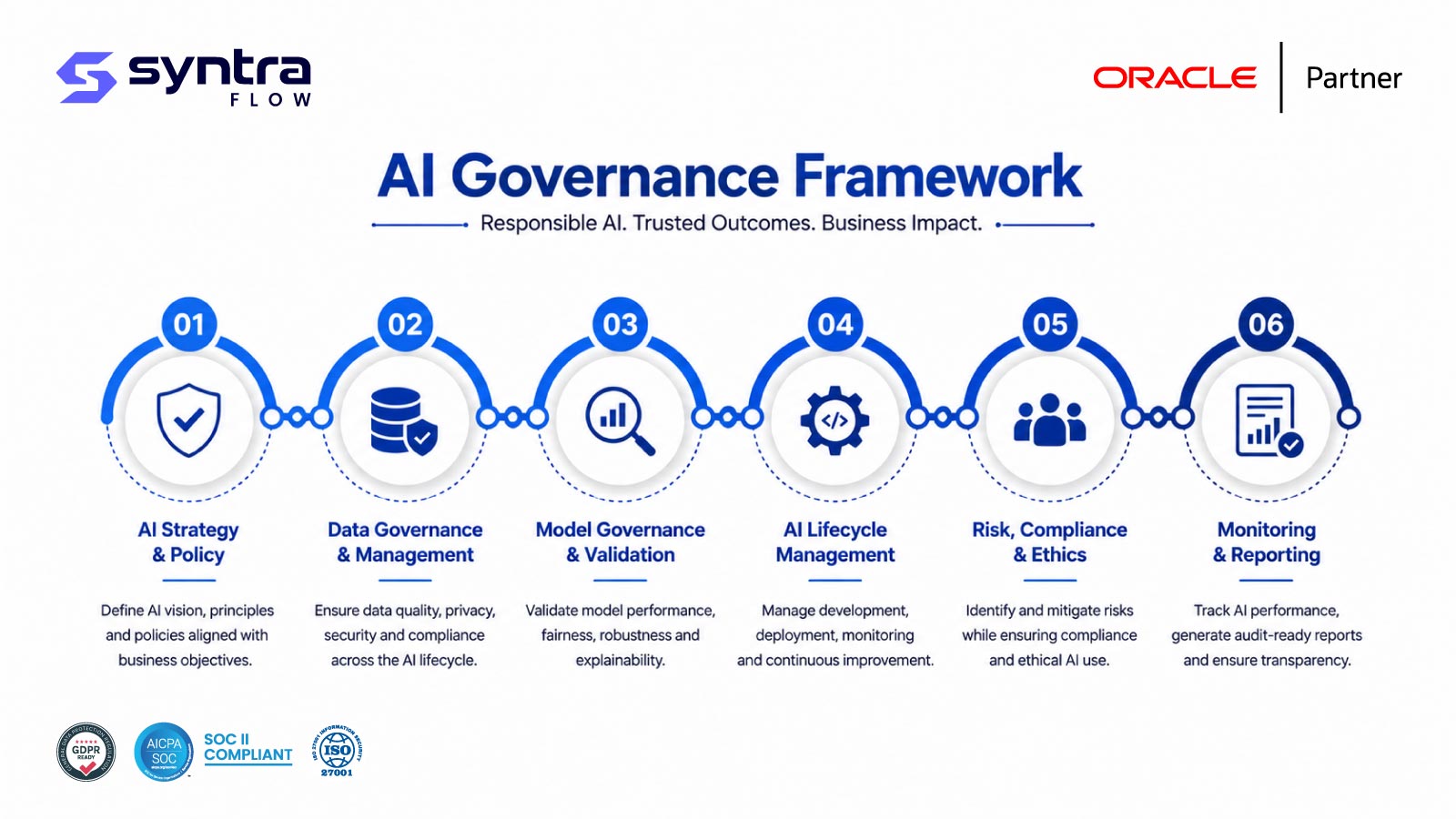
Governance Operating Model
A workable Oracle AI governance model has three layers. A strategic layer — a cross-functional committee spanning IT, finance, risk/compliance, security and the business — sets policy and reviews the AI use-case portfolio on a recurring cadence. An operational layer reviews individual use-case requests, runs pre-production testing, and tracks exceptions. A monitoring layer watches AI behavior and outcomes in production and feeds findings back to the strategic layer.
These layers do not need to be new organizational structures. Most organizations extend an existing change-advisory board, IT risk committee, or internal-controls/compliance function to cover Oracle AI. What matters is that the model is documented and applied consistently across every AI agent, embedded AI feature, and AI Agent Studio deployment — not just the ones a project team happens to flag.
Because Oracle expands its AI footprint with each quarterly update, the model also needs a defined entry point for new capability: a new agent or feature should not reach end users until it has passed the same approval and risk-classification steps as a use case the organization proposed itself. That release-triggered entry point is covered below under release governance.
Ownership and Accountability
Governance fails quickly when accountability is diffuse. A defensible model assigns clear ownership at three points: a business owner per AI use case, accountable for the outcome it produces; a technical owner, typically within the Oracle Cloud team, accountable for configuration and access; and a risk/compliance owner, accountable for confirming the use case was classified, approved and tested before go-live.
None of these three roles should be able to unilaterally approve and deploy an AI use case that also grants itself elevated transaction rights — that is a segregation-of-duties problem. Where an Oracle AI agent can initiate, approve, or release a transaction (an invoice, a journal, a payment run), the same segregation-of-duties discipline that governs human role design should extend to the agent's access. Organizations already running continuous SoD monitoring across Oracle Fusion can extend that same control set to AI agent roles — see SoD Intelligence.
A simple RACI mapped to each stage of the approval workflow — request, risk classification, testing, sign-off, monitoring — is usually enough to make ownership auditable without becoming bureaucratic.
AI Use-Case Approval
Every Oracle AI capability an organization intends to use in production — a specific AI agent, an embedded AI feature, or a custom agent built in AI Agent Studio — should pass through a defined approval gate before it touches live data or live processes. The intake typically captures the business process affected, the data it will read or write, whether it takes autonomous action or only recommends, the user population, and the proposed risk tier.
Approval should not be a one-time event. A practical workflow separates a pilot approval (limited scope, enhanced monitoring) from a production approval (full scope, standard monitoring cadence), so early experimentation is not blocked by the rigor required for enterprise-wide rollout.
Before approving a use case, most organizations benefit from a structured readiness check — confirming the data, process and organizational prerequisites are actually in place, rather than approving on paper and discovering gaps after go-live. That assessment is covered in detail on the Oracle AI Readiness page; this page assumes readiness has been assessed and focuses on the governance decision itself.
Risk Classification
Not every Oracle AI use case carries the same risk. A simple four-tier model, calibrated to autonomy and business impact rather than to the AI technology itself, works for most Oracle Fusion environments.
| Risk tier | Example use case | Required controls |
|---|---|---|
| Low / informational | AI-assisted search, internal knowledge lookup, natural-language reporting queries | Standard access control, usage logging, periodic policy review |
| Moderate | AI-drafted content for internal use — summarization, draft correspondence, first-pass analysis | Mandatory human review before external use, prompt/output logging, role-based access |
| Elevated | AI agent recommendations feeding transactional workflows — suggested invoice coding, forecast or reconciliation recommendations | Mandatory human approval step, segregation-of-duties review of approval rights, output validation testing, audit trail retained |
| High / restricted | AI agents with autonomous or semi-autonomous transactional actions in financial or HR processes | Formal use-case approval with committee sign-off, dual control, continuous monitoring, documented incident response plan, independent periodic testing |
Tiers and example use cases are illustrative. Organizations should calibrate their own thresholds — including which specific Oracle AI agents and embedded features fall into each tier — as part of the governance committee's policy work, not adopt this table as a fixed standard.
Data Governance
Oracle AI features operate on Oracle Fusion data — financial, HR, procurement and supply-chain records that already carry sensitivity and access restrictions under existing role-based security. Governance needs to confirm an AI agent's data access is scoped no more broadly than the human role it supports, sensitive fields are handled consistently with existing data-classification policy, and any data used to ground an AI feature is inventoried rather than assumed.
This page covers data governance at the policy level — what must be true before an AI feature is approved to touch a given data set. The technical controls that enforce it — access scoping, encryption, logging, and the security posture of AI agents and integrations themselves — are covered on Oracle AI Security, which this page defers to rather than duplicates.
Prompt and Agent Governance
Where users can write free-form prompts against Oracle AI features, or where AI Agent Studio is used to configure a custom agent, governance needs a review step for the instructions themselves, not only for the underlying data access. A prompt or agent configuration that directs the AI to take a specific action or follow a specific policy is effectively defining process behavior, and should be reviewed and version-controlled like any other process configuration.
Practical elements include a change log for agent instructions and system prompts, a review step before an agent's permitted actions are widened, and a clear owner for each custom agent — so an agent does not persist in production after the team that built it has moved on.
Guardrails against prompt injection, unauthorized instruction changes, and unsafe agent-to-system actions are technical security controls; they are addressed alongside the rest of the Oracle AI security posture on Oracle AI Security.
Human Oversight
Human oversight is the control that most directly determines whether an AI-driven error reaches a real business outcome. For any elevated or high-risk use case, governance should specify where a human must review or approve before an AI-generated recommendation or action takes effect, and where the AI may act without a human in the loop.
Oversight design should also address reviewer complacency — a known risk when an AI feature is usually correct. Sampling-based spot checks, periodic re-validation of AI output against manually derived results, and rotating review responsibility help keep oversight meaningful rather than nominal.
Confirming that an AI agent's actual behavior matches its approved, governed configuration — rather than assuming it does — is a testing activity. See Oracle AI Testing for how that verification is structured.
Auditability
An Oracle AI governance program is only as strong as the evidence it can produce after the fact. At minimum, an auditable program retains the use-case approval record and its risk tier, the data-access scope granted to the AI feature or agent, the prompt/agent configuration history, a log of AI-generated recommendations or actions and whether a human reviewed them, and the record of any incident and its resolution.
This evidence should be retained in a form an auditor can review without reconstructing it from ad hoc emails or tickets — ideally a single governance record per use case linking approval, risk classification, testing evidence, and the ongoing monitoring log.
SyntraFlow can be configured to help organizations connect testing evidence for Oracle AI features to that broader governance record — for example, retaining test results and validation history alongside the use-case approval so auditability does not depend on manually stitching evidence together after the fact.
Regulatory Considerations
This section is intentionally general. AI-related regulatory and compliance requirements vary by jurisdiction, industry and organization, and continue to evolve. This page does not identify specific laws, standards or frameworks as confirmed to apply to any given organization. Organizations should confirm applicable regulatory and compliance requirements with their own legal and compliance counsel before finalizing an Oracle AI governance policy.
In practice, most regulatory expectations around AI use converge on a similar set of questions regardless of jurisdiction: can the organization explain what the AI system does and why a given output was produced, can it show a human retained appropriate oversight, can it demonstrate the data used was handled appropriately, and can it produce evidence of all of the above on request. A governance program built around use-case approval, risk classification, human oversight and auditability addresses those questions directly, independent of which specific regime ultimately applies.
Requirements differ by industry and region, and AI-specific regulation remains an active, changing area. Treat this page as a governance framework to build on — not as legal or regulatory guidance, and not a substitute for confirming applicable requirements with qualified counsel.
Release Governance
Oracle ships AI capability on the same quarterly update cadence as the rest of Fusion — new or changed AI agents, embedded AI features, and AI Agent Studio functionality can appear, change behavior, or be enabled by default with each release. Governance needs a defined path for that change to flow through before it reaches production users, rather than letting an update silently expand what AI is doing in the environment.
A practical flow: review the quarterly release content for new or changed AI capability, assess whether it introduces a new use case or changes the risk profile of an existing one, re-classify if needed, test the change in a non-production environment, and only then allow it into production — on the same change-management timeline applied to other Oracle updates.
Tracking what AI-relevant content is actually in a given quarterly update is the starting point for this process. See Oracle AI Release Intelligence for how to identify AI-related changes in each Oracle release before they reach your environment.
Performance and Incident Monitoring
Approval and testing establish that an Oracle AI use case was appropriate at go-live; monitoring establishes whether it remains so. A monitoring plan should track output quality against a defined baseline, unexpected or out-of-scope agent actions, user override or rejection rates (a rising override rate is often the earliest signal of drift), and any access or data-handling anomaly.
An incident process should be defined before it is needed: who is notified when an AI agent takes an unexpected action or produces materially wrong output, how quickly access can be suspended, and how the incident feeds back into that use case's risk classification. High and elevated-risk use cases warrant a shorter monitoring review cycle than low-risk ones.
Ongoing validation that AI-driven Oracle processes still behave as approved — including after a quarterly update — is a testing discipline in its own right. See Oracle AI Testing for how that ongoing verification is structured, separate from the governance process that decides what gets monitored and how often.
Oracle AI Governance Checklist
A practical checklist for standing up or auditing an Oracle AI governance program, grouped by the stages covered on this page.
Foundational
- ✓AI governance committee named, spanning IT, risk/compliance, security and the business
- ✓Documented risk classification scheme calibrated to your own Oracle AI use cases
- ✓Ownership (business, technical, risk/compliance) assigned per AI use case
- ✓Segregation-of-duties review extended to AI agent access and approval rights
Per use case
- ✓Use case passed a documented approval gate before production go-live
- ✓Data access scoped and reviewed against existing data-classification policy
- ✓Prompt or agent configuration version-controlled with a named owner
- ✓Human oversight point defined for elevated and high-risk tiers
- ✓Pre-production testing evidence retained against the approved configuration
Ongoing
- ✓Quarterly Oracle updates reviewed for new or changed AI capability before production
- ✓Performance and override-rate monitoring in place, with review cadence by risk tier
- ✓Incident process exists, naming who is notified and how access is suspended
- ✓Applicable regulatory requirements confirmed with legal/compliance counsel and revisited periodically
Auditability
- ✓Each use case has a single governance record linking approval, risk tier, testing evidence and monitoring log
- ✓AI-generated recommendations or actions and human review decisions are logged
- ✓Incident history is retained and linked back to the affected use case's risk classification
Frequently Asked Questions
What is Oracle AI governance?
▼
Oracle AI governance is the operating model an organization uses to decide which Oracle AI agents and embedded AI features it will use, how each is risk-classified and approved, what human oversight applies, and how its behavior is monitored and audited over time. Oracle builds and ships the AI capability; governing its adoption is the customer's responsibility.
Who should own Oracle Fusion AI governance inside an organization?
▼
Most organizations extend an existing body — a change-advisory board, IT risk committee, or internal-controls/compliance function — rather than creating a new one. A business owner, a technical owner and a risk/compliance owner should be named for every AI use case, so accountability is not diffuse.
How do you classify Oracle AI risk?
▼
A practical model tiers use cases by autonomy and business impact rather than by the AI technology itself — from low-risk informational uses like AI-assisted search, up to high-risk agents taking autonomous transactional actions in financial or HR processes. Each tier carries proportionate controls, from standard logging up to mandatory committee approval and continuous monitoring.
What controls apply to Oracle AI compliance?
▼
A defensible control set covers use-case approval, data-access scoping, prompt/agent configuration review, a defined human-oversight point, and retained evidence linking approval, testing and monitoring. Which specific regulatory or industry frameworks apply on top of that depends on jurisdiction and sector — confirm applicable requirements with legal or compliance counsel rather than assuming a fixed list.
How is Oracle AI governance different from Oracle AI security?
▼
Governance is the decision-making framework — who approves an AI use case, how it is risk-classified, what oversight applies. Security is the technical control layer that enforces those decisions — access scoping, encryption, agent guardrails and misuse monitoring. See Oracle AI Security for the technical controls this framework relies on.
Should Oracle AI agents be subject to segregation-of-duties controls?
▼
Where an AI agent can initiate, approve or release a transaction, yes — the same segregation-of-duties discipline applied to human roles should extend to the agent's access. Organizations running continuous SoD monitoring in Oracle Fusion can extend that same control set to AI agents; see SoD Intelligence.
How should quarterly Oracle updates be handled from a governance standpoint?
▼
New or changed AI capability in a quarterly update should be reviewed for governance impact — a new use case, or a changed risk profile for an existing one — before it reaches production, on the same change-management timeline as other Oracle updates. See Oracle AI Release Intelligence.
How does testing fit into Oracle AI governance?
▼
Governance decides what needs to be tested and how often, based on a use case's risk tier; testing confirms an AI agent or embedded feature actually behaves as approved — before go-live and after each quarterly update. See Oracle AI Testing.
Bring Testing Evidence Into Your Oracle AI Governance Program
Governance frameworks are only as strong as the evidence behind them. SyntraFlow can be configured to help connect Oracle AI testing and validation evidence to your governance and audit records — talk to us about what that could look like for your Oracle Fusion environment.