Oracle AI Security for Fusion Applications
Oracle AI security is not a separate system layered on top of Fusion — AI agents, embedded AI features, and AI Agent Studio extensions operate inside the same role-based access control model that already governs Oracle Fusion Cloud Applications. An agent reading a supplier record, drafting an approval recommendation, or summarizing an HCM case is still constrained by the job roles, duty roles, and data security policies assigned to the user or service identity it runs under. Understanding Oracle AI security means understanding how that inherited model applies to agents, prompts, knowledge sources, and the actions AI is permitted to take.
This page is part of SyntraFlow's Oracle AI guide for Fusion customers, covering how roles extend to agents, where access controls need explicit attention, and a checklist for validating an AI deployment before it touches production data.
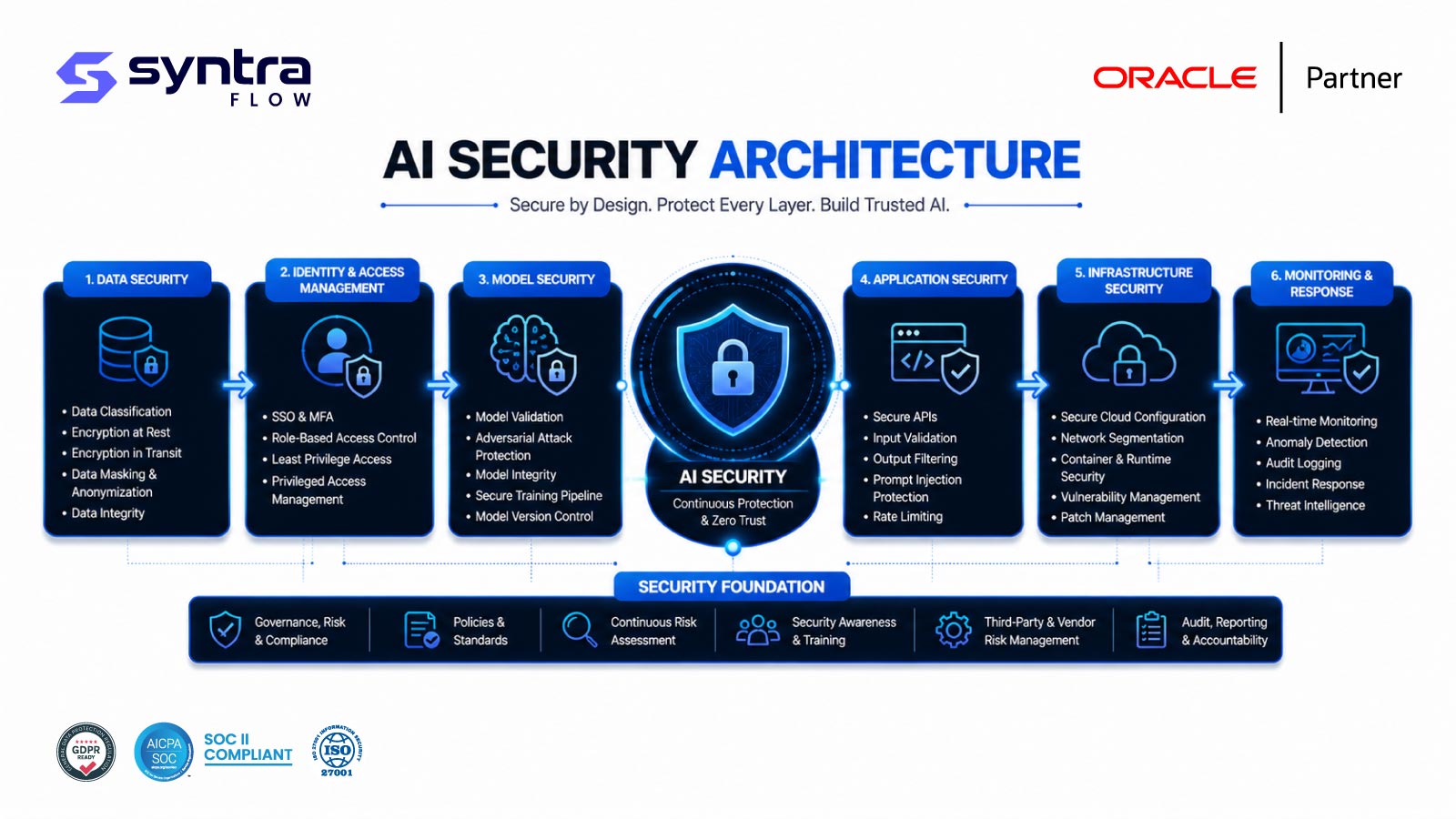
Oracle AI Agents Inherit Fusion's Role-Based Security Model
Every AI agent operating inside Oracle Fusion Cloud Applications runs within the platform's existing role-based access control (RBAC) framework — the same job roles, duty roles, and data security policies that determine what a human user can see and do. An agent invoked on behalf of a user is bound by that user's role assignments; it should not read a business object, approve a transaction, or expose a field the calling user isn't already authorized for. This inheritance is the foundational principle behind Oracle's AI capabilities: they extend what authorized users can already do, not a parallel access model. Inheritance alone does not fully resolve AI-specific risk, however — an agent with broad inherited access can still aggregate information across many records in one interaction, or complete a chained series of steps no individual role assignment anticipated. The sections below focus on where AI adds new considerations on top of the inherited model.
Scope note. This page does not re-explain Oracle's general role-based security model — duty role composition, data security policy structure, and privilege inheritance are covered in depth, in the context of segregation-of-duties risk, on the SoD Intelligence page. Here, the focus stays on how AI specifically interacts with that model.
User Roles and Privileges
Oracle Fusion AI features are typically invoked through a user's existing session or a dedicated service identity, and either path is evaluated against the same job role and duty role structure used everywhere else in the platform. A user's assigned roles determine which AI-exposed capabilities they can invoke, which business objects an agent acting on their behalf can query, and which actions — read, update, submit, approve — are available to that agent.
Because AI can lower the effort needed to touch many records or draft many transactions, role and privilege assignments deserve fresh scrutiny before AI is enabled broadly — a role that made sense for one transaction at a time may present different risk when an agent can draft dozens in a session. Reviewing which roles reach AI-enabled capabilities against least-privilege intent is a practical first step. Agent-specific access patterns are covered on Oracle AI Agents.
Agent Access Controls
Beyond the roles a human user holds, Oracle AI agents typically operate under configurable access boundaries defining which business processes, record types, and integrations an individual agent may touch when performing a task on a user's behalf. This matters because an agent is often given a task description rather than a single transaction — "process this batch of expense reports" rather than "approve this one" — so its effective access should be scoped to what the task requires, not the full extent of the invoking user's role.
Agent access controls are worth reviewing as their own category: which agents exist, what each is configured to perform, which data each can reach, and whether an agent's scope can be independently constrained rather than defaulting to a user's full role footprint. Governance over who can create, modify, or retire an agent configuration is covered on Oracle AI Governance.
Business-Object Access
AI agents that read, summarize, or act on Oracle Fusion business objects — invoices, purchase orders, worker records, service cases — are subject to the same data security policies that restrict which instances of an object a user can see, not just whether the object type is accessible at all. A user restricted to a single business unit or ledger should not have an agent surface data from outside that scope, even if the agent's underlying query logic would otherwise return it. This is worth explicit testing rather than assumption: policies are frequently layered — business unit, ledger, cost center, legal entity — and a query spanning multiple objects in one request can combine data in ways no single policy anticipated when defined in isolation.
Sensitive-Data Exposure
AI features that summarize, draft, or answer questions using Fusion data introduce an exposure risk distinct from direct field-level access. An agent can synthesize sensitive information — compensation detail, personally identifying information, health or disability data in HCM, banking details — into a single response even when no individual field it touched was, in isolation, restricted from the requesting user. The risk is less one unauthorized field and more aggregation and inference across otherwise-authorized fields producing an effectively sensitive output. Reviewing which AI-enabled features reach HCM, payroll, and other sensitive domains, and confirming data security policies extend correctly to that access path, is distinct from confirming general field-level security; teams with an existing testing discipline here can extend that rigor to AI paths — see Oracle HCM Security Testing for an example of that depth.
Prompt and Instruction Security
Prompt and instruction security concerns whether an AI agent's configured behavior can be altered by an unauthorized party — either a user crafting input designed to override the agent's intended instructions, or content the agent retrieves as part of its task (a document, a record field, an inbound message) that contains embedded text attempting to redirect its behavior. This pattern, often called prompt injection, is a known risk for any AI system processing untrusted or semi-trusted content. Practical mitigations include scoping what an agent may do regardless of its input — a boundary its access controls should enforce independent of prompt content — reviewing which fields feed into agent prompts, and treating any financially or data-consequential agent action as requiring the human approval controls discussed below, rather than relying on instruction-following alone.
Knowledge-Source Security
Where an Oracle AI feature draws on a configured knowledge source — internal documentation, policy content, or a curated set of records used to ground its responses — that source needs its own access review. A knowledge source assembled once during setup can drift out of alignment with current data security policies if it isn't revisited when roles or data classifications change, and content uploaded under one set of assumptions can stay retrievable long after the underlying policy changes. Review should cover who can add or modify content, whether the content itself contains information that shouldn't be broadly retrievable, and whether the source's access boundary stays in sync with the security model of the systems it originated from.
Integration and API Security
Oracle AI features frequently operate through the same REST APIs, web services, and integration patterns available to any Fusion extension, so API-level security — authentication, authorized scopes, rate and volume controls — applies to AI-initiated calls the same way it applies to any other integration. An AI agent invoking an API endpoint should face the same authorization checks a manually built integration would, not a separate, looser path. This matters most where AI features combine with custom extensions or third-party tools through Oracle's integration layer — that connected surface is only as strong as its weakest authenticated path, and AI-initiated traffic deserves the same review any other automated caller would receive.
Human Approval Controls
Because AI agents can draft, recommend, or in some configurations directly execute transactions, human approval controls are a primary safeguard against an agent acting incorrectly at scale rather than on a single record. Whether an AI-drafted transaction requires human review before submission, and whether approval workflows apply equally to AI- and user-initiated transactions, are decisions worth confirming explicitly. Approval is also where segregation-of-duties risk becomes concrete for AI: an agent that can both draft and approve the same transaction class recreates a conflict never permitted for a human user under the same role. Extending existing SoD analysis to agent-initiated transactions closes that gap; see SoD Intelligence.
Audit and Monitoring
Every AI agent action — a query executed, a record read, a transaction drafted or submitted — should be attributable to an identity and timestamped, supporting the same audit expectations applied to human-initiated activity. Because agents can act quickly, AI activity logs benefit from review as their own category rather than assumed coverage under logging designed for human-paced activity. Monitoring should also cover configuration changes to agents themselves — who modified an agent's scope or permitted actions — since such a change can silently expand effective access without touching a role assignment. See Oracle AI Release Intelligence for how quarterly updates have touched AI capabilities.
Oracle AI Security Validation Checklist
A working checklist for validating Oracle Fusion AI security before an agent or AI-enabled feature is opened to broader production use.
| ✓ | Area | Validation check | Why it matters |
|---|---|---|---|
| ☐ | Role & privilege alignment | Which job/duty roles reach AI-enabled features, and whether assignments still reflect least privilege | Prevents AI amplifying over-broad access |
| ☐ | Agent scope configuration | Each agent's task scope against the objects and actions it can actually reach | Agents shouldn't default to a user's full role |
| ☐ | Business-object access | Multi-object queries an agent can run, not just single policies in isolation | Aggregation can expose unanticipated data |
| ☐ | Sensitive-data domains | HCM, payroll, and PII-adjacent data paths used by AI respect existing policies | Sensitive data can surface via synthesis |
| ☐ | Prompt/instruction boundaries | Behavior boundaries hold regardless of user or retrieved-content instructions | Limits prompt injection and override |
| ☐ | Knowledge-source access | Who can add/modify content, and whether it stays in sync with data security policy | Stale sources persist past role changes |
| ☐ | Integration/API authorization | AI-initiated API calls pass the same auth and scope checks as manual integrations | AI shouldn't get a looser API path |
| ☐ | Human approval requirements | Which AI-drafted or AI-executed actions require human review first | Primary safeguard against agent error at scale |
| ☐ | Segregation-of-duties coverage | Existing SoD rule sets extended to agent-initiated transactions | Stops an agent drafting and approving one conflict pair |
| ☐ | Audit log completeness | Every agent action attributable to an identity and timestamped | Supports investigation and compliance review |
| ☐ | Agent configuration change tracking | Who modifies agent scope, knowledge sources, or permitted actions | Config changes can silently expand access |
| ☐ | Release-driven re-validation | Checks re-run after quarterly updates touching AI Agent Studio or AI features | Capability changes shift the security surface |
| ☐ | Test coverage extension | Access-control and negative-path testing covers AI workflows, not only manual UI | Untested AI paths are a coverage blind spot |
This checklist confirms controls are configured. Confirming they hold under real usage, across realistic scenarios and after each Oracle update, is a testing exercise covered on Oracle AI Testing. SyntraFlow can be configured to help extend existing Oracle Fusion test coverage toward these AI-enabled scenarios.
Related Oracle AI Pages
Oracle AI security connects closely to governance, agent design, and testing. Go deeper on adjacent topics:
Oracle AI ⭐
The Oracle AI hub for Fusion customers.
Oracle AI Governance →
Policy, oversight and agent lifecycle control.
Oracle AI Agents →
How Oracle's AI agents work in Fusion.
Oracle AI Testing →
Validating AI agent behavior and outputs.
Oracle AI Release Intelligence →
Quarterly update impact on Oracle AI features.
SoD Intelligence →
Role-based security and segregation-of-duties risk.
Oracle HCM Security Testing →
Example of role and access testing depth.
Frequently Asked Questions
What is Oracle AI security?
▼
Oracle AI security is how Oracle Fusion's AI agents, embedded AI features, and AI Agent Studio extensions operate within the platform's existing role-based access control model, plus the additional considerations AI adds — agent scope, prompt and instruction integrity, knowledge-source access, and human approval requirements for AI-initiated actions.
Do Oracle AI agents follow the same security model as the rest of Fusion?
▼
Yes. Oracle AI agents inherit and act within the same role-based model — job roles, duty roles, and data security policies — used across Fusion. An agent acting on a user's behalf is bound by that user's role assignments, so reviewing role assignments is a foundational step before expanding AI use.
Can an Oracle AI agent access data a user isn't authorized to see?
▼
An agent shouldn't have broader access than the identity it operates under, since it inherits the same data security policies as that user. The practical risk is less unauthorized direct access and more aggregation — an agent combining authorized data points into a response that is, in effect, more sensitive than any single field it touched.
What is prompt injection and does it apply to Oracle AI?
▼
Prompt injection is when content an AI agent processes — a document, a record field, an inbound message — contains embedded text designed to redirect its behavior away from its intended instructions. It's a known risk for any AI system processing untrusted content, and it applies to Oracle AI the same way, which is why agent access boundaries should hold regardless of prompt content.
How does Oracle AI security relate to segregation of duties?
▼
An AI agent that can both draft and approve the same transaction class recreates a segregation-of-duties conflict that would never be tolerated for a human user under the same role. Extending existing SoD rule sets to agent-initiated transactions applies that discipline directly; see SoD Intelligence.
Who should review Oracle AI agent access before enabling it?
▼
Typically the functions already responsible for role design and segregation-of-duties review — security administrators, internal audit, and functional process owners — extended to cover agent scope, knowledge sources, and approval requirements before broader production use.
Does Oracle AI security require human approval for transactions?
▼
Whether an AI-drafted or AI-executed transaction requires human approval is a configuration decision, not a given, and one of the most important controls to confirm explicitly. Financial or data-changing actions with material impact are the highest priority for a human review step before they take effect.
How often should Oracle AI security be re-validated?
▼
At minimum, after any Oracle quarterly update touching AI Agent Studio or AI-related features, and after any change to roles, data security policies, or an agent's own configuration. Security validation is an ongoing exercise, not a one-time setup step — see Oracle AI Release Intelligence for what each update has changed.
Validate Your Oracle AI Security Posture
Review agent access, sensitive-data exposure, and approval controls before expanding Oracle AI usage — and connect that review to your existing testing and segregation-of-duties program. SyntraFlow can be configured to help extend release-aware test coverage toward AI-enabled workflows.