Oracle AI Testing and Validation
Oracle AI testing requires a different discipline than functional test automation because AI behavior is probabilistic and context-dependent, not deterministic. A traditional Oracle Fusion test asserts that a fixed input produces a fixed output every time. An Oracle AI agent or generative feature can produce a different — and still valid — response on two runs with identical inputs, or a confident-sounding response that is factually wrong. Testing it means validating a range of acceptable behavior, not a single expected value.
This page covers how to validate Oracle's own AI: functional coverage, agent behavior, prompts, response quality, grounding, business actions, approval checkpoints, security, integrations, performance, and regression after quarterly updates. It sits under the Oracle AI hub alongside dedicated pages on agents, security, and release impact.
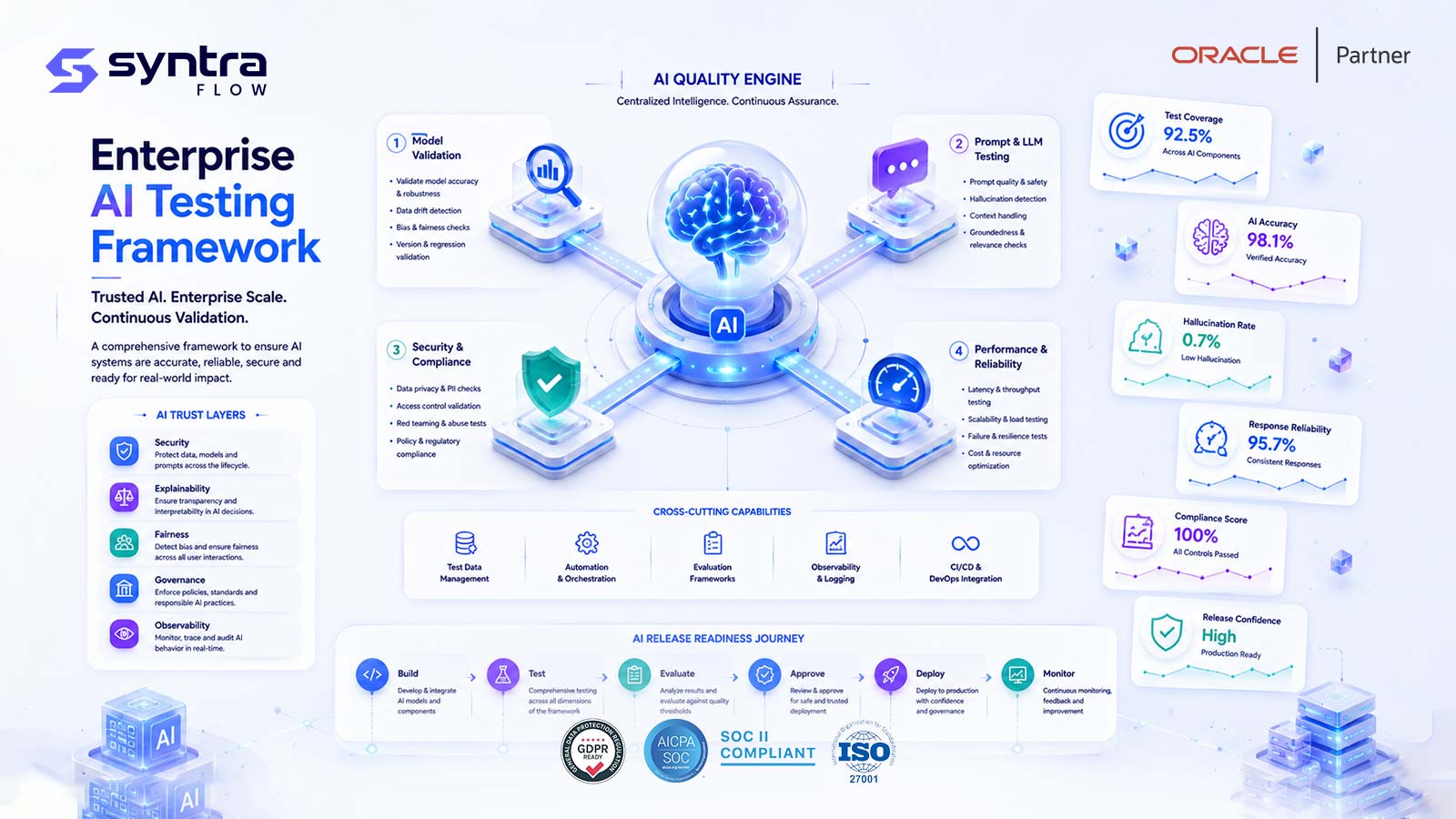
Why Oracle AI Requires Specialised Testing
Conventional Oracle Fusion testing checks that a screen renders, a field validates, or a process completes with an expected result. That model assumes determinism: same input, same output, every time. Oracle's AI capabilities — AI agents, AI Agent Studio workflows, and embedded generative features across ERP, HCM, and SCM — break that assumption. The same prompt can yield different phrasing or a different selection among valid options, depending on model version, context, and the data available at run time.
That variability does not mean AI features are untestable. It means test design has to shift from exact-match assertions to behavioral, outcome-based assertions: did the response stay grounded in real data, did the agent take the correct business action, did it stay inside its permitted role, and did it hand off to a human when it should have. Oracle AI testing validates those properties systematically rather than treating an AI feature as a black box that either "seems to work" or doesn't.
Functional Validation
Before behavioral testing, an Oracle AI feature still needs a functional baseline: does the entry point exist, does the agent or assistant launch in the expected context, does it accept the documented input types, and does it return a response rather than erroring out. This layer looks like conventional testing — UI and API checks that the feature is present, enabled for the right roles, and reachable through its intended trigger.
It is necessary but not sufficient. A feature that launches correctly and returns a well-formatted answer can still be "working" while being wrong, ungrounded, or unsafe — which is why the remaining sections go further than pass/fail checks.
AI Agent Testing
Oracle AI agents operate with more autonomy than a single generative response — they plan a sequence of steps, call tools or APIs, and decide when a task is complete. Oracle AI agent testing validates the whole chain: did the agent select an appropriate plan, did it invoke the right underlying function or record, did it stop at the correct point, and did it recover sensibly when a step failed.
Because agents built on AI Agent Studio can be extended by an organization, testing also needs to cover configuration-specific behavior — how a given tenant's agent instructions, tool access, and guardrails perform under realistic task variety, not just Oracle's out-of-the-box logic. See the Oracle AI Agents and Oracle AI Agent Studio pages for more.
Prompt and Instruction Testing
Every Oracle AI feature runs on some form of system instructions or prompt template, whether Oracle-authored or tenant-configured. Prompt testing checks that those instructions actually constrain the model's behavior: does the feature stay on-topic, does it decline requests outside its scope, and does it hold up when a user rephrases a request or provides incomplete information.
This includes adversarial cases — prompt-injection attempts embedded in a document an agent summarizes, or a user instructing an assistant to "ignore your previous instructions." A prompt that only survives clean inputs is not validated; a representative test set needs paraphrased, malformed, and deliberately manipulative variants too.
Response-Quality Validation
Because Oracle generative AI testing cannot rely on exact-string matching, response quality is evaluated against a rubric: relevance to the question asked, completeness against what the process requires, internal consistency, and absence of contradictory content. Automated scoring can flag likely issues at scale, but sampled human review remains necessary for the judgment calls automated scoring misses.
Quality thresholds should be set per use case rather than applied uniformly — a routine email draft tolerates more stylistic variance than a summary of figures feeding a financial decision. Define what "good enough" means before evaluating, not after.
Grounding and Factuality
Grounding testing asks a specific question: does the AI's output trace back to verified data in the Oracle instance, or is the model fabricating plausible-sounding detail? A response citing a supplier balance, a policy term, or an employee record needs to match what is actually in the system of record — not an approximation, and not a hallucinated figure that merely looks correct.
Practical grounding tests compare the AI's stated facts against the underlying transactional data directly, including edge cases where the correct answer is "no data available" — a well-grounded feature should say so rather than inventing an answer. Ungrounded output is high-risk here because it is often fluent and confident, making it harder for a reviewing user to catch without a systematic check.
Workflow and Action Testing
For agentic Oracle AI features, correctness is not just about what the agent says — it is about what the agent does. An agent that generates a well-written, plausible summary of "the action I took" while actually updating the wrong record or skipping a required step has failed, even though the generated text reads as correct. Workflow and action testing validates the underlying transaction, not the narrative describing it.
This means asserting against the system of record after every agent-driven action: the correct record was updated, the correct status was set, the correct amount or party was involved, and no unintended side effects occurred elsewhere. Testing the text output alone systematically understates risk in agentic scenarios.
Human Approval Testing
Most well-governed Oracle AI deployments route consequential actions through a human approval checkpoint before they take effect — a payment, a policy exception, a workforce change. Testing needs to confirm the checkpoint actually fires: the agent pauses at the correct point, the request presents enough context for a decision, and the action does not proceed on a timeout or a missing approver.
Equally important is testing what happens when approval is denied — does the agent correctly halt, or does it silently proceed with the original plan. A human-in-the-loop control that can be bypassed by an edge case is not a control.
Role and Security Testing
Oracle AI features inherit — and sometimes complicate — the role-based security model that governs the rest of Fusion. Role testing confirms an AI agent or assistant only surfaces data and actions the requesting user is entitled to, does not aggregate information across role boundaries, and respects segregation-of-duties rules when it proposes or executes a transaction on a user's behalf.
This extends into adversarial testing: prompt injection, attempts to extract data outside a user's authorization, and attempts to manipulate an agent into an action it should refuse. Given the stakes, security testing for Oracle AI deserves its own dedicated program — see Oracle AI Security and Oracle AI Governance for deeper treatment.
Integration Testing
Oracle AI features rarely operate in isolation — an agent may call REST services, read from and write to Fusion modules, or connect to external systems through OIC. Integration testing validates that these connections behave correctly under AI-driven use: the agent calls the right endpoint with correctly formed parameters, handles a failed or slow downstream call gracefully, and does not silently drop or duplicate a transaction when an integration step errors.
Because an AI agent can construct calls dynamically rather than follow a fixed script, integration tests should include cases where the agent must choose between multiple valid paths, confirming it consistently selects a correct one.
Performance and Reliability
Generative and agentic features add latency and variability conventional Oracle screens don't have — a multi-step agent task can take meaningfully longer than a form submission. Performance testing should establish realistic latency expectations and confirm the interface communicates progress rather than appearing to hang.
Reliability testing covers consistency across repeated runs: does the feature produce comparably correct results, and does it degrade predictably rather than unpredictably under load or when an upstream dependency is unavailable.
Regression Testing After Quarterly Releases
Oracle's quarterly update cycle applies to AI capabilities the same as any other feature — and often more so, since AI agents, AI Agent Studio, and embedded generative features are an area of active Oracle investment where behavior and available actions can change between releases. Oracle AI regression testing means re-running a representative case set after every quarterly update to confirm grounding, workflow actions, security boundaries, and response quality have not silently drifted.
Because full re-testing of every AI scenario on every release is rarely practical, prioritizing regression scope to what a given update actually touches is more sustainable. Oracle AI Release Intelligence covers how release notes affecting AI capabilities can be mapped to the specific test cases worth re-running each quarter.
Audit Evidence
AI features that touch financial, HR, or compliance-relevant processes need the same evidentiary trail as any other control — arguably more, given how new auditors and regulators still are to AI-driven decisioning. Evidence should capture what was tested, what the AI produced, what action it took, whether a human approval step fired, and how the result compared to the expected outcome.
Retaining this evidence in a structured, retrievable form — rather than ad hoc screenshots or a tester's memory — is what turns AI testing into a defensible, repeatable control that can support an internal or external audit request.
Oracle AI Testing Dimensions at a Glance
A summary of the dimensions covered above and an example failure mode a validated test should catch.
| AI testing dimension | What to check | Example failure mode |
|---|---|---|
| Grounding & factuality | Stated facts match verified system-of-record data | Agent cites a supplier balance that doesn't match the ledger |
| Workflow & action correctness | The underlying transaction matches the described action | Agent reports a completed approval it never actually submitted |
| Role & security boundaries | Output and actions stay within the requesting user's entitlements | Assistant surfaces payroll data to a user without HR access |
| Human approval checkpoints | Consequential actions pause for approval and honor denial | Payment action proceeds after an approval request times out |
| Prompt robustness | Instructions hold under rephrasing and adversarial input | Embedded document text overrides the agent's original task |
| Response quality | Output is relevant, complete, and internally consistent | Summary omits a material figure the source data contained |
| Performance & reliability | Latency stays within expectation; failures degrade predictably | Multi-step agent task hangs with no status feedback to the user |
| Regression after release | Prior behavior reproduces after a quarterly update | A quarterly update silently changes an agent's default tool selection |
SyntraFlow AI Validation Capabilities
SyntraFlow can be configured to help teams organize and evidence Oracle AI testing alongside their existing Oracle Fusion test coverage.
Test case organization
SyntraFlow can be configured to structure Oracle AI test cases by dimension — grounding, workflow action, security, quality — so coverage gaps are visible, not implicit.
Outcome assertion, not just text review
SyntraFlow helps organizations assess agent-driven actions against the underlying Oracle record, rather than relying solely on the AI's generated narrative.
Release-aware regression planning
SyntraFlow can connect release intelligence with test planning so AI regression scope after a quarterly update is prioritized by what actually changed.
Evidence retention
The SyntraFlow roadmap can support structured evidence capture for AI test runs, extending the audit-evidence approach already used for functional testing.
A note on scope. This AI-specific validation approach extends SyntraFlow's broader Oracle Fusion test automation platform, used for functional and regression testing across Oracle ERP, HCM, and SCM. Coverage for a specific AI agent, prompt, or workflow is scoped at assessment, not assumed from this page.
Frequently Asked Questions
What is Oracle AI testing?
▼
Oracle AI testing is the practice of validating Oracle's own AI capabilities — agents, AI Agent Studio workflows, and embedded generative features — before and after deployment. Because AI behavior is probabilistic rather than deterministic, it covers grounding, workflow actions, security, response quality, and regression, not just whether a feature functionally runs.
How is Oracle AI testing different from regular Oracle Fusion testing?
▼
Regular Oracle Fusion testing checks deterministic outcomes — the same input always produces the same result. Oracle AI testing has to account for legitimate variability in output while still catching real failures, such as fabricated data, an incorrect business action, or a security-boundary breach hidden inside a fluent, confident response.
What is Oracle AI agent testing?
▼
Oracle AI agent testing validates the full chain of an agent's behavior — the plan it forms, the tools or APIs it calls, the business action it ultimately takes, and how it recovers from a failed step — rather than just checking the agent's summary text. See Oracle AI Agents for more detail.
How do you test whether an Oracle AI response is grounded in real data?
▼
Grounding tests compare the specific facts an AI feature states — balances, statuses, policy terms, record values — directly against the underlying Oracle data. A grounded feature's claims should match the system of record exactly, including correctly reporting when no data is available rather than fabricating an answer.
Why does workflow and action testing matter more than checking the AI's text output?
▼
An AI agent can generate a well-written description of an action it did not actually perform correctly — updating the wrong record or skipping a step. Testing only the generated text misses this; asserting against the system of record confirms what actually happened, not just what the agent said happened.
How often should Oracle AI regression testing run?
▼
At minimum, after every Oracle quarterly update, since AI agents and generative features are an area of active change. Regression scope should be prioritized by what the release notes indicate actually changed, rather than re-running every case blind — see Oracle AI Release Intelligence.
Does Oracle AI testing include security testing?
▼
Yes — security and role testing is a required dimension, not an optional add-on. It confirms an agent or assistant stays inside a user's data entitlements and resists prompt-injection or manipulation attempts. See Oracle AI Security for a dedicated treatment.
What audit evidence should Oracle AI testing produce?
▼
Evidence should record what was tested, what the AI produced or did, whether a human approval checkpoint fired, and how the result compared to the expected outcome — retained in a structured, retrievable form so it can support an audit request rather than relying on ad hoc notes.
Assess Your Oracle AI Test Coverage
Identify where your Oracle AI agents, prompts, and generative features lack grounding, workflow, or security validation — and see how release-aware regression planning can extend to AI capabilities alongside your existing Oracle Fusion testing.