Oracle Customer Testing
The customer master record is the foundation every Receivables transaction depends on. In Oracle Fusion's Trading Community Architecture, a customer starts as a party — organization or person — that is classified, linked into one or more customer accounts, related to other parties in a hierarchy, and registered for tax before it is ever eligible to receive an invoice. If that master record is wrong, every downstream transaction inherits the defect.
This page is a practical guide to testing the customer master itself — creation, classification, accounts, relationships, tax registration, merge, and lifecycle status. It sits under the Oracle AR Testing Tool hub, which itself belongs to the broader Oracle ERP Testing Tool platform.
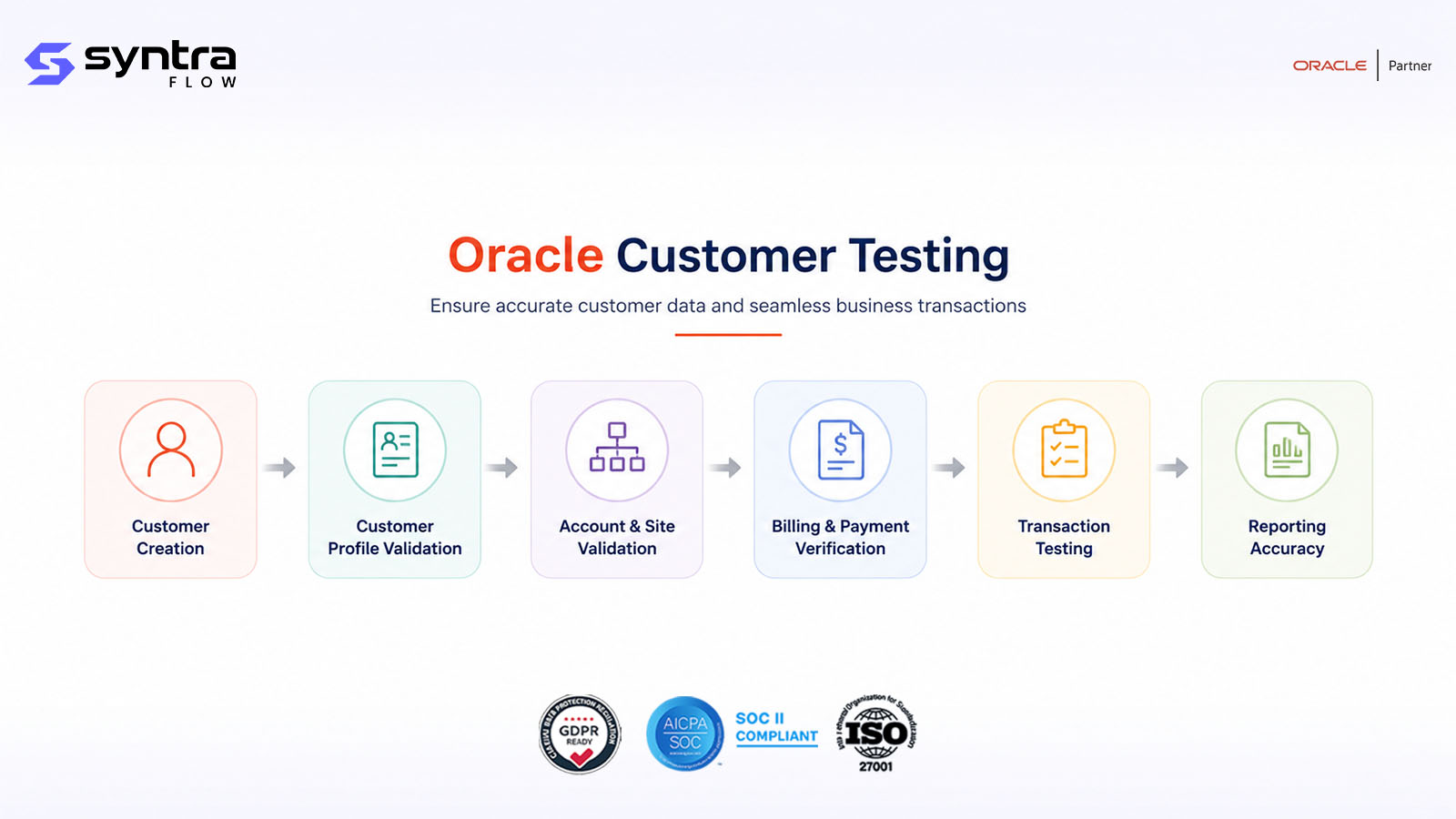
What Is Oracle Customer Testing?
Oracle customer testing verifies the customer master record — the party, its classification, its accounts, its relationships, and its tax registration. A customer begins life as a party in the Trading Community Architecture: an organization (a company) or a person (an individual). That party is then assigned a customer profile class, which supplies default behavior for terms and collections, and one or more customer accounts are created against it — the entity that actually carries transactional and accounting attributes.
From there, the master record can be extended: relationships link the customer to related parties in a parent/child hierarchy for consolidated exposure reporting; tax registrations and exemption certificates are captured at the customer level; contacts, party-level addresses, and bank accounts are attached; and classification codes support downstream reporting. Customers can be created directly in the UI, loaded in bulk through FBDI, created through the REST API, or synchronized from a CRM system such as Oracle Sales Cloud — and testing needs to confirm all four paths produce a consistent, correct record.
The teams that depend on the customer master being correct are AR processors who apply cash and manage collections, credit analysts who evaluate risk, and the finance and audit teams who rely on accurate customer data for reporting. Get the master record wrong and the error surfaces everywhere downstream — misdirected invoices, broken hierarchy rollups, or a merge that quietly drops an open balance.
Scope note. This page covers the customer master record only — party, profile class, account creation, relationships/hierarchy, customer-level tax registration, and merge. Site-level configuration — bill-to/ship-to addresses, site-level payment terms, and site defaults — is covered on Oracle Customer Account Site Testing. Credit limits and credit holds are covered on Oracle Credit Management Testing. Both sibling pages assume the master record tested here already exists.
Customer Master Data Components
A complete test suite has to cover every layer of the master record, not just the party name and number.
| Component | Description | Example | Test focus |
|---|---|---|---|
| Party (organization) | A company or legal entity registered as a party | A new corporate customer | Party creation & attribute validation |
| Party (person) | An individual registered as a party | A consumer or sole-trader customer | Person-type party validation |
| Customer profile class | Template supplying default terms and collections behavior | Standard Commercial class | Profile class assignment |
| Customer account | Transactional entity linked to the party | One party, multiple accounts | Account creation & linkage |
| Customer relationship | Party-to-party link, including parent/child | Subsidiary linked to a parent | Relationship & hierarchy testing |
| Tax registration | Customer-level registration number and tax regime | VAT/GST registration number | Tax registration validation |
| Party contact | A person associated with the party in a contact role | AP contact at the customer | Contact creation |
| Customer bank account | Bank account captured for direct-debit collection | IBAN for a direct-debit mandate | Bank account setup |
| Attribute flexfields | Configurable custom attributes on party or account | Industry code segment | Flexfield validation |
| Customer status | Active/inactive lifecycle flag on party or account | Party inactivated after review | Status change testing |
Why Testing the Customer Master Matters
Every AR transaction — invoice, receipt, credit memo, dunning letter — resolves to a customer account. A defect in the master record does not stay contained; it propagates into every transaction built on top of it. The risks specific to customer master data:
| Risk | Example | Potential impact | Testing response |
|---|---|---|---|
| Duplicate customer created | No duplicate check before create | Fragmented history; misdirected collections | Search/duplicate detection before create |
| Incorrect profile class assigned | Wrong default terms/behavior applied | Wrong terms and dunning treatment downstream | Profile class assignment negative test |
| Merge loses transactions | Merge run while duplicate has open invoices | Orphaned transactions; broken AR aging | Merge-with-open-transactions test |
| Tax registration missing or invalid | Registration not captured at customer level | Invoice tax miscalculation; compliance exposure | Tax registration validation test |
| Hierarchy misconfigured | Parent/child relationship incorrectly typed | Inaccurate consolidated exposure reporting | Hierarchy rollup test |
| Customer reactivated incorrectly | Inactive customer reactivated without review | Transactions posted to a stale record | Reactivation workflow test |
| Malformed import | FBDI load skips a required attribute | Downstream transaction failures | Import validation test |
| API/CRM sync divergence | CRM-created customer doesn't match UI equivalent | Inconsistent master data across systems | Integration parity test |
| Cross-BU access conflict | Customer shared incorrectly across business units | Unintended transaction posting or visibility | Cross-business-unit access test |
| PII mishandled | Personal data not masked or purged per policy | Regulatory and compliance exposure | Data-privacy field test |
The Oracle Customer Lifecycle Process Flow
A customer master record moves through a predictable lifecycle from creation to eventual merge or inactivation. Each stage introduces its own test conditions.
Customer lifecycle sequence
- Trigger: manual creation in the UI, an FBDI import, a REST API call, or a CRM/Sales Cloud sync.
- Key validations: party type and mandatory attributes, profile class default terms, account linkage, relationship type and hierarchy level, tax registration format, cross-BU access rules.
- Decision point: whether the customer becomes available for AR transactions immediately, or is held pending review — for example an incomplete tax registration or an unresolved duplicate match.
- Exceptions: a duplicate match blocks creation and routes to merge; a status change to inactive blocks new transactions but preserves history; a merge with open balances requires reassignment before it can complete.
- Expected output: a complete, correctly classified customer record with valid accounts, relationships, and tax registration.
- Downstream impact: every AR transaction, credit review, and site created against this customer inherits the master record's accuracy — or its defects.
Suggested visual: a swimlane diagram of the lifecycle with duplicate-detection and merge branches, for the web team to produce.
Testing Scope & Coverage Matrix
The dimensions a complete customer master test suite must cover, with automation suitability and priority.
| Test area | What must be validated | Example scenario | Automation | Priority |
|---|---|---|---|---|
| Functional (create) | Party and account creation succeeds | Organization and person creation | High | High |
| Negative | Invalid or incomplete data is rejected | Missing mandatory party attribute | High | High |
| Duplicate detection | Search prevents a duplicate party | Similar name or matching tax ID | High | High |
| Classification | Profile class and category applied correctly | Standard vs. high-risk profile class | High | Medium |
| Relationship / hierarchy | Parent/child link and rollup accuracy | Subsidiary consolidated to ultimate parent | Medium | High |
| Tax | Registration number and exemption certificate captured | VAT number and uploaded exemption certificate | High | High |
| Lifecycle | Status change and reactivation behave correctly | Inactive to active transition | High | High |
| Merge | Duplicate resolution preserves transaction integrity | Merge with an open balance | Medium | High |
| Integration | Import, API, and CRM sync produce parity | FBDI vs. REST vs. CRM-created customer | High | Medium |
| Cross-BU | Shared customer access respects security setup | Account visible in multiple business units | Medium | Medium |
| Flexfields | Descriptive flexfield capture and validation | Required segment enforced by context | High | Medium |
| Audit / compliance | Change history and data-privacy handling | Audit trail entry and GDPR field checks | Medium | Medium |
Oracle Customer Testing Scenarios
A representative set of 32 Oracle Fusion customer master scenarios — creation, classification, relationships, tax, merge, integration, and regression. Test IDs use the AR-CUS prefix.
| ID | Scenario | Preconditions | Expected result | Pri | Auto |
|---|---|---|---|---|---|
| AR-CUS-001 | Create customer as organization party | New company, no existing party match | Party and default account created | H | Y |
| AR-CUS-002 | Create customer as person party | Individual/consumer customer | Person party created with correct type | H | Y |
| AR-CUS-003 | Assign customer profile class | New customer, class selected at creation | Class attributes (terms, credit flag) applied | H | Y |
| AR-CUS-004 | Create customer account | Party exists without an account | Account created and linked to party | H | Y |
| AR-CUS-005 | Create multiple accounts per customer | Party needs separate accounts per division | Each account independently configurable | M | Y |
| AR-CUS-006 | Establish parent/child relationship | Two existing customer parties | Relationship recorded and visible in hierarchy | H | Y |
| AR-CUS-007 | Validate customer hierarchy rollup | Multi-level parent/child structure | Consolidated exposure rolls up to ultimate parent | M | Y |
| AR-CUS-008 | Capture tax registration number | Customer requires VAT/GST registration | Registration stored and format-validated | H | Y |
| AR-CUS-009 | Apply tax exemption certificate | Customer is tax-exempt | Certificate attached; exemption applies to transactions | M | Y |
| AR-CUS-010 | Change customer status active to inactive | Active customer, no open disputes | Status inactive; new transactions blocked | H | Y |
| AR-CUS-011 | Reactivate inactive customer | Previously inactivated customer | Status reset to active; account usable again | M | Y |
| AR-CUS-012 | Merge duplicate customers | Two confirmed duplicate parties | Records merged into one surviving customer | H | P |
| AR-CUS-013 | Merge customer with open transactions | Duplicate customer has open invoices/balances | Open transactions correctly reassigned | H | P |
| AR-CUS-014 | Search / duplicate detection before create | New entry with similar existing name or tax ID | Potential duplicate flagged before creation | H | Y |
| AR-CUS-015 | Create customer via FBDI import | Bulk customer file loaded | Customers created matching source; errors reported per row | H | Y |
| AR-CUS-016 | Create customer via REST API | Customer payload submitted via API | Customer created; matches UI-created equivalent | H | Y |
| AR-CUS-017 | Create customer via CRM integration sync | Lead converted in CRM/Sales Cloud | Customer created in Fusion with attributes synced | M | Y |
| AR-CUS-018 | Override profile class at account level | Account requires terms different from party default | Override applied without changing party-level class | M | Y |
| AR-CUS-019 | Assign customer classification for reporting | Customer requires a category code | Classification stored and available for reporting | M | Y |
| AR-CUS-020 | Link customer credit profile | New customer requiring credit review | Credit profile reference created and linked | M | P |
| AR-CUS-021 | Create customer contact | Customer requires a named contact | Contact party created and associated by role | M | Y |
| AR-CUS-022 | Create party-level address | Customer requires a primary address | Address captured at party level, distinct from site | M | Y |
| AR-CUS-023 | Add customer bank account for direct debit | Customer pays via direct debit | Bank account captured and linked for collection | M | Y |
| AR-CUS-024 | Assign customer role / usage | Party requires a customer party usage | Role assigned; party usable in AR transactions | H | Y |
| AR-CUS-025 | Share customer across business units | Customer must transact in multiple BUs | Customer/account accessible per BU security setup | M | P |
| AR-CUS-026 | Capture customer attribute flexfields | Customer requires custom segment values | DFF values stored and validated by context | L | Y |
| AR-CUS-027 | Review customer audit history | Change made to customer profile or status | Audit trail captures who, when, and what changed | M | Y |
| AR-CUS-028 | Create customer with multiple currencies | Customer transacts in more than one currency | Multiple invoicing currencies supported | M | Y |
| AR-CUS-029 | Apply GDPR / data-privacy fields | Customer is an individual/person party | Privacy indicators captured; hide/purge eligible per policy | M | P |
| AR-CUS-030 | Reject creation on missing mandatory attribute | Required party/account attribute omitted | Creation blocked with a clear validation error | H | Y |
| AR-CUS-031 | Extract customer master for downstream reporting | Customer records queried via BI/OTBI | Extract returns accurate, complete master attributes | L | Y |
| AR-CUS-032 | Quarterly-release regression pack | Post-quarterly-update tenant | All prior customer master results reproduce | H | Y |
Pri = priority (H/M/L). Auto = automation candidate (Y suitable · P partly, needs role/data setup or joint testing with a sibling process). Steps summarised; full step detail ships in the downloadable test pack.
Common Customer Master Defects
| Error / defect | Likely cause | Business impact | Recommended test |
|---|---|---|---|
| Duplicate customer created | Weak or bypassed duplicate search | Fragmented history; misdirected collections | AR-CUS-001, AR-CUS-014 |
| Wrong profile class defaults applied | Class misconfigured or wrong class selected | Incorrect terms and collections behavior | AR-CUS-003 |
| Merge leaves orphaned transactions | Merge run without transaction reassignment check | Broken AR aging; lost balances | AR-CUS-012, AR-CUS-013 |
| Hierarchy rollup incomplete | Relationship type mis-set (parent vs. reciprocal) | Inaccurate consolidated exposure reporting | AR-CUS-006, AR-CUS-007 |
| Tax registration format rejected or wrongly accepted | Validation rule missing for a country format | Compliance exposure; blocked invoicing | AR-CUS-008 |
| Exemption certificate not applied | Certificate not linked at transaction time | Tax over-charged on exempt customer | AR-CUS-009 |
| Reactivated customer missing prior setup | Status change doesn't restore account-level config | Rework; transaction errors | AR-CUS-011 |
| FBDI import silently drops rows | Error handling doesn't surface partial failures | Missing customers discovered late | AR-CUS-015 |
| API-created customer differs from UI | Mapping gap between REST resource and UI fields | Inconsistent master data by creation channel | AR-CUS-016 |
| CRM sync creates duplicate or incomplete customer | Sync mapping or matching rule gap | Duplicate cleanup effort; sync drift | AR-CUS-017 |
| Cross-BU access misconfigured | Security profile grants unintended visibility | Unauthorized transaction posting | AR-CUS-025 |
| PII not masked or purged correctly | Data-privacy policy not applied to the party | Regulatory and compliance exposure | AR-CUS-029 |
How SyntraFlow Automates Customer Testing
SyntraFlow drives customer creation, classification, merge, and integration paths, then asserts the resulting master record — not just that a page loaded.
AI test generation
Generates customer master variants — profile classes, relationship types, tax scenarios — from your configuration.
Self-healing execution
Playwright-based runs that re-anchor when Oracle changes the party or Redwood customer pages, so creation and merge assertions keep working.
Oracle Data Vault
The Oracle Data Vault provisions parties, accounts, and tax registrations that produce the specific master-record condition each test needs.
Regression suite
A maintained set of customer master cases that re-runs after every configuration or release change, not a one-time script.
Release intelligence
Runs the customer master subset a given release actually affects, instead of the full pack every quarter.
Configuration intelligence
Ties each test to the profile classes and tax rules that drive it, so a config change re-points the right tests.
UI + API execution
Runs customer creation through the UI, FBDI, and REST, and confirms all three agree on the resulting record.
Evidence capture
Timestamped screenshots, field-level diffs, and execution traces retained as audit-grade evidence for every run.
Quarterly-update testing
Scoped regression aligned to Oracle's quarterly cadence, so customer master behavior is verified before it reaches production.
A note on capability. AI-assisted generation, self-healing execution, UI/API testing, and evidence capture are current platform capabilities. Coverage scoped to your specific profile classes, hierarchy rules, and integrations is configurable during onboarding. Deeper CRM-sync or merge automation depth is confirmed at assessment rather than assumed here — some scenarios remain roadmap items and are not presented as live today.
When to Re-Test the Customer Master
Customer master behavior depends on configuration and integration setup, so a change to either is a regression trigger. Retest when these events occur:
| Change event | Risk to customer master | Recommended regression scope |
|---|---|---|
| Oracle quarterly update | Party/customer UI or API behavior changes | Full customer master pack, release-scoped |
| Redwood rollout | Customer and party pages redesigned | UI creation, merge, and hierarchy cases |
| Profile class configuration change | Default terms/behavior shifts | Profile class assignment + override cases |
| Tax regime or rule change | Registration/exemption validation shifts | Tax registration & exemption cases |
| Import (FBDI) mapping change | Column/attribute mapping altered | Import validation cases |
| REST API version/schema change | Customer resource payload changes | API creation & parity cases |
| CRM/Sales Cloud integration change | Sync mapping or matching rule updated | Integration/CRM sync cases |
| Security profile / data access change | Business-unit visibility changes | Cross-BU access cases |
| Duplicate-identification / merge rule change | Match criteria for duplicates updated | Duplicate detection & merge cases |
Customer Master Testing & Oracle Quarterly Releases
Oracle's quarterly updates can change party and customer behavior without any action on your part — Redwood redesigns of the customer pages, new validation rules, or altered duplicate-detection logic. Because the customer master feeds every downstream AR transaction, a silent change here is exactly the kind you must catch before it reaches production.
Rather than re-testing every customer scenario on every release, SyntraFlow Release Intelligence narrows the work to what actually changed in your tenant:
- 1.Analyses the Oracle release notes for changes touching Receivables customer/party objects.
- 2.Maps those changes to your configuration — profile classes, relationship types, tax rules.
- 3.Identifies which customer creation channels and integrations are affected.
- 4.Recommends the specific customer master test cases to run.
- 5.Prioritises regression execution by risk.
- 6.Tracks evidence for audit and sign-off.
See how the impact map is built on the Release Impact Analysis page.
Configurations That Drive the Customer Master
A customer master test is only trustworthy if the configuration behind it is known and stable. These setups determine how a customer is created, classified, and shared — and when they drift between environments, tests pass against the wrong reality.
| Configuration area | Testing impact | Example failure | Recommended validation |
|---|---|---|---|
| Customer profile classes | Sets default terms/behavior tested against | Wrong class definition shipped to production | Profile class assignment cases |
| Party / relationship types | Determines hierarchy and rollup accuracy | Relationship type misapplied | Hierarchy rollup cases |
| Tax regimes & registration rules | Governs registration number validation | Country format rule missing | Tax registration cases |
| Customer import (FBDI) mapping | Determines what's created via bulk load | Mapping drift between environments | Import validation cases |
| REST API resource configuration | Governs what integrations can create/update | Field exposed differs by environment | API parity cases |
| CRM / Sales Cloud sync mapping | Determines customer attributes synced | Matching rule differs by environment | Integration parity cases |
| Flexfield context setup | Defines required custom attributes | Required segment differs by environment | Flexfield validation cases |
| Business unit security / data access | Governs cross-BU customer sharing | Access broader or narrower than intended | Cross-BU access cases |
| Duplicate-identification / merge rules | Determines match threshold for dedupe | Threshold too loose or too strict | Duplicate detection & merge cases |
SyntraFlow's Configuration Intelligence compares these setups across environments and flags drift before it corrupts a customer master test result — so a passing test means the configuration was correct, not just present.
Customer Master Testing Best Practices
Always test duplicate detection before testing creation success — a clean create means nothing if duplicates slip through.
Test merge with open transactions explicitly — a merge that only works on clean records isn't tested at all.
Validate every creation channel — UI, FBDI, REST, CRM sync — against the same expected record.
Keep customer master tests separate from account-site and credit-limit tests so failures are unambiguous.
Test hierarchy rollup at more than two levels — single-level tests miss consolidation defects.
Cover both status change directions — active to inactive, and reactivation — not just deactivation.
Use production-like tax regimes and registration formats, not simplified test data.
Test cross-business-unit access explicitly wherever customers are shared.
Re-run the customer master pack on every quarterly update, scoped by release impact.
Capture field-level evidence for audit and sign-off, not just a pass/fail result.
Include data-privacy field checks wherever person-type parties are in scope.
Re-validate coverage after any profile class, tax, or integration mapping change.
Oracle Customer Testing Pack
Teams starting or expanding customer master test coverage often ask for a structured starting point rather than a blank page. The Oracle Customer Testing Pack lays out a working set of customer master scenarios — creation, classification, relationships, tax registration, and merge conditions — alongside the validation checks each one requires and the expected result for a pass.
Each scenario is written for direct execution: preconditions, the validation to run, the expected outcome, and an evidence-and-sign-off checklist so results are audit-ready rather than informally noted. It's built to extend, not replace, the coverage already in place — a reference for filling the gaps identified during a test assessment.
Related Oracle Receivables Pages
Customer master testing connects to the rest of the AR suite. Go deeper on adjacent topics:
Oracle Receivables Testing Tool ⭐
The AR testing hub.
Customer Account Site Testing →
Bill-to/ship-to sites and site-level defaults.
Credit Management Testing →
Credit limits, holds, and risk review.
Oracle Invoice Testing →
Transactions built on top of the customer master.
Oracle ERP Testing Tool →
The full Oracle Fusion testing platform.
Release Intelligence →
Quarterly update impact analysis.
Frequently Asked Questions
What is a "customer" in Oracle Fusion Receivables, technically speaking?
▼
A customer starts as a party in the Trading Community Architecture — an organization or a person. That party is assigned a profile class and linked to one or more customer accounts, which are the entities that actually carry transactional and accounting attributes. Testing the customer master means testing this party-to-account structure, not just a name in a form.
How is customer master testing different from customer account site testing?
▼
Customer master testing covers the party, profile class, account creation, relationships, and customer-level tax registration. Site-level configuration — bill-to/ship-to addresses, site-specific payment terms, and site defaults — is a separate concern covered on Customer Account Site Testing, which assumes the master record already exists.
How is customer master testing different from credit management testing?
▼
Customer master testing confirms the record exists and is correctly structured. Credit limits, credit holds, and risk scoring are a distinct control layer applied on top of that record, covered on Credit Management Testing. A customer credit profile link is tested here only as a reference relationship, not the credit logic itself.
What should duplicate-detection testing cover?
▼
Test that a search on name, tax registration number, or other matching attributes flags a likely duplicate before creation completes, both for exact matches and close variants. Duplicate detection is the cheapest place to prevent a defect — every duplicate that slips through eventually needs a merge, which carries more risk.
How do you test customer merge safely?
▼
Test merge scenarios with both clean duplicates and duplicates carrying open transactions. The clean case confirms the records combine correctly; the open-transaction case confirms balances and history are reassigned to the surviving customer rather than orphaned. Both must pass before merge is considered safe to run in production.
What tax attributes are tested at the customer level vs. the invoice level?
▼
At the customer level, testing covers the tax registration number and exemption certificates attached to the master record. Tax calculation on a specific transaction — rates, jurisdictions, and variance holds — is invoice-level behavior and belongs to invoice and tax testing rather than customer master testing.
How do you test customer relationships and hierarchy rollup?
▼
Create a multi-level parent/child structure and confirm exposure and reporting correctly consolidate up to the ultimate parent. Test at least three levels, not two — many hierarchy defects only appear once a chain of relationships is involved, and single-level tests miss them.
How is customer creation tested across import, API, and CRM integration?
▼
Each channel — the UI, FBDI bulk import, the REST API, and CRM/Sales Cloud sync — should produce a customer record with the same key attributes. Testing all four and comparing the results is the only way to catch a mapping gap that only affects one integration path while the others work correctly.
What happens when you test customer status changes?
▼
Test both directions: setting a customer inactive should block new transactions while preserving history, and reactivating it should restore full usability without requiring the account-level setup to be rebuilt. Testing only deactivation misses defects that surface on reactivation.
How do you test customer-level flexfields?
▼
Confirm required descriptive flexfield segments are enforced based on context, that values save correctly, and that they're available downstream in reporting. Flexfield rules often differ by customer classification, so test at least one scenario per context that applies a different required segment.
Why does cross-business-unit customer sharing need testing?
▼
When a customer transacts across multiple business units, access is governed by security setup that can be too broad or too narrow. Testing confirms the right business units can see and transact against the customer, and that others cannot — a gap here is a data-access control failure, not just a usability issue.
How does GDPR / data-privacy testing work for customer records?
▼
For person-type parties, testing confirms privacy-related indicators are captured correctly and that records eligible for hide or purge under your data-privacy policy behave as configured. This is scoped to the fields and flags on the master record; broader legal compliance is a policy matter outside test automation.
How often should customer master testing be repeated?
▼
On every Oracle quarterly update, and after any change to profile classes, tax registration rules, import mappings, API schemas, CRM sync mapping, or security/data-access setup. Because the customer master underpins every AR transaction, drift here is often only discovered once a downstream process fails.
Does Redwood change customer master testing?
▼
Redwood redesigns the customer and party pages, which breaks selector-based automation even when the underlying data model is unchanged. SyntraFlow understands Redwood pages semantically and self-heals, so customer creation and merge assertions keep running through UI redesigns rather than failing on the first page change.
What test data does customer master testing need?
▼
Each test needs data engineered to produce a specific outcome — a near-duplicate name for dedupe testing, a duplicate with an open balance for merge testing, an invalid tax format for a negative test. The Oracle Data Vault provisions parties and accounts that produce the intended condition reliably instead of relying on hand-built fixtures.
Strengthen Your Oracle Receivables Test Coverage
Identify gaps in your customer master test suite, automate high-risk merge and integration scenarios, and prepare for Oracle quarterly updates with SyntraFlow. See it run against customer scenarios like yours.