Oracle Accounts Receivable (AR) Testing Tool
The Oracle AR Testing Tool from SyntraFlow gives Oracle ERP, QA and finance teams a single, autonomous way to validate Oracle Fusion Cloud Receivables — from customer setup and invoicing through receipts, lockbox, credit memos, collections and revenue recognition. Receivables is where the enterprise collects the cash it has earned, so an untested change can misapply a receipt, miss a credit hold, or misstate revenue on the books.
Testing Oracle Receivables is hard because it spans customer master data, several distinct invoice-creation paths, bank-file processing, and revenue rules that must satisfy ASC 606 and IFRS 15. This page is the master hub for every Oracle Receivables testing topic — it explains the discipline, maps full coverage, and links you to the dedicated pages for each function rather than repeating them. It completes Order-to-Cash alongside Order Management and the O2C Testing Tool.
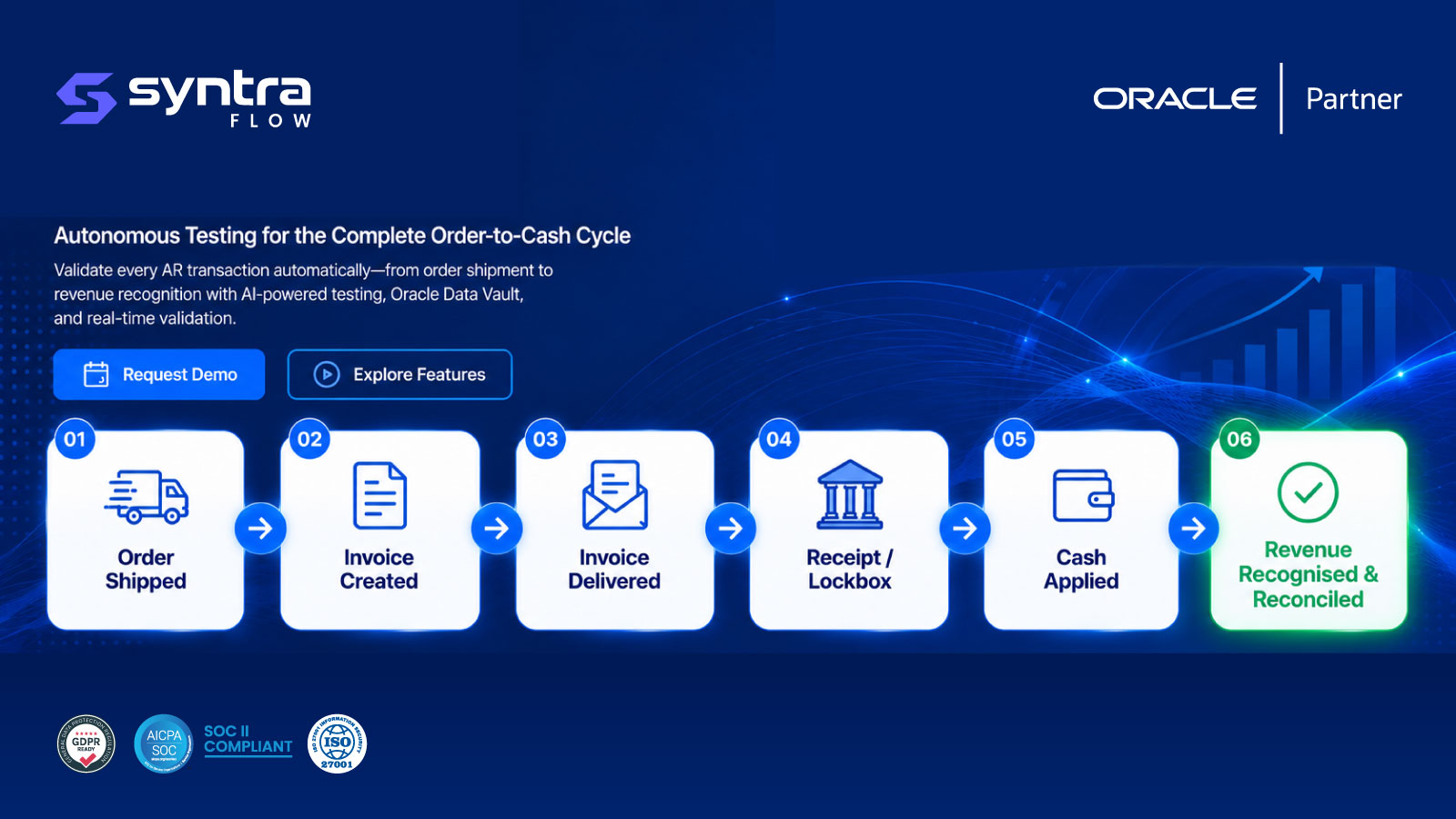
What Is Oracle Receivables Testing?
Oracle Receivables testing is the structured validation of the AR pillar inside Oracle Fusion Cloud ERP — confirming that customers are set up correctly, invoices are created and delivered accurately, cash is applied to the right transactions, and revenue is recognised in line with accounting standards. Receivables is not one screen; it is where customer master data, invoicing, banking and revenue rules converge into the enterprise's cash position.
A complete Receivables testing scope spans every one of those applications:
Customer & billing setup
Customer master data, account sites, and the bill-to/ship-to configuration invoicing depends on.
Invoicing
Manual AR invoices and the AutoInvoice import process that brings in transactions from upstream systems.
Receipts & credit
Receipt entry, bank lockbox processing, and the credit memos that adjust what a customer owes.
Collections & revenue
Dunning and follow-up strategies, plus revenue recognition under ASC 606 and IFRS 15.
Done properly, Receivables testing proves that customers and their sites default correctly, that every invoicing path — manual and AutoInvoice — produces accurate transactions, that receipts and lockbox files apply cash to the right invoices, and that revenue reported on the books matches what was actually earned.
Receivables does not test in isolation. It receives orders from Order Management, and together the two pillars form Order-to-Cash. A complete Receivables test strategy accounts for both.
Why Oracle Receivables Is Business-Critical
Receivables is the system of record for cash the enterprise is owed and the cash it collects. A defect here is a direct hit to working capital — either cash goes uncollected, or it's applied to the wrong account, or revenue is recognised incorrectly and restated later. The failure modes are concrete:
| Risk | How it happens in Oracle Receivables | Business impact |
|---|---|---|
| Misapplied receipt | Application logic or lockbox matching rules change | Wrong customer balance; collections chase a paid invoice |
| AutoInvoice exception backlog | Validation or grouping rules reject valid records | Delayed billing; revenue recognised late |
| Incorrect customer/site default | Bill-to, tax or payment-term defaulting drifts | Invoice sent to wrong address; payment-term dispute |
| Revenue misstatement | Revenue recognition rules change silently | ASC 606/IFRS 15 non-compliance; audit exception |
| Lockbox file rejection | Bank file format or matching tolerance changes | Cash sits unapplied; DSO increases |
Receivables closes the loop Order Management opens. Every order that ships eventually becomes an invoice and, ideally, cash in the bank. An error introduced anywhere in Receivables is a direct drag on days sales outstanding (DSO) and cash flow — which is why testing it thoroughly, on every quarterly release, is a finance-critical discipline, not just an IT one.
How SyntraFlow Tests Oracle Receivables
SyntraFlow replaces brittle scripts with an AI testing platform purpose-built for Oracle Fusion. Each capability applies directly to the Receivables functions that matter most.
AI Test Generation
Generates Receivables test cases from your configuration — customer defaults, AutoInvoice rules, lockbox matching — instead of hand-scripting each one.
Self-Healing
When Oracle changes a Redwood invoice or receipt page, SyntraFlow re-anchors automatically so the suite keeps running.
Oracle Data Vault
Supplies Receivables test data — customers, sites, invoices, bank files. Learn more →
Release Intelligence
Maps each Oracle quarterly release to the Receivables components it actually touches. Release Intelligence →
Configuration Intelligence
Detects drift in AutoInvoice rules, lockbox matching, and customer defaults across environments. Configuration Intelligence →
Process Mining
Reveals how invoices and receipts actually flow through your tenant, so testing prioritises real high-volume paths. Process Mining →
End-to-End Automation
Runs full O2C chains — order to invoice to receipt to revenue — not isolated screens.
REST API Validation
Validates Receivables REST and interface payloads directly, catching integration breaks the UI can't see.
Evidence & Reporting
Timestamped, audit-grade evidence and executive dashboards for coverage and release readiness.
Oracle Receivables Testing Coverage
SyntraFlow covers the full Receivables footprint. The matrix shows automation depth and AI support across every AR area.
| Business area | Coverage | Automation | AI support |
|---|---|---|---|
| Customer & site management | Full | ●●● | Yes |
| Invoicing | Full | ●●● | Yes |
| AutoInvoice | Full | ●●● | Yes |
| Receipts | Full | ●●● | Yes |
| Lockbox | Full | ●●○ | Yes |
| Credit memos | Full | ●●● | Yes |
| Collections | Full | ●●○ | Yes |
| Revenue recognition | Full | ●●○ | Yes |
| Quarterly release regression | Full | ●●● | Yes |
Illustrative coverage indicators. ●●● full autonomous execution · ●●○ automation with guided steps. Actual coverage is scoped to your tenant configuration during assessment.
Order-to-Cash: Where Receivables Fits
Receivables owns the invoice-to-cash half of Order-to-Cash. Every hand-off below is a point where a configuration change or a new Oracle feature can break behaviour downstream — which is why the transitions, not just the screens, must be tested.
Overdue invoices branch into Collections. The order-side hand-off is validated on the Order Management Testing Tool and the full cross-module view on the O2C Testing Tool page.
Oracle Quarterly Release Testing for Receivables
Oracle Fusion delivers four updates a year, and each can change Receivables — new AutoInvoice validation, Redwood redesigns of invoice and receipt pages, altered lockbox matching, or revenue-recognition rule changes. Quarterly updates continuously introduce changes that require regression validation whether or not your team asked for them.
SyntraFlow's Release Intelligence narrows testing to the Receivables components actually affected in your tenant, then auto-composes the exact regression pack. See how the impact map is built on the Release Impact Analysis page.
Configuration Intelligence for Receivables
A Receivables test is only trustworthy if the configuration behind it is known. AR behaviour is driven by extensive setup — and when it drifts between environments, tests pass against the wrong reality. SyntraFlow's Configuration Intelligence tracks the setup that governs how Receivables behaves: customer profile classes and site defaults, AutoInvoice grouping and validation rules, lockbox matching tolerances, receipt methods, and revenue-recognition rule sets — flagging drift before it corrupts a result.
Why Enterprises Choose SyntraFlow
How SyntraFlow compares to the ways Oracle Receivables is tested today.
| Capability | SyntraFlow | Generic automation | Manual / Excel | Selenium |
|---|---|---|---|---|
| Oracle-native AR knowledge | Yes | Partial | Manual | No |
| AI test generation | Yes | No | No | No |
| Self-healing on Redwood | Yes | No | N/A | No |
| Release-aware regression | Yes | No | No | No |
| Bank file / lockbox testing | Yes | Partial | Manual | No |
| Maintenance burden | Low | High | Very high | Very high |
The Complete Oracle Receivables Testing Cluster
Every Receivables function has a dedicated testing guide, organised the way Oracle Receivables is actually implemented — customer setup, billing, cash management, receivables operations, financial controls, and the test-asset resources that tie the suite together.
Customer setup
Customer Testing
Customer master data — profile, classification, relationships and merge.
Explore customer testing →Customer Account Site Testing
Bill-to and ship-to site configuration and payment-term defaults.
Explore customer account site testing →Customer Credit Management Testing
Credit profiles, limits, exposure, risk class and periodic customer review.
Explore credit management testing →Billing
Invoice Testing
The AR invoice transaction — header, lines, types and GL transfer.
Explore invoice testing →AutoInvoice Testing
Interface-table imports, grouping rules and exceptions.
Explore AutoInvoice testing →Cash management
Receipt Testing
Receipt creation and lifecycle — manual entry, batches and reversal.
Explore receipt testing →Lockbox Testing
Bank lockbox file import, automatic matching and exceptions.
Explore lockbox testing →Receivables operations
AR Credit Memo Testing
Customer-facing credit memos — creation, application and accounting impact.
Explore AR credit memo testing →Collections Testing
Delinquency, strategies, scoring, work items, promises to pay and disputes.
Explore collections testing →Adjustments Testing
Manual adjustments, write-offs, claims, miscellaneous receipts and chargebacks.
Explore adjustments testing →Financial controls
Revenue Recognition Testing
ASC 606 and IFRS 15 revenue recognition, contract and milestone revenue.
Explore revenue recognition testing →Receivables Accounting Testing
How SLA turns AR transactions into journals, GL transfer and reconciliation.
Explore receivables accounting testing →Resources
Oracle Receivables Test Cases
A structured test-case catalogue spanning customers, invoicing, receipts, lockbox and credit memos.
Explore the Receivables test-case library →Oracle Receivables UAT Checklist
A UAT planning and sign-off resource with RACI, entry/exit criteria and a grouped readiness checklist.
Explore the Receivables UAT checklist →Payables and Receivables: The Same Discipline, Two Directions
Oracle Payables and Oracle Receivables mirror each other structurally — money flowing out versus money flowing in — and SyntraFlow's testing coverage mirrors that symmetry. If you already know the Payables cluster, the Receivables equivalent is usually one row away.
Explore the full Oracle Payables Testing Tool to see the AP side of this symmetry in depth.
Frequently Asked Questions
What is Oracle Receivables testing?
▼
Oracle Receivables testing validates the AR lifecycle in Oracle Fusion Cloud — customer setup, invoicing (manual and AutoInvoice), receipts and lockbox, credit memos, collections and revenue recognition — confirming customers are billed correctly, cash is applied accurately, and revenue is recognised in compliance with ASC 606 and IFRS 15.
What does the Oracle AR Testing Tool cover?
▼
SyntraFlow's Oracle AR Testing Tool is an AI-powered platform that autonomously generates, executes and maintains Receivables test cases across Oracle Fusion Cloud — from customer master data to invoicing, AutoInvoice, receipts, lockbox, credit memos, collections and revenue recognition. It self-heals through Redwood changes and narrows regression to what each quarterly release actually changed.
How does Receivables testing relate to Order Management and O2C?
▼
Receivables owns invoicing through cash application; Order Management owns entry through shipping. Together they form Order-to-Cash. Errors introduced upstream in Order Management surface as billing disputes or reconciliation gaps in Receivables. See the Order Management Testing Tool and the O2C Testing Tool for the full cross-module view.
How often should Oracle Receivables be tested?
▼
At minimum on every Oracle quarterly update, and after any change to AutoInvoice rules, lockbox matching, customer defaults, or revenue-recognition setup. Because SyntraFlow narrows regression to affected components, testing every release becomes practical rather than a multi-week manual effort.
Does SyntraFlow support Oracle Redwood for Receivables?
▼
Yes. SyntraFlow understands Redwood invoice, receipt and customer pages semantically rather than by fixed selectors, so Receivables tests keep running through Redwood redesigns, with self-healing that re-anchors automatically when Oracle changes page structure.
Which Receivables functions have dedicated test guides?
▼
Customers, customer account sites, invoices, AutoInvoice, receipts, lockbox, AR credit memos, collections and revenue recognition — plus test-asset resources: Receivables test cases and a UAT checklist. All are linked in the cluster above.
Can SyntraFlow test bank lockbox files?
▼
Yes. Lockbox testing covers bank file import, automatic customer and invoice matching, matching tolerances, and exception-workbench handling. See Lockbox Testing for the full scenario set.
Who uses the Oracle AR Testing Tool?
▼
Oracle ERP and QA managers, Receivables and credit-to-cash leads, functional consultants, test leads, CIOs, Oracle support teams and system integrators — anyone accountable for AR correctness across Oracle Fusion quarterly releases.
Make Oracle Receivables Testing Autonomous
See how the Oracle AR Testing Tool validates every customer, invoice, receipt and credit memo across your Oracle Fusion quarterly releases — with audit-grade evidence and a fraction of the effort. This page is your hub; the next step is a working demo against scenarios like yours.