Oracle Receivables Accounting Testing
Every completed AR transaction — an invoice, a receipt, a credit memo, an adjustment — has to become a correct, balanced accounting entry before it can reach the general ledger. Subledger Accounting (SLA) is the engine that does this, applying AR-specific journal entry rule sets to derive accounts, build journal lines, and hand a validated entry off to General Ledger. When those rules are mis-configured or silently altered by a quarterly update, revenue posts to the wrong account, receipts misstate cash, or transactions stall in accounting exceptions that block period close.
This page is a practical guide to testing how SLA turns Receivables transactions into accounting — the events created, the journals generated, and the reconciliation back to GL. It sits under the Oracle Accounts Receivable (AR) Testing Tool hub.
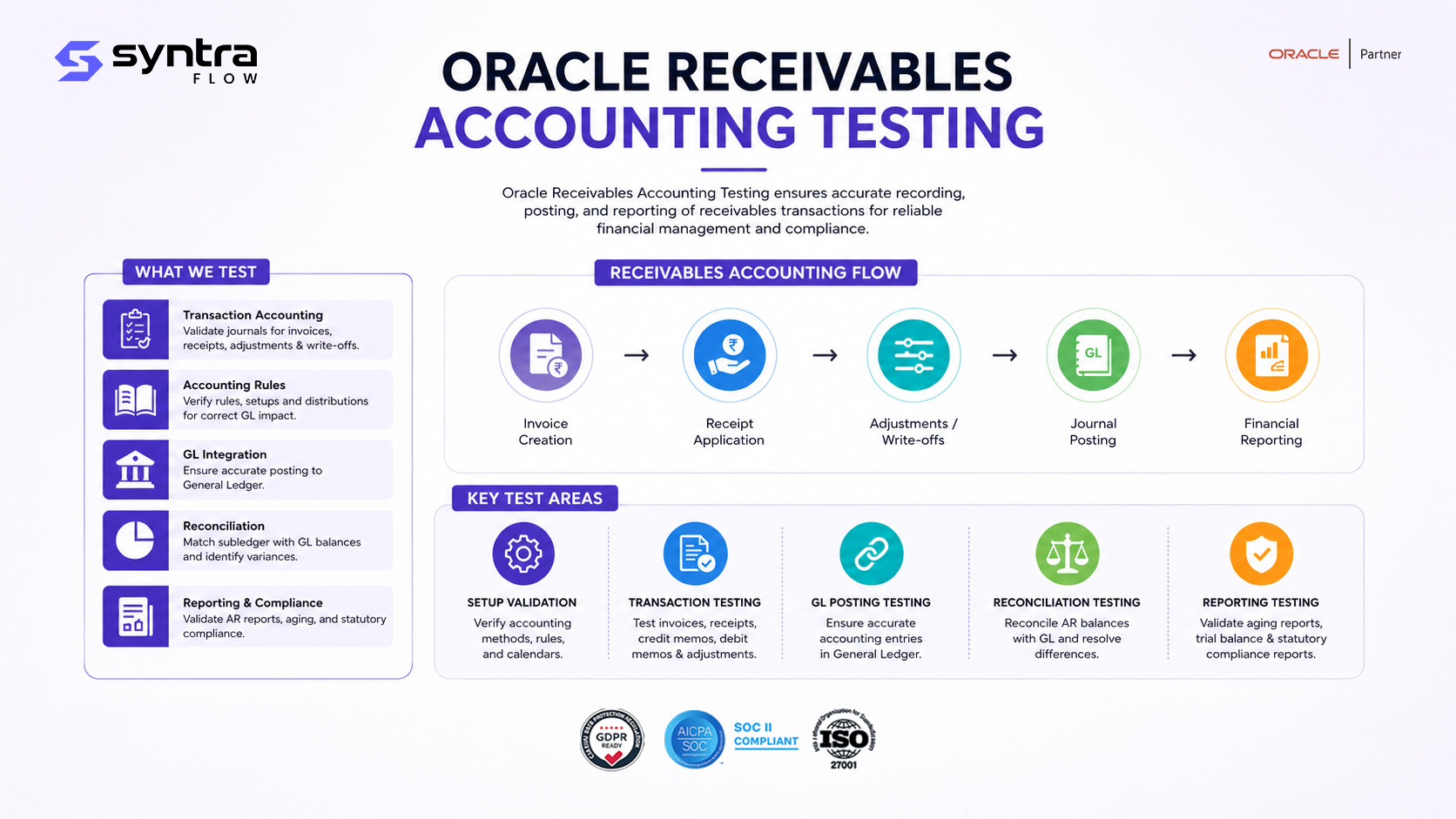
What Is Oracle Receivables Accounting?
When an AR transaction completes — an invoice is validated, a receipt is applied, a credit memo is issued, an adjustment is approved — Oracle Receivables raises an accounting event. Subledger Accounting evaluates that event against the journal entry rule sets configured for Receivables, derives the accounts for each line, and generates a subledger journal. Once accounted in final mode, the journal is transferred to General Ledger, imported, and posted, at which point AR and GL are expected to agree.
The people who depend on this working correctly are AR analysts who run Create Accounting, GL accountants who reconcile the AR control account at close, and functional consultants who configure the sources, mapping sets, and journal line rules that drive each AR event class. Its upstream dependency is the transaction itself — type, memo line, receivables activity, tax, currency, business unit; its downstream dependency is a general ledger that reflects Receivables accurately.
Scope note. This page focuses on how SLA transforms Receivables transactions specifically — invoices, receipts, credit memos and adjustments — into accounting. For general Subledger Accounting rule configuration across all Oracle modules, see the general Oracle Subledger Accounting Testing page.
Once accounted, the resulting journal is only half the story — it also has to tie back to General Ledger cleanly, which makes this page a natural bridge into Oracle General Ledger testing coverage as that area of the ERP Testing Tool expands.
Why Testing AR Accounting Matters
AR accounting sits between revenue recognition and the general ledger, so a defect here rarely stays contained — it either mis-states GL balances or blocks transactions from ever reaching GL. The risks specific to AR-SLA behaviour:
| Risk | Example | Potential impact | Testing response |
|---|---|---|---|
| Wrong revenue account derived | Memo line maps to an incorrect natural account | Mis-stated revenue by product or segment | Validate derivation per memo line and transaction type |
| Receipt cash account misapplied | Receivables activity misconfigured | Cash overstated or understated | Test receipt accounting per activity type |
| Credit memo fails to reverse | Reversal rule or linkage broken | Revenue remains overstated | Test paired invoice / credit memo accounting |
| Missing SLA rule for AR event | New or altered event type has no rule assigned | Transaction cannot be accounted | Negative test against an unconfigured event class |
| Tax on AR misaccounted | Tax rule or account mismatch | Tax liability mis-stated; compliance exposure | Validate tax lines per jurisdiction and rate |
| FX gain/loss miscalculated | Wrong conversion rate type applied on receipt | Distorted realized gain/loss in GL | Multi-currency receipt boundary tests |
| Draft mistaken for final | Draft accounting relied on as posted | Decisions made on unposted balances | Explicit draft-vs-final mode tests |
| Transfer to GL fails silently | Transfer to GL program errors or skips rows | AR and GL fall out of sync | Test transfer and posting status explicitly |
| AR-to-GL reconciliation break | Journal total doesn't tie to the trial balance | Undetected reconciliation gap at close | Automated AR-to-GL tie-out testing |
| Silent rule change on update | Quarterly update alters AR accounting behaviour | Undetected control drift | Release-aware regression on AR accounting |
The AR Transaction-to-Accounting Process Flow
SLA is triggered by the completion of an AR transaction and runs through validation, generation, transfer, and posting before reconciliation closes the loop.
AR accounting sequence
- Trigger: completion of an invoice, receipt, credit memo, adjustment, chargeback, or miscellaneous receipt.
- Key validations: event class has an assigned SLA rule set, derived accounts are valid and enabled, distributions balance, accounting date falls in an open period.
- Decision point: Create Accounting can run in draft (preview, non-transferable) or final mode (posted, eligible for transfer).
- Exceptions: a failed check produces an accounting exception rather than a silent skip — the transaction stays out of the GL transfer until resolved.
- Expected output: a final, balanced subledger journal transferred and posted to General Ledger.
- Downstream impact: AR trial balance and the GL AR control account must reconcile at period close.
Suggested visual: a swimlane diagram of the AR transaction-to-GL accounting sequence with the exception branch, for the web team to produce.
AR Accounting-Event Matrix by Transaction Type
Each AR transaction type raises a distinct accounting event and typical journal pattern.
| Transaction type | Accounting event | Typical journal lines | AR-specific SLA driver | Priority |
|---|---|---|---|---|
| Standard invoice | Invoice completed / validated | Dr Receivables · Cr Revenue (+ Cr Tax) | Transaction type / memo line mapping | High |
| Receipt (applied) | Receipt applied to transaction | Dr Cash · Cr Receivables | Receivables activity + application status | High |
| Receipt (unapplied) | Receipt entered, not applied | Dr Cash · Cr Unapplied Receipts | Receivables activity account | High |
| Credit memo | Credit memo completed | Dr Revenue · Cr Receivables (reversal) | Transaction type + reason code | High |
| Adjustment | Adjustment approved | Dr/Cr per receivables activity | Activity account mapping | High |
| Write-off | Write-off approved | Dr Bad Debt Expense · Cr Receivables | Activity + approval limit | Medium |
| Chargeback | Chargeback created against a receipt | New receivable created; original relieved | Transaction type derivation | Medium |
| Miscellaneous receipt | Misc receipt entered | Dr Cash · Cr configured activity account | Activity account | Medium |
| Deferred / unearned revenue | Revenue recognition event | Dr Unearned Revenue · Cr Revenue | Revenue scheme / recognition rule | Medium |
Input-to-Accounting Mapping
The transaction attributes that determine what accounting SLA generates — and what a test must confirm.
| AR input / attribute | Where set | Accounting outcome it drives | What to test |
|---|---|---|---|
| Transaction type | Transaction header | SLA rule set / journal category selected | Correct rule set applied per type |
| Memo line / revenue account | Transaction line | Revenue account derivation | Correct GL account derived per memo line |
| Receivables activity | Receipt / adjustment / misc receipt | Offset account for cash, write-off, chargeback | Correct activity account posted |
| Customer bill-to site | Transaction header | Legal entity / business unit / ledger assignment | Correct ledger and BU on journal |
| Tax classification code | Transaction line | Tax account derivation | Correct tax payable account and amount |
| Currency & exchange rate | Transaction / receipt header | Functional-currency conversion; gain/loss | Correct converted amount and rate type |
| Transaction business unit | Transaction header | BU-scoped SLA rule application | Correct BU-scoped accounting |
| AutoInvoice batch source | Import source configuration | Account mapping from the source system | Imported accounting matches manual entry |
| Lockbox receipt source | Receipt origin / bank account | Cash account and activity mapping | Correct cash account for lockbox receipts |
| Accounting date | Transaction / receipt | Period assignment for the journal | Correct period; hold when period is closed |
Oracle Receivables Accounting Test Scenarios
A representative set of 34 Oracle Fusion Receivables accounting scenarios — event creation, AR-specific SLA rules, journal generation, transfer, posting, and reconciliation. Test IDs use the AR-ACC prefix.
| ID | Scenario | Preconditions | Expected result | Pri | Auto |
|---|---|---|---|---|---|
| AR-ACC-001 | Standard invoice accounting (revenue/receivable lines) | Completed, validated invoice | Dr Receivables / Cr Revenue generated | H | Y |
| AR-ACC-002 | Receipt accounting — applied receipt | Receipt fully applied to open invoice | Dr Cash / Cr Receivables recorded | H | Y |
| AR-ACC-003 | Receipt accounting — unapplied receipt | Receipt entered, no application | Dr Cash / Cr Unapplied Receipts | H | Y |
| AR-ACC-004 | Credit memo accounting (reversal lines) | Credit memo issued against an invoice | Reversal entry generated correctly | H | Y |
| AR-ACC-005 | Adjustment accounting | Adjustment approved on a transaction | Entry posts per receivables activity | H | Y |
| AR-ACC-006 | Write-off accounting | Write-off approved within limit | Dr Bad Debt Expense / Cr Receivables | M | Y |
| AR-ACC-007 | Chargeback accounting | Chargeback created against applied receipt | New receivable created; original relieved | M | Y |
| AR-ACC-008 | Miscellaneous receipt accounting | Misc receipt entered against an activity | Dr Cash / Cr configured activity account | M | Y |
| AR-ACC-009 | Unearned / deferred revenue accounting | Revenue recognition schedule active | Dr Unearned Revenue / Cr Revenue on event | M | Y |
| AR-ACC-010 | Tax accounting on standard invoice | Taxable transaction line | Tax line posts to configured account | H | Y |
| AR-ACC-011 | Tax accounting on credit memo | Taxable credit memo issued | Tax reversal posts correctly | M | Y |
| AR-ACC-012 | Multi-currency invoice accounting | Foreign-currency transaction, rate present | Functional-currency amounts correct | H | Y |
| AR-ACC-013 | Exchange-rate gain/loss on receipt | Receipt applied at a different rate than invoice | Realized gain/loss line generated | H | Y |
| AR-ACC-014 | Invalid account derivation | Memo line maps to a disabled segment | Accounting exception raised | H | Y |
| AR-ACC-015 | Missing SLA rule for AR event | New AR event class with no rule assigned | Create Accounting fails with a clear error | H | Y |
| AR-ACC-016 | Closed accounting period | Accounting date in a closed AR period | Accounting rejected / period exception | H | Y |
| AR-ACC-017 | Future accounting date | Accounting date beyond current open period | Behaviour per period configuration | M | Y |
| AR-ACC-018 | Create Accounting — draft mode | Create Accounting run in draft | Draft journal created; not transferable | H | Y |
| AR-ACC-019 | Create Accounting — final mode | Create Accounting run in final | Final journal created; eligible for transfer | H | Y |
| AR-ACC-020 | Transfer to General Ledger | Final accounted transactions selected | Journal transferred to GL interface | H | Y |
| AR-ACC-021 | GL posting of transferred journal | Journal imported to GL | Journal posted; GL balances updated | H | Y |
| AR-ACC-022 | Accounting reversal on transaction void | Previously accounted transaction voided | Reversing entry generated automatically | H | Y |
| AR-ACC-023 | Distribution correction re-accounting | Distribution corrected post-accounting | Original reversed; corrected entry created | M | Y |
| AR-ACC-024 | Accounting exception / hold handling | Event fails SLA validation | Exception logged; held from transfer | H | Y |
| AR-ACC-025 | Reconciliation to AR trial balance | Period-end AR trial balance run | Journal totals tie to trial balance | H | Y |
| AR-ACC-026 | Reconciliation to GL control account | GL AR control account reviewed | Control account ties to subledger balance | H | Y |
| AR-ACC-027 | Cross-business-unit AR accounting | Transaction BU differs from ledger default | Journal routes to correct BU / ledger | M | Y |
| AR-ACC-028 | Cross-ledger AR condition | Customer/transaction spans multiple ledgers | Entries isolated correctly per ledger | M | Y |
| AR-ACC-029 | Revenue-recognition-driven accounting entry | Scheduled recognition transaction | Entries generated per recognition schedule | M | Y |
| AR-ACC-030 | AutoInvoice-sourced transaction accounting | Invoice imported via AutoInvoice | Accounting matches manual equivalent | H | Y |
| AR-ACC-031 | Lockbox-sourced receipt accounting | Receipt imported via lockbox file | Cash/application accounting correct | M | Y |
| AR-ACC-032 | Accounting audit trail | Any accounted AR transaction | Drill-down from journal to source available | M | Y |
| AR-ACC-033 | Role-based accounting access | User lacks Create Accounting privilege | Action denied per role | M | P |
| AR-ACC-034 | Quarterly-release regression | Post-quarterly-update tenant | All prior AR accounting results reproduce | H | Y |
Pri = priority (H/M/L). Auto = automation candidate (Y suitable · P partly, needs role/data setup). Steps summarised; full step detail ships in the downloadable checklist.
Common AR Accounting Defects
| Defect | Likely cause | Business impact | Recommended test |
|---|---|---|---|
| Revenue posts to the wrong account | Memo line / account derivation misconfigured | Mis-stated revenue by product or segment | AR-ACC-001, AR-ACC-014 |
| Receipt cash account incorrect | Receivables activity misconfigured | Cash mis-stated; reconciliation break | AR-ACC-002, AR-ACC-003, AR-ACC-008 |
| Credit memo doesn't reverse revenue | Reversal rule or linkage broken | Revenue remains overstated | AR-ACC-004, AR-ACC-011 |
| Tax line missing or misaccounted | Tax rule/account gap | Tax liability mis-stated | AR-ACC-010, AR-ACC-011 |
| FX gain/loss not recognized | Realized gain/loss rule missing | Distorted period FX result | AR-ACC-013 |
| Transaction stuck in exception | No SLA rule for the event class | Blocked from GL; delays close | AR-ACC-015, AR-ACC-024 |
| Closed-period transaction accounted anyway | Period-status check bypassed | Reopens closed-period risk | AR-ACC-016 |
| Draft balance treated as final | UI or process confusion | Decisions made on unposted balances | AR-ACC-018, AR-ACC-019 |
| Transfer to GL silently fails | Transfer program error or skipped rows | AR and GL desynchronized | AR-ACC-020, AR-ACC-021 |
| Void doesn't reverse accounting | Reversal event not triggered | Residual GL balance | AR-ACC-022 |
| Trial balance doesn't tie to GL | Reconciliation break unnoticed | Audit finding; delayed close | AR-ACC-025, AR-ACC-026 |
| Unauthorized Create Accounting run | Role privilege too broad | Control / segregation-of-duties weakness | AR-ACC-033 |
AR-to-GL Reconciliation Points
Where Receivables balances must tie to General Ledger — and where they commonly break.
| Reconciliation point | AR source | GL target | Common break condition | Test approach |
|---|---|---|---|---|
| AR trial balance vs GL control account | AR subledger trial balance | GL AR control account | Unposted or rejected journal | AR-ACC-025, AR-ACC-026 tie-out |
| Unapplied receipts vs cash clearing | Unapplied Receipts register | Cash clearing / unapplied GL account | Receipt accounted but not transferred | Compare receipt status to GL balance |
| Deferred revenue schedule vs GL liability | Revenue recognition schedule | Unearned Revenue GL account | Recognition event not accounted | AR-ACC-009 schedule-to-GL tie-out |
| Tax on AR vs GL tax payable | AR tax lines | GL tax payable control account | Tax rule misrouted | AR-ACC-010, AR-ACC-011 tie-out |
| Write-off / bad debt vs GL expense | Write-off transactions | Bad Debt Expense account | Approval-limit bypass | AR-ACC-006 tie-out |
| Cross-BU / cross-ledger AR | Transaction BU balances | Ledger-level AR balances | BU-to-ledger misrouting | AR-ACC-027, AR-ACC-028 tie-out |
| Suspense / exception accounts | Held / exception transactions | Suspense GL account | Exceptions not cleared before close | AR-ACC-024 exception aging check |
How SyntraFlow Automates AR Accounting Testing
SyntraFlow compares the transaction to the journal it produced, not just that Create Accounting ran without an error.
Transaction-to-journal comparison
Compares the source AR transaction to the resulting subledger journal line by line, not just at the total.
Dynamic test data
The Oracle Data Vault provisions invoices, receipts, credit memos and adjustments engineered to exercise a specific AR-SLA rule.
Expected account derivation
Checks derived accounts against the expected combination for the memo line, activity, or tax rule involved.
Accounting evidence
Captures the journal, its source transaction, and the accounting status as retained, audit-ready evidence.
Cross-system reconciliation
Ties AR trial balance figures to the GL control account so a passing test reflects a genuine reconciliation, not a coincidence.
UI and ESS-process validation
Runs Create Accounting and Transfer to GL through both the UI and the underlying ESS processes and confirms they agree.
Exception detection
Flags accounting exceptions and held transactions instead of treating "no crash" as a pass.
Quarterly-release test selection
Uses Release Intelligence to select the AR accounting cases a given update actually affects.
SyntraFlow can also structure your AR accounting testing around an Oracle Receivables Accounting Reconciliation Checklist — covering the transaction, its distributions, the SLA journal, the GL journal, debit/credit totals, transfer status, posting status, and reconciliation status for each test case.
A note on capability. Dynamic test data, evidence capture, UI-driven Create Accounting and Transfer to GL validation are current platform capabilities. Coverage scoped to your specific AR-SLA rule sets, activities, and ledgers is configurable during onboarding. Broader cross-system reconciliation into future General Ledger testing coverage is on the roadmap and is confirmed at assessment rather than assumed here.
When to Re-Test AR Accounting
AR accounting depends on configuration that changes independently of the transactions flowing through it. Retest when these events occur:
| Change event | Risk to AR accounting | Recommended regression scope |
|---|---|---|
| Oracle quarterly update | AR-SLA rule or Create Accounting behaviour changes | Full AR-ACC pack, release-scoped |
| Redwood rollout | Create Accounting / journal pages change | UI accounting-action cases |
| SLA rule / account-derivation change | Journal accounts shift for AR events | Account-derivation cases |
| Receivables activity change | Offset accounts for receipts/adjustments shift | Receipt / adjustment / misc receipt cases |
| Tax setup change | Tax accounting on AR shifts | Tax accounting cases |
| Chart-of-accounts / CCID change | Account validation on AR journals changes | Invalid-account and derivation cases |
| Revenue recognition policy change | Deferred revenue accounting shifts | Recognition-driven cases |
| New BU / ledger / legal entity | Setup gaps cause new exceptions | Cross-BU and cross-ledger cases |
| Security-role change | Who can run Create Accounting / Transfer changes | Role-based access cases |
| AutoInvoice / lockbox integration change | Imported transaction accounting diverges | AutoInvoice / lockbox cases |
| Production defect fix | Fix may regress adjacent accounting | Targeted + smoke AR-ACC pack |
AR Accounting & Oracle Quarterly Releases
Oracle's quarterly updates can change AR-SLA behaviour without any action on your part — new or altered journal line rules, Redwood redesigns of the Create Accounting pages, or changed default account derivation. Because AR accounting feeds GL directly, an undetected change here surfaces as a reconciliation break at close, which is a costly place to find it.
Rather than re-testing every accounting scenario on every release, SyntraFlow Release Intelligence narrows the work to what actually changed in your tenant:
- 1.Analyses the Oracle release notes for changes touching Receivables Subledger Accounting.
- 2.Maps those changes to your configuration — AR-SLA rules, activities, and account mappings.
- 3.Identifies the AR transaction types and event classes affected.
- 4.Recommends the specific AR-ACC test cases to run.
- 5.Prioritises regression execution by reconciliation risk.
- 6.Tracks accounting evidence for audit and close sign-off.
See how the impact map is built on the Release Impact Analysis page.
Configurations That Drive AR Accounting
An AR accounting test is only trustworthy if the configuration behind it is known and stable across environments.
| Configuration area | Testing impact | Example failure |
|---|---|---|
| AR-SLA journal line rule sets | Determine accounts derived per AR event | Rule set differs between environments |
| Receivables activities | Set offset accounts for receipts, adjustments, write-offs | Activity account misassigned |
| Memo lines & revenue accounts | Drive revenue account derivation | Memo line mapped to wrong segment |
| Tax rules & rates | Drive tax accounting on AR | Rate/rule out of sync between tenants |
| Chart of accounts / CCID | Validate derived accounts | Segment disabled in one environment |
| Ledger / calendar / periods | Gate accounting-date validation | Period open in one environment only |
SyntraFlow's Configuration Intelligence compares these setups across environments and flags drift before it corrupts an AR accounting test result.
AR Accounting Testing Best Practices
Compare the journal to the transaction line by line, not just the account total.
Test every AR transaction type — invoices, receipts, credit memos, adjustments, chargebacks — separately.
Cover both draft and final Create Accounting modes explicitly.
Test the reversal path, not just the original entry — voids and corrections included.
Reconcile AR trial balance to the GL control account as part of every accounting test cycle.
Include multi-currency and exchange-rate boundary cases in every cycle.
Test AutoInvoice and lockbox-sourced transactions, not just manually entered ones.
Assert that accounting exceptions are raised, not silently skipped.
Test role-based access to Create Accounting and Transfer to GL.
Re-run the AR accounting pack on every quarterly update, scoped by release impact.
Manual vs Generic Automation vs SyntraFlow
For AR accounting testing specifically.
| Capability | Manual | Generic automation | SyntraFlow |
|---|---|---|---|
| Transaction-to-journal comparison | Manual | No | Yes |
| Pre-built AR-ACC cases | No | No | Yes |
| AR-to-GL reconciliation testing | Manual | No | Yes |
| Self-healing on Redwood | N/A | No | Yes |
| Release-impact analysis | No | No | Yes |
| Configuration awareness | Manual | No | Yes |
| Audit-grade evidence | Weak | Partial | Yes |
| Maintenance effort | Very high | High | Low |
Related Oracle Receivables Pages
AR accounting connects to the rest of the Receivables suite. Go deeper on adjacent topics:
Oracle Accounts Receivable (AR) Testing Tool ⭐
The AR testing hub.
Subledger Accounting Testing →
General SLA rule configuration across all modules.
Oracle AR Invoice Testing →
Invoice entry, lines, and completion.
Oracle AR Credit Memo Testing →
Credit memo creation and application.
Oracle Invoice Accounting Testing →
The Payables equivalent — AP invoice accounting and GL reconciliation.
Oracle O2C Testing Tool →
The full Order-to-Cash lifecycle.
Part of Order-to-Cash
This process forms part of the complete Oracle Order-to-Cash (O2C) lifecycle. AR accounting is the step that turns fulfilled orders, invoices, and receipts into GL-ready journals, sitting downstream of order capture and invoicing and upstream of cash and revenue reporting. For the full end-to-end sequence, see the Oracle O2C Testing Tool.
Frequently Asked Questions
What is Oracle Receivables Accounting Testing?
▼
It is testing of how Subledger Accounting turns completed Receivables transactions — invoices, receipts, credit memos, and adjustments — into subledger journals, transfers them to General Ledger, and reconciles back to the AR trial balance. It covers accounting-event creation, AR-specific journal entry rules, transfer, posting, and reconciliation.
How is this different from Oracle Subledger Accounting Testing?
▼
The general Oracle Subledger Accounting Testing page covers SLA rule configuration — accounting rules, journal line rules, sources, and mapping sets — across all Oracle Fusion subledgers. This page focuses only on how those rules apply to Receivables transactions specifically: invoice, receipt, credit memo and adjustment accounting, and reconciliation back to GL.
What accounting is created for a standard AR invoice?
▼
A completed, validated invoice typically generates a debit to Receivables and a credit to Revenue, plus a credit to a tax account when the line is taxable. The exact accounts are derived from the transaction type, memo line, and business unit through the AR-specific SLA rule set.
How does receipt accounting differ from invoice accounting?
▼
Invoice accounting debits Receivables and credits Revenue. Receipt accounting debits Cash and credits either Receivables, when the receipt is applied, or an Unapplied Receipts account, when it is not. The receivables activity assigned to the receipt determines the offset account.
What happens when Create Accounting runs in draft vs final mode?
▼
Draft mode generates a preview journal for review; it is not eligible for transfer to General Ledger. Final mode posts the journal in the subledger and makes it eligible for the Transfer to General Ledger process. Tests should cover both explicitly, since treating a draft balance as final is a common source of error.
How do you test AR-to-GL reconciliation?
▼
By comparing the AR subledger trial balance, and specific sub-balances like unapplied receipts and deferred revenue, to the corresponding GL control accounts after transfer and posting. A reconciliation test should fail loudly when a transferred journal doesn't post, or when a transaction never reaches transfer at all.
What causes an AR accounting exception?
▼
Common causes include a missing SLA rule for the event class, an invalid or disabled account combination, an accounting date in a closed period, or an unbalanced distribution. Each should be tested as a negative case that confirms the exception is raised and the transaction is held from transfer, rather than silently skipped.
How does multi-currency affect AR accounting testing?
▼
Foreign-currency transactions must convert correctly to the ledger's functional currency, and receipts applied at a different rate than the original invoice generate a realized exchange gain or loss line. Both the conversion and the gain/loss calculation need dedicated test cases.
How is credit memo accounting tested?
▼
By pairing the credit memo's accounting with the original invoice's accounting and confirming the reversal is correct in both amount and account — including the tax line, when applicable. A credit memo that doesn't fully reverse the original entry leaves revenue overstated.
How does AutoInvoice or lockbox affect AR accounting testing?
▼
Transactions and receipts created through AutoInvoice or a lockbox file follow the same SLA rules as manually entered ones, but the source data quality differs. Tests should confirm imported transactions and receipts produce the same accounting outcome as their manually entered equivalents.
How often should AR accounting be regression tested?
▼
On every Oracle quarterly update, and after any change to AR-SLA rules, receivables activities, tax setup, the chart of accounts, or security roles. Because AR accounting feeds GL directly, drift here is most expensive when it's found during close rather than before it.
Does Redwood change AR accounting testing?
▼
Redwood redesigns the Create Accounting and journal review pages, which can break selector-based automation even when the underlying accounting logic is unchanged. SyntraFlow understands Redwood pages semantically and self-heals, so accounting assertions keep running through UI redesigns.
How do you test role-based access to Create Accounting?
▼
Run the same Create Accounting or Transfer to GL action under different roles and assert who can and cannot execute it. This protects segregation of duties between transaction entry, accounting, and GL posting, and should be retested after any security-role change.
What test data does AR accounting testing need?
▼
Each test needs a transaction engineered to exercise a specific accounting rule — a particular memo line, receivables activity, tax scenario, or currency combination. SyntraFlow's Oracle Data Vault provisions the invoices, receipts, credit memos, and adjustments needed so tests produce the intended accounting outcome reliably.
Strengthen Your Oracle Receivables Accounting Coverage
Identify gaps in your AR-to-GL test coverage, automate high-risk accounting scenarios, and prepare for Oracle quarterly updates with SyntraFlow. See it run against accounting cases like yours.