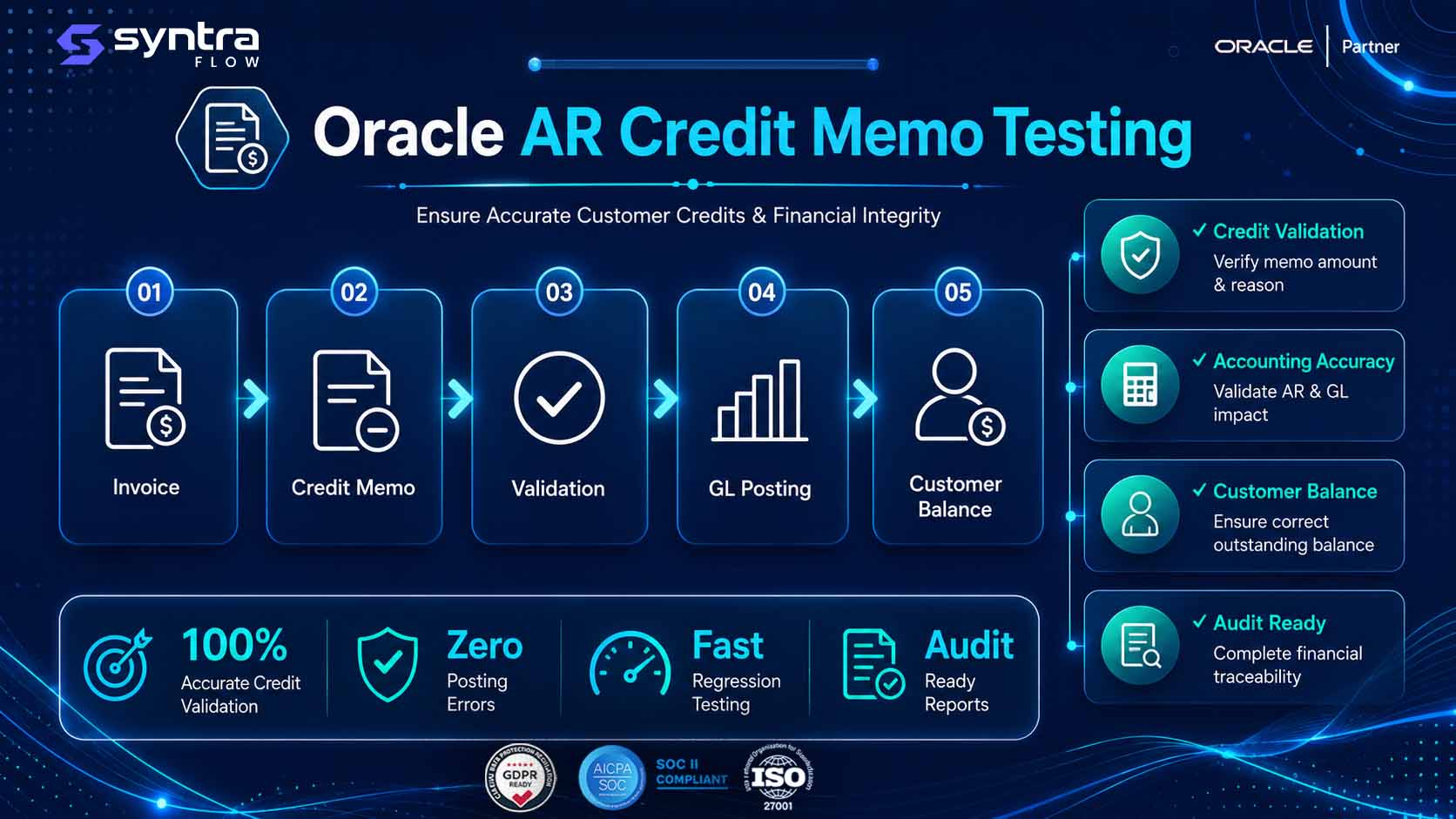
Oracle AR Credit Memo Testing
An Oracle Receivables credit memo is a negative adjustment issued to a customer — it reduces the amount that customer owes your business, whether raised against a specific invoice, on-account, or in response to a pricing dispute, return, or billing error. Get creation, application, or accounting wrong and the error carries forward into the customer balance, the general ledger, and the collections queue.
This page is a practical guide to testing the Receivables credit memo lifecycle — creation, validation, approval, application to open invoices or receipts, accounting, and the resulting customer balance impact. It sits under the Oracle Accounts Receivable (AR) Testing Tool hub, itself part of the wider Oracle ERP Testing Tool suite.
What Is an Oracle AR Credit Memo?
In Oracle Fusion Receivables, a credit memo is a transaction type that reduces a customer's balance. It can be raised against a specific invoice — fully or partially — or on-account, with no invoice reference at all. Common reasons include a pricing dispute, damaged or returned goods, a billing error on the original invoice, or a discretionary goodwill adjustment. Once created, a credit memo is validated, routed for approval when it exceeds configured thresholds, and then applied to an open invoice or receipt — or refunded directly to the customer.
The teams that depend on credit memo processing behaving correctly are AR processors who issue and apply credits, collections teams who rely on an accurate open balance, and finance and audit teams who need the accounting impact to be correct and traceable. Its upstream dependencies are the originating invoice, customer, and tax setup; its downstream dependencies are customer balance, credit limit, ageing, and GL reconciliation.
Scope note. This page covers the Receivables (AR) credit memo only — the adjustment reduces what a customer owes your business. It is the mirror image of, and a completely separate Oracle object and process from, a Payables (AP) credit memo, which a supplier issues against an amount your business owes them. The two live in different subledgers, use different transaction types, and are tested with different preconditions and accounting outcomes. If you are testing a supplier-issued AP credit memo, this is not the right page. The invoices an AR credit memo typically references are covered on Oracle Invoice Testing.
Common AR Credit Memo Use Cases
Credit memos are issued for different reasons, and each reason implies different preconditions, approval sensitivity, and evidence a test must capture.
| Use case | Description | Typical source document | Approval sensitivity |
|---|---|---|---|
| Pricing dispute | Customer disputes unit price or discount applied | Original invoice | Often requires supervisor approval |
| Damaged goods / return | Goods returned or found damaged after delivery | Return Order or original invoice | Line-level credit tied to returned quantity |
| Billing error | Invoice issued with wrong price, quantity, or tax | Original invoice | Often below auto-approval threshold |
| Goodwill / service recovery | Discretionary credit to preserve a customer relationship | On-account, no invoice reference | Typically requires approval regardless of amount |
| Consolidated invoice correction | One credit line applies against a multi-order consolidated invoice | Consolidated invoice | Requires line-level traceability |
| Return-order-driven credit | Return processed and approved in Order Management | Return Order | Often system-generated; still needs accounting validation |
Why Testing AR Credit Memos Matters
A credit memo directly changes revenue, tax, and what a customer owes. A defect here is not cosmetic — it either understates what customers legitimately owe or leaves disputes unresolved and revenue mis-stated. The risks specific to Receivables credit memos:
| Risk | Example | Potential impact | Testing response |
|---|---|---|---|
| Overstated credit amount | Credit exceeds the valid dispute or return value | Revenue overstatement; customer under-billed | Negative test on credit exceeding invoice balance |
| Understated credit amount | Credit doesn't fully offset a valid claim | Customer dissatisfaction; repeat disputes | Line-level amount validation |
| Misapplication | Credit applied to the wrong open invoice | Incorrect ageing; reconciliation break | Application-target validation |
| Duplicate credit | Same dispute credited twice | Revenue leakage | Duplicate credit memo detection test |
| Tax reversal miscalculated | Tax not proportionally reversed on the credit | Tax mis-statement; compliance exposure | Tax reversal test per rate and jurisdiction |
| Unauthorised approval | Credit approved outside the authority matrix | Segregation-of-duties failure | Role-based approval test |
| Closed-period posting | GL date in a closed AR period is accepted | Failed accounting; close delay | Period/date validation |
| Credit-held customer handling | Hold logic incorrectly blocks or bypasses credit issuance | Collections and credit-control error | Credit-hold interaction test |
| Incorrect GL impact | Debit/credit entries unbalanced or misdirected | Reconciliation break | Accounting/GL assertion test |
| Ageing/reporting distortion | Unapplied credit not reflected in AR reports | Inaccurate ageing; collections misprioritised | Reporting/ageing validation |
The Oracle AR Credit Memo Process Flow
A credit memo moves through a defined sequence from creation to its final impact on the customer balance and the ledger.
Credit memo sequence
- Trigger: manual entry, a return order from Order Management, or an integration/API call.
- Key checks: credit amount within the referenced invoice balance, tax proportionally reversed, GL date in an open period, no duplicate.
- Decision point: amounts above the configured threshold route to approval; amounts below auto-approve.
- Application: an approved credit is applied to a specific invoice, split across several invoices, applied to a receipt, or left on-account for later use — or refunded.
- Expected output: the customer balance and credit limit reflect the credit, the invoice or receipt is updated, and the GL carries a balanced entry.
- Downstream impact: ageing, collections prioritisation, and revenue reporting all read from the post-credit balance.
Suggested visual: a swimlane diagram of the credit memo sequence with the approval branch, for the web team to produce.
Testing Scope & Coverage Matrix
The dimensions a complete AR credit memo test suite must cover, with automation suitability and priority.
| Test area | What must be validated | Example scenario | Automation | Priority |
|---|---|---|---|---|
| Functional (creation) | Credit memo creates correctly against invoice or on-account | Full credit against a matched invoice | High | High |
| Negative | Invalid credit is blocked or flagged | Credit amount exceeds invoice balance | High | High |
| Approval workflow | Correct routing and auto-approval thresholds | Credit above threshold routes to approver | High | High |
| Application | Credit applies correctly to invoice(s) or receipt | Credit split across multiple invoices | High | High |
| Accounting / GL | Correct debit/credit entries and balance | Accounted credit memo balances to zero | High | High |
| Tax | Tax proportionally reversed | Partial credit reverses matching tax portion | High | High |
| Currency | FX conversion accurate on credit | Foreign-currency credit memo | Medium | Medium |
| Role-based | Only privileged roles approve or release credits | Processor denied approval authority | Medium | High |
| Integration / API | API and import match UI behaviour | REST-created credit memo validates identically | High | Medium |
| Customer balance | Balance and available credit limit update correctly | Credit increases available credit limit | High | High |
| Reporting / ageing | Credit reflected accurately in AR reports | Unapplied credit shown in ageing report | Medium | Medium |
| Regression / release | Behaviour unchanged after a quarterly update | Re-run pack after update | High | High |
| Redwood UI | Create/apply/approve actions work on Redwood pages | Credit memo approval on redesigned page | High | Medium |
| Evidence capture | Result and approval evidence captured for audit | Screenshot and approval log retained | High | Medium |
Oracle AR Credit Memo Test Scenarios
A representative set of 32 Oracle Fusion Receivables credit memo scenarios — happy path, validation failures, approval and role conditions, application, accounting, currency, and regression. Test IDs use the AR-CM prefix.
| ID | Scenario | Preconditions | Expected result | Pri | Auto |
|---|---|---|---|---|---|
| AR-CM-001 | Credit memo against specific invoice (full) | Open invoice, full credit issued | Invoice balance reduced to zero; credit linked to invoice | H | Y |
| AR-CM-002 | Credit memo against specific invoice (partial) | Open invoice, partial amount credited | Invoice balance reduced by credit amount only | H | Y |
| AR-CM-003 | On-account credit memo (no invoice reference) | Credit issued without an invoice link | Credit posts as unapplied; reduces total AR balance | H | Y |
| AR-CM-004 | Credit memo for pricing dispute | Customer disputes unit price | Credit reflects the price variance only | H | Y |
| AR-CM-005 | Credit memo for damaged goods / return | Return authorised, goods received or reported damaged | Credit issued for returned line(s) and related tax | H | Y |
| AR-CM-006 | Credit memo for billing error | Invoice line billed with wrong price, quantity, or tax | Correcting credit matches the error amount exactly | H | Y |
| AR-CM-007 | Credit memo exceeding invoice balance | Credit amount > remaining invoice balance | Validation error; credit blocked | H | Y |
| AR-CM-008 | Credit memo approval workflow | Credit amount above auto-approval threshold | Routed to approver; status pending until approved | H | Y |
| AR-CM-009 | Credit memo auto-approval below threshold | Credit amount under configured limit | Auto-approved with no manual step | H | Y |
| AR-CM-010 | Credit memo tax reversal | Original invoice line was taxable | Tax proportionally reversed on the credit | H | Y |
| AR-CM-011 | Credit memo in foreign currency | Customer transacts in a non-ledger currency | Credit converts at the correct rate | M | Y |
| AR-CM-012 | Credit memo against closed period | GL date falls in a closed AR period | Period/date error raised | H | Y |
| AR-CM-013 | Credit memo application to open invoice | Unapplied credit exists on the account | Applied; invoice balance reduced accordingly | H | Y |
| AR-CM-014 | Credit memo application to multiple invoices | Single credit split across several open invoices | Applied proportionally; each balance reduced correctly | M | Y |
| AR-CM-015 | Credit memo refund instead of application | Customer requests a cash refund | Refund processed; credit consumed, not applied | M | Y |
| AR-CM-016 | Credit memo accounting / GL impact | Credit memo accounted through Receivables | Correct debit/credit entries created and balanced | H | Y |
| AR-CM-017 | Credit memo reversal / void | Credit memo issued in error | Reversal restores original balance; audit trail retained | H | Y |
| AR-CM-018 | Credit memo against credit-held customer | Customer account on credit hold | Credit memo still permitted; hold logic unaffected | M | Y |
| AR-CM-019 | Credit memo via REST API | Credit created through an integration call | API result matches UI-created credit memo | M | Y |
| AR-CM-020 | Credit memo via integration / bulk import | Batch credit memo load via FBDI or similar | All records validate and post correctly | M | Y |
| AR-CM-021 | Credit memo from return order | Return Order processed in Order Management | Credit memo generated referencing the return; see Return Order Testing | H | Y |
| AR-CM-022 | Duplicate credit memo detection | Same invoice, same amount credited twice | Duplicate flagged or blocked | H | Y |
| AR-CM-023 | Credit memo reporting / ageing | Credit memo outstanding or unapplied | Reflected correctly in ageing and AR reports | M | Y |
| AR-CM-024 | Credit memo audit trail | Credit memo created, approved, and applied | Full history retained: creator, approver, timestamps | M | Y |
| AR-CM-025 | Credit memo role-based approval authority | User without approval privilege attempts approval | Approval denied | H | P |
| AR-CM-026 | Credit memo impact on customer credit limit | Customer near or at credit limit | Available credit increases by the credit memo amount | M | Y |
| AR-CM-027 | Credit memo line-level detail | Multi-line credit memo | Each line credited independently with correct amounts | M | Y |
| AR-CM-028 | Credit memo against consolidated invoice | Invoice consolidates multiple orders or shipments | Credit applies to the correct underlying line(s) | M | Y |
| AR-CM-029 | Credit memo GL date handling | GL date differs from transaction date | Accounting posts to the correct period | H | Y |
| AR-CM-030 | Quarterly-release regression pack | Post-update tenant | All prior credit memo results reproduce | H | Y |
| AR-CM-031 | Credit memo cancellation before application | Unapplied credit cancelled prior to use | Credit removed; no residual GL or balance impact | M | Y |
| AR-CM-032 | Redwood UI credit memo action | Redwood Receivables pages enabled | Create, apply, and approve actions work; self-healing verified | M | Y |
Pri = priority (H/M/L). Auto = automation candidate (Y suitable · P partly, needs role/data setup). Steps summarised; full step detail ships in the downloadable test pack.
Common AR Credit Memo Defects
| Defect | Likely cause | Business impact | Recommended test |
|---|---|---|---|
| Credit exceeds invoice balance, accepted | Validation rule missing or misconfigured | Revenue overstatement | AR-CM-007 |
| Duplicate credit memo posted | Weak duplicate check | Revenue leakage | AR-CM-022 |
| Credit misapplied to wrong invoice | Manual application error or defect | Ageing and reconciliation break | AR-CM-013, AR-CM-014 |
| Tax not reversed correctly | Tax engine or rate mismatch | Tax mis-statement | AR-CM-010 |
| Approval bypassed | Threshold or role misconfiguration | Segregation-of-duties failure | AR-CM-008, AR-CM-025 |
| Closed-period credit accepted | GL date/period check gap | Failed accounting; close delay | AR-CM-012 |
| On-account credit not visible for application | UI or report gap | Delayed application; customer confusion | AR-CM-003, AR-CM-013 |
| Credit limit not updated | Limit recalculation not triggered | Inaccurate available credit | AR-CM-026 |
| Return-order credit not generated | Integration gap between Order Management and Receivables | Manual credit rework | AR-CM-021 |
| API/UI accounting mismatch | Integration validates differently than UI | Inconsistent controls | AR-CM-019, AR-CM-020 |
| Reversal leaves a residual balance | Void logic incomplete | Incorrect customer balance | AR-CM-017 |
| Ageing report excludes unapplied credit | Reporting logic gap | Misprioritised collections | AR-CM-023 |
Credit Memo Accounting Impact
Each credit memo scenario has a distinct expected accounting outcome and a distinct effect on the customer balance. Testing should assert both, not just that the transaction saved.
| Credit memo type | Typical accounting entry | Customer balance impact | Notes |
|---|---|---|---|
| Full credit against invoice | Debit revenue/returns, debit tax payable, credit receivables | Invoice balance reduced to zero | Mirrors the original invoice distribution in reverse |
| Partial credit against invoice | Debit revenue (partial), credit receivables (partial) | Invoice balance reduced, not zeroed | Remaining balance stays open and ages normally |
| On-account credit (unapplied) | Debit revenue/unearned, credit receivables | Total AR balance reduced, no invoice reference | Sits as an unapplied credit until applied |
| Credit applied to an open invoice | Application record only; no new revenue entry | Invoice and credit balances both updated | The application, not the credit itself, links the two transactions |
| Credit refunded, not applied | Debit receivables (clear credit), credit cash/bank | Customer balance unaffected once refund clears | Refund substitutes for an offset against a future invoice |
| Credit memo reversal / void | Original entry reversed in full | Customer balance restored to pre-credit state | Full audit trail of both entries required |
| Tax reversal on credit memo | Debit tax payable for the reversed portion | Reduces the tax component of the balance | Must match the original tax rate and jurisdiction |
How SyntraFlow Automates AR Credit Memo Testing
SyntraFlow drives credit memo creation, application, and accounting across the UI and integration paths, then asserts the customer balance and GL outcome — not just that the transaction saved.
Automated credit memo creation
Creates credit memos against an invoice or on-account across the scenarios your test pack requires, without manual re-entry.
Matching / application validation
Confirms a credit applies to the correct invoice, receipt, or split target, and that the remaining balance is exactly what's expected.
Customer-balance comparison
Compares customer balance and available credit limit before and after, so a passing test means the balance actually moved correctly.
Accounting validation
Asserts the debit/credit entries and GL impact against the expected accounting for each credit memo type.
Negative test data
The Oracle Data Vault provisions invoices, customers, and tax setups engineered to trigger over-limit, duplicate, and closed-period conditions.
Evidence capture
Timestamped screenshots, approval logs, and accounting output retained as audit-grade evidence for every run.
Integration testing
Runs credit memo creation through the UI, REST API, and bulk import, and confirms all three produce the same result.
Regression selection
Runs the credit memo subset a given release or configuration change actually affects, instead of the full pack every time.
A note on capability. Automated creation, application validation, accounting assertions, and evidence capture are current platform capabilities. Coverage scoped to your specific approval thresholds, tax rules, and roles is configurable during onboarding. Any tenant-specific extension is confirmed at assessment rather than assumed here.
Downloadable: Oracle AR Credit Memo Test Cases
A structured starter pack covering credit type, source invoice, credit amount, tax impact, expected customer balance, expected accounting, and evidence & status — built for teams standing up or extending Receivables credit memo coverage.
Request the Test Case PackWhen to Re-Test AR Credit Memos
Credit memo behaviour depends on configuration, approval rules, and tax setup, so any change to these is a regression trigger. Retest when these events occur:
| Change event | Risk to credit memo testing | Recommended regression scope |
|---|---|---|
| Oracle quarterly update | Credit memo or application logic changes | Full AR-CM pack, release-scoped |
| Redwood rollout | Credit memo UI actions change | Creation, application, and approval cases |
| Tax rate / rule change | Tax reversal amounts shift | Tax reversal cases |
| Approval workflow / threshold change | Routing and auto-approval behaviour shifts | Approval and role-based cases |
| Credit limit policy change | Available credit calculation shifts | Credit-limit impact cases |
| Chart of accounts / GL change | Account derivation on credit memos changes | Accounting / GL cases |
| AR period / calendar change | Period-close validation shifts | Closed-period cases |
| Security-role change | Who can approve or apply credits shifts | Role-based approval cases |
| Integration / API change | API or import diverges from UI behaviour | API and integration cases |
| Production defect fix | Fix may regress adjacent scenarios | Targeted plus smoke regression pack |
AR Credit Memos & Oracle Quarterly Releases
Oracle's quarterly updates can change credit memo behaviour without any action on your part — through feature opt-ins, Redwood redesigns of the Receivables pages, new approval logic, or tax and security changes. Because a credit memo directly changes what a customer owes, a silent change is exactly the kind you must catch before it reaches production.
Rather than re-testing every credit memo scenario on every release, SyntraFlow Release Intelligence narrows the work to what actually changed in your tenant:
- 1.Analyses the Oracle release notes for changes touching Receivables credit memos.
- 2.Maps those changes to your configuration — approval thresholds, tax rules, and credit-limit policy.
- 3.Identifies the customer segments and transaction types affected.
- 4.Recommends the specific AR-CM test cases to run.
- 5.Prioritises regression execution by risk.
- 6.Tracks evidence for audit and sign-off.
See how the impact map is built on the Release Impact Analysis page, and how configuration drift is caught with Configuration Intelligence.
Related Oracle Receivables Pages
Credit memo testing connects to the rest of the AR suite. Go deeper on adjacent topics:
Oracle AR Testing Tool ⭐
The Receivables testing hub.
Invoice Testing →
The AR invoices credit memos reference.
Customer Testing →
Customer master, balance, and credit limit.
Collections Testing →
Ageing, dunning, and collections workflows.
Return Order Testing →
Return orders that drive AR credit memos.
Oracle ERP Testing Tool →
The full Fusion test automation suite.
Frequently Asked Questions
What is an Oracle AR (Receivables) credit memo?
▼
An AR credit memo is a Receivables transaction that reduces the amount a customer owes your business. It can be raised against a specific invoice, fully or partially, or on-account with no invoice reference, and is typically issued for a pricing dispute, a return, a billing error, or a goodwill adjustment.
How is an AR credit memo different from a Payables (AP) credit memo?
▼
An AR credit memo is issued by your business to a customer and reduces what that customer owes you. A Payables credit memo is the reverse: a supplier issues it to your business, reducing what you owe them. They are different transaction types in different subledgers with different preconditions and accounting outcomes, and this page covers the Receivables side only.
What's the difference between an on-account credit and a credit against a specific invoice?
▼
A credit against a specific invoice reduces that invoice's balance directly and is linked to it from creation. An on-account credit has no invoice reference at the point it's issued — it reduces the customer's total AR balance and sits as an unapplied credit until it's applied to an invoice, applied to a receipt, or refunded.
Can a credit memo exceed the invoice balance?
▼
It shouldn't. A credit memo referencing a specific invoice should be validated against the invoice's remaining open balance, and an amount beyond that balance should be blocked or flagged. Testing this boundary — including a credit that exactly matches the remaining balance — catches configuration gaps that would otherwise overstate a credit.
How does credit memo approval work in Oracle Receivables?
▼
Credit memos above a configured amount threshold route to an approver before they can be applied or accounted; amounts below the threshold can auto-approve. Testing should cover both paths, plus the role-based check that only privileged users can approve or override a credit above their authority.
What GL entries does a credit memo create?
▼
A typical credit memo debits revenue or a returns/allowances account and the related tax payable, and credits receivables — reversing the relevant portion of the original invoice's accounting. Application of an existing credit to an invoice is generally a linking action rather than a new revenue entry. See the accounting-impact table above for scenario-specific detail.
How does a credit memo affect customer credit limit?
▼
A processed credit memo reduces the customer's outstanding balance, which increases the available credit against their credit limit. Testing should confirm the limit recalculation happens promptly and correctly, particularly for customers near or at their limit.
Can a credit memo be applied to multiple invoices?
▼
Yes. An on-account or partially-used credit can be split across several open invoices. Testing should confirm each invoice's balance is reduced by the correct portion and that the credit's remaining amount, if any, is tracked accurately.
What happens if a credit memo needs to be reversed?
▼
A reversal or void restores the customer balance to its pre-credit state and reverses the associated GL entries. Testing should confirm no residual balance or accounting entry is left behind, and that the reversal and the original credit are both fully traceable in the audit trail.
How do return orders generate AR credit memos?
▼
When a return order is processed and approved in Order Management, it can generate a Receivables credit memo referencing the return and the original shipment or invoice. Testing this path spans both modules — the return-order mechanics are covered on Return Order Testing, while this page covers the resulting credit memo, its accounting, and its balance impact.
Can credit memos be created through the REST API?
▼
Yes. Oracle exposes Receivables credit memo creation through REST and bulk import in addition to the UI. A complete test suite runs all entry points and confirms they produce the same validation, approval routing, and accounting outcome, since integrations often bypass UI-only checks.
How does tax get reversed on a credit memo?
▼
Tax on a credit memo should reverse proportionally to the credited amount, using the same rate and jurisdiction as the original invoice line. A partial credit should reverse only the corresponding portion of tax, not the full tax amount, and this should be tested explicitly rather than assumed.
Why does duplicate credit memo detection matter?
▼
The same dispute or return credited twice directly reduces revenue with no offsetting transaction. Because credit memos are often issued from customer service or collections workflows outside strict PO-style controls, duplicate detection is one of the higher-value negative tests in the suite.
How often should AR credit memo testing be re-run?
▼
On every Oracle quarterly update, and after any change to approval thresholds, tax setup, the chart of accounts, credit-limit policy, or security roles. Because a credit memo changes revenue and customer balance directly, testing after these events protects against drift that would otherwise surface in a customer statement or audit.
What test data does AR credit memo testing need?
▼
Each test needs data engineered to produce a specific outcome — an invoice with a known open balance, a customer near their credit limit, a closed-period date, a duplicate credit attempt. SyntraFlow's Oracle Data Vault provisions valid customers, invoices, and tax setups so tests produce the intended result reliably instead of relying on hand-built fixtures.
Strengthen Your Oracle Receivables Test Coverage
Identify gaps in your AR credit memo test suite, automate high-risk approval and application scenarios, and prepare for Oracle quarterly updates with SyntraFlow. See it run against credit memo cases like yours.