Oracle Supplier Qualification Testing
Supplier Qualification Management is the control that decides whether a supplier is fit to do business — and, increasingly, whether they can even be awarded. When you build a qualification area, launch an initiative or assessment, collect supplier responses, and score them into a qualification outcome and level, Oracle turns questionnaire data into a governed judgement. If any step is mis-configured or silently changed by a quarterly update, unqualified suppliers slip through — or qualified ones expire unnoticed and block an award.
This page is a practical guide to testing qualification itself — the areas and questions, the initiatives that gather evidence, the scoring that produces outcomes and levels, and the expiration and renewal that keep them current. It sits under the Oracle Procurement Testing Tool hub and focuses on qualification assessment, not supplier master-data creation.
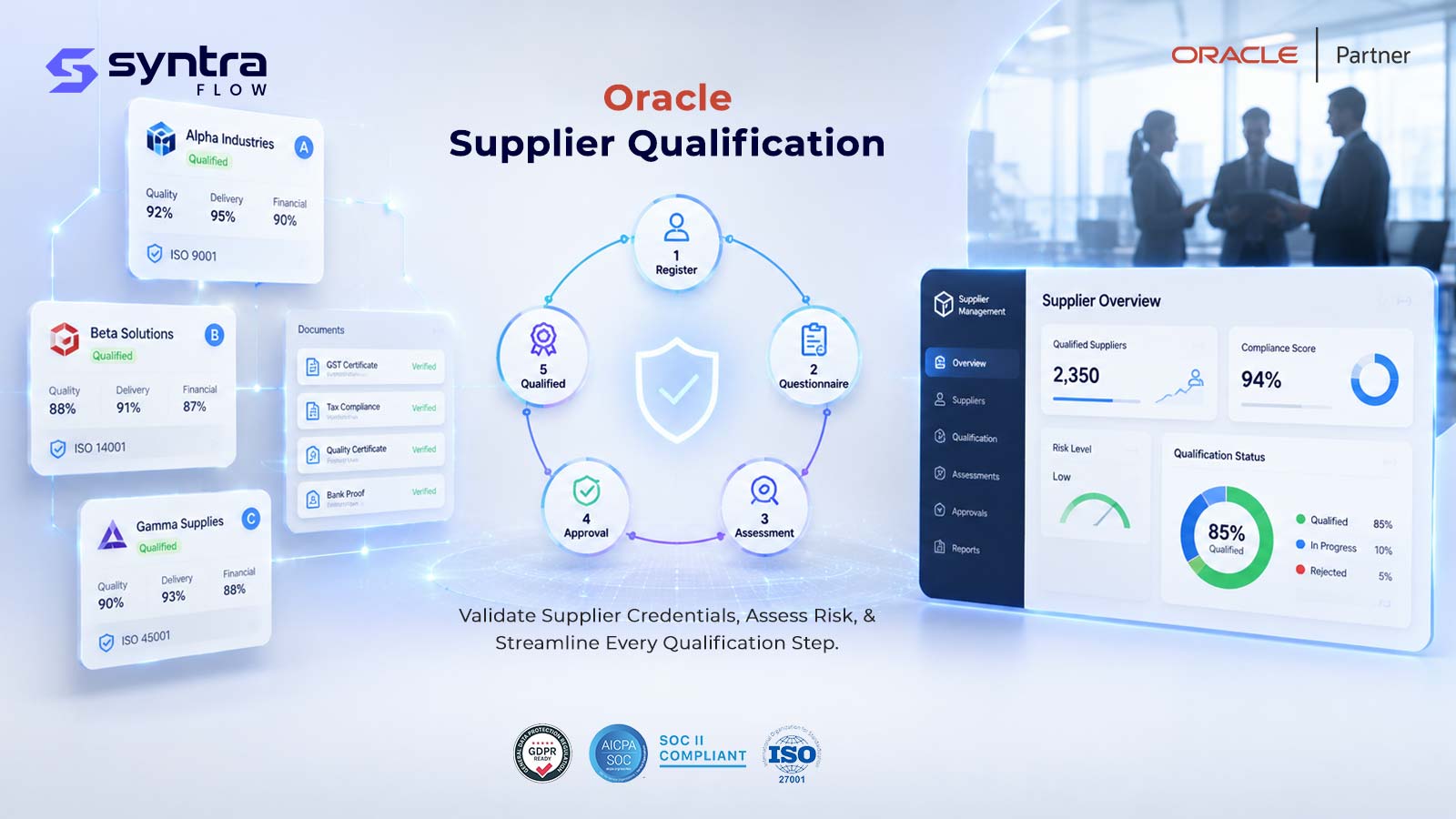
What Is Supplier Qualification in Oracle Fusion?
Oracle Fusion Supplier Qualification Management is the process that collects and evaluates information about a supplier to determine whether — and to what level — the supplier is qualified. It is built from a small set of reusable objects: qualification areas (a grouping of related questions), questions with defined response types, qualifications that roll areas into an assessable result, and initiatives or assessments that gather responses from suppliers and internal responders and drive them to an outcome.
A qualification runs its own lifecycle: an initiative is launched, questions are sent to supplier-facing and internal responders, responses are submitted with any required attachments or evidence, evaluators score the responses, and the qualification resolves to an outcome and a qualification level. Levels and outcomes can then gate downstream procurement — a negotiation may require a qualified supplier before award, and an expired qualification can remove that eligibility until it is renewed.
The teams that depend on qualification behaving correctly are category and sourcing managers who rely on qualified supplier lists, supplier managers and qualification owners who launch and evaluate initiatives, the suppliers who respond, and the compliance and audit teams who treat qualification as a preventive control. Its upstream dependencies are the supplier and supplier contact records and the registration questionnaire; its downstream dependencies are sourcing award eligibility, purchase agreements, and category strategy.
Scope note. This page owns qualification assessment — areas, questions, qualifications, initiatives, scoring, outcomes, levels, expiration and renewal, and registration questionnaires as they feed qualification. Creating and maintaining the underlying supplier master record — profile, sites, banking, contacts — is covered on the Oracle Supplier Testing page, and the broader onboarding and change flow on Supplier Lifecycle Testing. Sourcing negotiations that consume a qualification are covered on Sourcing Testing. Here we focus on how a supplier becomes — and stays — qualified.
Qualification Building Blocks
Qualification is assembled from four reusable objects. A test suite must exercise each one on its own and in combination, because a defect in a shared area or question propagates into every qualification and initiative that reuses it.
| Building block | What it defines | Key attributes to test | Reuse risk |
|---|---|---|---|
| Qualification area | A reusable grouping of questions and its scoring model | Questions included, weighting, acceptable responses, area score | Shared across many qualifications |
| Question | A single item with a defined response type | Response type, required flag, internal vs supplier, branching, attachments | Reused across areas and questionnaires |
| Qualification | Areas combined into an assessable result with an outcome model | Areas included, outcome rules, levels, expiration policy | Drives award eligibility downstream |
| Initiative / assessment | The instance that gathers responses and produces the result | Suppliers targeted, responders, due dates, evaluators, approval | Where live supplier and BU context applies |
Why Testing Supplier Qualification Matters
Qualification is a preventive control on who you do business with, so a defect here is not cosmetic — it either lets an unqualified supplier reach award or unfairly blocks a qualified one. Both outcomes carry compliance and commercial cost. The risks specific to qualification:
| Risk | Example | Potential impact | Testing response |
|---|---|---|---|
| Wrong outcome scored | Passing responses resolve to "not qualified" | Valid supplier excluded from award | Assert outcome and level per scoring model |
| Unqualified supplier passes | Failing responses still resolve to "qualified" | Risk exposure; control breach | Negative test: bad responses must fail |
| Level assigned incorrectly | Score maps to the wrong qualification level | Over- or under-stated supplier standing | Boundary test at each level threshold |
| Expired qualification honoured | Past-expiry qualification still gates award | Business with a lapsed supplier | Test expiration date vs eligibility |
| Renewal not triggered | Re-assessment initiative never launches | Silent lapse of qualified pool | Test renewal launch and notification |
| Internal question exposed | Internal-only question shown to supplier | Confidential scoring leak | Assert internal vs supplier-facing visibility |
| Branching skips a question | Conditional logic hides a required item | Incomplete evidence; false pass | Test each branch path and required flags |
| Evidence not required | Attachment-required response accepted empty | Unsupported qualification claim | Negative test on missing attachment |
| Evaluator access too broad | Unauthorised user scores or approves | Segregation-of-duties weakness | Role-based access and approval cases |
| Silent behaviour change | Quarterly update alters scoring or UI | Undetected qualification drift | Release-aware regression on qualification |
The Supplier Qualification Process Flow
Qualification moves from definition to a governed, time-bound result. Once the building blocks exist, an initiative gathers responses and drives them to an outcome, level, and eventual renewal.
Qualification sequence
- Define: build qualification areas and questions with response types, then combine areas into a qualification with an outcome model, levels, and expiration policy.
- Launch: create an initiative or assessment targeting suppliers and contacts, assign internal responders and evaluators, set due dates.
- Respond: suppliers answer supplier-facing questions and attach evidence; internal responders answer internal questions; branching shows or hides items.
- Score: single or multiple evaluators score responses; the qualification resolves to an outcome and a level per the model.
- Outcome: the qualification is approved and becomes eligible to gate sourcing award and agreements.
- Renew: on expiry, a re-assessment initiative is launched and the cycle repeats; a lapsed qualification loses its gating effect.
Suggested visual: a swimlane diagram of the qualification lifecycle with supplier, evaluator, and system lanes, for the web team to produce.
Testing Scope & Coverage Matrix
The dimensions a complete qualification test suite must cover, with automation suitability and priority.
| Test area | What must be validated | Example scenario | Automation | Priority |
|---|---|---|---|---|
| Definition (setup) | Areas, questions, qualifications build correctly | Create area with weighted questions | High | High |
| Question response types | Each response type captures and validates | Text, numeric, date, single/multi choice | High | High |
| Initiative launch | Initiative targets suppliers and responders | Launch to a supplier set with due date | High | High |
| Response submission | Supplier submits complete responses | Portal response with attachments | High | High |
| Response validation | Required and format rules enforced | Missing required answer blocked | High | High |
| Internal vs supplier | Visibility of questions by responder type | Internal question hidden from supplier | Medium | High |
| Conditional / branching | Branch logic shows/hides questions | Answer A reveals follow-up question | High | High |
| Scoring & outcome | Responses resolve to correct outcome | Scored responses → qualified | High | High |
| Level assignment | Score maps to the correct level | Boundary between Silver and Gold | High | High |
| Multi-evaluator | Combined scoring across evaluators | Two evaluators, aggregated score | Medium | Medium |
| Approval | Qualification routes and approves | Outcome approved before it gates award | Medium | High |
| Expiration & renewal | Expiry, notification, re-assessment | Expired → renewal initiative launched | High | High |
| Role-based access | Only privileged roles evaluate/approve | Buyer cannot approve qualification | Medium | High |
| Cross-business-unit | Qualification scoped per BU access | Qualification visible in one BU only | Medium | Medium |
| Award linkage | Qualification gates sourcing award | Unqualified supplier blocked from award | Medium | High |
| Integration / API | Imported responses / API parity | Integration-created qualification | High | Medium |
| Regression / release | Behaviour unchanged after an update | Re-run pack after quarterly update | High | High |
| Evidence capture | Result and responses captured for audit | Scored response + evidence retained | High | Medium |
Oracle Supplier Qualification Test Scenarios
A representative set of 34 Oracle Fusion qualification scenarios — definition, initiative and response flow, scoring and outcome, expiration and renewal, access and integration, and regression. Test IDs use the PR-SQ prefix.
| ID | Scenario | Preconditions | Expected result | Pri | Auto |
|---|---|---|---|---|---|
| PR-SQ-001 | Create qualification area with questions | Manage Qualification Areas privilege | Area saved with weighted questions | H | Y |
| PR-SQ-002 | Create question — text response | Manage Questions privilege | Text question saved and reusable | M | Y |
| PR-SQ-003 | Create question — single/multiple choice | Acceptable response values defined | Choice question with scored values | H | Y |
| PR-SQ-004 | Create question — numeric / date response | Response type numeric or date | Format validated on entry | M | Y |
| PR-SQ-005 | Required vs optional question | Question flagged required | Submission blocked if unanswered | H | Y |
| PR-SQ-006 | Question weighting affects area score | Weights configured on area | Area score reflects weights | H | Y |
| PR-SQ-007 | Create qualification from areas | Areas exist | Qualification with outcome model and levels | H | Y |
| PR-SQ-008 | Internal vs supplier-facing question | Questions flagged by responder type | Internal question hidden from supplier | H | P |
| PR-SQ-009 | Conditional / branching question shown | Branch rule on parent answer | Follow-up appears on trigger answer | H | Y |
| PR-SQ-010 | Branching hides non-applicable question | Non-trigger answer selected | Hidden question not required | M | Y |
| PR-SQ-011 | Launch initiative to supplier set | Qualification and suppliers exist | Initiative created; notifications sent | H | Y |
| PR-SQ-012 | Launch assessment (internal-only) | Internal responders assigned | Assessment gathers internal responses | M | Y |
| PR-SQ-013 | Supplier response submission | Supplier contact has portal access | Responses submitted and recorded | H | Y |
| PR-SQ-014 | Response validation — missing required | Required question left blank | Submission rejected with error | H | Y |
| PR-SQ-015 | Response validation — format error | Text in numeric response | Format error raised | M | Y |
| PR-SQ-016 | Attachment / evidence required on response | Question requires attachment | Submission blocked without file | H | Y |
| PR-SQ-017 | Evidence attached and retained | Valid attachment uploaded | File stored and visible to evaluator | M | Y |
| PR-SQ-018 | Response due-date reminder / overdue | Due date passed, no response | Reminder sent; overdue flagged | M | Y |
| PR-SQ-019 | Reviewer / evaluator assignment | Evaluator role assigned to initiative | Evaluator can score responses | H | Y |
| PR-SQ-020 | Single-evaluator scoring & outcome | Responses complete | Outcome resolves per scoring model | H | Y |
| PR-SQ-021 | Multi-evaluator aggregated scoring | Two or more evaluators assigned | Combined score per aggregation rule | M | P |
| PR-SQ-022 | Negative — failing responses not qualified | Below-threshold responses | Outcome resolves to not qualified | H | Y |
| PR-SQ-023 | Qualification level assignment | Levels defined on qualification | Score maps to correct level | H | Y |
| PR-SQ-024 | Level boundary — at vs beyond threshold | Score exactly at level cutoff | Correct level either side of cutoff | H | Y |
| PR-SQ-025 | Qualification approval routing | Approval rule configured | Outcome approved before it gates award | H | P |
| PR-SQ-026 | Qualification expiration | Expiry date reached | Status expired; eligibility removed | H | Y |
| PR-SQ-027 | Expiration notification | Approaching expiry window | Owner notified before expiry | M | Y |
| PR-SQ-028 | Renewal / re-assessment launch | Qualification expired or expiring | Re-assessment initiative launched | H | Y |
| PR-SQ-029 | Qualification required for award | Negotiation requires qualification | Unqualified supplier blocked from award | H | P |
| PR-SQ-030 | Registration questionnaire feeds qualification | Supplier registered via questionnaire | Responses seed / trigger qualification | M | Y |
| PR-SQ-031 | Cross-business-unit qualification | Multi-BU procurement setup | Qualification scoped per BU access | M | Y |
| PR-SQ-032 | Role-based access — no evaluate privilege | Buyer role attempts to score/approve | Action denied | H | P |
| PR-SQ-033 | Integration-created qualification / imported responses | Responses loaded via import/API | Imported result matches UI scoring | M | Y |
| PR-SQ-034 | Quarterly-update regression pack | Post-update tenant | All prior outcomes reproduce | H | Y |
Pri = priority (H/M/L). Auto = automation candidate (Y suitable · P partly, needs role/data setup). Steps summarised; full step detail ships in the downloadable test pack.
Common Qualification Errors & Defects
| Error / defect | Likely cause | Business impact | Recommended test |
|---|---|---|---|
| Wrong outcome scored | Scoring model or weighting mis-set | Valid supplier excluded | PR-SQ-020, PR-SQ-022 |
| Level mis-assigned | Level thresholds overlap or drift | Over/under-stated standing | PR-SQ-023, PR-SQ-024 |
| Internal question exposed | Responder-type flag wrong | Confidential scoring leak | PR-SQ-008 |
| Required question skipped | Branching hides required item | Incomplete evidence; false pass | PR-SQ-009, PR-SQ-014 |
| Missing evidence accepted | Attachment-required rule not enforced | Unsupported claim qualifies | PR-SQ-016 |
| Expired qualification honoured | Expiry not enforced on eligibility | Business with lapsed supplier | PR-SQ-026, PR-SQ-029 |
| Renewal not triggered | Re-assessment schedule mis-set | Silent lapse of qualified pool | PR-SQ-027, PR-SQ-028 |
| Unauthorised evaluate / approve | Role privileges too broad | Segregation-of-duties weakness | PR-SQ-025, PR-SQ-032 |
| Award not gated | Qualification requirement not linked | Unqualified supplier awarded | PR-SQ-029 |
| Import / UI mismatch | Imported responses scored differently | Inconsistent qualification results | PR-SQ-033 |
| Multi-evaluator aggregation error | Aggregation rule misconfigured | Wrong combined outcome | PR-SQ-021 |
| Cross-BU visibility leak | BU scoping not applied | Qualification seen where it shouldn't be | PR-SQ-031 |
How SyntraFlow Automates Qualification Testing
SyntraFlow drives qualification across setup, the supplier portal, and evaluation, then asserts the exact outcome and level — not just that a page loaded.
Pre-built qualification cases
A starter pack of area, question, scoring, and expiration scenarios you extend to your own qualifications — no scripting from zero.
AI-assisted generation
Generates qualification variants — response types, branch paths, level boundaries, and renewal cases — from your configuration.
Self-healing execution
Playwright-based runs that re-anchor when Oracle changes the qualification or Redwood pages, so scoring assertions keep working.
Dynamic test data
The Oracle Data Vault provisions suppliers, contacts, and qualification responses that produce the specific outcome each test needs.
Outcome-level assertions
Verifies the exact outcome and level — not just that an initiative "ran" — the difference between a real and a hollow test.
UI + API execution
Runs qualification through the UI, the supplier portal, and REST, confirming imported responses score the same as entered ones.
Evidence capture
Timestamped screenshots, response records, and execution traces retained as audit-grade evidence for every run.
Release-impact selection
Runs the qualification subset a given release or config change actually affects.
Configuration-aware testing
Ties each test to the areas, scoring, and levels that drive it, so a config change re-points the right tests.
A note on capability. Pre-built cases, self-healing execution, UI and API execution, and evidence capture are current platform capabilities. Coverage scoped to your specific qualification areas, scoring models, levels, and roles is configurable during onboarding. Any tenant-specific extension is confirmed at assessment rather than assumed here.
When to Re-Test Supplier Qualification
Qualification depends on configuration, scoring models, and security, so any change to those is a regression trigger. Retest when these events occur:
| Change event | Risk to qualification | Recommended regression scope |
|---|---|---|
| Oracle quarterly update | Scoring or qualification logic changes | Full qualification pack, release-scoped |
| Redwood rollout | Initiative / response UI changes | UI response + evaluation cases |
| Qualification area / question edit | Shared object change ripples widely | Definition + scoring cases |
| Scoring model change | Outcome / level thresholds shift | Scoring, outcome, and level cases |
| Level definition change | Level boundaries move | Level boundary cases |
| Expiration / renewal policy change | Expiry or re-assessment timing shifts | Expiration + renewal cases |
| Approval rule change | Who approves qualification shifts | Approval routing cases |
| Security-role change | Who can evaluate/approve changes | Role-based access cases |
| Registration questionnaire change | Feed into qualification alters | Questionnaire + qualification cases |
| New BU / procurement setup | Scoping gaps cause visibility issues | Cross-BU + config cases |
| Integration / API change | Imported responses diverge from UI | Import + API parity cases |
Qualification & Oracle Quarterly Releases
Oracle's quarterly updates can change qualification without any action on your part — through feature opt-ins, Redwood redesigns of the qualification and supplier portal pages, altered scoring behaviour, or deprecated options. Because qualification is a control on who can be awarded, a silent change is exactly the kind you must catch before it reaches production.
Rather than re-testing every qualification scenario on every release, SyntraFlow Release Intelligence narrows the work to what actually changed in your tenant:
- 1.Analyses the Oracle release notes for changes touching Supplier Qualification Management.
- 2.Maps those changes to your configuration — areas, questions, scoring models, and levels.
- 3.Identifies the initiatives and supplier types affected.
- 4.Recommends the specific qualification test cases to run.
- 5.Prioritises regression execution by risk.
- 6.Tracks qualification evidence for audit and sign-off.
See how the impact map is built on the Release Impact Analysis page.
Configurations That Drive Qualification
A qualification test is only trustworthy if the configuration behind it is known and stable. These setups determine whether a supplier qualifies and at what level — and when they drift between environments, tests pass against the wrong reality.
| Configuration area | Testing impact | Example failure | Recommended validation |
|---|---|---|---|
| Qualification areas & questions | Define what is asked and scored | Area edited between envs | Definition + scoring cases |
| Scoring & acceptable responses | Drive outcome resolution | Response weights out of sync | Outcome and boundary cases |
| Qualification levels | Map score to level | Level cutoff differs from prod | Level boundary cases |
| Expiration & renewal policy | Govern validity and re-assessment | Expiry window differs | Expiration / renewal cases |
| Approval rules | Route qualification for sign-off | Approver differs between envs | Approval routing cases |
| Responder & visibility setup | Internal vs supplier-facing questions | Visibility flag inconsistent | Internal/supplier visibility cases |
| Registration questionnaire | Feeds initial qualification data | Questionnaire mapping drift | Questionnaire feed cases |
| Roles & data security | Who evaluates, approves, and sees results | Privilege drift across envs | Role-based access cases |
SyntraFlow's Configuration Intelligence compares these setups across environments and flags drift before it corrupts a qualification test result — so a passing test means the configuration was correct, not just present.
Qualification Integration Points
Qualification reads from upstream supplier data and gates downstream procurement. These are the connections a qualification test must respect:
| Integration | Data exchanged | Key test | Failure risk |
|---|---|---|---|
| Supplier master | Supplier and contact records | Initiative targets valid contacts | Response cannot be submitted |
| Supplier registration | Registration questionnaire responses | Questionnaire feeds qualification | Qualification not seeded |
| Supplier portal | Supplier-facing responses | Portal submission and evidence | Bad data bypasses validation |
| Sourcing | Qualification / level status | Qualification gates award | Unqualified supplier awarded |
| Purchase agreements | Qualified supplier eligibility | Agreement respects qualification | Agreement with lapsed supplier |
| Notifications / BPM | Reminders, expiry, approval | Notification and routing fire | Missed renewal or approval |
| REST APIs / import | Qualification + response data | API/import scoring parity | Import/UI divergence |
| Reporting / OTBI | Qualification status and outcomes | Qualification report accuracy | Mis-stated qualified pool |
For the full cross-module flow from qualified supplier through to pay, see Oracle P2P End-to-End Testing.
Supplier Qualification Testing Best Practices
Assert the exact outcome and level, not just that an initiative completed.
Test each level threshold at, below, and above its cutoff — boundaries are where defects hide.
Cover every response type and every branch path, including the hidden ones.
Separate positive (qualified) and negative (not qualified) packs so failures are unambiguous.
Verify internal-only questions never render to supplier responders.
Test evaluate and approve privileges by role to protect segregation of duties.
Use production-like scoring models, levels, and expiration policies, not simplified test config.
Cover expiration and renewal so the qualified pool never lapses silently.
Confirm the award linkage — a qualification test that never gates a negotiation is incomplete.
Capture responses, evidence, and outcome automatically for audit and sign-off.
Include attachment-required and missing-evidence cases in every cycle.
Re-test after any change to a shared area, question, scoring model, or role.
Test resource
The Oracle Supplier Qualification Testing Checklist
A practical checklist your team can work through before every qualification go-live and after every quarterly update. It walks the full lifecycle — qualification areas and question response types, initiative and assessment launch, response validation and evidence, scoring and outcomes, level assignment, expiration and renewal, and audit sign-off — with the boundary and negative cases that catch the defects most likely to reach production.
Use it to size your qualification coverage gap, prioritise the highest-risk scoring and expiration scenarios, and map each check to the configuration that drives it. Request it as part of a working session and we will tailor it to your qualification areas and scoring models.
Manual vs Generic Automation vs SyntraFlow
For supplier qualification testing specifically.
| Capability | Manual | Generic automation | SyntraFlow |
|---|---|---|---|
| Qualification outcome awareness | Manual | No | Yes |
| Pre-built qualification cases | No | No | Yes |
| Maintenance effort | Very high | High | Low |
| Self-healing on Redwood | N/A | No | Yes |
| Release-impact analysis | No | No | Yes |
| Configuration awareness | Manual | No | Yes |
| UI + API execution | Partial | Partial | Yes |
| Audit-grade evidence | Weak | Partial | Yes |
| Reusability | Low | Medium | High |
Related Oracle Procurement Pages
Qualification connects to the rest of the procurement suite. Go deeper on adjacent topics:
Oracle Procurement Testing Tool ⭐
The procurement testing hub.
Oracle Supplier Testing →
Supplier master data and profile.
Supplier Lifecycle Testing →
Onboarding and change flow.
Oracle Sourcing Testing →
Negotiations that consume qualification.
Purchase Agreement Testing →
Agreements with qualified suppliers.
P2P End-to-End Testing →
Full procure-to-pay flow.
Frequently Asked Questions
What does Supplier Qualification Management do in Oracle Fusion?
▼
It collects and evaluates information about a supplier to decide whether — and to what level — the supplier is qualified. You build qualification areas and questions, combine them into a qualification, launch an initiative or assessment to gather responses, score those responses, and resolve to an outcome and a qualification level that can gate downstream procurement.
How is qualification testing different from supplier testing?
▼
Supplier testing covers creating and maintaining the supplier master record — profile, sites, banking, contacts. Qualification testing covers assessing that supplier: areas, questions, initiatives, scoring, outcomes, levels, and renewal. The master record is a prerequisite; qualification is the judgement about whether the supplier is fit to be awarded. See the supplier testing page for master-data cases.
What are qualification areas, questions, and qualifications?
▼
A question is a single item with a defined response type. A qualification area groups related questions and defines how they score. A qualification combines one or more areas into an assessable result with an outcome model, levels, and an expiration policy. These are reusable, so a defect in a shared area or question ripples into every qualification that reuses it — which is why each is tested on its own.
What is the difference between an initiative and an assessment?
▼
Both are instances that gather responses and drive a qualification to a result. An initiative typically targets suppliers and their contacts to respond, while an assessment can be run to evaluate a supplier — often with internal responders. A complete suite tests both paths, because the responder set, visibility, and scoring flow differ.
What question response types should qualification testing cover?
▼
At minimum: text, numeric, date, and single- and multiple-choice questions with defined acceptable response values. Each should be tested for capture, format validation, required enforcement, and correct contribution to the score. Choice questions with scored values are especially important because they drive the outcome directly.
How do you test scoring, outcomes, and qualification levels?
▼
Provision responses engineered to hit a specific score, then assert the exact outcome and level the model should produce. Test level thresholds at the boundary — a score at the cutoff versus one point beyond — because that is where mapping defects hide. Cover both a qualifying and a non-qualifying case so a false pass or false fail is caught.
How do you test internal versus supplier-facing questions?
▼
Launch an initiative that mixes internal and supplier-facing questions, respond as a supplier contact, and assert that internal-only questions never render or become answerable on the supplier side. This protects confidential scoring criteria and is critical to re-check after any change to a shared question's responder-type flag.
How do you test conditional or branching questions?
▼
Exercise each branch path: give the trigger answer and confirm the follow-up question appears and is required where expected; give a non-trigger answer and confirm the follow-up is hidden and not required. Branching defects are dangerous because a hidden required question can let an incomplete response resolve to a false pass.
How do you test attachments and evidence on responses?
▼
For questions that require supporting evidence, attempt submission without an attachment and assert it is blocked, then attach a valid file and confirm it is stored and visible to the evaluator. Evidence-required cases matter because a qualification claim accepted without proof is an unsupported control.
How do you test qualification expiration and renewal?
▼
Advance a qualification to its expiry and assert the status becomes expired and its gating effect is removed, then confirm the expiration notification fires and a re-assessment initiative can be launched. Expiration and renewal are where a qualified pool silently lapses, so they belong in every cycle — not just at go-live.
How does qualification link to sourcing award?
▼
A negotiation can require that a supplier hold a qualification (or a minimum level) before it can be awarded. Test both sides: a qualified supplier should be eligible, and an unqualified or expired supplier should be blocked. The award linkage is covered end-to-end alongside Sourcing Testing.
How do you test role-based access to qualifications?
▼
Run the same initiative under different roles and assert who can define, evaluate, approve, and view qualifications. This protects segregation of duties — a buyer should not be able to score or approve a qualification they will benefit from awarding. Role cases become critical after any security-role change.
Can qualification be tested through the API or with imported responses?
▼
Yes. Oracle exposes qualification data through REST and supports imported responses, so integration- or import-created qualifications must produce the same outcome and level as ones entered in the UI. Testing the API path confirms that bulk or integrated flows apply the identical scoring — any divergence there is a control gap.
How often should qualification be regression tested?
▼
On every Oracle quarterly update, and after any change to a shared area or question, the scoring model, level definitions, expiration policy, approval rules, or security roles. Because qualification is a preventive control on award eligibility, testing it after these events protects against silent drift that would otherwise surface only when an unqualified supplier is awarded.
What test data does qualification testing need?
▼
Each test needs data engineered to produce a specific outcome — responses that hit a level boundary, a missing required answer, a missing attachment, an expired qualification. SyntraFlow's Oracle Data Vault provisions valid suppliers, contacts, and response sets so tests produce the intended outcome reliably instead of relying on hand-built fixtures.
Strengthen Your Oracle Procurement Test Coverage
Identify gaps in your qualification test suite, automate high-risk scoring and expiration scenarios, and prepare for Oracle quarterly updates with SyntraFlow. See it run against qualification cases like yours.