Salesforce Test Data Management for Reliable Testing
Salesforce test data management is the discipline of preparing, protecting and provisioning the business records every test needs. SyntraFlow is designed to give every Salesforce test the right data while protecting sensitive customer, employee and commercial information across sandboxes, regression suites and end-to-end runs.
Built for repeatable regression, integration, UAT and sandbox testing where realistic, referentially complete data is the difference between a trustworthy result and a false failure.
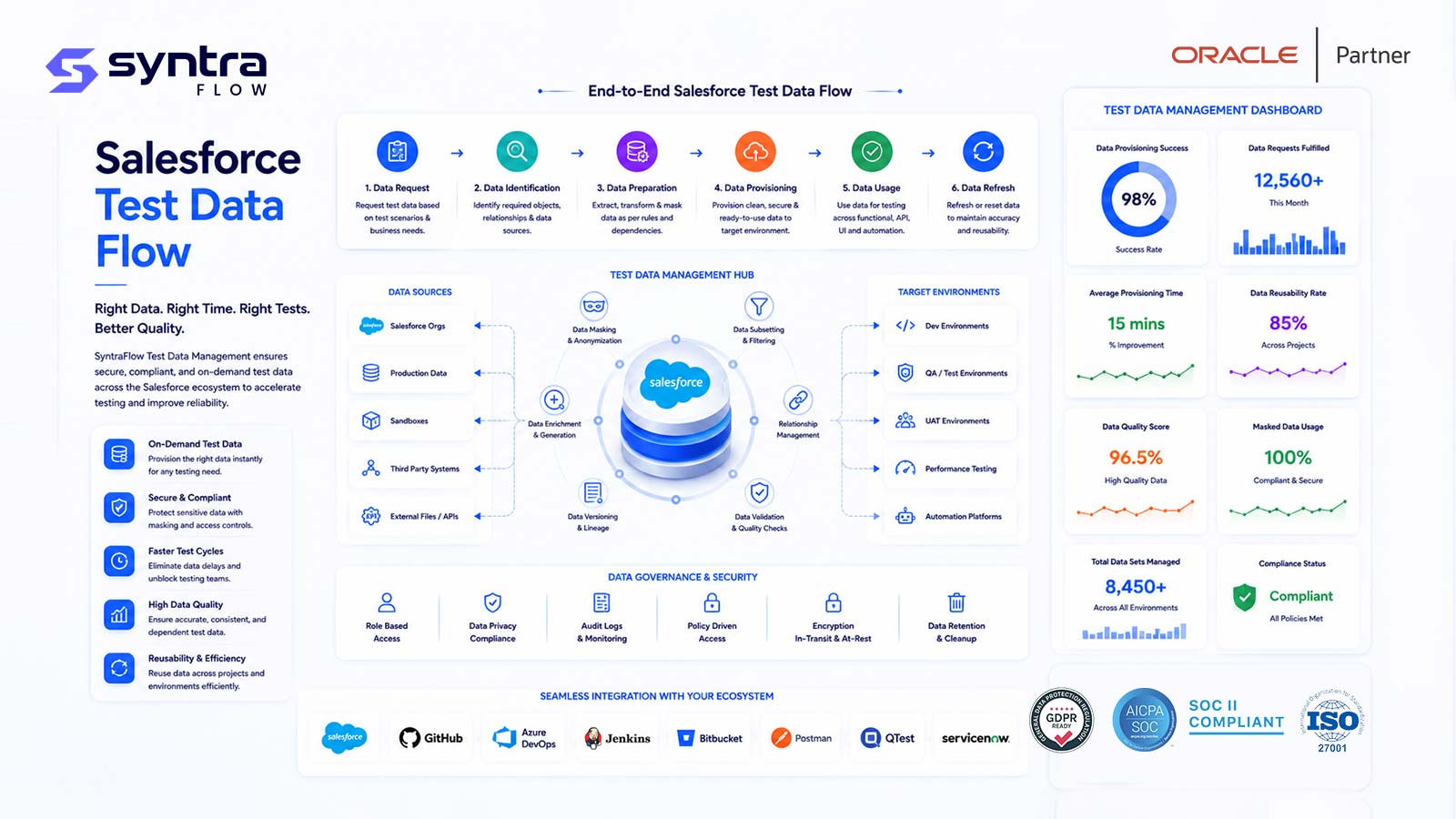
Test data is business records, not configuration
This page is about test data: the Accounts, Contacts, Opportunities, Cases, Quotes, Orders and custom-object rows your tests read and write. That is deliberately different from metadata, which is the configuration and components that define your org — objects, fields, Flows, Apex, permission sets, profiles and validation rules.
The distinction matters because the two are managed with different tools and different risks. Metadata moves through source control and deployments; a test-data problem is usually a missing related record, a masked field that broke referential integrity, or two parallel runs colliding on the same row. When you need to understand, compare or track the configuration side, see Salesforce Metadata Intelligence. This page focuses exclusively on the records that flow through that configuration.
Test data management sits alongside the rest of the practice: it feeds Salesforce test automation, supports every seasonal release cycle, and even supplies the grounding records that Agentforce testing needs, because agents reason over real data too.
The Salesforce test-data challenge
Salesforce data models are deeply relational, privacy-sensitive and large. Getting the right records into the right environment — safely, repeatably and without collisions — is one of the hardest parts of a Salesforce quality program.
Empty or stale sandboxes
Developer and Developer Pro sandboxes copy metadata but little or no data. Teams start against empty orgs, or against data that has drifted far from what production looks like today.
Incomplete record relationships
A single Opportunity is useless without its Account, Contacts, Products, Price Book entries and owner. Hand-built data almost always misses a required lookup, and the test fails for the wrong reason.
Production-data privacy
Copying raw production records into sandboxes spreads real customer names, emails, phone numbers and financial details to environments with looser access controls — a serious privacy exposure.
Large data volumes
Full sandboxes can hold hundreds of millions of rows. Refreshing, seeding and querying at that scale is slow, and most tests only need a carefully chosen slice, not the whole org.
Test-data collisions
When several suites share one sandbox, one test edits or deletes a record another test depends on. Flaky, order-dependent failures follow, and nobody trusts the results.
Reusable scenario requirements
Regression needs the same scenarios every run: a renewal-ready contract, an escalated case, a partial return. Rebuilding these by hand each cycle is slow and inconsistent.
CPQ dependencies
Salesforce CPQ layers Quotes, Quote Lines, discount schedules, product rules and price rules on top of standard objects. Valid CPQ test data requires a full, consistent configuration-plus-record chain.
Account-Contact-Opportunity chains
The core sales model spans Accounts, Contacts, Opportunities, Opportunity Contact Roles and teams. Breaking any link produces data that looks fine but behaves nothing like production.
Cases & entitlements
Service Cloud testing needs Cases wired to Entitlements, Milestones, Service Contracts and Assets so that SLA timers, escalation rules and entitlement processes actually fire.
Integration identifiers
External IDs, correlation keys and cross-system references must line up so that integration and end-to-end tests can match a Salesforce record to its counterpart in an ERP, billing or portal system.
Data Cloud considerations
Data Cloud ingests, unifies and segments data across sources. Testing Data Cloud-driven behavior means provisioning consistent source records — an emerging area SyntraFlow treats as roadmap.
Cleanup and parallel runs
Data created by one run has to be reset or removed before the next, and multiple parallel runs must stay isolated so a shared sandbox does not become a shared source of failures.
The test-data lifecycle
SyntraFlow is designed to manage Salesforce test data as a repeatable lifecycle rather than a one-off copy. Each stage keeps data useful, safe and isolated from the runs around it.
Identify scenario requirements
Start from the test, not the table. Define what each scenario needs — a renewal-ready account, an escalated case, a multi-line quote — so provisioning targets business outcomes.
Discover required object relationships
Walk the object graph to find every parent, child and lookup a scenario touches, so no required related record is missed before data is built.
Select or generate records
Choose an existing subset from a source org or generate synthetic records that satisfy field rules, picklists and validation logic for the scenario.
Mask sensitive information
Where real records are used, replace personal, financial and commercial fields with realistic but non-identifying values before the data ever reaches a lower environment.
Preserve referential integrity
Keep relationships intact through selection and masking so foreign keys, external IDs and rollups still resolve, and masked values stay consistent across every record that shares them.
Provision data into the test environment
Load the prepared set into the target sandbox or scratch org in dependency order, so parents exist before children and every insert succeeds.
Reserve or isolate datasets
Assign records to a specific run so parallel suites do not read or modify each other's data, removing a major source of flaky, order-dependent failures.
Execute tests
Run automated or manual tests against data that is complete, realistic and reserved, so a failure points to a defect rather than to missing or corrupted records.
Validate results
Check that records ended in the expected state — stages advanced, cases closed, rollups recalculated — confirming the data behaved as the scenario intended.
Reset, refresh or clean up
Return the environment to a known baseline — roll data back, refresh a scenario pack, or remove run-created records — so the next cycle starts clean.
Test-data capabilities
The following capabilities are designed for Salesforce test data and are available for demonstration and proof-of-concept validation. Each describes what it does, why it matters and the Salesforce components it touches.
Test-data discovery
Designed to map the object graph behind a scenario — parents, children and lookups — so teams know exactly which records a test requires before any data is built or copied.
Synthetic data generation
Designed to generate realistic records that respect field types, picklists and validation rules, giving teams safe data with no production exposure for Accounts, Contacts, Opportunities and custom objects.
Production data subsetting
Designed to extract a small, coherent slice of a source org — a handful of accounts and everything related — so lower environments get realistic data without the cost of a full copy.
Data masking
Designed to replace personal, financial and commercial field values with realistic substitutes, so sandboxes and CI orgs never hold real customer or employee information.
Relationship preservation
Designed to keep foreign keys, external IDs and rollups consistent through subsetting and masking, so provisioned data behaves like production rather than a broken fragment of it.
Sandbox seeding
Designed to load a curated baseline into a fresh or refreshed sandbox so developer and Developer Pro orgs start with usable data instead of an empty shell.
Scenario-based data packs
Designed to bundle the records for a named scenario — renewal, escalation, partial return — into a reusable pack so every regression run starts from the same known state.
On-demand provisioning
Designed to provision a scenario pack into a target org when a pipeline or tester requests it, so data is ready exactly when a run needs it rather than prepared days ahead.
Data reservation
Designed to lease specific records to a single run, preventing two suites from editing the same Account or Case and removing a common cause of intermittent failures.
Parallel-run isolation
Designed to partition data across concurrent runs so many pipelines can share one sandbox while each works on its own isolated dataset.
Data reset
Designed to return records to a known baseline between runs so state left by one execution never leaks into the next and results stay repeatable.
Data cleanup
Designed to remove records created during a run in correct dependency order, keeping sandboxes lean and avoiding the slow drift toward bloated, unusable orgs.
Cross-system data alignment
Designed to keep a customer or order consistent across Salesforce and connected systems such as an ERP, so end-to-end tests match the same entity on both sides.
Audit logging
Designed to record what data was generated, masked, provisioned and cleaned up, giving teams a traceable history of how test data was handled across environments.
Salesforce object relationships
Realistic Salesforce test data is rarely a single row. A useful scenario spans a chain of related standard and custom objects. The tables below show representative sales, service and custom relationships — not every customer uses the same data model, so treat these as a starting pattern rather than a fixed template.
Sales & commerce chain
| Object | Typical relationship | Why the test needs it |
|---|---|---|
| Account | Root of the customer graph | Anchors ownership, hierarchy and most downstream records. |
| Contact | Child of Account | Provides people for roles, approvals and communications. |
| Opportunity | Related to Account, with Contact Roles | Drives stage, forecast and sales-process automation. |
| Product | Referenced by line items | Defines what is being sold and its attributes. |
| Price Book | Links Products to prices | Supplies valid pricing entries for quotes and orders. |
| Quote | Child of Opportunity | Carries pricing, discounts and approval state. |
| Quote Line | Child of Quote, references Product | Holds per-product quantity, price and discount detail. |
| Contract | Related to Account and Opportunity | Governs terms, renewals and downstream orders. |
| Order | Related to Contract and Account | Represents fulfillment and often integrates with an ERP. |
Service chain
| Object | Typical relationship | Why the test needs it |
|---|---|---|
| Case | Related to Account and Contact | Triggers assignment, escalation and entitlement processes. |
| Entitlement | Related to Account and Case | Drives SLA milestones and support eligibility. |
| Asset | Related to Account and Product | Represents the installed product a case or work order concerns. |
| Work Order | Related to Case, Asset and Account | Coordinates field service actions tied to a case. |
Custom objects
Most orgs extend the standard model with custom objects — for example a Subscription__c linked to Account and Contract, a Usage__c record rolling up to a subscription, or a Claim__c tied to a Case. Test data has to include these custom relationships and their master-detail or lookup constraints, or automation built on them will not fire. Because every org's custom schema differs, test-data discovery inspects the actual object graph rather than assuming a fixed shape.
Synthetic vs masked data
Two safe sources of test data serve different needs. Choosing well — and never copying raw production data — keeps tests both realistic and compliant.
Generate synthetic data when…
You need specific scenarios that may not exist in production, you want zero exposure to real personal or commercial data, or you are seeding a brand-new object or feature that has no history yet.
Synthetic records are built to satisfy field rules and relationships from scratch, so they carry no privacy risk and can model edge cases — a five-year renewal, a maximum-discount quote — that are rare or absent in live data.
Mask a subset when…
You need the statistical shape, volume and messiness of real data — realistic distributions, legacy quirks and long-tail values — that synthetic generation is unlikely to reproduce faithfully.
A masked subset takes a coherent slice of a source org and replaces sensitive fields with realistic substitutes, preserving relationships so the data behaves like production without being production.
Why copying raw production data is risky
A direct production copy carries real customer names, emails, phone numbers, financial figures and commercial terms into environments with broader access and weaker controls. It multiplies the number of places sensitive data can leak from, complicates data-minimisation and retention obligations, and often exceeds sandbox size limits. Masking or synthesis removes the sensitive content while keeping the data useful — which is why raw copies should be avoided even when they seem convenient.
Coordinated data across every system in the process
Salesforce rarely runs a business process alone. A true end-to-end test needs the same entity to exist consistently in every system it touches — and that is where SyntraFlow's cross-system heritage sets it apart.
Consider a quote-to-cash flow. The same customer and order must line up across Salesforce and an Oracle ERP so that an order created in Salesforce can be found, priced and fulfilled downstream. If the account exists in Salesforce but not in the ERP — or the external IDs disagree — the end-to-end test fails on plumbing, not on a real defect.
SyntraFlow is designed to provision and align coordinated test data across Salesforce, Oracle ERP, SAP, Workday, NetSuite, MuleSoft, data warehouses, payment providers and customer portals — so shared identifiers match on every side and end-to-end scenarios exercise the real integration path.
SyntraFlow is Oracle-native and expanding into Salesforce, so this cross-system coordination reflects genuine depth in enterprise back-office testing. Explore the counterpart discipline in the Oracle ERP testing tool.
Privacy & compliance
Test data management is as much a privacy control as a testing tool. SyntraFlow is designed to help teams keep sensitive information out of lower environments while still testing against realistic data.
Personal information (PII)
Names, emails, phone numbers and addresses are designed to be masked or synthesised so no real individual is identifiable in a test org.
Financial information
Amounts, account references and commercial terms can be substituted with realistic values, keeping sensitive figures out of shared environments.
Health information where applicable
For orgs that hold health-related fields, those values are designed to be masked so they never propagate into testing environments.
Data minimisation
Subsetting provisions only the records a scenario needs, reducing how much data — sensitive or otherwise — ever leaves the source org.
Role-based access
Designed to work with role-based controls so that who can generate, mask, provision or view test data can be governed centrally.
Retention & audit logging
Designed to support retention limits and to log how data was generated, masked and cleaned up, giving teams a traceable record of handling.
SyntraFlow does not claim any specific compliance certifications on this page. For platform-level security details, see SyntraFlow security.
Recommended next steps
Dive deeper into each part of Salesforce test data management. These focused guides expand on the capabilities above.
Outcomes teams aim for
With test data managed as a lifecycle, Salesforce quality programs are designed to move toward outcomes like these.
Reliable, repeatable tests
Every run starts from a known, complete data state, so failures reflect real defects instead of missing or corrupted records.
Improved test-data availability
Scenario packs and on-demand provisioning mean testers wait less for the right data and rebuild it by hand far less often.
Protected sensitive data
Masking and synthesis keep real personal, financial and commercial information out of sandboxes and CI orgs.
Parallel execution without collisions
Reservation and isolation let many suites share a sandbox while each works on its own dataset, removing a major source of flakiness.
Better cross-system visibility
Aligned identifiers across Salesforce and connected systems make end-to-end tests exercise the real integration path.
Cleaner, leaner environments
Reset and cleanup keep sandboxes from drifting into bloated, unusable states over successive cycles.
Test data management FAQs
Common questions about managing Salesforce test data.
What is Salesforce test-data management?
It is the practice of preparing, protecting and provisioning the business records that Salesforce tests need — discovering required object relationships, generating or subsetting records, masking sensitive fields, loading data into an environment, isolating it per run, and cleaning it up afterward so tests are realistic, safe and repeatable.
Why should production Salesforce data not be copied directly?
A raw copy spreads real customer, employee and commercial data into environments with broader access and weaker controls, multiplying where it can leak from and complicating data-minimisation and retention obligations. It is also often too large for sandbox limits. Masking or synthesising the data removes the sensitive content while keeping it useful.
What is synthetic Salesforce test data?
Synthetic test data is records generated from scratch to satisfy field types, picklists, validation rules and relationships, without deriving from any real record. It carries no privacy risk and can model rare or edge-case scenarios — such as a maximum-discount quote or a long-term renewal — that may not exist in production.
How does Salesforce data masking work?
Masking replaces sensitive field values — names, emails, phone numbers, financial figures — with realistic but non-identifying substitutes before data reaches a lower environment. Consistent masking keeps the same input mapped to the same output across records, so relationships and external IDs stay intact and the data still behaves like production.
Can related Salesforce records be preserved during subsetting?
Yes. Subsetting is designed to walk the object graph so that when it selects an Account it also brings the related Contacts, Opportunities, Quotes and custom-object rows, preserving foreign keys and referential integrity so the slice behaves like a coherent piece of production rather than a broken fragment.
Can test data be provisioned on demand?
Yes. Scenario-based data packs are designed to be provisioned into a target sandbox or scratch org when a pipeline or tester requests them, so the right data is loaded exactly when a run needs it rather than being prepared and left to drift ahead of time.
How is test data isolated for parallel execution?
Data reservation leases specific records to a single run, and parallel-run isolation partitions datasets across concurrent runs. Together they let many suites share one sandbox while each works on its own data, removing the collisions that cause flaky, order-dependent failures.
Can SyntraFlow coordinate Salesforce and ERP test data?
Yes. SyntraFlow is designed to provision and align coordinated data across Salesforce and connected systems such as Oracle ERP, SAP, Workday, NetSuite and MuleSoft, so a shared customer or order matches on every side and end-to-end tests exercise the real integration path. See the Oracle ERP testing tool.
What is sandbox seeding?
Sandbox seeding loads a curated baseline of data into a fresh or refreshed sandbox. Because developer and Developer Pro sandboxes copy metadata but little or no data, seeding gives those orgs usable records to test against instead of starting from an empty shell.
What is the difference between Salesforce metadata and test data?
Metadata is configuration — objects, fields, Flows, Apex, permission sets and profiles that define how the org behaves. Test data is the business records that flow through that configuration, such as Accounts, Cases and Orders. This page covers test data; for the configuration side, see Salesforce Metadata Intelligence.
Give every test the right data
See how SyntraFlow is designed to prepare, protect and provision Salesforce test data across sandboxes, regression suites and end-to-end runs.