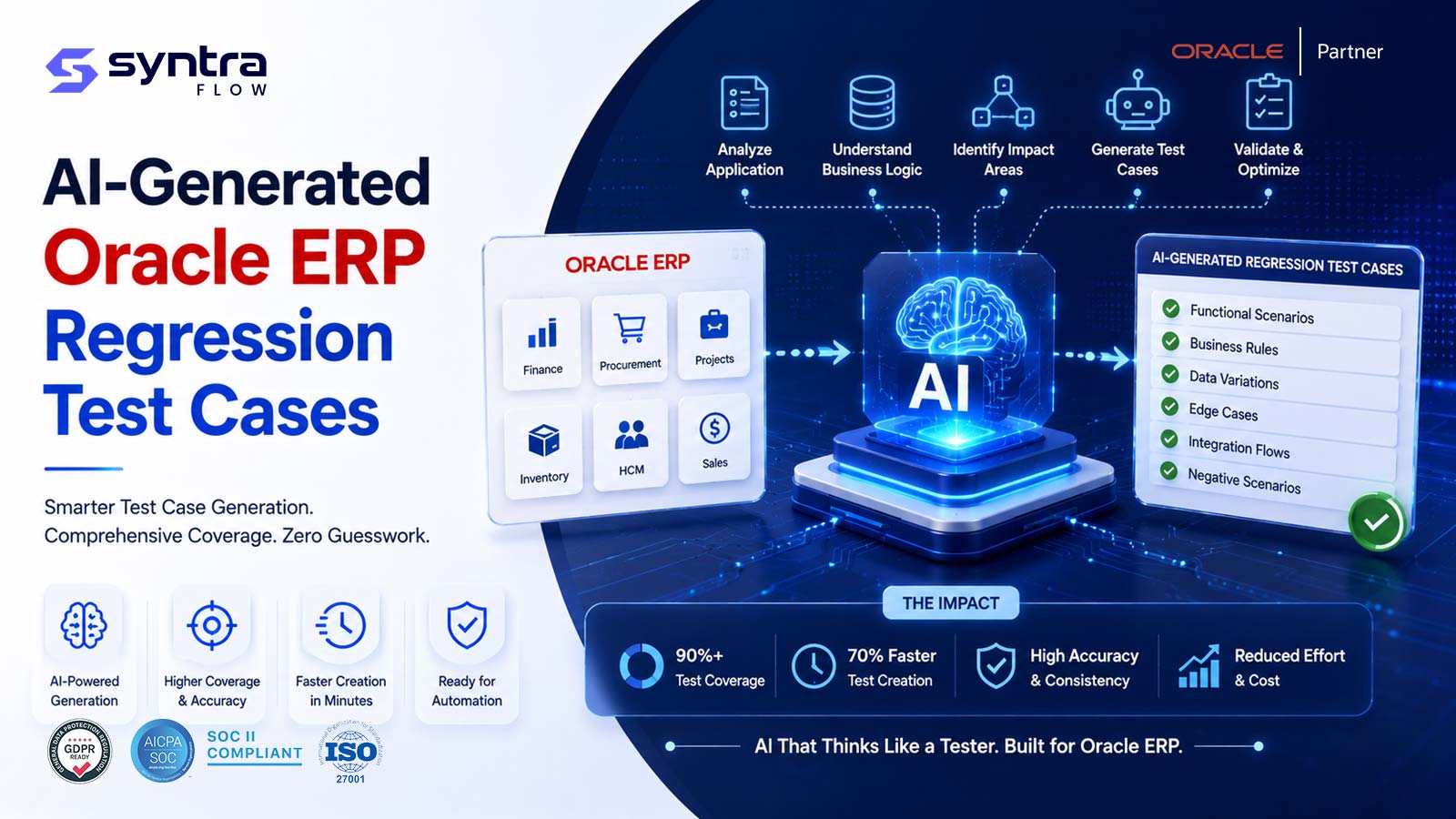
AI generates Oracle ERP regression test cases by reading the structured artifacts that already describe how your system behaves — business-process flows, configuration and setup data, quarterly release notes, REST API definitions, and the Redwood page structure — and turning them into executable scenarios with steps, test data, and expected outcomes. Instead of a human analyst hand-writing every Procure-to-Pay or Record-to-Report path, the AI infers the paths from these inputs, proposes the assertions that matter, and drafts the negative and boundary cases people usually skip. The important nuance: this is not magic, and it is not autonomous sign-off. AI produces a first draft of a regression suite at a scale and speed no manual team can match, and a human still validates the high-risk cases before they become the safety net your quarterly updates depend on.
This guide explains the practical mechanics — what the AI reads, how it converts each input into a scenario, what a genuinely good generated test looks like, and where the technique breaks down and needs people. It is a methodology guide, not a product tour. Where relevant we point to how SyntraFlow's Oracle ERP testing platform embodies these ideas, but the concepts apply whatever tool you use.
Last reviewed: 19 July 2026
One distinction up front, because the terminology collides. "AI and Oracle testing" now means two completely different things. This article is about AI generating the regression tests you run against Oracle Fusion — the test tooling is the AI. That is separate from testing Oracle's own AI agents — validating that the Payables Agent or an Agent Studio flow behaves within policy. Those agents are probabilistic systems that demand a different validation philosophy, covered in our guide to testing Oracle AI agents and in the Oracle AI agent testing gap. Keep the two ideas apart as you read: here, the AI writes the tests; it is not the thing under test.
The manual test-authoring problem
Oracle Fusion Cloud ships updates on a quarterly cadence — 26A, 26B, 26C, and the upcoming 26D — plus optional monthly maintenance packs in between. Each release can touch UI layouts, add fields, change defaulting logic, alter APIs, and introduce new features that Oracle turns on by default. A regression suite exists to answer one question after every one of those events: did anything that used to work stop working? To answer it credibly, the suite has to cover your critical business flows end to end, with real configuration and real data.
Hand-authoring that coverage does not scale, for reasons that compound:
- Combinatorics. A single Procure-to-Pay flow branches by business unit, currency, tax rule, approval hierarchy, item type, and matching tolerance. Writing one "happy path" script captures a fraction of the real surface area. Covering the branches by hand is weeks of analyst time per process.
- Perishability. A script written against a specific Redwood page breaks the moment Oracle restructures that page. Manually maintained suites spend more effort on repair than on new coverage, and teams quietly let coverage rot to keep the maintenance bill down.
- The quarterly clock. Oracle's readiness material for a release lands only weeks before it reaches your production pod. Hand-authoring net-new tests for every changed area inside that window is simply not feasible for most teams, so they test what they had time for — not what actually changed. That gap is exactly what traditional regression misses across Oracle quarterly updates.
- Knowledge concentration. The people who know which flows are business-critical are usually the ones least available to write test scripts. Coverage ends up reflecting who had time, not what carries risk.
The result is familiar: suites that are simultaneously too small (missing branches and negative paths) and too fragile (breaking on cosmetic UI changes). AI-generated test cases attack both problems by moving authoring from a manual craft to a generation-and-review workflow — the machine drafts broadly and fast, and human effort concentrates on judgement rather than typing.
What AI reads to generate tests
AI does not invent Oracle knowledge out of thin air, and you should be suspicious of any tool that claims to. Good generation is grounded: the AI reads concrete artifacts that describe your specific environment and Oracle's specific behaviour, then reasons over them. There are five input sources that matter most, and understanding them tells you both what the technique can do and where its blind spots are.
1. Business-process structure
The backbone of any regression suite is the set of end-to-end processes you run: Procure-to-Pay, Order-to-Cash, Record-to-Report, Hire-to-Retire, and their sub-flows. AI reads process structure from whatever you can give it — a process catalog, BPM diagrams, an existing (even partial) test inventory, or recorded sessions of a user performing the flow. From that, it infers the sequence of steps, the decision points where a flow branches, and the hand-offs between modules (for example, a purchase order in Procurement becoming an invoice in Payables becoming a payment in Cash Management). Process structure is what lets the AI generate a scenario — a coherent journey with a business goal — rather than a disconnected click sequence.
2. Configuration and setup data
Two Oracle tenants running the same module behave differently because their setup differs. Business units, ledgers, legal entities, chart-of-accounts structures, approval rules, payment terms, tax configuration, item and supplier attributes, descriptive flexfields — all of it shapes which paths are valid and what the expected outcome is. AI that reads your configuration (via setup export, BI Publisher extracts, or REST reads of setup objects) can generate tests that reflect your reality: the right business units, the approval chain that actually applies, the tolerance that will trigger a hold. Without configuration awareness, generation produces generic Oracle tests that fail on your instance for reasons that have nothing to do with defects. This is also why generated suites are environment-specific and should not be blindly copied between tenants.
3. Release-note changes
Oracle's quarterly readiness content — the "What's New" and feature documentation for each release — is the single most valuable input for targeted regression. It describes, feature by feature, what is changing: new fields, changed defaulting, features enabled by default, deprecated behaviour, and UI updates. AI that parses release notes can do something a manual team rarely has time for: map each announced change to the business processes and existing tests it could affect, then generate new or updated cases specifically for the delta. This is the difference between re-running last quarter's suite and actually testing what changed. Connecting release signals to test planning this way is the core idea behind Oracle release intelligence. Always confirm the specifics against Oracle's own Readiness / What's New material for your release, because generation from release notes is only as accurate as the notes it reads.
4. REST API definitions
Oracle Fusion exposes a large catalog of REST APIs with published schemas describing resources, fields, data types, required attributes, and allowable values. These definitions are a goldmine for generation because they are precise and machine-readable in a way UI layouts are not. From an API schema, AI can generate: data-setup steps (create the supplier, PO, or employee a UI test needs), API-level assertions (confirm the invoice reached the expected status without navigating a screen), and boundary cases derived directly from field constraints (maximum lengths, required-field omissions, invalid enum values). API-grounded tests are also more durable than UI-grounded ones — a REST resource changes far less often than a Redwood page — which is why mature generated suites lean on APIs for setup and verification wherever a business outcome can be checked at the data layer.
5. Redwood UI structure
Much of Oracle Fusion is still driven and validated through the Redwood interface, so the AI has to read the UI too. Rather than recording brittle coordinate- or index-based locators, effective generation parses the page's semantic structure — component roles, labels, ARIA attributes, and stable identifiers — to build resilient element references. Understanding Redwood's structure lets the AI generate steps that survive cosmetic changes (a field moving position, a restyled button) and lets it recognise the same logical field even when the page is re-laid-out in a new release. Redwood awareness is also what makes self-healing possible: when a locator drifts, an AI that understands page structure can re-identify the element instead of failing outright.
How AI turns those inputs into regression scenarios
The step that matters is the transformation: taking each input signal and producing a concrete, runnable test case — steps, data, and an expected outcome expressed as a business result, not just a screen state. The table below shows the pattern for common inputs. The scenario descriptions are illustrative examples of the shape of generated output, not fixed templates.
| Input signal | What the AI reads | Generated regression scenario (illustrative) | Primary assertion |
|---|---|---|---|
| Business-process flow | Procure-to-Pay sequence and its module hand-offs | Create PO → receive goods → match invoice → approve → pay, for a standard business unit | Payment posts and PO/invoice/payment amounts reconcile |
| Configuration / setup | Two-way vs three-way matching tolerance set for the BU | Submit an invoice exceeding tolerance against its PO | Invoice goes on hold with the correct hold reason, not auto-approved |
| Release-note change | A 26x feature enabled by default that adds a field or changes defaulting | Run the affected flow with and without the new field populated | Prior behaviour is preserved; the new field defaults and validates as documented |
| REST API definition | Supplier resource schema — required fields, field lengths, allowed values | Attempt to create a supplier omitting a required attribute and with an over-length name | API returns the expected validation error; no partial record is created |
| Redwood UI structure | Semantic layout of the Manage Invoices page | Navigate, enter a distribution, and save using stable label-based references | Record saves and the entered values persist on reload |
| Approval configuration | Multi-tier approval hierarchy and dollar thresholds | Submit transactions just below and just above each threshold | Routing matches the configured approver at each tier |
Three things are worth noticing about this transformation. First, one input often yields several scenarios — a single tolerance setting produces a within-tolerance case, an over-tolerance case, and an exactly-at-boundary case. Multiplying inputs into cases is precisely the leverage AI brings. Second, the strongest scenarios combine inputs: process structure gives the journey, configuration gives the branch, and an API gives the data setup and the assertion. Third, generation prioritises. A tool worth using does not dump every conceivable permutation on you; it ranks candidate scenarios by risk and change impact — which is where AI-driven script selection earns its keep, choosing which generated cases to run for a given release rather than running everything every time.
What good AI-generated test cases look like
Generation volume is easy; generation quality is the hard part. A tool can emit a thousand test cases overnight and leave you no safer than before if those cases only click through screens and assert that no error dialog appeared. Use these four criteria to judge whether generated cases are actually worth adding to your regression suite.
Coverage that follows risk, not convenience
Good generated coverage maps to your critical business processes and their meaningful branches, weighted toward what carries financial, compliance, or operational risk. A period-close posting or a payment run deserves deeper generated coverage than a rarely used inquiry screen. Coverage should be visible and explainable — you should be able to see which processes and branches are covered and which are not, so gaps are a decision rather than an accident.
Assertions on business outcomes, not just UI state
This is the single most important quality signal. A weak generated test asserts "the page saved without error." A strong one asserts the business outcome: the invoice reached Validated status, the accounting entry hit the correct account with the correct amount, the payment reconciled against the PO, the tax was calculated at the right rate. Business-outcome assertions are what catch the silent regressions that matter — a defaulting change that posts to the wrong account will happily save without any UI error. Prefer generated cases that verify results at the data or API layer, and be sceptical of suites whose assertions are almost all "element is visible."
Realistic, isolated test data
A generated case is only reliable if it controls its own data. Good generation includes setup steps (create the supplier, PO, or employee it needs, ideally via API) and, where appropriate, teardown — so the case can run repeatedly without colliding with itself or with other tests. Data should be realistic for the configuration: valid business units, currencies, and tax codes that actually exist in the target environment. Cases that depend on pre-existing "magic" records that may or may not be present are a common source of false failures.
Negative and boundary cases, not just happy paths
The cases humans skip under time pressure are exactly the ones AI is well suited to generate at scale: the over-tolerance invoice, the missing required field, the amount one cent above an approval threshold, the invalid date, the duplicate submission. API schemas and configuration thresholds give the AI precise, defensible boundaries to test against. A generated suite that is all happy path is doing the easy half of the job; the negative and boundary cases are where regressions most often hide.
| Quality check | Weak generated case | Strong generated case |
|---|---|---|
| Assertion depth | "Page saved, no error shown" | "Invoice = Validated; distribution posted to account 5100 for £15,000" |
| Data handling | Relies on an existing record being present | Creates its own supplier/PO via API, then tears down |
| Path type | Happy path only | Happy path + over-tolerance + missing-field + boundary amount |
| Locators | Positional / index-based, breaks on relayout | Label- and role-based, survives cosmetic Redwood changes |
| Traceability | No link to a process or requirement | Tagged to the process, BU, and the release change that prompted it |
The critical step: validating AI-generated cases
Here is the rule that separates teams who benefit from AI-generated tests from teams who get burned by them: never blind-trust generated cases. AI can misread configuration, assume a defaulting rule that does not apply to your setup, assert an outcome that is plausible but wrong, or generate a "boundary" that is not actually a boundary in your instance. An unvalidated generated suite that passes tells you nothing — it may be asserting the wrong thing consistently. Generation gives you a draft; validation makes it a control.
Validation does not mean re-reviewing every case with equal effort — that would erase the time savings. It means risk-tiering review so scrutiny lands where the cost of a wrong test is highest:
- Tier 1 — high-risk, mandatory human review. Cases covering financial posting, payments, tax, period close, statutory or regulatory reporting, and anything touching audit-relevant controls. A subject-matter expert confirms the expected outcome is genuinely correct for your configuration before the case is trusted. Treat regulatory-adjacent assertions (for example VAT/withholding logic or statutory file formats) as confirm-against-the-authority items rather than accept-as-generated.
- Tier 2 — medium-risk, sampled review. Core operational flows without direct financial posting. Review a representative sample; if the sample is sound, accept the batch and spot-check the rest.
- Tier 3 — low-risk, lightweight review. Inquiry screens, navigation, and non-critical UI validation. A quick sanity pass is enough; the downside of an imperfect case here is low.
A practical validation checklist for each case under review:
- Is the expected outcome correct for this environment's configuration — not Oracle's generic default?
- Does the assertion check a business result, or just that a screen rendered?
- Is the test data valid and self-contained, and does the case clean up after itself?
- For release-driven cases: does it actually exercise the announced change, and does the change match Oracle's readiness documentation?
- Would a real defect in this area cause this case to fail? (If nothing you break makes it fail, the assertion is too weak.)
A useful way to build confidence quickly is deliberate fault injection on a sample: change a configuration value or introduce a known-bad transaction and confirm the relevant generated cases fail as they should. A suite that stays green when you have intentionally broken something is worse than no suite, because it manufactures false assurance. Validation is the step most vendors gloss over; treat any "fully automated, no review needed" claim as a red flag.
Keeping generated suites current across updates
Generating a suite once is a project; keeping it current is the actual value. Oracle's quarterly cadence means a suite that was accurate for 26B can be partially stale for 26C. AI helps on both sides of currency — repairing what drifts, and extending coverage to what changed.
Self-healing for cosmetic drift. When a Redwood page is re-laid-out and a locator no longer resolves, an AI that understands page structure can re-identify the element by its label and role and update the reference, instead of the whole case failing. This turns most UI-change breakage from a maintenance ticket into a silent, logged repair — the mechanism behind autonomous, self-healing test execution. Self-healing should be transparent: every auto-repair recorded so a human can review whether the change was cosmetic (heal it) or behavioural (investigate it).
Change-driven regeneration. Cosmetic healing is not enough when Oracle changes behaviour. When a release alters defaulting, adds a mandatory field, or enables a feature, the correct response is to generate new cases for the delta and flag existing cases whose expected outcomes may no longer hold. Feeding each release's readiness content back into generation, and mapping announced changes to the affected tests, is what keeps the suite testing current reality rather than last quarter's. This release-to-test loop is the heart of a regression testing approach built for Oracle's update model, and it is where release intelligence and test planning meet.
- Before a release reaches production: parse the readiness notes, map changes to existing coverage, generate delta cases, and run the impacted subset in a test pod.
- When locators drift: let self-healing repair cosmetic changes and log them for review.
- When behaviour changes: regenerate affected cases and route Tier-1 items back through human validation before trusting them.
- Continuously: retire cases for deprecated features so the suite does not accumulate dead weight.
Limitations and where humans stay essential
An honest guide names the ceiling. AI generation is powerful for breadth, speed, and maintenance, but it has real limits, and the teams that succeed design their process around them rather than pretending they do not exist.
- It cannot know intent it was never given. AI reads what your configuration and processes do, not what your business meant. A control that exists for a regulatory reason, an undocumented workaround, or a "this must never happen" rule that lives only in someone's head will not be generated unless a human supplies it.
- Expected-outcome correctness needs an SME. The AI can produce a well-formed assertion that is confidently wrong for your setup. Deciding whether an outcome is correct — not merely consistent — is human judgement, especially for financial and statutory results.
- Novel and cross-system flows are hard. Brand-new processes with no prior structure to read, and end-to-end journeys spanning Oracle plus third-party systems, still benefit heavily from human design. AI extends and maintains these better than it invents them.
- Grounding quality caps output quality. Generation is only as good as its inputs. Sparse configuration access, missing process documentation, or thin release notes all degrade the result. Garbage in, plausible-looking garbage out.
- Risk prioritisation is a business call. A tool can rank by change impact, but which processes are truly business-critical — and what an acceptable coverage gap is — is a decision the business owns, not the model.
The right mental model is a strong drafting partner, not an autonomous author. AI removes the mechanical burden — the typing, the permutations, the locator maintenance — so your experts spend their scarce time on judgement: what to cover, whether an outcome is right, and what risk you are willing to carry. That division of labour is also why AI test generation stays distinct from the broader discipline of AI in Oracle testing and, again, from validating Oracle's own agentic features — different problems, different techniques.
Request the Oracle regression-generation readiness checklist
We maintain a one-page checklist that pulls the practical parts of this guide together — the five input sources to make available for grounding, the four quality criteria for judging generated cases, the three-tier validation model, and the per-release currency loop. It is a planning aid you can walk through with your QA and functional teams before you turn generation on. It is available on request rather than as a download: ask for the Oracle regression-generation readiness checklist and we will share it and walk through it with you.
How SyntraFlow helps
Everything above is methodology and applies whatever tooling you choose. SyntraFlow's platform features can be configured to embody it for Oracle Fusion. SyntraFlow can be set up to read your business processes, configuration, release readiness content, REST definitions, and Redwood structure, and from those to generate candidate regression scenarios with business-outcome assertions rather than shallow UI checks. Its AI-driven script selection can prioritise which generated cases to run for a given release, and its autonomous, self-healing execution can absorb the cosmetic UI drift that Oracle's quarterly updates produce.
Two deliberate boundaries. SyntraFlow does not remove human validation — it is designed to route high-risk generated cases to your reviewers, not to sign them off for you, because blind-trusting generated financial or statutory tests is exactly the failure mode this guide warns against. And SyntraFlow's role here is generating and maintaining the tests you run against Oracle; validating Oracle's own AI agents is a related but separate capability. Used with the validation discipline described above, SyntraFlow helps organisations move from hand-authored, perpetually-behind suites to generated, risk-prioritised, self-maintaining coverage that keeps pace with 26C, 26D, and beyond.
If you want to see the generation-and-validation workflow applied to your own processes and configuration, see how SyntraFlow generates Oracle regression coverage — book a working session and we will walk your team through it end to end.
Official Oracle references
- Oracle Fusion Cloud Applications Readiness / What's New
- Oracle Fusion Applications AI
- Oracle Fusion AI — key capabilities