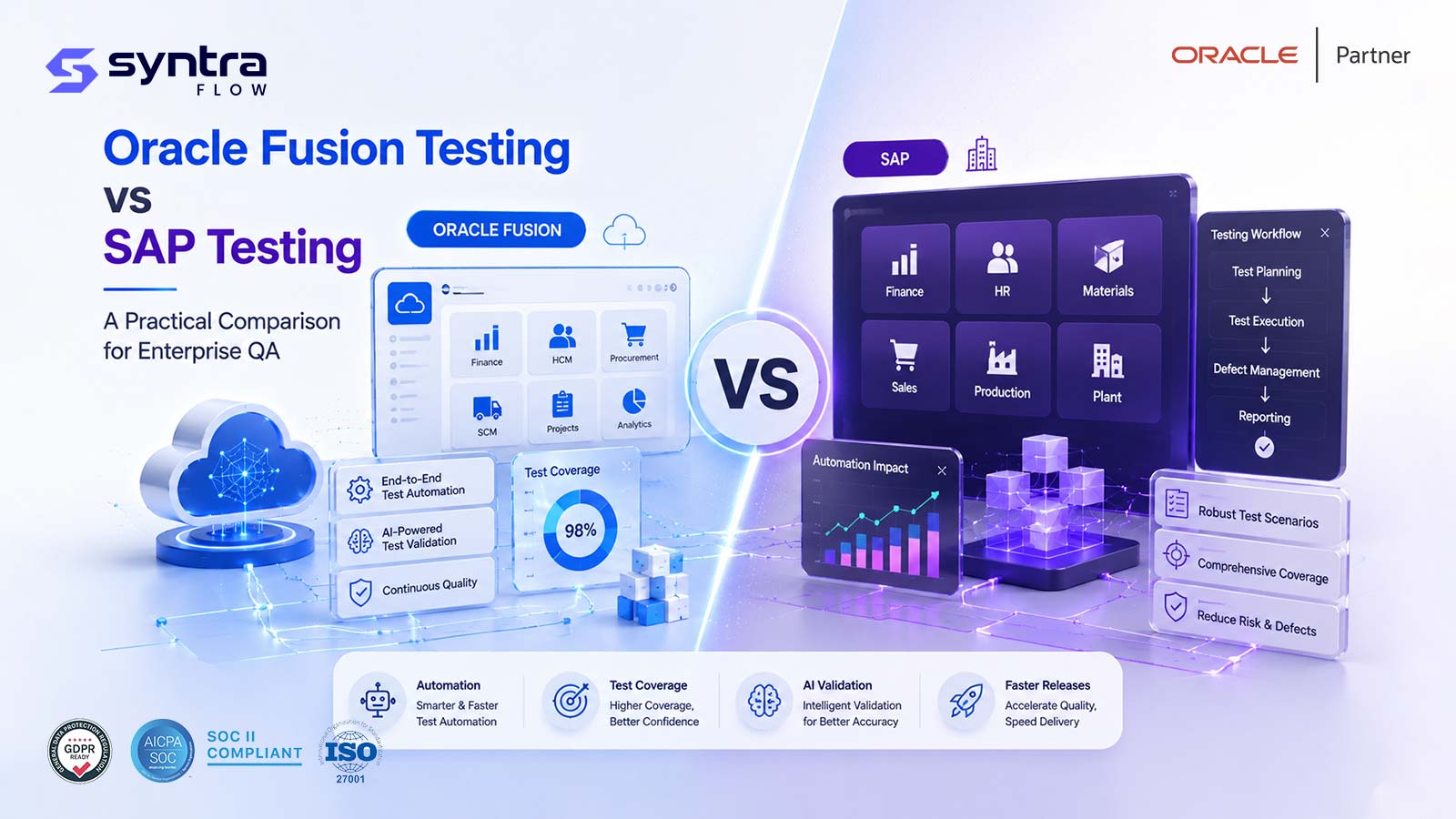
Oracle Fusion Applications and SAP S/4HANA are both continuously evolving cloud ERP platforms, and both demand ongoing regression testing — but the shape of that testing differs because the two vendors update, present, and extend their software in different ways. The single most consequential difference for a QA team is cadence and how change reaches you: Oracle delivers quarterly updates on a fixed calendar (roughly four times a year) that every customer receives, whereas SAP's S/4HANA Cloud model spans public and private editions with their own release and upgrade rhythms. That one distinction ripples into UI stability, automation maintenance, regression scope, and how you staff and budget your QA function.
This guide compares the two platforms fairly and at the level each is publicly documented — Oracle Fusion at the verified detail we work with directly, and SAP at a general, well-established level. One thing up front, stated plainly: SyntraFlow is an Oracle-focused testing platform. We do not test SAP. Where we describe SAP, we describe it generally so an enterprise leader comparing the two can reason accurately; we do not present SyntraFlow as an SAP tool, and where cadence or edition specifics matter to your decision, confirm the current details with the respective vendor. If you run both ERPs — as many large enterprises do after acquisitions or divisional splits — the goal here is to help you set the right test strategy for each rather than forcing one playbook onto both.
Last reviewed: 19 July 2026
In this guide
- Release & upgrade cadence — Oracle quarterly vs SAP major upgrades / continuous
- UI & automation surface — Redwood vs Fiori, and why both challenge brittle automation
- AI in the platforms — embedded agents and what they mean for QA
- Testing complexity & scope
- Business-process differences
- Regression burden per model
- ROI & team implications
- Which model you're in → what it means for your test strategy
- Summary comparison table
Release & upgrade cadence: the difference that shapes everything else
Cadence is where the two platforms diverge most sharply for QA, so it is worth being precise. Oracle Fusion Cloud Applications follow a quarterly update model — Oracle ships named updates (for example 26A, 26B, 26C, 26D) roughly four times a year, and every customer on the SaaS platform receives them on Oracle's schedule. You do not opt out of the functional stream; you schedule when your environments take it within Oracle's window, and you test against Oracle's readiness material for that update. New features arrive as optional (opt-in) capabilities that later become default, so the platform is always moving even between the headline updates.
SAP S/4HANA is best understood as a family rather than a single cadence. SAP S/4HANA Cloud is offered in more than one edition — a public, multi-tenant SaaS edition and a private-edition / customer-managed model — and there is also on-premise S/4HANA. Broadly, the public cloud edition follows a more frequent, standardized upgrade rhythm managed by SAP, while private-edition and on-premise deployments give the customer more control over when they take an upgrade and how long they stay on a given release, within SAP's maintenance windows. Because the exact number of releases per year and the upgrade obligations depend on the edition and contract, confirm the current details with SAP for your specific deployment rather than assuming a single figure.
The practical takeaway is not that one cadence is "better." It is that they impose different testing rhythms. Oracle's fixed quarterly beat means regression is a recurring, calendar-driven event you can plan around every quarter — predictable, but relentless. A private-edition or on-premise SAP landscape can mean fewer, larger upgrade events with more customer discretion on timing — but each event tends to be a bigger, project-scale regression push, often with more custom code (ABAP) to re-validate. Neither is free; they just distribute the work differently across the year.
| Cadence dimension | Oracle Fusion Cloud | SAP S/4HANA (general) |
|---|---|---|
| Update frequency | Fixed quarterly updates (~4x/year), e.g. 26A–26D | Varies by edition — public cloud more frequent/standardized; private & on-prem less frequent, customer-timed (confirm with SAP) |
| Who controls timing | Oracle schedules the stream; customer schedules environment window | Public: largely SAP-managed. Private/on-prem: more customer discretion within maintenance windows |
| Can you skip a functional update? | No — the SaaS functional stream applies to all customers | Depends on edition; private/on-prem allow staying on a release longer (confirm with SAP) |
| New-feature delivery | Opt-in first, then default; documented in Oracle Readiness "What's New" | Delivered via releases/feature packs and SAP release information (confirm current model) |
| Typical regression rhythm | Recurring quarterly regression — smaller, predictable, frequent | Often larger, project-scale regression around upgrade events; frequency varies by edition |
| Custom-code re-validation | Configuration/extension-driven; less classic custom code than legacy on-prem | Can involve significant ABAP custom code, especially private/on-prem landscapes |
For a deeper look at why the quarterly model specifically defeats older, static regression suites on the Oracle side, see our companion analysis of how traditional regression misses the risks in Oracle's quarterly updates.
UI & automation surface: Redwood vs Fiori, and why both punish brittle scripts
Both vendors have modernized their user experience, and both modern UIs create the same fundamental problem for legacy test automation: dynamic, component-based front ends whose underlying markup is not a stable contract you can pin a script to.
Oracle Redwood
Oracle's Redwood design system is the direction Fusion Applications are moving toward across modules. Redwood pages are rendered from a component framework with dynamic, generated DOM structures — element identifiers can shift between updates, components lazy-load, and the same logical field may be reached through different underlying paths depending on context. Scripts built on brittle absolute XPaths or auto-recorded selectors tend to break when Redwood pages are refreshed or when a quarterly update changes the rendered structure. This is exactly why resilient, self-healing location strategies matter so much on Oracle; we cover the specifics on our Oracle Redwood UI testing page.
SAP Fiori
SAP Fiori, built on SAPUI5, is SAP's modern role-based UX for S/4HANA. Fiori applications are likewise dynamic single-page-style front ends. In practice, teams automating Fiori generally lean on SAP's own automation-friendly attributes and tooling designed for the SAPUI5 stack. As with Redwood, automation that depends on positional or brittle locators is vulnerable when apps are updated. The general lesson holds for both platforms: the more the UI is a living, generated surface, the more your automation needs to identify elements by durable, semantic anchors and to self-heal when those anchors move.
A fair way to frame it: Fiori and Redwood are peers in the sense that both are modern, component-driven UIs that reward robust locator strategies and punish recorded, position-based scripts. The difference for QA planning is mostly about how often the surface changes underneath you — which loops back to cadence. On Oracle, the quarterly stream means the Redwood surface can shift up to four times a year for everyone, so self-healing is not a nice-to-have but a baseline requirement.
AI in the platforms: from features to agents
Both vendors are embedding AI deeply into their ERP suites, and both are moving from "AI features" toward agentic capabilities — software that can take multi-step actions within the application's own permissions and approval controls. This matters for QA because an agent that acts is a new thing to test: you are no longer only validating deterministic screens and calculations, you are validating decisions and actions that can vary with context.
Oracle's embedded AI and agents (verified level)
On the Oracle side we can be specific. Oracle AI Agent Studio reached general availability in the 25C update. In 26A, Oracle added MCP tools, external REST tools, REST-API agent access, and Slack and Microsoft Teams channels. In 26B, Oracle's Financials AI agents — Ledger, Payables, Payments, and Expenses — reached general availability alongside the broader Fusion Agentic Applications wave spanning ERP, HCM, SCM, and CX, and Document IO gen-AI invoice ingestion became a default in Payables. In 26C, Oracle introduced Agent2Agent (A2A). Oracle describes the agentic portfolio as "more than 20" specialized agents that operate as coordinated teams inside existing Fusion permissions, policies, and approvals; SCM and HCM capabilities are largely named by function or workspace (for example Design-to-Source, Sourcing Command Center, or Cost Accounting Close) rather than as standalone branded "agents." (The upcoming 26D update has not been released as of this review; treat it only as something to prepare for, and confirm current specifics against Oracle's readiness material.) We go deeper on testing this new surface across our Oracle AI testing hub and specifically on AI agent testing.
SAP's AI (general level)
SAP is investing heavily in embedded AI across its business suite, including a generative-AI assistant and a growing set of AI capabilities positioned to help users act within business processes. SAP has publicly signaled a move toward more autonomous, agentic assistance in its applications as well. Because the exact feature names, availability, and edition coverage evolve quickly, we deliberately keep the SAP picture general here and recommend confirming the current AI roadmap and availability directly with SAP. The important cross-platform point for QA leaders is directional and shared: as both suites add agents, your test strategy has to expand from validating fixed outputs to validating decision behavior within acceptable boundaries — and to re-validating that behavior as the underlying models and features change with each update.
Testing complexity & scope
The scope of ERP testing on either platform is driven by three things: how broad your process footprint is, how much you have configured or extended, and how often the ground moves under you. Both platforms are large, integration-heavy systems where a change in one module can surface in another, so end-to-end business-process testing — not just screen-level checks — is essential on both.
Where the character of the work differs:
- Oracle Fusion concentrates complexity in configuration and extensions against a SaaS core you do not modify at the code level. Much of your regression exposure comes from the quarterly stream changing behavior, defaults, or UI beneath your configured processes. The testing challenge is keeping a living regression suite aligned with a core that updates four times a year.
- SAP S/4HANA, particularly in private-edition and on-premise landscapes, can carry substantial custom code (ABAP) and bespoke integrations. That expands the surface to include custom-object regression, and upgrade events can require re-validating custom developments against the new release — a classic driver of large, project-scale test cycles. Public-cloud SAP reduces some of this by constraining customization, trading flexibility for a more standardized upgrade path.
A useful mental model: Oracle's complexity is more continuous and cadence-driven; SAP's is more variable by edition, ranging from tightly standardized (public cloud) to highly customized (private/on-prem). Estimate your scope from your own footprint and extension level on each platform rather than from a platform stereotype.
| Scope driver | Oracle Fusion Cloud | SAP S/4HANA (general) |
|---|---|---|
| Primary source of change | Quarterly SaaS updates to a shared core | Upgrade events + custom code; frequency varies by edition |
| Customization surface | Configuration & low-code extensions on an unmodified core | Config plus potentially significant ABAP custom code (private/on-prem) |
| Integration testing | Essential — cross-module and external integrations | Essential — often extensive interface/middleware landscape |
| Dominant regression trigger | The calendar (every quarter) | The upgrade project + custom-code changes |
Business-process differences
At the level of end-to-end business processes, the two platforms cover the same enterprise ground — record-to-report, procure-to-pay, order-to-cash, hire-to-retire — but they model and name things differently, and each has its own strengths and process conventions. For QA, the point is not which vendor's process design is superior; it is that your test cases must reflect your configured processes on each platform, because the flows, approval structures, and terminology are not interchangeable.
Practical implications when you run or compare both:
- Test assets do not port across platforms. An Oracle Fusion procure-to-pay test suite is not reusable as an SAP one and vice versa — different data models, screens, and controls. Budget for two libraries, not one.
- Approval and control patterns differ. Both platforms enforce approvals, segregation of duties, and audit controls, but they are configured and surfaced differently, so your control-validation tests are platform-specific.
- Localization and compliance vary by configuration. Statutory and tax processes (for example e-invoicing or payroll compliance in a given country) are handled through each platform's localization framework. Test them as "what does our configured process produce," and confirm the underlying statutory rules against the current authority guidance rather than assuming either platform's defaults are complete.
On the Oracle side, mapping your critical business flows and keeping them continuously covered is exactly what our Oracle ERP testing platform is built around, across AP, P2P, O2C and R2R.
Regression burden per model
Regression is where cadence, UI, and scope all cash out into real QA hours. The two platforms generate regression demand with different shapes, and understanding the shape tells you how to resource it.
Oracle Fusion: continuous, quarterly regression
Because every customer takes the quarterly stream, Oracle regression is a steady drumbeat. Four times a year, you need to know what changed, which of your configured processes are exposed, and where to focus testing before the update becomes default in your environments. The risk with a static, record-and-replay suite is twofold: it breaks on Redwood UI changes (maintenance drag), and it silently misses new-feature or changed-default risk that no one wrote a test for. The winning pattern on Oracle is targeted, change-aware regression — connect knowledge of what the update changes to the subset of tests that matter, rather than re-running everything blindly. That is precisely the premise of connecting Oracle release intelligence to test planning, and of a purpose-built Oracle regression testing tool that self-heals against quarterly UI churn.
SAP S/4HANA: event-driven (and edition-dependent) regression
SAP regression tends to cluster around upgrade and change events, especially in private-edition and on-premise landscapes where you may run longer between major upgrades but then face a larger validation effort — including custom-code re-testing — when you do move. Public-cloud SAP shifts this toward a more frequent, standardized rhythm. In all cases, robust automation with resilient locators reduces the pain, but the planning question ("do I regress on a calendar or around projects?") is answered differently than on Oracle. Confirm your specific upgrade obligations and frequency with SAP so you resource the peaks correctly.
| Regression characteristic | Oracle Fusion Cloud | SAP S/4HANA (general) |
|---|---|---|
| Shape of demand | Continuous, calendar-driven (every quarter) | Event-driven around upgrades; frequency varies by edition |
| Peak intensity | Recurring, moderate peaks four times a year | Fewer but larger project-scale peaks (private/on-prem) |
| Biggest maintenance risk | Brittle scripts breaking on Redwood changes; unseen new-feature risk | Custom-code (ABAP) re-validation at upgrade time |
| Winning strategy | Change-aware, self-healing quarterly regression | Strong upgrade regression discipline + resilient automation |
ROI & team implications
The return on test automation is fundamentally about avoided cost and avoided risk: fewer production incidents after an update, less manual regression labor, and faster confidence to adopt new capability. The way you realize that return differs by platform because the demand shape differs. The figures below are illustrative — they are a way to reason about the trade-offs, not measured benchmarks; model your own numbers from your footprint, update frequency, and current manual effort.
- Oracle Fusion (illustrative). If a team spends, say, several person-weeks manually regression-testing critical flows every quarter, that cost recurs four times a year. Automation that self-heals against Redwood changes and targets only impacted areas can compress each quarterly cycle substantially — the ROI compounds precisely because the event repeats on the calendar.
- SAP S/4HANA (illustrative). Where regression clusters around larger, less frequent upgrades, the ROI case is often framed around de-risking a big-bang event and shortening the upgrade project — including the cost of re-validating custom code — rather than around a steady quarterly grind.
Team implications follow from this. Oracle QA staffing benefits from a continuous operating model — a standing capability that treats every quarter as a mini-release, tightly coupled to release-impact analysis. SAP QA, especially private/on-prem, often blends a steady baseline with the ability to surge around upgrade projects. On both, the skills premium is shifting from writing brittle scripts toward maintaining resilient, business-process-level test assets and, increasingly, validating AI-driven behavior. Our 2026 Oracle ERP testing tool buyer's guide and our roundup of the best Oracle Fusion testing tools for 2026 go deeper on how to evaluate and staff the Oracle side specifically.
Which model you're in → what it means for your test strategy
Use this as a quick self-diagnosis. Find the row that matches your situation and read across to the strategy implication.
| If you are… | Your dominant test-strategy imperative |
|---|---|
| On Oracle Fusion only | Build continuous, change-aware quarterly regression with self-healing locators; wire release intelligence into test selection so you test what actually changed. |
| On SAP S/4HANA public cloud | Adopt a standardized, frequent regression rhythm with resilient Fiori automation; confirm the exact upgrade cadence with SAP. |
| On SAP S/4HANA private / on-prem | Invest in strong upgrade-time regression discipline including custom-code (ABAP) re-validation; maintain resilient automation between events. |
| Running both ERPs | Run two platform-specific test libraries and two rhythms — continuous on Oracle, event-driven on SAP — under one governance model; don't force a single playbook onto both. |
| Deploying embedded AI / agents (either platform) | Extend testing from fixed outputs to decision-behavior-within-boundaries, and re-validate as models and features change each update. |
| Choosing between the two | Decide on business fit, not testability alone — but factor cadence into your TCO: continuous QA cost on Oracle vs event-driven surge cost on SAP. |
Summary comparison table
A single-glance summary. Everything here reflects the general, publicly documented level for SAP and the verified level for Oracle Fusion; where your decision hinges on specifics, confirm current details with the respective vendor.
| Dimension | Oracle Fusion | SAP S/4HANA |
|---|---|---|
| Delivery model | SaaS cloud applications, shared updating core | Public cloud, private edition, and on-premise options |
| Update cadence | Quarterly (~4x/year), all customers | Varies by edition — confirm with SAP |
| Modern UI | Redwood design system | Fiori (SAPUI5) |
| Automation challenge | Dynamic Redwood DOM changing up to 4x/year — self-healing essential | Dynamic Fiori front end — resilient locators essential |
| Embedded AI / agents | Agent Studio (25C); Financials agents + Agentic wave (26B); A2A (26C); "more than 20" agents | Embedded AI assistant and growing AI/agentic capabilities — confirm current roadmap with SAP |
| Customization surface | Configuration & low-code extensions on unmodified core | Config plus potential ABAP custom code (esp. private/on-prem) |
| Regression shape | Continuous, calendar-driven | Event-driven around upgrades; edition-dependent |
| QA operating model | Standing continuous capability, release-impact-led | Baseline + surge around upgrades (private/on-prem) |
| SyntraFlow coverage | Yes — SyntraFlow is purpose-built for Oracle Fusion | No — SyntraFlow does not test SAP |
The takeaway for QA leaders
If you remember one thing, make it this: Oracle Fusion and SAP S/4HANA both require serious, ongoing regression testing, but they distribute the work differently — Oracle spreads it evenly across a fixed quarterly calendar, while SAP tends to concentrate it around upgrade events whose frequency depends on your edition. Your test strategy, tooling, and staffing model should match the shape of the demand on each platform rather than copy a single template between them. Modern UIs (Redwood and Fiori) make resilient, self-healing automation a baseline requirement on both, and embedded AI agents on both sides are pushing QA from validating fixed outputs toward validating bounded decision behavior. Choose your ERP on business fit — but price in the QA operating model, because it is a recurring cost, not a one-time project.
Want a side-by-side worksheet to run this comparison against your own environment? We maintain an Oracle Fusion vs SAP testing-strategy comparison matrix and an Oracle quarterly-update regression checklist that map cadence, UI, AI, and regression burden to a concrete test plan. They are not downloadable files on this page — request them and we will walk you through them: schedule a demo and mention the comparison matrix.
How SyntraFlow fits — Oracle-focused, clearly stated
To be unambiguous: SyntraFlow is an Oracle-focused testing platform. We do not test SAP, and nothing in this comparison should be read as SyntraFlow offering SAP coverage — we included SAP at a general level purely so leaders comparing the two can reason accurately. Where we help is the Oracle side of the picture: SyntraFlow can be configured to run continuous, change-aware regression against Oracle Fusion, self-heal against Redwood UI churn, and connect release intelligence to test planning so each quarterly update is validated where it actually matters. For teams adopting Oracle's embedded agents, SyntraFlow helps organizations assess and re-validate agent-driven behavior as the platform evolves. If your Oracle Fusion estate is on a quarterly treadmill, that is exactly the problem we are built for.
See how SyntraFlow approaches Oracle Fusion testing. Bring your current quarterly regression pain and we will show you the change-aware, self-healing approach on your own critical flows.
Official Oracle references
- Oracle Fusion AI
- Oracle Fusion AI — key capabilities
- Oracle Financials AI agents (26B docs)
- Oracle Readiness / What's New