Oracle AI Roadmap for Fusion Cloud Applications
Oracle's AI capability inside Fusion Cloud has moved through four fairly distinct phases: embedded predictive features, generative AI woven into existing screens, task-specific AI agents, and — most recently — a studio for building and orchestrating agents across the suite. Understanding that progression is the most reliable way to anticipate where Oracle's AI investment is headed next, without relying on speculation dressed up as fact.
This page separates what Oracle has actually shipped from what is a reasonable, hedged read of its public direction. For the broader picture of Oracle's AI capability set, start at the Oracle AI hub. For agent-specific detail, see Oracle AI Agent Studio.
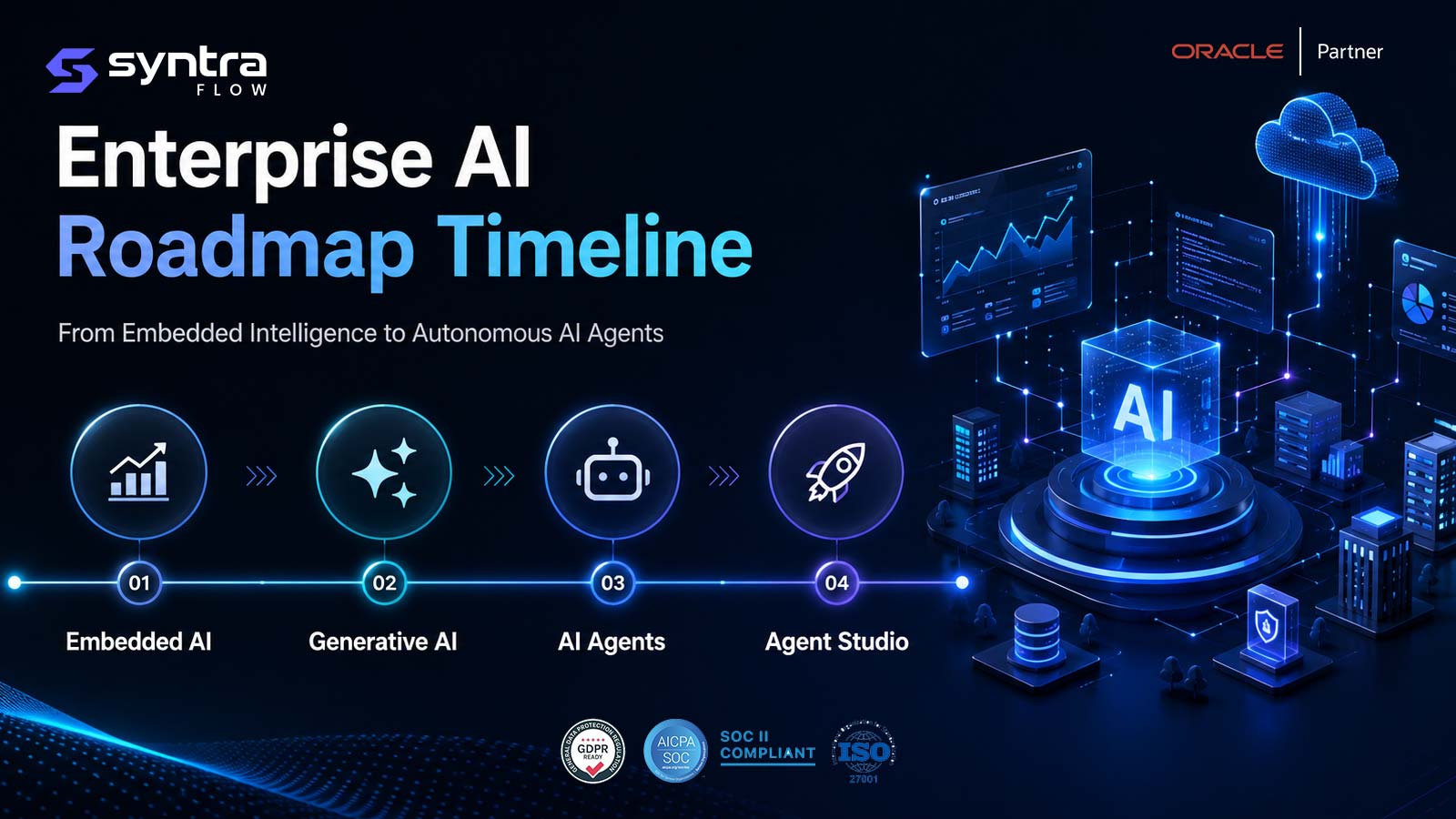
The Evolution of Oracle AI in Fusion Cloud
Oracle did not arrive at AI agents overnight. Fusion Cloud's AI capability has built up in layers, and each layer is still present and running underneath the next — Oracle has not retired embedded AI to make room for agents, it has stacked capability on top of capability. Reading the roadmap forward is really about recognizing that pattern and extrapolating it carefully, rather than guessing at a specific next feature.
Broadly, the progression runs: predictive and embedded AI features inside existing transactions, then generative AI added to drafting and summarization tasks, then AI agents that complete a defined piece of a process end to end, and most recently AI Agent Studio — a layer for building, governing, and connecting agents across modules rather than consuming only what Oracle ships pre-built.
Embedded AI timeline
The earliest phase built machine learning directly into existing Fusion transactions: anomaly detection on expense reports and journal entries, demand and cash-flow forecasting, intelligent document recognition for invoices and receipts, and recommendation features surfaced inside standard pages. These features run in the background of a process a user already knows — the user is not "using AI," they are just processing an invoice or an expense report faster and with fewer errors.
Generative AI timeline
The next phase layered generative AI onto the same screens: drafting job descriptions and performance narratives in HCM, summarizing service cases and customer interactions in CX, generating journal and transaction descriptions in ERP, and adding conversational assistants that can answer questions about a record instead of requiring a report to be run. This phase changed how users interact with existing data more than it changed what processes exist.
AI agent timeline
The current phase introduces AI agents scoped to a specific job — reconciling a ledger, triaging a service request, assembling a sourcing shortlist — that can take multiple steps and call other systems, rather than answering a single question. Agents now appear across ERP, HCM, SCM, and CX modules, generally as opt-in features tied to specific business processes rather than a single monolithic "AI mode" for the suite.
AI Agent Studio timeline
The most recent phase is AI Agent Studio: a layer for building, extending, and orchestrating agents rather than only consuming the ones Oracle pre-builds, including interoperability standards for connecting agents to external tools and other agents, broader API and data-source access for agents, and observability features for measuring what agents actually do. See Oracle AI Agent Studio for a deeper look at this layer specifically.
Where Oracle AI Shows Up Across the Suite
The same four-phase pattern plays out differently in each major application area, because each area has different processes and different data to work with.
ERP
Ledger and reconciliation agents, anomaly detection on transactions, invoice and expense document recognition, and generative drafting of accounting narratives. ERP is where Oracle has been most explicit about agent-based capability in its recent quarterly updates.
HCM
Recruiting and talent-matching assistance, generative drafting for job descriptions and performance content, and agents scoped to specific HR service and case-management tasks.
SCM
Demand forecasting, supply and inventory recommendations, and sourcing and procurement agents that assemble supplier or bid information for a human decision-maker.
CX
Case summarization, conversational service assistants, and agents that triage or route customer interactions ahead of a human agent picking them up.
This page stays intentionally high-level on a module-by-module basis. For the fuller catalog of Oracle AI capability by feature and module, see Oracle AI Features.
Current Capabilities and Announced Direction
These two columns are deliberately kept separate. The left side is what Oracle has shipped and documented. The right side is a reading of Oracle's public communications and product pattern — it is not a confirmed Oracle commitment, and none of it should be treated as a promised feature or date.
Current capabilities
- •Embedded predictive and anomaly-detection features across ERP, HCM, and SCM transactions.
- •Generative AI drafting and summarization inside standard Fusion pages (narratives, descriptions, case summaries).
- •Task-specific AI agents in production for defined process steps, including ledger and reconciliation agents in ERP, documented on Oracle's own quarterly release notes and reflected in SyntraFlow's 26A ERP & AI Agents update.
- •AI Agent Studio as a shipped capability for building and extending agents, including interoperability support (MCP and A2A-style connections), REST API access for agents, and a Redwood-integrated agent experience.
- •Expanded connectivity to external data sources and a marketplace/LLM-choice model for agent configuration.
- •Early observability and ROI-measurement tooling for agents, so usage and outcomes can be tracked rather than assumed.
Announced direction
- •Broader interoperability between Oracle-built agents and third-party or customer-built agents, extending the pattern already visible in current interoperability features.
- •More agents that span multiple modules rather than operating inside a single ERP, HCM, SCM, or CX process.
- •Continued expansion of the LLM and model-choice options available to a given agent, following the direction already set by the current marketplace/flexibility features.
- •Deeper observability and governance tooling as agent adoption grows, building on the ROI-measurement capability already shipped.
- •Industry- and role-specific agent templates, extending the applications-builder pattern Oracle has already introduced.
None of the items above have confirmed Oracle release dates, version numbers, or product names at the time this page was written. Treat them as a direction to plan around, not a checklist to hold Oracle to.
Oracle AI and the Quarterly Release Timeline
Oracle ships Fusion Cloud changes on a quarterly cadence, and AI capability moves on that same cadence rather than through a separate release schedule. New or expanded agents, generative features, and Agent Studio capability typically appear as part of a standard quarterly update rather than as a standalone launch — which means an Oracle AI roadmap is, in practice, a rolling series of quarterly updates rather than one fixed plan.
SyntraFlow's Oracle AI Release Intelligence tracks what actually changes in each quarterly update specifically for AI and agent capability, module by module. For a worked example of how a single quarter's AI and agent changes get documented — including affected pages, APIs, and recommended test cases — see the 26A ERP & AI Agents update.
That page sits inside the broader Oracle Release Intelligence vertical, which covers every Fusion module's quarterly changes, not only AI-specific ones. Reading AI changes in that broader context matters, because an AI agent update to a module often lands alongside non-AI configuration or workflow changes in the same quarter.
What This Trajectory Means for Planning
A roadmap is only useful if it changes what a customer does before the next quarterly update. Given the pattern above — capability arriving quarterly, layered on top of what already exists, and increasingly agent-based rather than purely embedded — a few planning implications follow directly:
Treat every quarterly update as a potential AI or agent change, not just a UI or configuration change, and check the release notes for AI-specific items each cycle.
Inventory which agents and generative features are actually enabled in your tenant — opt-in features can be turned on by an admin well before a governance process notices.
Assume agent capability will expand across more modules and more cross-module scenarios, and plan governance and testing ownership accordingly rather than module by module.
Build a recurring readiness check into the quarterly update cycle instead of a one-time AI assessment, since the roadmap itself is a rolling one.
Distinguish observed-direction planning from committed-feature planning in internal roadmaps and business cases, so stakeholders are not surprised when a trend does not materialize on a specific date.
Prioritize observability and evidence for whichever agents are already live in your tenant before adding more, since governance debt compounds with each new agent.
SyntraFlow's Oracle AI Adoption Guide walks through this readiness planning in more detail — how to inventory what is enabled, what to govern first, and how to sequence testing as agent adoption grows. SyntraFlow can be configured to connect that release intelligence with test planning, so a quarterly AI or agent change is a scoped testing task rather than a surprise.
Confirmed vs. Observed: A Field Guide
A single reference for which parts of this page describe something Oracle has shipped versus a direction inferred from Oracle's public communications and release pattern.
| Area | Status (Confirmed / Observed trend) | Note |
|---|---|---|
| Embedded predictive AI (forecasting, anomaly detection, document recognition) | Confirmed | In production across ERP, HCM, and SCM transactions today. |
| Generative drafting and summarization in Fusion pages | Confirmed | Shipped across multiple modules, not a single suite-wide feature. |
| Task-specific AI agents in ERP (e.g. ledger/reconciliation agent) | Confirmed | Documented on Oracle's quarterly release notes; see the 26A ERP & AI Agents update. |
| AI Agent Studio (build/extend/orchestrate agents) | Confirmed | Shipped capability, including Redwood integration and REST API access for agents. |
| Agent interoperability standards (MCP/A2A-style connections) | Confirmed | Present as a shipped feature in current AI Agent Studio capability. |
| Agent observability / ROI measurement | Confirmed | Early tooling shipped; depth expected to vary by module and by tenant configuration. |
| Broader third-party / customer-agent interoperability | Observed trend | Extrapolated from current interoperability features, not a confirmed Oracle commitment. |
| Cross-module agent orchestration (single agent spanning ERP/HCM/SCM/CX) | Observed trend | Consistent with the direction of recent updates; no confirmed timeline. |
| Expanded LLM/model choice per agent | Observed trend | Builds on an already-shipped marketplace/flexibility feature; further expansion is not guaranteed on any date. |
| Industry- or role-specific agent templates | Observed trend | Consistent with the existing applications-builder pattern; no specific templates confirmed here. |
| Deeper agent governance and policy controls | Observed trend | A reasonable expectation as agent adoption grows, not an announced feature set. |
Frequently Asked Questions
What is the Oracle AI roadmap for Fusion Cloud applications?
▼
Oracle does not publish a single fixed AI roadmap document. In practice, Oracle's AI capability has progressed through embedded predictive features, generative AI, task-specific AI agents, and AI Agent Studio, with new capability arriving through the regular quarterly update cycle rather than a separate AI-specific schedule. This page traces that pattern and separates confirmed capability from observed direction.
Is everything on this page an official Oracle commitment?
▼
No. This page clearly separates confirmed, already-shipped capability from observed direction inferred from Oracle's public communications and release pattern. The "announced direction" content and the "observed trend" rows in the table are explicitly not confirmed Oracle commitments and carry no guaranteed date or feature name.
What is the difference between Oracle's embedded AI and Oracle AI agents?
▼
Embedded AI runs quietly inside an existing transaction — flagging an anomaly, forecasting a balance, recognizing a document — without changing the process itself. AI agents take on a defined piece of a process end to end, potentially across multiple steps and systems, rather than surfacing a single insight inside a screen the user already knows.
What is AI Agent Studio and how does it fit the roadmap?
▼
AI Agent Studio is the most recent phase in Oracle's AI progression: a layer for building, extending, and orchestrating agents, including interoperability standards and API access, rather than only consuming agents Oracle pre-builds. See Oracle AI Agent Studio for a dedicated look at this capability.
How often does Oracle release new AI features in Fusion Cloud?
▼
AI and agent capability generally moves on the same quarterly release cadence as the rest of Fusion Cloud rather than a separate schedule. Oracle AI Release Intelligence tracks what actually changes for AI specifically in each quarterly update.
Where can I see a real example of an AI-related quarterly update?
▼
The 26A ERP & AI Agents update documents a specific quarter's AI and agent changes in ERP, including affected pages, APIs, and recommended regression tests, as one worked example of how this tracking works in practice.
How should customers plan for future Oracle AI features?
▼
Plan around the pattern rather than a specific unannounced feature: treat every quarterly update as a possible AI or agent change, inventory what is already enabled in your tenant, and build a recurring readiness check into the update cycle. The Oracle AI Adoption Guide covers this planning process in more depth.
Does a growing Oracle AI roadmap change how Fusion Cloud should be tested?
▼
It generally increases the surface area to cover, since each new agent or generative feature is a new behavior that can drift on a quarterly update. SyntraFlow can be configured to connect Oracle release intelligence with test planning, so newly enabled AI and agent capability becomes a scoped testing task rather than an unmonitored change. See Oracle AI Features for the current capability catalog those tests would need to cover.
Plan Ahead of Oracle's Next Quarterly AI Update
Whatever direction Oracle's AI roadmap takes next, it will most likely arrive through a quarterly update — and it will need to be understood, governed, and tested in your tenant. SyntraFlow can be configured to connect Oracle release intelligence with test planning so your team is ready before, not after, the next update lands.