Oracle AI for Customer Experience Applications
Oracle CX AI refers to the AI capabilities Oracle has embedded across its Fusion Customer Experience applications — sales, service, and marketing. In practice this means AI-assisted sales recommendations and lead prioritization, AI-generated case and service-request summaries, product and offer recommendations shown to customers, and conversational digital assistants that answer questions for customers or agents. These capabilities read from customer, order, and interaction data and can generate text, scores, or suggestions that a rep, agent, or customer sees directly.
Because CX AI output is customer-facing — a summary an agent relies on, a recommendation a buyer sees, an answer a chatbot gives — the risk surface is different from back-office AI. This page focuses specifically on that surface: how Oracle grounds generated responses in verified data, how customer data and role security constrain what AI can see and produce, and how to test the accuracy of what gets generated. For a broader look at Oracle's AI agents and embedded features generally, see Oracle AI Agents and Oracle AI Features.
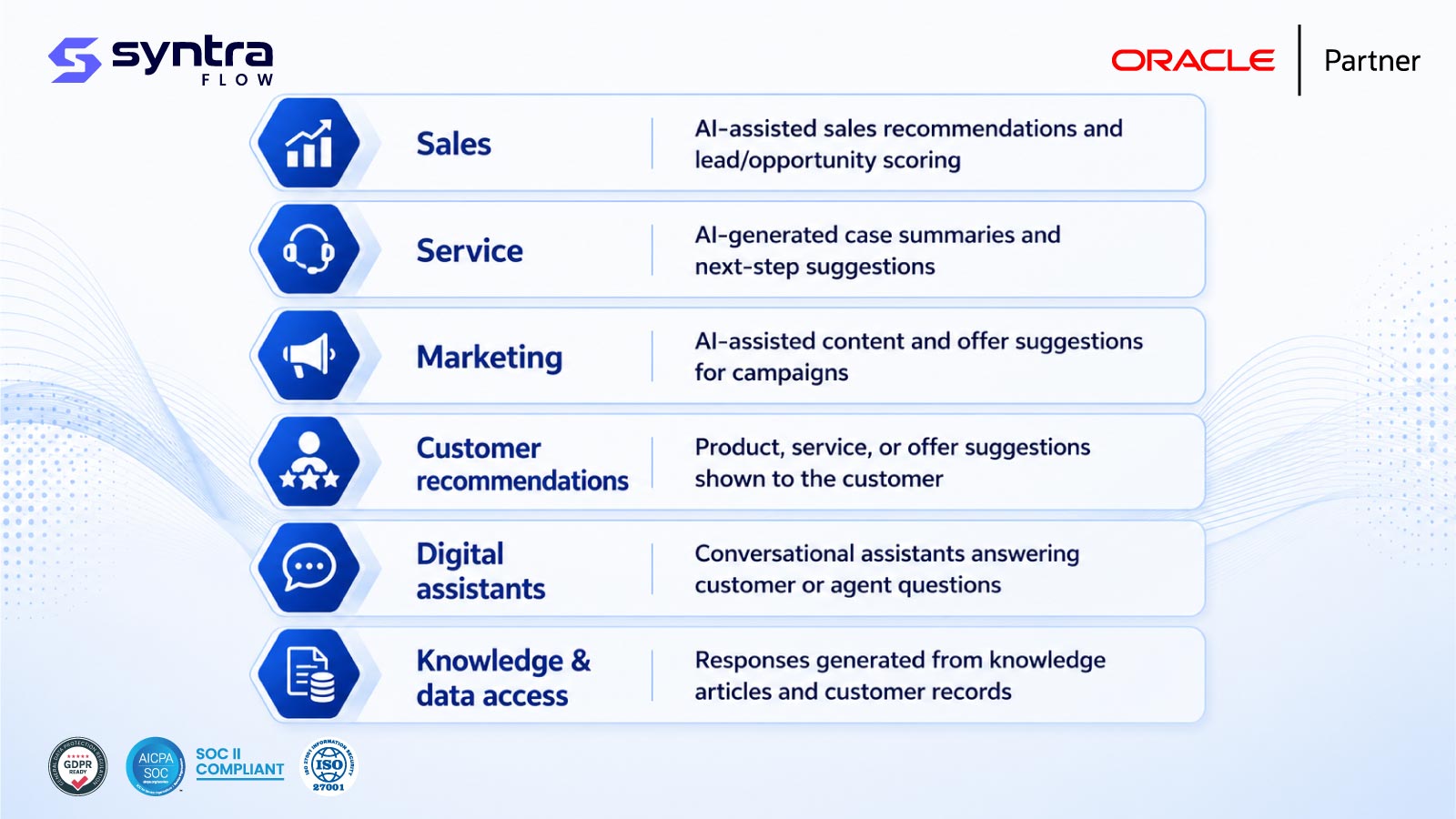
CX Areas, AI Capabilities, and What to Validate
Oracle Fusion CX AI capabilities show up differently depending on the application area. This table maps the areas covered on this page to a representative capability and the risk that testing should target.
| CX area | Example AI capability | Key risk to validate |
|---|---|---|
| Sales | AI-assisted sales recommendations and lead/opportunity scoring | Recommendation traceable to real pipeline and account data, not plausible-sounding guesses |
| Service | AI-generated case summaries and next-step suggestions | Summary matches the underlying case notes and history, no fabricated detail |
| Marketing | AI-assisted content and offer suggestions for campaigns | Output stays within approved brand and compliance boundaries |
| Customer recommendations | Product, service, or offer suggestions shown to the customer | Relevance and eligibility checked against actual entitlement and order data |
| Digital assistants | Conversational assistants answering customer or agent questions | Grounded answers, correct escalation, no invented policy or pricing detail |
| Knowledge & data access | Responses generated from knowledge articles and customer records | Citation accuracy, role-based visibility, and customer data handling |
Sales AI in Oracle CX
Oracle sales AI covers AI-assisted capabilities used by sales reps and managers inside Fusion Sales — surfacing recommended next actions, scoring leads and opportunities, and suggesting content or products likely to be relevant to a given account. These features work from CRM data: opportunity stage, account history, product catalog, and past interactions.
The practical concern is not whether a recommendation is generated, but whether it is defensible. A lead score or next-best-action suggestion that a rep acts on should be traceable to real account signals, not an unsupported inference. When sales AI recommendations feed forecasting or compensation-adjacent decisions, treat them as a business input worth validating on a recurring basis rather than a one-time configuration check.
Service AI in Oracle CX
Oracle service AI supports agents working Fusion Service cases — suggesting resolutions, surfacing similar past cases, and generating summaries an agent can review before responding to a customer. The value proposition is speed: an agent picking up a case gets an AI-generated summary of what has happened so far instead of reading the full case history line by line.
That speed only helps if the summary is accurate. An agent who trusts a flawed AI-generated summary can misinform a customer, miss an open commitment, or repeat a step the customer already completed. Service AI output should be reviewed as an assist to the agent, not a substitute for the case record, especially on cases involving refunds, SLAs, or escalations.
Customer Recommendations
Customer-facing recommendations — the products, services, or offers an AI feature suggests directly to a buyer — carry a different risk than internal sales scoring, because a bad recommendation is visible to the customer immediately. A recommendation that ignores entitlement, contract terms, region, or product availability is not just unhelpful; it can create a commitment the business cannot honor or damage trust in the channel.
Recommendation testing should confirm two things separately: that the underlying data driving the suggestion is current and correctly scoped to the customer, and that the recommendation logic respects eligibility rules rather than optimizing purely for engagement or conversion.
Case and Service-Request Summarisation
AI-generated case summaries condense a service request's notes, communications, and status changes into a short brief. This is one of the more mature Oracle CX AI capability categories because the input — the case record — is structured and bounded, which makes summarisation a more contained task than open-ended generation.
Contained does not mean risk-free. A summary can still omit a material detail, misstate a timeline, or blend information from a similar but different case if retrieval scoping is loose. The practical test is a side-by-side comparison: does the AI-generated summary match what the full case record actually says, on a sample large enough to catch drift rather than a handful of favorable examples.
Digital Assistants
Conversational digital assistants sit in front of both customers and internal users, answering questions, guiding self-service tasks, and routing requests that need a human. Within Oracle CX, a digital assistant might help a customer check an order status, help an agent find a policy, or help a sales rep pull account information without leaving a conversational interface.
Because a digital assistant's output is read directly by the person asking, the tolerance for a wrong or invented answer is low — a chatbot that confidently states an incorrect return policy or delivery date creates a customer-facing problem, not just an internal inconvenience. This is the capability category where knowledge grounding, covered next, matters most.
Knowledge-Grounded Responses
Grounding is the practice of tying an AI-generated response to a specific, verifiable knowledge source — a knowledge article, a case record, an order record — rather than letting the model generate an answer purely from its own training. In a customer-facing context this distinction matters a great deal: a grounded response can be traced back to the document or record that supports it, while a free-form generated response cannot.
The reason grounding is treated as a control rather than a nice-to-have is straightforward. A digital assistant, a service summary, or a recommendation that isn't grounded can produce a fluent, confident-sounding answer that is simply wrong — a policy that doesn't exist, a price that doesn't match the system of record, a resolution step that was never actually taken. Because the audience is a customer or an agent acting on the customer's behalf, an ungrounded error is not a cosmetic bug; it is a statement the business may be held to.
What to look for. A well-grounded CX AI response should be attributable to an identifiable source, should decline or escalate when no supporting source exists rather than filling the gap with plausible text, and should stay current as the underlying knowledge base or record changes. Where any of those three properties is unclear, treat the response as unverified rather than assuming it is correct.
Customer Data Privacy
CX AI features work by reading customer data — contact details, order history, case notes, communications — to generate summaries, recommendations, and answers. That means every generative feature is also a new data-handling surface: what customer information is included in a prompt or retrieval step, where that information can end up in an output, and who can see the result.
Two questions are worth asking of any CX AI capability before it reaches production use: does the feature expose more customer data in its output than the requesting user was already entitled to see, and could a generated summary or recommendation surface information across customers or accounts that should stay separated. Privacy testing for CX AI is less about the model itself and more about whether existing data-access boundaries hold once generation is added to the workflow.
Role Security
Role-based security determines which case records, accounts, and knowledge sources a given user — or the AI feature acting on that user's behalf — can draw on. In principle, an AI-generated summary or recommendation should never expose data the requesting role could not already access directly. In practice, generative features are new enough in most CX deployments that this assumption deserves explicit verification rather than being taken on faith.
The scenario worth testing directly: does an AI feature respect the same role and data-security boundaries as the underlying Fusion CX application, or can it, through a retrieval or summarisation step, surface a detail from a case, account, or knowledge source the requesting role would not normally be permitted to see. Any gap here is a security issue, not a quality issue, and should be treated with the same seriousness as a role misconfiguration anywhere else in Oracle Fusion.
Testing the Quality of AI-Generated CX Responses
The capabilities above share a common testing need: someone has to check, on an ongoing basis, whether the AI-generated summary, recommendation, or answer is actually accurate, grounded, and scoped to the right role — not just whether the feature runs without error. That is a different discipline from functional testing of a form or a workflow, because the "correct" output is a matter of accuracy and relevance judged against source data, not a fixed expected value.
This kind of response-quality testing typically covers a few recurring checks: comparing generated summaries against the underlying case or record, sampling recommendations against eligibility and entitlement rules, verifying that digital-assistant answers cite or align with an actual knowledge source, and confirming role-based access holds across generated output. Because Oracle updates these capabilities on its regular release cycle, response quality is worth re-checking after updates that touch CX AI features, not only at initial rollout.
For the methodology behind testing Oracle's AI capabilities more broadly — evaluation approach, evidence capture, and how AI testing differs from conventional functional testing — see Oracle AI Testing. SyntraFlow can be configured to help organizations assess AI-generated output against source records as part of a broader Oracle Fusion test program; the specific scope for CX response-quality checks is confirmed at assessment rather than assumed here.
Business Process Impact
CX AI capabilities are meant to change how sales and service processes actually run — faster case handling through AI-generated summaries, faster lead follow-up through AI-assisted scoring, more consistent responses through digital assistants. Whether that impact is real, rather than assumed, is a question about process behavior: case handling time, response consistency, escalation rates, and where AI-assisted steps sit inside the broader case-to-resolution or lead-to-opportunity flow.
Because those are process-level questions — how long a case actually takes, where it stalls, how often it deviates from the expected path — they are natural territory for process mining rather than feature-level testing alone. SyntraFlow's Process Mining can be applied to CX processes such as case handling and service response times to help organizations see whether AI-assisted steps are actually shortening cycle time or introducing new bottlenecks, using the process data Oracle Fusion already generates.
Keeping Up With CX AI Changes
Oracle CX AI capabilities are not static — new AI-assisted features, expanded digital-assistant scope, and changes to existing recommendation or summarisation behavior can appear on Oracle's regular release cycle. Some of this is directional: Oracle has signaled continued investment in embedded and agentic AI across Fusion applications, though the exact scope of any future CX release is Oracle's decision to confirm, not something to assume in advance.
Tracking what actually changed in a given update — and which CX processes and roles it touches — is covered on Oracle AI Release Intelligence. For a broader view of how Oracle's AI agents fit into CX and other Fusion pillars, see Oracle AI Agents.
Frequently Asked Questions
What AI capabilities does Oracle include in CX applications?
▼
Oracle Fusion CX AI spans sales, service, and marketing: AI-assisted sales recommendations and lead scoring, AI-generated case and service-request summaries, product and offer recommendations shown to customers, and conversational digital assistants for customers and agents. Not every capability is available in every deployment, and scope varies by Oracle release.
What is Oracle sales AI used for?
▼
Oracle sales AI supports reps and managers in Fusion Sales by scoring leads and opportunities, suggesting next actions, and recommending relevant content or products based on account and interaction history. It is an assist to the rep's judgment, not a replacement for reviewing the underlying account data.
How does Oracle service AI summarize cases?
▼
Service AI reads a case's notes, communications, and status history and generates a condensed summary an agent can review before acting. Because the summary can omit or misstate detail, it should be checked against the full case record, particularly on cases involving refunds, SLAs, or escalations.
What does "grounding" mean for Oracle CX AI responses?
▼
Grounding means an AI-generated response is tied to a specific, verifiable source — a knowledge article, case record, or order record — rather than generated freely from the model's own training. A grounded response can be traced back to what supports it; an ungrounded one cannot, which matters most in customer-facing answers.
How does Oracle protect customer data used by AI features in CX?
▼
Customer data privacy for CX AI rests on the same data-access boundaries as the rest of Fusion CX, extended to whatever a generative feature reads and outputs. The practical question for any deployment is whether a generated summary or recommendation can expose more customer data, or data across accounts, than the requesting user was already entitled to see.
How does role-based security affect what CX AI can see or generate?
▼
An AI-generated summary or recommendation should respect the same role and data-security boundaries as the underlying application — it should not surface case, account, or knowledge detail the requesting role could not already access directly. This is worth verifying explicitly rather than assumed, especially after role or AI feature changes.
How should teams test the quality of AI-generated customer responses?
▼
Response-quality testing compares generated summaries and answers against the underlying record, samples recommendations against eligibility rules, and checks that digital-assistant answers align with an actual knowledge source. See Oracle AI Testing for the broader methodology, which applies across Oracle's AI capability areas, not only CX.
Does Oracle CX AI replace human sales and service reps?
▼
No. The capability categories described here — recommendations, summarisation, digital assistants — are positioned as assists that speed up or inform a rep's or agent's work, not autonomous replacements for human judgment on customer-facing decisions. Human review remains the control point for accuracy, especially on financially or contractually significant interactions.
Validate Your Oracle CX AI Before Customers Do
SyntraFlow helps organizations assess Oracle Fusion CX AI output — grounding, data exposure, and role security — as part of a broader Oracle test program. See how an assessment maps to your CX deployment.