Oracle AI Agents for Fusion Cloud Applications
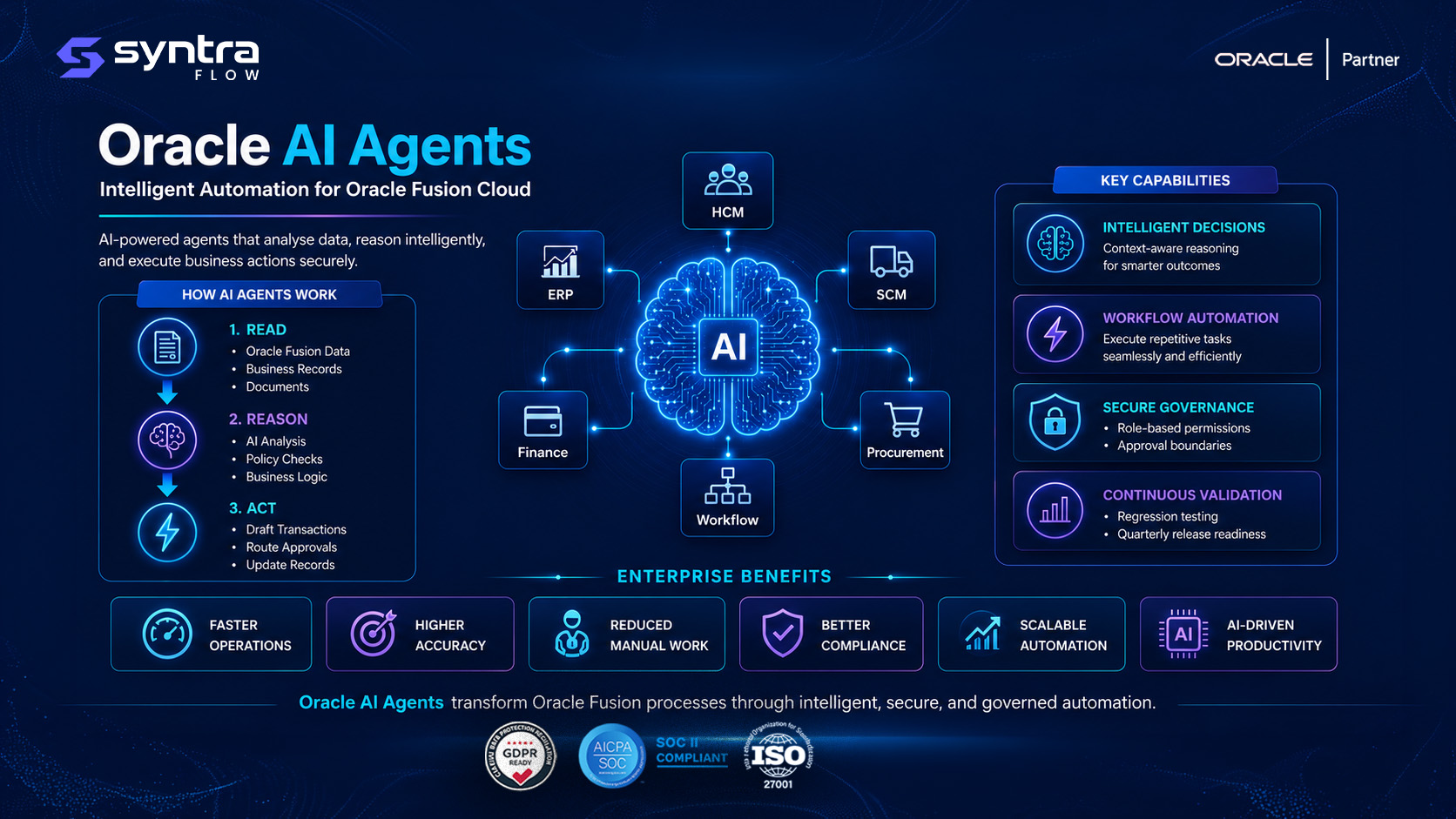
Oracle AI agents are AI-driven components inside Oracle Fusion Cloud Applications that read data from ERP, HCM, and SCM records, reason over that data, and — within configured approval boundaries — take an action in the application, such as drafting a transaction, proposing a record update, or advancing a workflow step. That separates an agent from a conventional embedded AI feature: a feature typically summarizes, classifies, or recommends; an agent is built to act, subject to the review and role controls an organization configures around it.
This page orients you to Oracle AI agents as a category — what they are, how they differ from embedded AI, where they show up across Fusion modules, and what governance, security, and testing questions they raise. For configuration mechanics, see Oracle AI Agent Studio; for validation methodology, Oracle AI Testing; for access controls, Oracle AI Security.
What Are Oracle AI Agents?
An Oracle AI agent is an AI-driven capability, built on generative and predictive models, that operates against Oracle Fusion Cloud Applications data with a defined scope of inputs, a reasoning step, and a set of permitted actions. Rather than answering a single prompt in isolation, an agent is oriented around a business task — for example, working through the exceptions in a reconciliation queue, drafting responses to a set of candidate inquiries, or checking a batch of transactions against a policy — and it can carry that task through several steps rather than stopping after one response.
Oracle has been rolling out agent capability across Fusion Cloud Applications on its quarterly update cadence, expanding both the number of available agents and the tooling — AI Agent Studio — used to configure, extend, and govern them. The exact set of agents available in a tenant depends on licensed modules, the quarterly update applied, and what an administrator has enabled; this page does not enumerate named agents, since that list is best tracked on the module and release-intelligence pages linked below.
Scope note. This page covers Oracle AI agents as a category across Oracle Fusion Cloud Applications. Agent configuration and orchestration mechanics live on Oracle AI Agent Studio; validation approach and methodology live on Oracle AI Testing. This is deliberately an orientation page, not a deep-dive into either.
How Agents Differ From Embedded AI Features
Oracle Fusion Cloud Applications ship with two broad categories of AI-driven capability, and the distinction matters for governance and testing. Embedded AI features are generative or predictive functions attached to a specific screen or field — a summary, a suggested value, a classification. An Oracle AI agent goes further: it can chain reasoning across multiple data points and, within its configured permissions, initiate an action rather than only surface a suggestion.
| Dimension | Embedded AI feature | Oracle AI agent |
|---|---|---|
| Typical output | A summary, suggestion, or classification shown on screen | A proposed or executed action against a record or process |
| Scope | Usually bound to one field, form, or single request | Can span multiple records, steps, or a defined task across a queue |
| Persistence | Stateless — one prompt, one response | Can retain task context across a multi-step interaction |
| Action capability | Generally advisory — a human still performs the action | Can be configured to take or draft an action, subject to approval gates |
| Configuration surface | Limited feature-level toggles | Configured through AI Agent Studio — role, data scope, approval rules |
| Governance emphasis | Output accuracy and relevance | Output accuracy plus action authorization, auditability, and role boundaries |
| Testing emphasis | Does the suggestion make sense for the input | Did the agent read the right data, reason correctly, and stay inside its permitted actions |
The line between the two is not always sharp in practice — Oracle continues to extend what embedded features and agents can each do — but the distinction is useful for scoping governance and test effort.
Oracle AI Agents by Module
Oracle AI agents appear across the Fusion Cloud Applications footprint, with the specific agent set differing by module and by how recently each pillar received agent capability in a quarterly update. Below is a brief orientation to each area; the dedicated module pages go deeper on what's available and how it behaves.
Oracle ERP AI Agents
In Oracle Fusion ERP, agent capability has been introduced around finance and procurement workflows — for example, working through reconciliation exceptions or supporting invoice and payables processes. Oracle ERP AI agents read and act on the same financial data that ERP testing already covers.
Oracle AI for ERP →Oracle HCM AI Agents
Oracle HCM AI agents have been an early focus of Oracle's agent investment, with AI Agent Studio enhancements for HCM highlighted in recent quarterly updates — spanning recruiting support and employee-facing assistance. Scope varies by release.
Oracle AI for HCM →Oracle SCM AI Agents
Oracle SCM AI agents extend agent capability into planning, procurement, and supply-chain execution data. As with ERP and HCM, the practical question is less "what can this agent do" and more "what data can it see, and what can it change."
Oracle AI for SCM →Because AI agents in Oracle Fusion act on ERP, HCM, and SCM records, they inherit the same data-quality and configuration dependencies as any Oracle Fusion process. Organizations with structured test coverage for Oracle ERP — see the Oracle ERP Testing Tool — are typically better positioned to extend that discipline to agent-touched processes.
Agent Inputs, Actions, and Outputs
Understanding an Oracle AI agent means understanding three things: what it is allowed to read, what it is allowed to do, and what it produces. This is a different question from "is the answer accurate," because an agent's action can have consequences even when its underlying reasoning looks reasonable.
- Inputs. Structured application data (transactions, records, configuration), attached documents, and in some cases prior task history. Which objects and fields an agent can read is a configuration decision, not a fixed property of the agent.
- Reasoning. The agent interprets input against a task definition and, depending on the agent, may consult policy or knowledge content.
- Actions. The part that goes beyond embedded AI features — an agent can be configured to draft a record, propose or submit a transaction, route a workflow step, or flag an exception, rather than only returning text.
- Outputs. A recommendation for a human to accept, a drafted artifact awaiting approval, or — where configured — a completed action logged for audit.
The practical implication is that evaluating an Oracle AI agent means evaluating all three stages, not just whether the final text reads well. A correct-sounding output built on the wrong input data, or an action taken outside its intended scope, is a defect even when the language generated is fluent.
Human Review and Approval
Oracle's agent framework is built around configurable approval gates rather than unsupervised execution by default. Depending on how an agent is configured in AI Agent Studio, an agent's proposed action can require a named approver to review and accept it before anything changes in the application, or the action can proceed automatically within narrower, pre-approved conditions. The right posture depends on the risk of the action — a drafted response for a human to send is a very different governance question from an agent that can post a transaction.
In practice, organizations rolling out Oracle enterprise AI agents tend to start with review-required configurations for any action with financial, HR, or supply-chain consequence, relaxing that requirement only for narrowly scoped, low-risk actions once behavior has been observed over time.
Practical checklist for approval design. Which role approves each action type · per-instance approval vs. pre-authorized conditions · how a rejected action is logged and routed back · whether the approver sees underlying data and reasoning, not just the conclusion · how approval behavior is verified after a quarterly update.
Security and Role Requirements
An Oracle AI agent runs against Oracle Fusion's existing security model — it does not bypass role-based access, data security policies, or segregation-of-duties constraints, but it does introduce a new question: what role is the agent itself operating under, and does that role's access match what the agent is actually meant to see and do? An agent scoped too broadly can technically function correctly while still creating a security exposure, because it can read or act on data beyond the intended business task.
Role design, data-exposure boundaries, and audit logging for agent actions are covered in depth on Oracle AI Security. The short version: treat agent role assignment with the same rigor as any other privileged Oracle Fusion role, with periodic review as agent capability expands each quarterly update.
Data and Knowledge Dependencies
An Oracle AI agent is only as reliable as the data and configuration it draws on. Because agents reason over live Fusion Cloud Applications data — chart of accounts setup, supplier and employee records, transactional history — data quality problems that once surfaced as a report error or a manual-entry mistake can now surface as an agent drawing an incorrect conclusion or proposing an inappropriate action.
Where an agent consults supplementary knowledge content — policy documents, help text, configured business rules — the currency of that content becomes part of its dependency chain too. Stale policy content can lead an otherwise well-built agent to a wrong answer even when the underlying transactional data is correct.
The practical takeaway: map each agent's data and knowledge dependencies before enabling it broadly, and treat those dependencies as an ongoing monitoring item, not a one-time setup step.
Agent Testing Requirements
Testing an Oracle AI agent is not the same exercise as testing a conventional Oracle Fusion transaction, because an agent's behavior can vary with the input data, the underlying model, and the knowledge content it draws on, even when configuration hasn't changed. A meaningful test approach covers whether the agent read the correct scope of data, whether its reasoning stayed within intended business rules, whether its proposed action respected approval and role boundaries, and whether that behavior holds after Oracle's next quarterly update.
That is a substantial methodology on its own, covered in depth on Oracle AI Testing, including how it differs from testing deterministic transactions. This page only flags that the requirement exists.
Agent Release Timeline
Oracle ships new and enhanced agent capability on its quarterly Fusion Cloud update cadence, alongside the rest of each release. The set of available Oracle AI agents, their configuration options in AI Agent Studio, and the modules they cover is not fixed — a capability absent in one quarterly update may appear in the next. Oracle's own release notes on ERP AI agents are one example; see the 26A ERP AI agents update for a concrete instance of a quarterly agent-capability change.
Tracking that cadence matters for governance as much as adoption — an agent's approval configuration, data scope, or available actions can shift with an update, so review and testing done on a previous quarter's behavior doesn't automatically carry forward. Ongoing tracking of Oracle AI quarterly changes is covered on Oracle AI Release Intelligence.
How SyntraFlow Supports Oracle AI Agent Validation
SyntraFlow is a separate product from Oracle's own AI agents. The agents described on this page run inside Oracle Fusion Cloud Applications and belong to Oracle; SyntraFlow's own AI-driven testing engine is a different capability, used to build and maintain automated test coverage for Oracle Fusion — including processes that Oracle AI agents now touch. See Oracle ERP Testing Tool for SyntraFlow's own AI-assisted testing capability.
SyntraFlow helps organizations assess which agent-touched processes carry the most testing risk, and the SyntraFlow roadmap can support connecting Oracle's quarterly release intelligence with targeted regression planning for the ERP, HCM, and SCM processes an agent reads from or acts on. SyntraFlow can be configured to extend existing regression coverage to the transactions an agent is permitted to touch, so a change in agent behavior after a quarterly update surfaces as a test result rather than a downstream surprise.
This is not a claim that SyntraFlow automatically tests every Oracle AI agent or guarantees agent accuracy — full methodology is on Oracle AI Testing. This section is an orientation, not a feature list.
Frequently Asked Questions
What are Oracle AI agents?
▼
Oracle AI agents are AI-driven components in Oracle Fusion Cloud Applications that read application data, reason over it, and — within configured approval boundaries — can propose or take an action, such as drafting a record or advancing a workflow step, rather than only producing a summary or recommendation.
How is an Oracle AI agent different from an embedded AI feature?
▼
Embedded AI features are generally advisory — a summary, suggestion, or classification on a single screen that a human then acts on. An Oracle AI agent can chain reasoning across multiple data points and, when configured to do so, initiate or draft an action itself, subject to approval gates and role permissions.
Which Oracle Fusion modules have AI agents?
▼
Oracle has introduced agent capability across ERP, HCM, and SCM, with the specific agents available depending on modules licensed and the quarterly update applied. See Oracle AI for ERP, Oracle AI for HCM, and Oracle AI for SCM for module-specific detail.
Can an Oracle AI agent take action without human approval?
▼
It depends on configuration. Oracle's agent framework supports approval gates requiring a named role to review and accept a proposed action before it takes effect, and organizations can also configure narrower, pre-approved conditions for lower-risk actions. Approval design is a policy decision made through AI Agent Studio, not a fixed property of every agent.
What roles and security controls apply to Oracle AI agents?
▼
Agents operate under Oracle Fusion's existing role-based access and data security model, but each agent also needs its role assignment reviewed for scope — an agent granted broader access than its task requires is a security exposure even if it functions correctly. See Oracle AI Security for role design and data-exposure boundaries.
How often does Oracle release new AI agent capability?
▼
Oracle ships new and enhanced agent capability on its quarterly Fusion Cloud update cadence. The set of available agents, their configuration options, and the modules they cover can change with each update — see Oracle AI Release Intelligence for ongoing tracking.
How should Oracle AI agents be tested?
▼
Agent testing needs to cover the data an agent reads, whether its reasoning respects business rules, whether its proposed actions stay inside approval and role boundaries, and whether that behavior holds after a quarterly update. The methodology is covered in depth on Oracle AI Testing.
Is SyntraFlow the same as Oracle's AI agents?
▼
No. Oracle AI agents run inside Oracle Fusion Cloud Applications and are Oracle's own capability. SyntraFlow is a separate Oracle Fusion test automation platform with its own AI-driven testing engine, used to build and maintain test coverage for Oracle Fusion processes — including ones that Oracle AI agents now touch. See Oracle ERP Testing Tool for SyntraFlow's own testing capability.
Assess Which Oracle AI Agents Apply to Your Fusion Environment
Talk to SyntraFlow about mapping the Oracle AI agents active or available in your ERP, HCM, and SCM environment, and where existing test coverage needs to extend to agent-touched processes.