Oracle AI for Fusion Supply Chain Management
Oracle SCM AI is not a single feature. Oracle has embedded AI capability across most of Fusion Supply Chain Management — in supply and demand planning, inventory, manufacturing, maintenance, order management, logistics, and product lifecycle processes. For Oracle Fusion SCM AI customers, the practical question isn't whether AI is present in a given screen — it's where it operates, what data it depends on, and how its output should be checked before a planner, buyer, or scheduler acts on it.
This page maps Oracle SCM AI capability by process area, flags the integration dependencies that make that capability reliable or unreliable, and outlines what SCM-AI-specific testing should cover. For a broader introduction to Oracle's AI agents and embedded AI features across Fusion applications, see the Oracle AI hub, Oracle AI Agents, and Oracle AI Features.
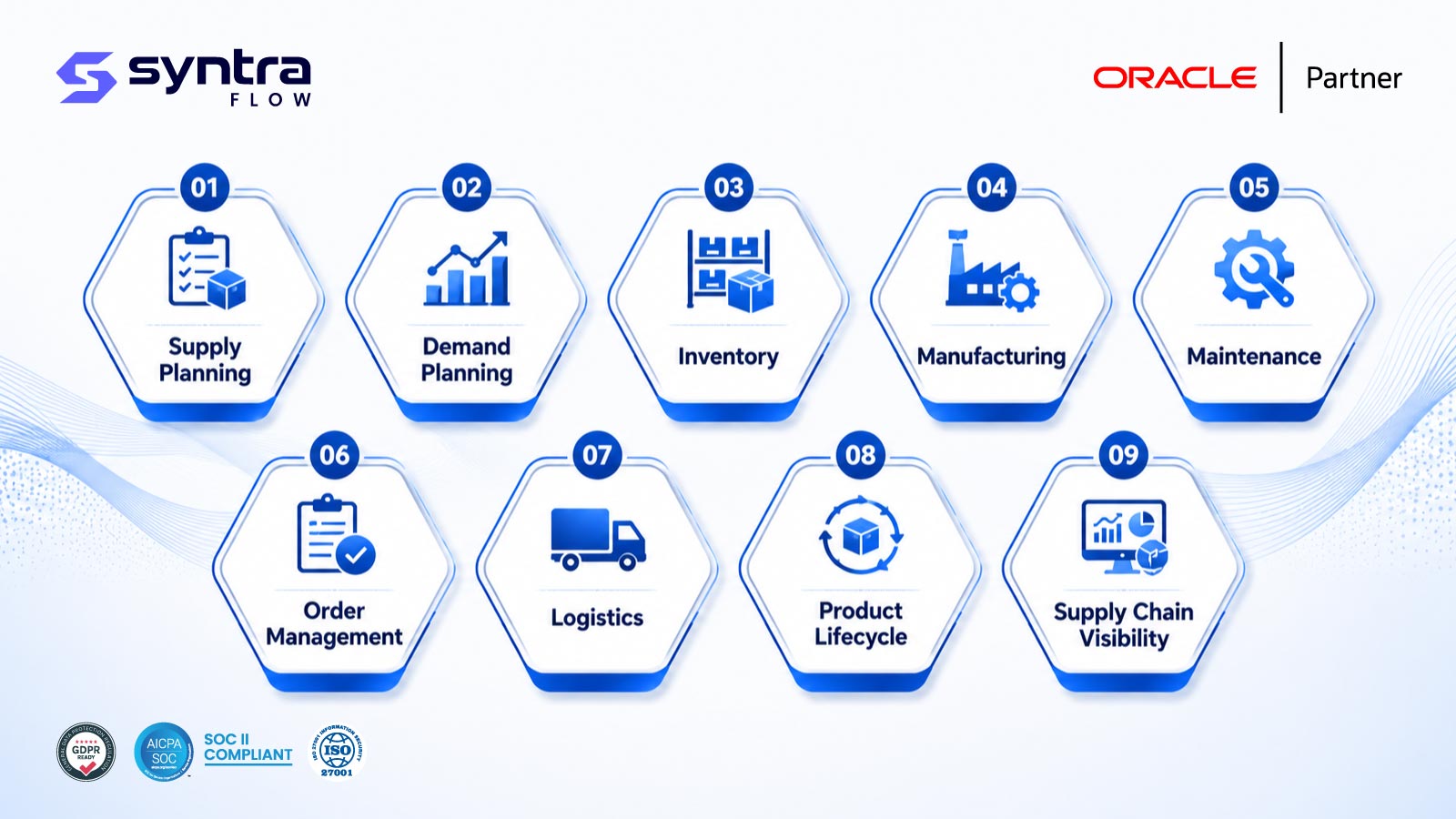
How AI Shows Up in Fusion SCM
Across Fusion SCM, Oracle AI capability generally falls into three categories: embedded machine-learning models that score, forecast, or flag anomalies inside an existing process (a forecast adjustment, an inventory exception); generative AI features that summarize, draft, or explain (a condensed exception list, a change-impact summary); and agent-based capabilities that can propose or take a bounded action for a user to review. Which category applies to a given SCM process determines how much human review its output still needs, and how testing should be structured around it.
General treatment of these categories — what Oracle AI agents are, how they're configured, and the difference between embedded and generative AI features — lives on the Oracle AI Agents and Oracle AI Features pages. This page stays focused on what those categories look like specifically inside supply chain processes, and what that means for validation.
Oracle SCM AI Capability by Process Area
Where AI appears across Fusion SCM, and the risk each area carries.
Supply Planning
AI-assisted supply planning surfaces recommended supply adjustments — reallocating supply, flagging constraint violations, prioritizing orders — based on demand signals, capacity, and sourcing rules. Oracle supply chain AI narrows planner attention to exceptions rather than requiring a full manual review of every plan run. The risk: recommendations are only as good as the constraints and lead times configured behind them, so a stale sourcing rule or an unmodeled capacity limit can produce a confident-looking but wrong recommendation.
Demand Planning
AI-assisted demand forecasting blends statistical and machine-learning methods to generate a baseline forecast, then flags outliers or shifts against historical demand patterns. Oracle planning AI typically improves baseline accuracy for stable demand but is less reliable for new products, promotions, or structural demand shifts where history doesn't represent what's coming. Accuracy should be tracked against actuals on a defined cadence, not accepted because the model produced a number.
Inventory
Inventory-related AI centers on anomaly detection in inventory levels and movements — flagging unexpected stock-outs, excess accumulation, or transactions that deviate from expected patterns. Oracle inventory AI is most useful as an early-warning layer across a large SKU and location count where manual review isn't practical. Because anomaly thresholds are configurable, an over-sensitive setting produces noise that trains users to ignore alerts, while an under-sensitive one lets real issues pass.
Manufacturing
Within Oracle Manufacturing, AI capability spans production exception flagging, work-order prioritization assistance, and quality-pattern detection across production data. Oracle manufacturing AI outputs generally support the scheduler or quality analyst rather than replace them — a recommended reprioritization still needs someone to confirm it doesn't conflict with a constraint the model didn't see, such as an unscheduled maintenance window.
Maintenance
Predictive maintenance recommendations use asset and work-order history to suggest which equipment is likely to need attention before a failure occurs. This depends heavily on the completeness of historical maintenance data feeding the model; assets with sparse history produce lower-confidence recommendations that should be weighted accordingly rather than treated as equivalent to well-supported ones.
Order Management
Oracle order management AI capability includes exception-handling assistance, order-fallout pattern detection, and recommended resolutions for held or backordered orders. This page addresses only the AI-specific capability and risk here — deep functional test coverage for Oracle Order Management processes (holds, fulfillment, backorders, cancellations) lives on the Oracle Order Management Testing Tool hub.
Logistics
AI in Oracle logistics processes typically supports shipment exception detection and delivery-date risk flagging, drawing on carrier, routing, and historical transit data. The output is a risk-weighted flag or recommendation, not a guaranteed outcome, and should be tested against known disruption scenarios rather than only clean-path cases.
Product Lifecycle
Product lifecycle management AI capability includes assisted classification, change-impact summarization, and pattern detection across product data and change orders. Because product data quality varies across a typical Fusion instance's history, AI-assisted classification and impact summaries should be spot-checked against known product records rather than assumed uniformly accurate.
Capability-to-Risk Reference
A quick reference for what to validate before trusting Oracle SCM AI output in each area.
| SCM area | Example AI capability | Key risk to validate |
|---|---|---|
| Supply planning | Recommended supply/order reallocation from constraints and demand signals | Recommendation built on stale lead time or capacity data |
| Demand planning | AI-assisted baseline forecast and outlier detection | Forecast bias undetected because it's never checked against actuals |
| Inventory | Anomaly detection on stock levels and movements | Thresholds mistuned — too noisy or too silent |
| Manufacturing | Production exception flagging, quality-pattern detection | Recommendation ignores an unmodeled scheduling constraint |
| Maintenance | Predictive maintenance recommendations | Low-confidence output from sparse asset history treated as reliable |
| Order management | Exception and fallout pattern detection, resolution suggestions | Suggested resolution accepted without root-cause check |
| Logistics | Shipment exception and delivery-risk flagging | Flag not validated against real disruption scenarios |
| Product lifecycle | Assisted classification, change-impact summarization | Summary built on inconsistent historical product data |
Forecast and Recommendation Validation
AI demand forecasts and AI-generated supply recommendations are probabilistic outputs, not verified facts. Oracle Fusion's demand planning AI produces a forecast baseline; the supply planning AI layer proposes an adjustment or allocation in response. Both are propositions to be checked against actuals, not accepted on the strength of a confident presentation in the UI.
Practical validation means comparing forecast output to actual demand and actual supply outcomes on a defined cadence — for example, each planning cycle — and calculating variance rather than trusting a model score alone. A forecast that is directionally right but consistently biased in one direction is arguably worse than one that is randomly wrong, because a consistent bias compounds across planning cycles instead of averaging out.
Validation should also happen at the exception level, not only in aggregate: check whether a specific flagged exception — such as a recommendation to reduce safety stock at a location — held up once the underlying condition played out, not only whether overall forecast-accuracy metrics look acceptable. Any Oracle release update to planning or forecasting logic is a trigger to re-baseline this validation, since a change to the underlying model or its inputs can shift accuracy without any visible change to the screen. See Oracle AI Release Intelligence for how to track those changes.
Integration Dependencies
AI output in Fusion SCM is only as reliable as the data feeding it, and that data typically crosses several modules. Demand planning AI depends on clean historical sales and order history from Order Management; supply planning AI depends on accurate lead times, supplier data, and open PO or work-order status from Procurement and Manufacturing; inventory anomaly detection depends on transaction completeness from Inventory and Receiving; predictive maintenance depends on asset and work-order history that is often maintained outside the core transactional flow.
A gap or delay in any of these upstream feeds doesn't make the AI capability fail visibly — it produces output that looks normal but is built on stale or incomplete data. That makes integration health a precondition for trusting SCM AI output, not a separate concern from it. Where integrations run through REST APIs, file-based imports, or middleware, changes on either side — an Oracle quarterly update, a middleware version change, an upstream system change — are worth treating as SCM-AI regression triggers, not only as functional-integration ones.
Recommended Testing Scenarios for Oracle SCM AI
General guidance for how to test Oracle's AI agents and embedded AI features — validation approach, evidence capture, what "testing AI" means functionally — is covered on the Oracle AI Testing page. Applied to SCM specifically, a testing program should include scenarios such as:
- 1.Demand forecast variance check. Compare the AI-generated forecast for a representative item/location set against actual demand over a defined window, and confirm bias and variance stay within an agreed threshold.
- 2.Supply recommendation re-validation after a constraint change. Alter a lead time, supplier capacity, or calendar constraint and confirm the AI-generated supply recommendation updates consistently rather than reflecting stale constraints.
- 3.Inventory anomaly detection accuracy. Seed known abnormal transactions (an unexpected large withdrawal, an out-of-pattern receipt) and confirm the anomaly is flagged, alongside a check that normal transactions aren't over-flagged.
- 4.Predictive maintenance recommendation review. Sample assets with strong versus sparse maintenance history and confirm recommendation confidence isn't presented uniformly across both.
- 5.Order management exception-resolution check. For a sample of held or backordered orders, confirm the AI-suggested resolution is checked against the actual root cause before acceptance — the AI-specific layer on top of the functional test library at the Oracle Order Management Testing Tool hub.
- 6.Release regression on SCM AI behavior. After an Oracle quarterly update, re-run the checks above on affected areas rather than assuming AI behavior is unchanged just because the UI looks the same — see Oracle AI Release Intelligence.
SyntraFlow can be configured to run functional Oracle SCM test coverage alongside AI-specific validation checks like these, and the SyntraFlow roadmap can support connecting release intelligence with SCM AI regression planning — so a quarterly update touching planning or forecasting logic surfaces as a targeted re-test rather than a full-suite re-run. Confirm current scope for your tenant during a test assessment rather than assuming AI-specific coverage is already built for every process.
Frequently Asked Questions
What AI capabilities does Oracle include in Fusion Supply Chain Management?
▼
Oracle SCM AI spans embedded machine-learning capability (demand forecasting, anomaly detection in inventory, predictive maintenance recommendations), generative AI features (summaries, drafted explanations), and agent-based recommendations across planning, inventory, manufacturing, maintenance, order management, logistics, and product lifecycle. For a general introduction to these categories, see Oracle AI Agents and Oracle AI Features.
How accurate is Oracle's AI-assisted demand forecasting?
▼
It varies by item and demand pattern. Baseline forecasting tends to perform better for stable, historically consistent demand and less reliably for new products, promotions, or structural shifts. Accuracy shouldn't be assumed — it should be tracked against actuals on a defined cadence, as described in Forecast and Recommendation Validation above.
Is it safe to auto-accept an Oracle AI supply planning recommendation?
▼
Not without validation. Supply planning recommendations depend on the constraints, lead times, and capacity data configured behind them. If those inputs are stale or incomplete, the recommendation can look confident while being wrong, so it should be checked rather than auto-accepted, particularly for high-value or high-risk items.
How is testing Oracle SCM AI different from testing Oracle SCM functionality?
▼
Functional testing confirms a process works mechanically — an order fulfills, a work order completes, a hold releases. AI testing confirms whether a probabilistic output (a forecast, a recommendation, an anomaly flag) is accurate and appropriately confident given the data behind it. Both matter, but they answer different questions. See Oracle AI Testing for the general approach.
Does Oracle's order management AI replace the need for order management testing?
▼
No. AI-assisted exception detection and resolution suggestions add a layer on top of Order Management, they don't replace the need to test the underlying process. Deep functional scenario coverage for holds, fulfillment, backorders, and cancellations lives on the Oracle Order Management Testing Tool hub; this page covers only the AI-specific risk layered on top.
How often should Oracle SCM AI outputs be re-validated?
▼
Forecast and recommendation variance should be checked on a regular planning cadence — for most organizations, every planning cycle. In addition, treat every Oracle quarterly update that touches planning, forecasting, or SCM AI logic as a re-validation trigger, since model or input changes can shift behavior without a visible UI change. See Oracle AI Release Intelligence.
What data quality issues most affect Oracle SCM AI reliability?
▼
Stale lead times and supplier data, incomplete inventory transaction history, sparse predictive-maintenance records, and delayed or partial integration feeds from upstream modules are the most common causes. Because these gaps don't make the AI output fail visibly, they need to be checked directly rather than inferred from how confident the output looks.
Can SyntraFlow test Oracle's AI-driven SCM recommendations?
▼
SyntraFlow can be configured to run functional Oracle SCM test coverage alongside AI-specific validation checks such as forecast variance and anomaly-detection accuracy, and the SyntraFlow roadmap can support connecting release intelligence with SCM AI regression planning. Scope for a specific tenant and process area should be confirmed during a test assessment rather than assumed.
Understand and Test Your Oracle SCM AI Surface
See where Oracle SCM AI operates in your Fusion instance, what it depends on, and where validation gaps might be hiding in your forecasts and recommendations.