Enterprise Test Data Management for Connected Applications
Discover valid enterprise data, understand its business relationships, protect sensitive values and supply reusable test datasets to implementation, regression and autonomous testing.
Automated testing is only reliable when the right business data exists in the target environment.
Test Automation Often Fails Because the Data Is Wrong
Automated testing is only reliable when the right business data exists in the target environment. A test script can be correctly built and still fail — not because the application changed, but because the record it depends on no longer qualifies for the scenario.
Static, hard-coded test data becomes stale as configuration, master data and business rules change over time — a supplier that was valid last quarter, a period that has since closed, a payment term that has been retired. DataVault is designed to keep test data grounded in what is currently valid in the connected system.
Understand Business Objects and Their Dependencies
Enterprise applications are not flat tables — a supplier depends on a supplier site, a worker depends on an organization and assignment context, an opportunity depends on an account and contact. DataVault connectors are designed to understand these application-specific relationships rather than treating every system as an unrelated list of records.
Oracle
Workday
ConceptualSalesforce
SAP
Conceptual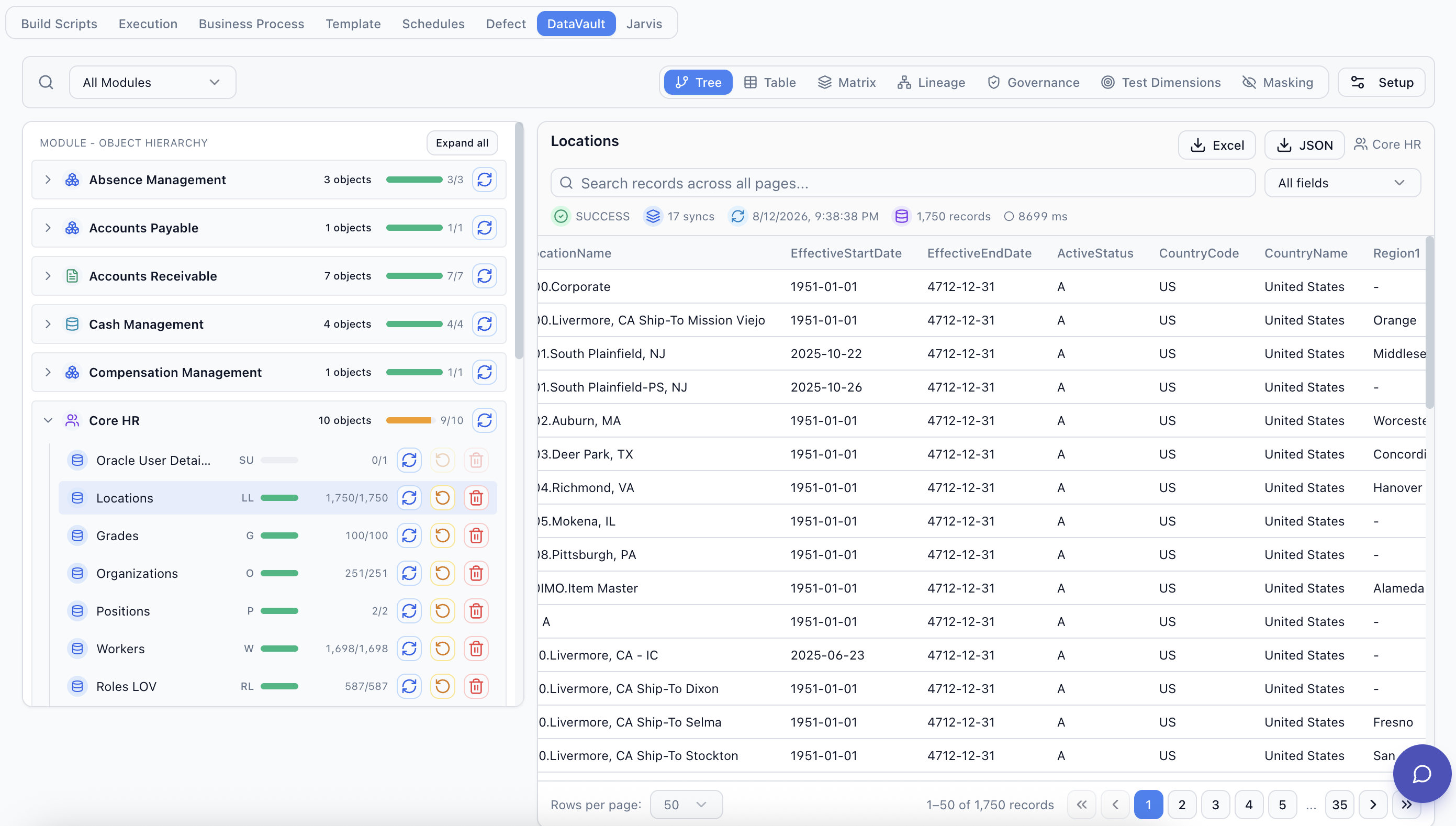
Turn Enterprise Data Into Test Dimensions
DataVault is designed to organize harvested data along the dimensions testers actually plan scenarios around, so a single business object can be filtered and combined the way a test case needs it.
This directly relates to AI-generated test coverage — Jarvis can draw on DataVault dimensions to build scenario variations instead of relying on a single fixed data combination.
Select Data Based on the Test Requirement
Testers typically describe the data they need in terms of the business condition it must satisfy, not a record ID. DataVault's scenario and data-selection logic is designed to work from criteria like this:
"Find an active supplier with a valid supplier site, GBP currency and valid payment terms in the UK Business Unit."
This represents the underlying selection criteria model DataVault evaluates against harvested, organized data — where matching data exists, DataVault is designed to return it. It is not a natural-language chat interface; it is the logic that scenario and data-selection features are built on.
Build Reusable Data Packs
AP Invoice Dataset
- Business Unit
- Supplier
- Supplier Site
- Currency
- Payment Terms
- Distribution
AR Invoice Dataset
- Business Unit
- Customer
- Transaction Type
- Currency
- Payment Terms
- Revenue Account
Worker Dataset
- Worker
- Organization
- Location
- Manager / Reporting Context
- Relevant Employment Attributes
Data packs are designed to be reused across implementation cycles, regression runs and autonomous test execution rather than rebuilt for every test pass.
Use Realistic Data Without Exposing Sensitive Values
Realistic test data and privacy are not a trade-off. DataVault is designed to combine test-data usability — valid, dependency-correct business records — with masking policies applied to the sensitive attributes those records carry.
Use the Data You Need — Not an Entire Production Copy
ConceptThis is a concept DataVault's architecture is designed around, not a claim of a fully shipped, generally available feature today: select a representative business subset and retain the dependencies required for testing, rather than working with — or copying — an entire production dataset.
Worker Subset Example
500 workers, plus the organizations, managers, payroll context and related reference data required to keep those workers testable.
Supplier Subset Example
200 suppliers, plus their sites, bank and payment configuration, currencies and payment terms.
Detect When Test Data Becomes Stale
Data that was valid when it was harvested does not necessarily stay valid. DataVault is designed to be run to identify conditions such as:
Where configured, DataVault can be run to refresh and revalidate harvested data against current source-system conditions, helping flag datasets that need to be re-selected before they are relied on for a test run — this is a scheduled or on-demand check rather than an automatic, instant, real-time guarantee.
Turn Test Data Into AI-Generated Test Coverage
Jarvis can use DataVault dimensions to generate scenario variations from a standard business test, turning one manually authored test into a broader set of positive, negative, boundary and configuration-specific scenarios.
Standard Test
"Create Supplier Invoice"
DataVault Dimensions
Suppliers, Business Units, Currencies, Payment Terms, Accounts, Amounts
Jarvis Generates
- Positive combinations
- Negative conditions
- Boundary scenarios
- Configuration-specific variants
Reuse Data Across Scheduled Regression Packs
DataVault's relationship to SyntraFlow regression testing follows a consistent sequence:
- Select scenario
- Select data dimensions
- Generate variations
- Add to regression pack
- Run now
- Schedule
- Collect evidence
Manage Data for End-to-End Tests
Cross-system tests require corresponding business entities and consistent masked identities on both sides of the flow — the same worker or supplier needs to be recognizable, and correctly masked, at every step.
Workday Example
Oracle Example
Tracing which downstream systems a business entity reaches, and confirming its masked identity is applied consistently along the way, is covered in more depth on Data Lineage and Downstream Masking.
DataVault Across Enterprise Applications
DataVault is built on a connector-based architecture. Platform-specific pages are published as connectors are validated.
Workday →
Worker and implementation data masking and downstream verification.
Oracle Fusion →
Object-level test data harvesting and masking for Oracle Fusion environments.
SAP
RoadmapConnector not yet validated.
Salesforce
RoadmapConnector not yet validated.
Frequently Asked Questions
What is enterprise test data management?
How is DataVault different from a spreadsheet of test data?
Can DataVault keep test data private?
Can test data be reused across environments?
Can DataVault provide data to Jarvis?
Can DataVault manage cross-system test data?
Does DataVault copy production data?
See DataVault Across Your Enterprise Landscape
Show us a representative application and downstream data flow. We'll demonstrate how DataVault can model sensitive data, masking policies, test-data relationships, lineage and downstream verification.