Oracle AI Agent Lifecycle
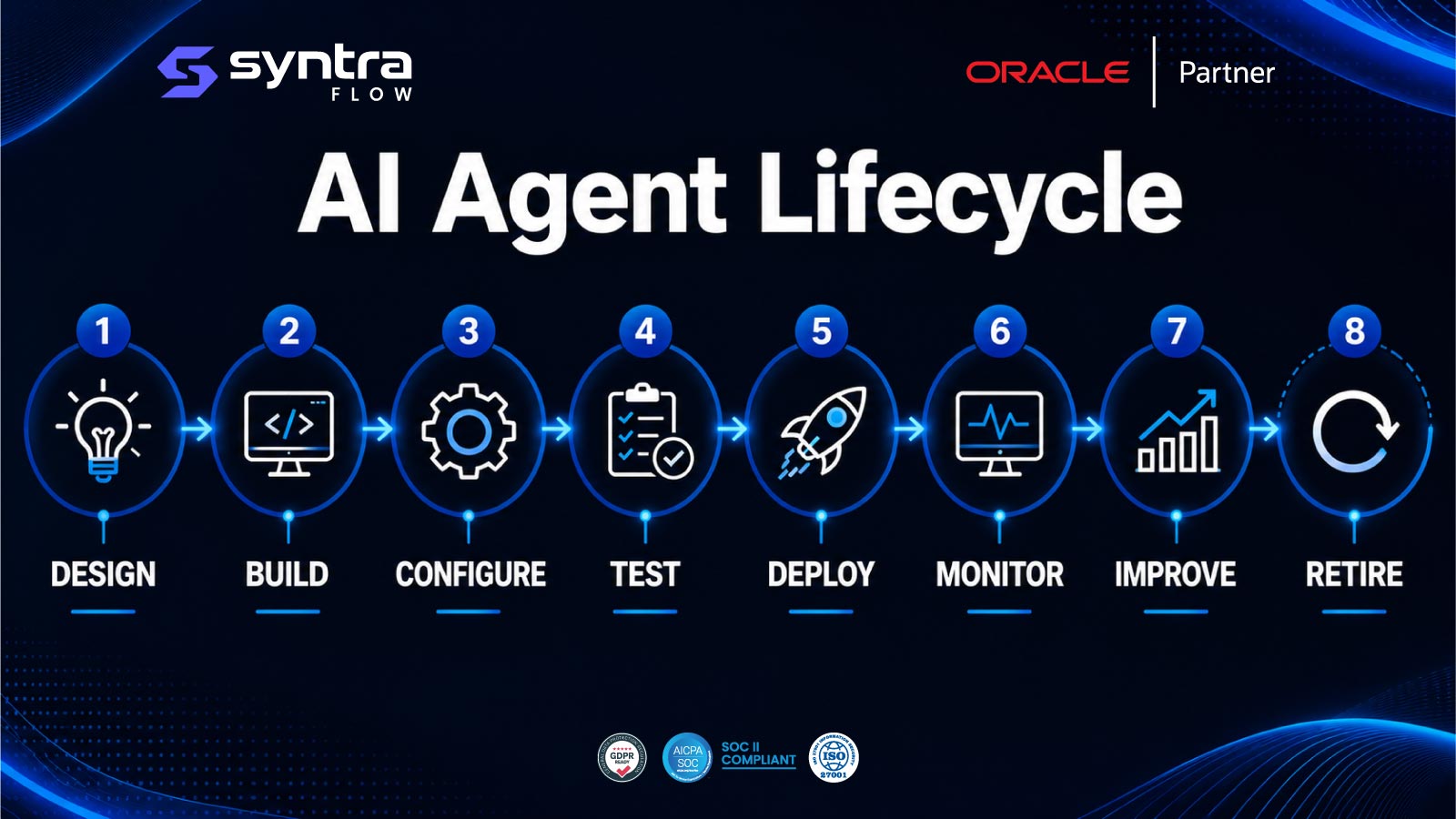
The Oracle AI Agent Lifecycle is the end-to-end sequence an AI agent moves through inside Oracle Fusion — from Design and Build, through Configure, Test and Deploy, into ongoing Monitor and Improve, and finally to controlled Retire. Treating an agent as a governed asset across all eight stages — rather than a one-time build in AI Agent Studio — is what separates a demo from a production control that finance and audit can rely on.
This page is a map, not a deep dive. Each stage below gives you the objective and the key controls to hold, then points to the dedicated page that treats it in depth. Start from the Oracle AI hub for the wider picture, or read what Oracle AI agents are if the concept is new.
What the Oracle AI Agent Lifecycle Covers
Oracle now ships AI agents that act inside business processes — a Payables invoice-handling agent capability, an HCM candidate-screening agent, and agents built on the AI Agent Studio and Agentic Applications Builder. Because these agents read Oracle data, take actions, and can be exposed over REST and MCP, they carry the same operational risk as any other change to a financial system — but they also change behaviour as models, prompts and Oracle releases evolve.
The lifecycle gives that risk a shape. Instead of asking "did the agent work in the demo?", it asks a sequence of harder questions: is this the right process to automate, what can the agent access, how do we prove it behaves, how do we watch it in production, and how do we retire it cleanly when it is superseded. Every stage has an owner, an objective, and a control that should exist before the agent advances.
Two governance disciplines run across all eight stages rather than sitting inside one: agent governance (who approves and owns each agent) and agent readiness (whether the environment, data and roles are ready before you build). We cover both in their own sections after the stage table.
Scope note. This page is the lifecycle overview — the stages and their sequence. It deliberately stays shallow on each stage so it does not compete with the dedicated pages. For the tooling that builds agents, see AI Agent Studio; for the test types that prove them, see AI agent testing; for production watching, see agent observability. This is the map that ties them together.
The Eight Stages of the Oracle AI Agent Lifecycle
A linear flow with two feedback loops: Monitor and Improve feed back into Configure and Build, so a live agent keeps changing rather than staying frozen at go-live.
Lifecycle sequence
| Stage | Objective | Key controls | Where to go deeper |
|---|---|---|---|
| 1 · Design | Decide which process the agent should act in and where a human stays in the loop | Process fit, in-scope actions, human-approval points, success criteria | Oracle AI agents |
| 2 · Build | Assemble the agent — prompts, tools, data grounding and actions | Studio topic/tool config, LLM choice, grounding sources, version control | AI Agent Studio |
| 3 · Configure | Bind the agent to roles, data scope and integration surfaces | Agent roles/privileges, business-object scope, REST/MCP exposure, guardrails | Agent governance |
| 4 · Test | Prove the agent behaves — accuracy, workflow, security, approvals | Prompt, workflow, API, regression, human-approval and response-validation tests | Agent testing |
| 5 · Deploy | Release the agent to production under change control | Approval to release, phased/pilot rollout, rollback path, sign-off record | AI release intelligence |
| 6 · Monitor | Watch live behaviour, cost, drift and exceptions | Action logs, accuracy/drift signals, escalation rates, audit trail | Agent observability |
| 7 · Improve | Refine prompts, grounding and scope from observed behaviour | Change requests, re-test before re-release, versioned improvements | Oracle AI testing |
| 8 · Retire | Decommission a superseded or unused agent cleanly | Access revocation, data/audit retention, dependency check, stakeholder notice | Agent governance |
Each Stage in Brief
1 · Design
Design is the cheapest place to prevent an expensive mistake. Here you decide whether an agent is the right answer at all, which business process it acts in, what actions it may take, and — critically — where a human keeps approval authority. A candidate-screening agent that recommends is a different risk profile from one that rejects. Define the success criteria and the failure modes now, because everything downstream tests against them. Start from a clear view of what Oracle AI agents can and cannot do so the design stays inside real capability.
2 · Build
Build is the assembly step — prompts, tools, data grounding, and the actions the agent can invoke — done predominantly in Oracle AI Agent Studio or the Agentic Applications Builder. The controls that matter are version control over the agent definition, deliberate model selection given Oracle's LLM marketplace flexibility, and grounding the agent in the right data sources rather than letting it improvise. Treat each build as a versioned artifact so you can compare, roll back, and audit what changed.
3 · Configure
Configuration binds a built agent to the real environment: the roles and privileges it runs under, the business-object scope it can read and write, the guardrails on its actions, and whether it is exposed over REST or through MCP and A2A interoperability. This is where over-permissioning creeps in, so configuration is inseparable from agent governance — an agent's access should map to a documented, approved role, not a convenient superset.
4 · Test
Testing proves the agent behaves before it touches production data. Agents need test types that scripted UI testing never had to consider: prompt and response validation, workflow paths, API behaviour, security and access boundaries, human-approval gates, and regression against a known baseline. The dedicated agent testing page breaks down each type; the broader discipline sits under Oracle AI testing. Because agent output is probabilistic, a single pass is not proof — you test for consistent behaviour across runs.
5 · Deploy
Deploy releases the agent into production under the same change discipline you would apply to any Oracle configuration change: an approval to release, a phased or pilot rollout rather than a big-bang switch, a documented rollback path, and a sign-off record. Because Oracle's own quarterly updates can change agent behaviour underneath you, deployment planning connects naturally to AI release intelligence — knowing which release changed what.
6 · Monitor
A deployed agent is not a finished agent. Monitoring watches live behaviour — the actions it takes, accuracy and drift signals, escalation and exception rates, and cost — and retains an audit trail of what the agent did and why. This is the domain of agent observability: the difference between assuming an agent still behaves and being able to show it. Monitoring is also the primary feedback source for the next stage.
7 · Improve
Improve is the feedback loop that keeps an agent useful. Observed behaviour drives changes to prompts, grounding data, or scope — but an improvement is a change like any other, so it re-enters the lifecycle at Configure or Build and must be re-tested before it is re-released. Skipping the re-test on a "small" prompt tweak is one of the most common ways a working agent quietly regresses. Route improvements through the same AI testing gate that admitted the original.
8 · Retire
Agents are superseded — by a better agent, a process change, or an Oracle-delivered capability. Retirement is a controlled decommission, not a silent switch-off: revoke the agent's access and roles, check for downstream dependencies and integrations that call it, retain its action history and audit trail per your records policy, and notify affected stakeholders. An unretired, unmonitored agent that still holds live privileges is a standing risk, which is why retirement is a governed stage rather than an afterthought — see agent governance.
Governance Runs Across Every Stage
Governance is not stage nine — it is the layer that spans all eight. Every agent needs a named owner, an approval before it advances between stages, a change-management path for improvements, and agent-level controls over what it can access and do. Without that layer, agents accumulate as ungoverned automations: nobody owns them, nobody approved their current scope, and nobody can say when they were last tested.
Practically, governance shows up as three questions asked at every transition — who approved this, who owns it now, and what changed since the last approval. The Oracle AI agent governance page treats the operating model in depth: agent approval, ownership, change management and agent-level controls. This page only marks where governance touches the lifecycle; it does not attempt to replace that treatment.
Governance checkpoints by stage
- Design → Build: approved use case and defined human-in-the-loop points before any build begins.
- Configure → Test: agent roles and data scope reviewed against least-privilege before testing.
- Test → Deploy: test evidence signed off; a release approval on record.
- Monitor → Improve: changes raised as tracked requests, not ad-hoc edits.
- Improve → Retire: ownership and dependencies confirmed before decommission.
Readiness Comes Before the First Build
The lifecycle assumes a starting point: an environment ready to host agents at all. Readiness sits before Design and Build and asks whether the foundations exist — the right Oracle release and infrastructure, the integrations the agent will call, the role model it will run under, and the data quality it will depend on. An agent grounded in inconsistent or poorly governed data inherits those problems no matter how well it is built.
Rushing to build in Agent Studio before readiness is confirmed is a common and costly reversal. The Oracle AI agent readiness page covers the infrastructure, integration, role and data checks in detail. Confirm readiness first; the eight stages then run on solid ground rather than on assumptions.
Common Lifecycle Mistakes
Most agent problems trace back to a skipped or collapsed stage. The recurring ones:
| Mistake | Stage it skips | Consequence |
|---|---|---|
| Building in Studio before readiness is confirmed | Readiness | Agent inherits bad data, missing integrations, wrong roles |
| No defined human-approval points | Design | Agent takes irreversible actions no one authorised |
| Over-permissioning the agent's scope | Configure | Data leakage and segregation-of-duties gaps |
| Testing once, treating a single pass as proof | Test | Probabilistic behaviour goes unverified across runs |
| Big-bang deploy with no rollback path | Deploy | No safe way back when the agent misbehaves |
| Deploy-and-forget, no live monitoring | Monitor | Drift and cost creep go unnoticed until they surface as errors |
| Improving prompts without re-testing | Improve | A working agent silently regresses on a "small" edit |
| Leaving retired agents with live access | Retire | Standing privileges on an unowned, unmonitored agent |
| No owner or approval trail per agent | Governance (all stages) | Agents accumulate as ungoverned automations |
| Ignoring Oracle quarterly updates | Monitor / Deploy | Oracle changes agent behaviour underneath you, undetected |
How SyntraFlow Helps Across the Lifecycle
SyntraFlow is a testing and release-intelligence platform, so it helps most where the lifecycle needs evidence — the Test, Deploy, Monitor and Improve stages. It does not build Oracle agents; it helps organisations prove and watch the agents Oracle builds.
Test-stage coverage
SyntraFlow can be configured to exercise agent workflows, API paths and human-approval gates, and to assert expected behaviour rather than just that the agent responded.
Regression on release
SyntraFlow can connect release intelligence with test planning, so when an Oracle quarterly update touches agent behaviour, the affected checks can be re-run.
Evidence for governance
SyntraFlow helps organisations retain timestamped run evidence, which can support the sign-off records governance expects at Deploy.
Readiness assessment
SyntraFlow helps organisations assess environment, data and role readiness before a build begins, so gaps surface early rather than at deploy.
Re-test on improve
The SyntraFlow roadmap can support re-running a baseline pack when a prompt or grounding change is made, so improvements are verified before re-release.
Monitoring signals
SyntraFlow can be configured to feed test and behaviour signals alongside observability, supporting the Monitor stage rather than replacing Oracle's own telemetry.
A note on capability. The items above describe where SyntraFlow can be configured to help across the lifecycle, not a guaranteed out-of-the-box coverage of every Oracle AI agent. Which stages and agents apply to your environment is confirmed during an assessment rather than assumed here. SyntraFlow's testing engine is a separate capability from Oracle's own AI agents — it is used to test them, not part of them.
Frequently Asked Questions
What are the stages of the Oracle AI agent lifecycle?
▼
Eight stages: Design, Build, Configure, Test, Deploy, Monitor, Improve, and Retire. They run in sequence, but Monitor and Improve form a feedback loop back into Configure and Build, so a live agent keeps evolving. Governance and readiness are not stages in the line — governance spans all eight, and readiness comes before the first build.
Where does the agent lifecycle start — Design or Readiness?
▼
Readiness comes first, then Design is stage one of the lifecycle proper. Readiness confirms the environment, integrations, roles and data are in place; only then does it make sense to design and build an agent. Building in AI Agent Studio before readiness is confirmed is a common reversal — see agent readiness.
How is testing different from monitoring in the lifecycle?
▼
Testing happens before deployment and proves the agent behaves against defined cases; monitoring happens after deployment and watches live behaviour, drift and cost. Both are needed — testing admits the agent, monitoring keeps it honest. See agent testing for the pre-deploy side and agent observability for the live side.
Why does governance span the whole lifecycle rather than being one stage?
▼
Because decisions that need approval and ownership occur at every transition — who approved the use case, who owns the deployed agent, what changed before re-release, who confirmed retirement. Placing governance in a single box would leave the other stages ungoverned. The agent governance page covers the operating model in full.
Do Oracle quarterly updates affect agents already in production?
▼
They can. Oracle delivers AI capabilities and changes through its quarterly update cadence, and a released change can alter how an existing agent behaves. That is why the Deploy and Monitor stages connect to AI release intelligence — knowing which release changed what, and re-testing accordingly, rather than discovering drift through a production error.
What does the Retire stage actually involve?
▼
A controlled decommission: revoke the agent's roles and access, check for downstream integrations or processes that depend on it, retain its action history and audit trail per your records policy, and notify affected stakeholders. The risk of skipping it is a retired agent that still holds live privileges but has no owner and no monitoring.
How does SyntraFlow fit into the lifecycle?
▼
SyntraFlow is a testing and release-intelligence platform, so it helps most at the Test, Deploy, Monitor and Improve stages — where evidence is needed. It can be configured to exercise agent workflows and approval gates, and to re-run affected checks after an Oracle release. It does not build Oracle agents; SyntraFlow's own testing engine is used to test them, and is separate from Oracle's AI.
Is the lifecycle specific to Agent Studio, or does it apply to all Oracle AI agents?
▼
It applies to Oracle AI agents generally — whether custom-built in AI Agent Studio or delivered as a packaged capability inside a Fusion module. Oracle-delivered agents may compress the Build stage, but Design, Configure, Test, Deploy, Monitor, Improve and Retire still apply. For the concept itself, start at Oracle AI agents.
Map Your Oracle AI Agents to a Governed Lifecycle
See where your agents sit across the eight stages, where readiness and governance gaps are, and how SyntraFlow can be configured to add test and release evidence. Book an assessment tailored to your Oracle environment.