Oracle AI Agent Directory
The Oracle AI Agent Directory is a structured, filterable inventory of the AI agents Oracle ships — or has signalled — inside Oracle Fusion Cloud Applications, organised by module, business process, and release. It exists to answer one operational question: which Oracle AI agents touch which process, what can they do, and does a human still approve the outcome? Use it as a working register when you plan enablement, governance, and testing across ERP, Procurement, HCM, SCM, and CX.
Only a small number of Oracle AI agents are individually named and confirmed today; most are described here by capability category tied to a module and process, and flagged as announced or roadmap so you are never planning against something invented. For the conceptual explanation of what an Oracle AI agent actually is, start at the Oracle AI Agents page; this directory assumes you already know the concept and want the inventory.
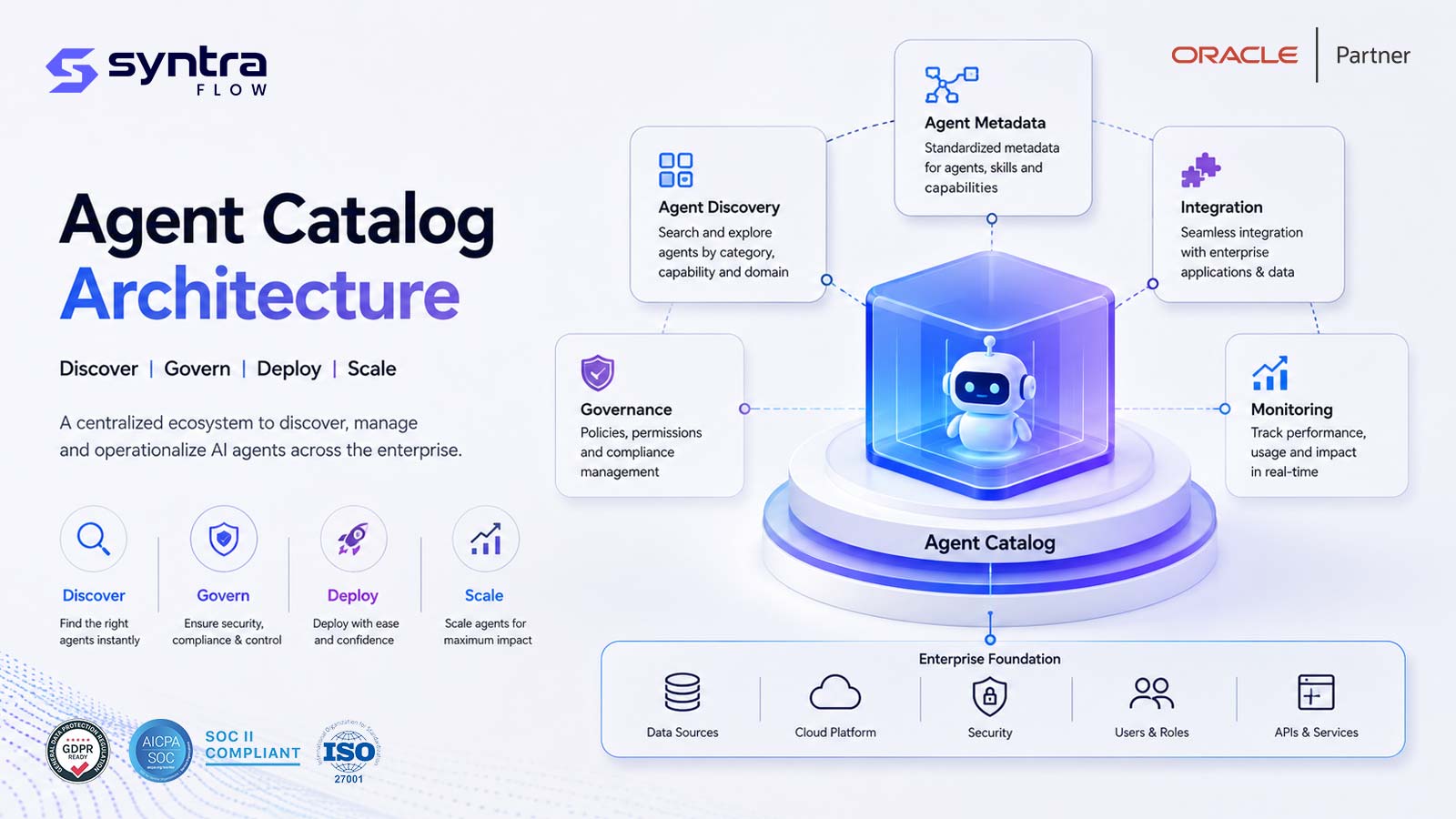
What This Directory Is — and Is Not
This page is a reference artifact: a table you scan and filter to locate an Oracle AI agent by the module and business process it affects. It is deliberately shallow on concept and deep on inventory. Each row tells you the module, the process, when the capability first appeared (where that is confirmed), the Oracle product it lives in, whether a human approval gate applies, what the agent does at a high level, how confident we are that it exists today, and where to read more.
It is not an explainer. It does not define agentic AI, walk through how the reasoning loop works, or compare Oracle's approach to other vendors. That conceptual material lives on the hub and its concept page, and this directory links back to them rather than repeating them.
Scope note. This directory is a structured inventory — a searchable table of agents by module and process. The conceptual companion, Oracle AI Agents, answers what agents are, how they reason and act, and how they differ from embedded generative AI. If you want to understand the idea, read that page first. If you already know the idea and want the list, stay here. For the broader picture of Oracle's AI across features, security, and readiness, see the Oracle AI hub.
How to Read the Directory
The table below has nine columns. Two of them — Human Approval and Status — carry most of the governance weight, so read them carefully before you act on any row.
| Column | What it tells you |
|---|---|
| Agent Name | The named agent where Oracle has confirmed one, otherwise a capability-category label (e.g. "Payables invoice-handling agent — capability area"). A category label is a description, not a product name. |
| Module | The Oracle Fusion functional area the agent operates in — Financials, Procurement, HCM, SCM, or CX. |
| Business Process | The specific process the agent participates in, so you can map it to your own process owners and controls. |
| First Release | A concrete Oracle quarter only where confirmed on-site; otherwise "—" or "Announced". We do not attach a release version to anything unconfirmed. |
| Oracle Product | The Oracle Fusion Cloud application (or platform, such as AI Agent Studio) the agent is delivered in. |
| Human Approval | Yes — required: a person must approve the agent's output before it takes effect. Recommended: no forced gate, but a human checkpoint is advisable. Configurable: you decide the gate when you build or enable it. Treat this as a control requirement, not a footnote. |
| AI Capability | A short description of what the agent does — drafting, extraction, ranking, anomaly detection, orchestration — so you can judge blast radius. |
| Status | Confirmed: a named agent referenced on our on-site quarterly pages. Announced: Oracle has signalled the capability area. Observed / roadmap: a directional pattern, not a firm commitment. Plan enablement only against Confirmed rows. |
| Links | Where to go next — the relevant Oracle AI page for testing, security, or governance of that agent, or a quarterly-update page, or "—". |
A practical way to use the table: filter mentally to your module, read the Business Process column to find the agents that touch your controls, then look only at the Human Approval and Status columns to decide what is real enough to plan for and what still needs a human gate. Everything marked Observed / roadmap belongs on a watch-list, not an enablement plan.
The Oracle AI Agent Directory
Oracle AI agents across ERP/Financials, Procurement, HCM, SCM, and CX. Two rows name confirmed agents referenced on our on-site 26A quarterly pages; the remainder describe capability categories tied to a module and process and are labelled Announced or Observed / roadmap. No release version is attached to an unconfirmed row.
| Agent Name | Module | Business Process | First Release | Oracle Product | Human Approval | AI Capability | Status | Links |
|---|---|---|---|---|---|---|---|---|
| Ledger Agent | Financials (GL) | Period close, journals & reconciliation | 26A | Oracle Fusion Cloud ERP | Yes — required | Reconciliation & close assistance | Confirmed | 26A ERP agents |
| Applicant Screening AI Agent | HCM (Recruiting) | Candidate screening & shortlisting | 26A | Oracle Fusion Cloud HCM | Yes — required | Candidate evaluation & ranking | Confirmed | 26A HCM |
| Payables invoice-handling agent — capability area | Financials (Payables) | Invoice entry & exception handling | Announced | Oracle Fusion Cloud ERP | Yes — required | Invoice extraction & match assist | Announced | Agent testing |
| Expense audit assistant — capability area | Financials (Expenses) | Expense audit & policy checks | Announced | Oracle Fusion Cloud ERP | Recommended | Policy & anomaly detection | Announced | Agent security |
| Receivables collections assistant — capability area | Financials (Receivables) | Collections & dunning | — | Oracle Fusion Cloud ERP | Recommended | Prioritisation & outreach drafting | Observed / roadmap | — |
| Procurement sourcing assistant — capability area | Procurement | Sourcing & negotiation support | Announced | Oracle Fusion Cloud Procurement | Yes — required | Supplier & bid analysis | Announced | Agent governance |
| Supplier onboarding assistant — capability area | Procurement | Supplier registration & qualification | — | Oracle Fusion Cloud Procurement | Recommended | Data validation & risk flags | Observed / roadmap | — |
| Contract drafting assistant — capability area | Procurement | Contract authoring & review | Announced | Oracle Fusion Cloud Procurement | Yes — required | Clause generation & summarisation | Announced | Agent security |
| Recruiting content & hiring assistant — capability area | HCM (Recruiting) | Job requisition & offer support | Announced | Oracle Fusion Cloud HCM | Yes — required | Content drafting & summarisation | Announced | 26A HCM |
| Employee HR knowledge assistant — capability area | HCM (HR Help Desk) | Employee self-service Q&A | — | Oracle Fusion Cloud HCM | Recommended | Knowledge retrieval & answering | Observed / roadmap | — |
| Performance & goals assistant — capability area | HCM (Talent) | Goal & review drafting | Announced | Oracle Fusion Cloud HCM | Yes — required | Draft generation from inputs | Announced | — |
| SCM demand-planning assistant — capability area | SCM (Planning) | Demand & supply planning | — | Oracle Fusion Cloud SCM | Recommended | Forecast analysis & scenarios | Observed / roadmap | AI testing |
| Order-management assistant — capability area | SCM (Order Mgmt) | Order orchestration & exceptions | Announced | Oracle Fusion Cloud SCM | Recommended | Exception triage & routing | Announced | — |
| Inventory & logistics assistant — capability area | SCM (Inventory) | Replenishment & logistics | — | Oracle Fusion Cloud SCM | Recommended | Shortage & anomaly detection | Observed / roadmap | — |
| CX service response assistant — capability area | CX (Service) | Case handling & response drafting | Announced | Oracle Fusion Cloud CX | Yes — required | Response drafting & summarisation | Announced | Agent security |
| CX sales next-best-action assistant — capability area | CX (Sales) | Opportunity & quote support | — | Oracle Fusion Cloud CX | Recommended | Next-best-action suggestions | Observed / roadmap | — |
| Custom agent (built in AI Agent Studio) | Cross-module | Customer-defined process | — | Oracle AI Agent Studio | Configurable | Customer-defined / configurable | Platform capability | AI Agent Studio |
Confirmed = a named agent referenced on our on-site 26A quarterly pages. Announced = a signalled capability area. Observed / roadmap = a directional pattern, not a firm Oracle commitment — no specific product name or release version is asserted for these rows. The last row is a platform capability: agents you build yourself in Oracle AI Agent Studio, alongside the Agentic Applications Builder.
How Agents Are Added Each Quarter
Oracle delivers new and revised AI agents through its quarterly update cycle, the same cadence that governs every other Fusion feature. An agent that is Announced or Observed / roadmap today can become a Confirmed, named agent in a future quarter — and an existing agent's behaviour, scope, or approval model can change from one release to the next without any action on your part.
Rather than re-scan every Oracle release note by hand, this directory is maintained against the quarterly analysis captured in Oracle AI Release Intelligence. Each quarter, the workflow is:
- 1.Review the quarter's Oracle release content for new agents, changed capabilities, and altered approval gates across ERP, Procurement, HCM, SCM, and CX.
- 2.Promote a capability-category row to a named, Confirmed row only when Oracle names the agent and it is referenced in on-site quarterly content — for example the 26A ERP agents and HCM pages.
- 3.Record the First Release quarter for newly confirmed agents, and leave unconfirmed rows without a version.
- 4.Flag any agent whose approval model or capability changed, so governance and testing owners can re-check it.
- 5.Retire or relabel rows Oracle has withdrawn or superseded.
The analysis method behind that cadence — how a release note becomes an impact assessment — is described on the Oracle AI Release Intelligence page. For a chronological, quarter-by-quarter view of AI changes rather than this current-state table, that page is the better starting point.
What to Check Before Enabling Any Agent
Locating an agent in this directory is the start, not the decision. Before you enable a Confirmed agent — or plan for an Announced one — walk the same three checks for every row: security, governance, and testing. Each has a dedicated page in this vertical.
Security
Confirm the agent's roles and privileges, the business objects it can read and write, its REST/MCP exposure, and where its data flows. An agent inherits access — scope it deliberately.
Oracle AI Agent Security →Governance
Decide who owns the agent, who approves its enablement and changes, and what the human-approval gate is for its outputs. The directory's Human Approval column is the input to this decision.
Oracle AI Agent Governance →Testing
Validate the agent's prompts, workflow, API behaviour, response accuracy, and the approval gate itself — before enablement and again after each quarterly update.
Oracle AI Agent Testing →For the broader validation discipline that surrounds embedded and generative AI as well as agents, see Oracle AI Testing. If you are building your own agents rather than enabling Oracle's, the capabilities involved — Oracle AI Agent Studio and the wider agentic applications pattern — carry the same three checks, plus the design decisions the Studio exposes.
Enablement checklist. For each agent you plan to turn on: (1) confirm its Status is Confirmed, not Announced or roadmap; (2) map its roles, privileges, and business-object scope; (3) set or verify the human-approval gate; (4) define the owner and change-approval path; (5) build the agent test set — prompt, workflow, API, response validation; (6) schedule re-testing on the next Oracle quarterly update. Skipping any step turns an assistive agent into an unmonitored actor.
How SyntraFlow Helps
SyntraFlow is an Oracle Fusion testing and release-intelligence platform. It does not replace Oracle's agents — it helps organisations inventory, govern, and test them as they arrive. Every capability below is offered as a configurable engagement, confirmed at assessment rather than assumed.
Maintain your own inventory
SyntraFlow can be configured to keep a tenant-specific version of this directory — the agents you have actually enabled, with their approval gates and owners.
Connect releases to the register
SyntraFlow can connect release intelligence with your agent inventory, so a new or changed agent in a quarterly update surfaces against the processes it affects.
Assess agent readiness
SyntraFlow helps organisations assess whether the roles, integrations, and data behind an agent are in place before enablement — not after.
Plan agent test coverage
The SyntraFlow roadmap can support building test sets around agent prompts, workflows, API behaviour, and the human-approval gate, tied to each directory row.
Evidence for governance
SyntraFlow can be configured to retain execution evidence for agent tests, giving governance and audit owners a record rather than an assertion.
Scope by module and process
Because SyntraFlow already models Oracle by module and process, it helps organisations map agents onto existing controls and regression packs.
A note on capability. SyntraFlow's AI-driven testing engine — used to test Oracle, including Oracle's AI agents — is distinct from Oracle's own AI. The items above describe what SyntraFlow can be configured to do for agent inventory, readiness, and testing; the exact scope for your tenant is confirmed during an assessment, not guaranteed here. SyntraFlow does not claim to automatically test every Oracle AI agent or to certify agent accuracy.
Frequently Asked Questions
What is the Oracle AI Agent Directory?
▼
It is a structured, filterable inventory of the AI agents Oracle ships or has signalled inside Oracle Fusion Cloud Applications, organised by module, business process, and release. Each row records the module, process, whether a human approval gate applies, what the agent does, and how confident we are that it exists today — so you can plan enablement, governance, and testing from one register.
How is this different from the Oracle AI Agents page?
▼
The Oracle AI Agents page is conceptual — it explains what an Oracle AI agent is, how it reasons and acts, and how it differs from embedded generative AI. This directory is the inventory: a searchable table of agents by module and process. Read the concept page to understand agents; use this page to look one up. The two are complementary, and this directory deliberately does not re-explain the concept.
Which Oracle AI agents are actually confirmed today?
▼
Two named agents are Confirmed against our on-site 26A quarterly content: the Ledger Agent in Financials and the Applicant Screening AI Agent in HCM. Every other row describes a capability category tied to a module and process, marked Announced or Observed / roadmap. We do not attach a specific product name or release version to unconfirmed rows.
What does the Human Approval column mean?
▼
It states whether a person must sign off the agent's output before it takes effect. "Yes — required" means a mandatory human gate; "Recommended" means no forced gate but a checkpoint is advisable; "Configurable" means you set the gate when you build or enable the agent. Treat this as a control requirement and pair it with the agent governance decision on ownership and approval.
How often is the directory updated?
▼
On Oracle's quarterly update cadence. Each quarter, new and changed agents are reviewed against Oracle release content, capability-category rows are promoted to Confirmed only when Oracle names the agent on-site, and altered approval models are flagged. The analysis method behind that cadence lives on the Oracle AI Release Intelligence page.
Can we build agents that are not in this list?
▼
Yes. Oracle provides AI Agent Studio and the Agentic Applications Builder as platform capabilities for creating your own agents across modules — the last row of the directory. Custom agents carry the same security, governance, and testing checks as Oracle's own, plus the design decisions the Studio exposes. See the wider agentic applications pattern for context.
What should we check before enabling an Oracle AI agent?
▼
Three checks per agent: security (roles, privileges, business-object scope, REST/MCP exposure — see agent security), governance (owner, change approval, human-approval gate — see agent governance), and testing (prompt, workflow, API, response validation — see agent testing). Only enable rows whose Status is Confirmed.
Does SyntraFlow test Oracle AI agents?
▼
SyntraFlow can be configured to help organisations inventory, assess readiness for, and test Oracle AI agents — building test sets around prompts, workflows, API behaviour, and the human-approval gate, and retaining evidence for governance. SyntraFlow's testing engine is distinct from Oracle's own AI, and the exact scope for your tenant is confirmed at assessment rather than assumed. It does not claim to automatically test every agent or certify agent accuracy.
Book an Oracle AI Assessment
Turn this directory into a tenant-specific register: inventory the Oracle AI agents that touch your processes, map their approval gates and owners, and plan governance and testing before you enable them. SyntraFlow can help you scope the work.