Oracle AI Best Practices for Fusion Applications
Oracle AI best practices come down to a short list of disciplines: start narrow, keep a human on high-risk decisions, secure and govern what the AI can see and do, and test the actions it takes — not just the text it produces. None of this is exotic. It is the same control discipline Fusion teams already apply to workflow rules, security roles, and integrations, applied to AI agents, AI Agent Studio, and embedded generative AI features.
This page brings together twelve practical Oracle Fusion AI best practices that apply across implementation, security, governance, and testing. Each one links to a deeper resource — Oracle AI Testing, Oracle AI Governance, Oracle AI Security, and the Oracle AI Adoption Guide — for the implementation detail. Start here for the checklist; go deeper on each topic from the pages it links to.
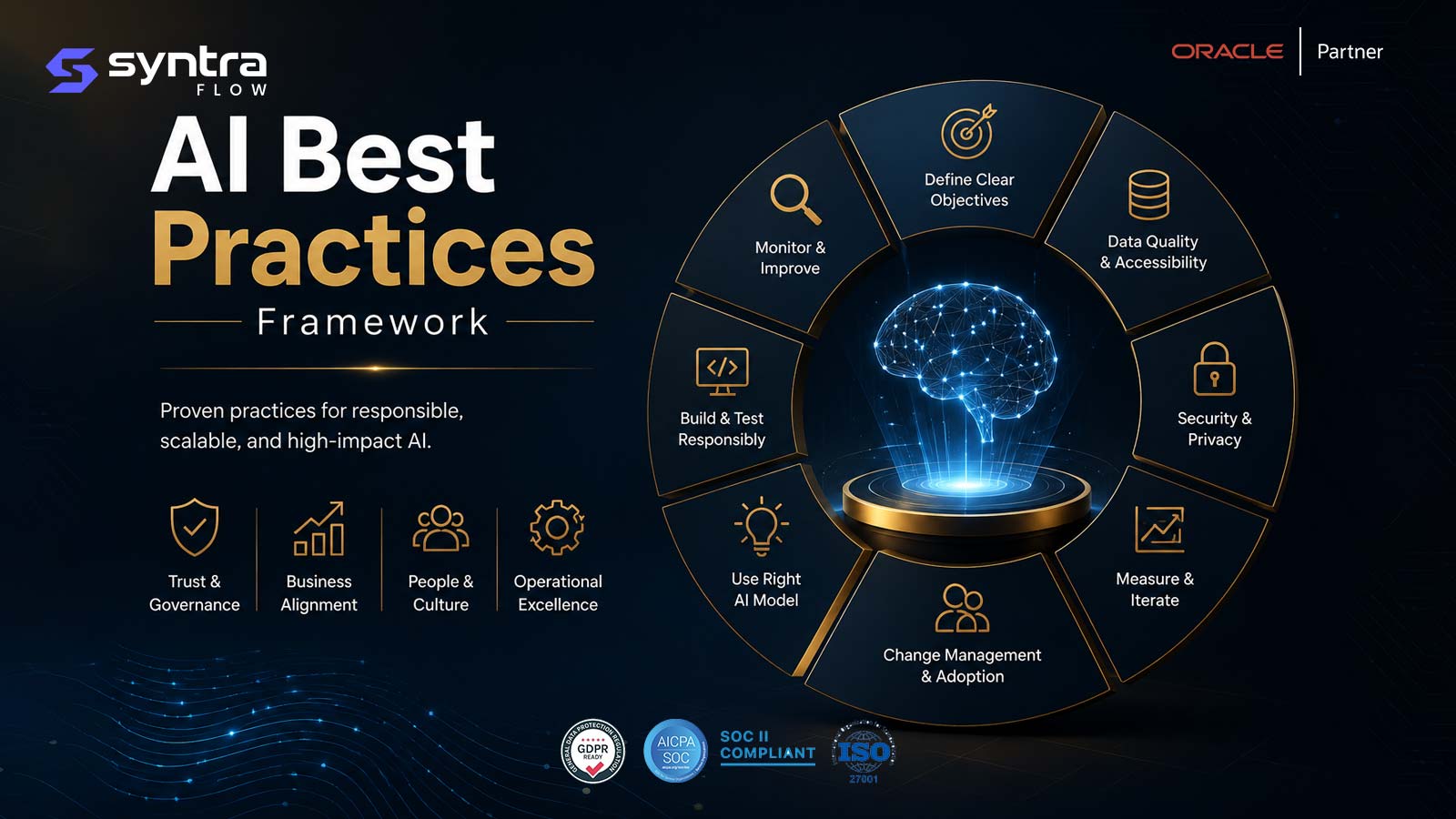
Why Oracle AI Needs Its Own Best-Practice Discipline
Oracle AI agent best practices differ from ordinary Fusion configuration guidance in one important way: AI agents and embedded AI features can interpret instructions, generate content, and in some configurations initiate business actions with a degree of variability that a static workflow rule does not have. That variability is the point — it's what makes the AI useful — but it also means the assumptions that make traditional Fusion controls sufficient don't automatically carry over.
Oracle AI implementation best practices, Oracle AI governance best practices, and Oracle AI testing best practices are really three views of the same underlying question: how do you get the productivity benefit of AI in Fusion without losing the control discipline your finance, HR, and audit teams already rely on. The twelve practices below answer that question across the full lifecycle — from first pilot through ongoing quarterly-update review.
Scope note. This page covers Oracle's own AI capabilities inside Fusion Applications — AI agents, AI Agent Studio, and embedded generative AI features. It is not about SyntraFlow's own AI-driven testing engine, which is a separate capability used to test Oracle, covered under Oracle ERP Testing Tool. For the broader orientation to this vertical, start at the Oracle AI hub.
12 Oracle AI Best Practices for Fusion Teams
Each practice below covers why it matters and how to apply it in a Fusion environment.
Start With Controlled Use Cases
Why it matters: Rolling out an Oracle AI agent or embedded AI feature broadly before understanding its actual behavior multiplies risk across every process it touches. A narrow pilot lets you observe real behavior against real Fusion data before it influences anything that hits the ledger.
How to apply: Pick one bounded process — a single AI agent scoped to one business unit, or one embedded AI feature within a single module — define explicit success and failure criteria before go-live, and expand only after a full quarterly-update cycle has passed without incident. Keep a written inventory of every enabled AI capability and its scope.
Keep Humans in High-Risk Decisions
Why it matters: Depending on configuration, Oracle AI agents can recommend or initiate business actions — approvals, adjustments, payments. A wrong or hallucinated recommendation acted on without review can create financial or compliance exposure that is expensive to unwind after the fact.
How to apply: Classify every AI-touched action by financial and compliance impact, and require human review above a defined threshold. Treat "human in the loop" as a configuration to be verified after every update, not an assumption to trust — confirm the actual approval routing still works as intended.
Use Trusted Knowledge Sources
Why it matters: Generative and agentic AI features answer or act based on whatever data and documents they're grounded in. Stale policy documents, incorrect configuration data, or overly broad data access get inherited by the AI's output — with a false sense of authority attached.
How to apply: Audit what each AI feature is grounded on — transactional data, attached documents, knowledge bases — and remove stale or unauthorized sources. Apply the same data classification and governance rules that already cover reporting and analytics, and review source lists whenever a new AI feature is enabled.
Apply Least-Privilege Security
Why it matters: An AI agent's effective access is a security boundary like any other integration. Overly broad role grants let an agent read or act on data far beyond its intended use case, so a compromised or misconfigured agent inherits legitimate credentials to a wide blast radius.
How to apply: Scope agent-related roles and data access as narrowly as the use case requires, run periodic segregation-of-duties analysis with AI-related roles explicitly in scope, and revalidate access whenever an agent's function changes. See Oracle AI Security for the fuller access-control model.
Validate AI-Generated Responses
Why it matters: Generative AI outputs in Fusion — summaries, drafted content, recommended values — can be fluent and confident while still being wrong. Users under time pressure are prone to accepting a well-formatted answer without checking it against the underlying transaction.
How to apply: Spot-check AI-generated content against source records on a defined cadence, require traceability to source data wherever the feature supports it, and train end users to treat AI output as a draft or recommendation — not a verified result — until confirmed.
Test Business Actions, Not Only Text
Why it matters: The output of an AI agent is often a transaction, not just a summary — a requisition created, a record updated, a workflow triggered. A check that only reads the agent's explanation of what it did misses whether the underlying business action actually happened correctly.
How to apply: Test the transaction the agent produced, not the response text: confirm the record was created with correct values, the workflow advanced as expected, and downstream accounting or approvals fired. This specific discipline is covered in depth on Oracle AI Testing.
Maintain Regression Coverage
Why it matters: Oracle ships quarterly updates that can change AI agent behavior, prompt handling, or embedded AI features without a corresponding customer-side change request. A scenario that passed last quarter is not guaranteed to pass this quarter.
How to apply: Keep a maintained regression pack covering every enabled AI use case and re-run it each quarterly update cycle, not only for traditional Fusion functionality. Track pass/fail history over time so a new failure is visible as a change, not lost in one-off manual testing.
Monitor Agent Behaviour
Why it matters: An AI agent's behavior can drift over time as underlying models, prompts, or connected data change. Problems that only show up at production volume or on edge-case data may never surface in a small pre-production test set.
How to apply: Monitor live agent activity for anomalies — unexpected action types, unusual volume, repeated errors, or actions outside the agent's intended scope — and set up alerting so deviations are caught quickly rather than discovered during a downstream reconciliation.
Govern Prompts and Instructions
Why it matters: The instructions that shape an AI agent's behavior are effectively configuration, but they're often edited more casually than a workflow rule or role definition — creating an ungoverned change path into a control-relevant capability.
How to apply: Treat prompt and instruction changes with the same change-control discipline as any other Fusion configuration change — version them, require review before production changes, and log who changed what and when. Oracle AI Governance covers the broader operating model this fits into.
Review Every Quarterly Update
Why it matters: Oracle's AI capabilities are an active area of investment, and quarterly updates are where new AI agents, AI Agent Studio changes, and embedded AI features typically appear or change. Reading release notes after the fact is reactive, not planned.
How to apply: Review Oracle's quarterly update documentation specifically for AI-related changes before each update lands, assess the impact on your enabled use cases, and schedule the corresponding regression and governance review as a standard part of the update cycle.
Capture Evidence and Audit Trails
Why it matters: When an AI agent takes a business action, auditors and control owners need to reconstruct what happened and why — what it was instructed to do, what data it used, what it changed. That reconstruction is only possible if evidence was captured at the time.
How to apply: Capture and retain logs of agent inputs, outputs, and resulting transactions, alongside test evidence for validated scenarios. Store it in a form that supports audit and control testing, not just informal troubleshooting — this is a core piece of a defensible Oracle AI governance program.
Measure Business Outcomes
Why it matters: Enabling an Oracle AI capability is not the same as it delivering value. Without a defined outcome measure, an underperforming or even net-negative AI deployment can continue simply because no one is tracking whether it's actually helping.
How to apply: Define the business metric each AI use case should move — cycle time, error rate, first-time approval rate — before go-live, and review it on a regular cadence. The Oracle AI Adoption Guide gives a fuller framework for sequencing this across a rollout.
How These Practices Sequence Across a Rollout
Not all twelve practices are needed on day one. The table below groups them by where they typically fall in an Oracle AI rollout — useful as a rough sequencing checklist rather than a rigid gate.
| Phase | Focus | Practices |
|---|---|---|
| Foundation | Before or at first go-live of an AI agent or feature | Controlled use cases, human-in-the-loop, trusted sources, least-privilege security |
| Operate | Running the AI capability in production | Validate responses, test business actions, monitor behaviour, capture evidence |
| Sustain | Ongoing governance as Oracle AI and your usage evolve | Regression coverage, prompt governance, quarterly update review, measure outcomes |
Where to Go Deeper on Each Practice
This page is a synthesis across the whole Oracle AI vertical, deliberately kept at a checklist level. For implementation depth, use the dedicated pages: Oracle AI Testing for how to validate agent actions and embedded AI outputs, Oracle AI Governance for operating models, ownership, and prompt/change control, Oracle AI Security for access, data exposure, and least-privilege detail, and the Oracle AI Adoption Guide for how to sequence adoption and measure outcomes over time.
Where SyntraFlow fits. Practices 6, 7, and 11 above — testing business actions, maintaining regression coverage, and capturing evidence — are testing and evidence disciplines. SyntraFlow can be configured to help Oracle Fusion customers apply these disciplines to AI-touched processes, and the SyntraFlow roadmap can support extending release-aware regression testing to Oracle AI agent behaviour as Oracle's AI capabilities continue to evolve. This is distinct from Oracle's own AI: SyntraFlow's AI-driven testing engine is covered separately under Oracle ERP Testing Tool.
Frequently Asked Questions
What are the most important Oracle AI best practices to start with?
▼
Start with controlled use cases, keep a human in high-risk decisions, and apply least-privilege security to any agent's role and data access. These three foundation practices reduce risk before an AI agent or embedded AI feature has produced enough production history to trust more broadly.
How is testing Oracle AI different from testing traditional Fusion functionality?
▼
Traditional Fusion functionality behaves deterministically, so a passing test result reliably repeats. AI agents and embedded AI features can vary in phrasing or approach between runs, so testing has to focus on whether the resulting business action and data are correct — not on matching an exact prior output. See Oracle AI Testing for the full approach.
Who should own Oracle AI governance in a Fusion organization?
▼
Most organizations split ownership: IT security owns access and least-privilege enforcement, functional/process owners own use-case scope and outcome measurement, and a governance function — often compliance or internal audit — owns evidence, change control, and quarterly review. See Oracle AI Governance for a fuller operating-model breakdown.
How often should Oracle AI features be reviewed?
▼
At minimum, review AI-related changes at every Oracle quarterly update, since that is the primary channel through which AI agent behaviour and embedded AI features change. Add ad hoc review whenever you enable a new use case, change a prompt or instruction set, or observe anomalous agent behaviour.
Do Oracle AI best practices apply to embedded AI as well as AI agents?
▼
Yes. Embedded generative AI features — drafting, summarization, recommended values — carry the same validation and governance concerns as AI agents, even though they don't typically initiate business actions on their own. The main difference is emphasis: embedded AI leans more heavily on practice 5, validating generated responses, while agents lean more on practices 2 and 6, human oversight and testing business actions.
What's the biggest risk of skipping AI governance in Fusion?
▼
Silent drift. Without governed prompts, access reviews, and quarterly-update review, an AI agent's behaviour can change without anyone noticing until it surfaces downstream — in a reconciliation break, an audit finding, or an incorrect approval that already went through. Governance turns that into a planned review instead of an unplanned discovery.
How does SyntraFlow help with Oracle AI best practices?
▼
SyntraFlow can be configured to help apply the testing and evidence practices on this page — validating business actions and maintaining regression coverage across Oracle quarterly updates — to Oracle Fusion processes touched by AI. It does not replace the security, governance, or human-review practices, which remain organizational responsibilities. See Oracle ERP Testing Tool for details on SyntraFlow's own testing capability.
Where should we start if we haven't governed Oracle AI yet?
▼
Start with an inventory: list every Oracle AI agent and embedded AI feature currently enabled in your Fusion environment, who owns each one, and what access and data it touches. That inventory is the prerequisite for every other practice on this page, and it's the starting point covered in the Oracle AI Adoption Guide.
Bring Testing Discipline to Oracle AI-Touched Processes
See how SyntraFlow can be configured to help validate the Fusion transactions your Oracle AI agents and embedded AI features touch, and to maintain regression coverage across quarterly updates.