Oracle HCM Security Testing
Oracle HCM security is the layer that decides who can see and do what — which worker records a manager can open, which fields an HR specialist can edit, which transactions a role can complete. It is built from job and abstract roles, duty roles, privileges, and data security policies, provisioned automatically or manually through the Security Console. When any of these pieces drift, the result is either a locked-out user who cannot do their job or an over-privileged one who can see data they should never touch.
This page is a practical guide to testing that security model directly — role composition, provisioning and autoprovisioning, data security scoping, and segregation of duties — rather than testing a single HCM transaction. It sits under the Oracle HCM Testing Tool hub and governs access across every other HCM process, including Oracle Worker Testing.
What Is Oracle HCM Security?
Oracle Fusion Cloud HCM uses role-based access control layered with data security. A user is assigned one or more job roles or abstract roles (Employee, Line Manager, HR Specialist). Each role inherits duty roles, and each duty role carries the privileges — function security policies — that determine which pages and actions are visible. Layered on top, data security policies decide which specific records a role can act on: an employee's own record, a manager's direct reports, or a department, business unit, or legal employer scope.
Roles reach users through role provisioning — manual assignment, or autoprovisioning rules that grant or remove a role automatically based on assignment attributes. The Security Console is where administrators build and copy roles, add duty roles and privileges, run comparisons, and review who holds what. Segregation of duties (SoD) analysis sits across the whole model, flagging role combinations that let one person perform two conflicting functions — for example, entering and approving the same change.
This process forms part of the complete Oracle Hire-to-Retire (H2R) lifecycle — every hire, transfer, promotion, and termination depends on the right role landing on the right person at the right time. See the Oracle HCM Testing Tool hub for how security testing connects to the rest of H2R.
Scope note. This page covers the security mechanics themselves — roles, duties, privileges, data security, provisioning, and SoD — not the functional coverage of individual transactions; Oracle Worker Testing is one example of a transaction role-gated by the mechanics tested here. For scenario catalogs and sign-off checklists, see Oracle HCM Test Cases and the Oracle HCM UAT Checklist.
Why Testing HCM Security Matters
A security defect in Oracle HCM rarely looks like a bug — it looks like a person quietly able to do something they shouldn't, or unable to do something they must. Unauthorized access to compensation, national ID, or performance data is a privacy failure; a role that lets one user both initiate and approve a change is a segregation-of-duties failure auditors will find. Because roles change with every custom edit, autoprovisioning rule, and quarterly update, security needs continuous verification, not a one-time check.
This is where HCM security testing and two other SyntraFlow products meet at a clear boundary. This page validates that a role or privilege change does not introduce a new SoD conflict before it reaches production — a pre-production gate on the design. Oracle Fusion Segregation of Duties (SoD) then takes over once roles are live, continuously monitoring assignments for conflicts that emerge as people are hired, transferred, or reassigned. Testing proves the design is sound; continuous monitoring proves it stays sound.
The second boundary is with configuration migration. A security role, its duty-role composition, and its data security profile are themselves a configuration artifact, no different in principle from a flexfield, and need to migrate correctly across environments. Oracle Config Intelligence compares configuration across environments and flags drift; Oracle HCM Configuration Migration applies that to HCM setup, so a role that tested clean does not silently diverge by production.
| Risk | Impact | Mitigation via testing |
|---|---|---|
| Over-privileged custom role | User accesses data or actions beyond job need | Duty-role and privilege composition testing |
| SoD conflict introduced by role change | One user can enter and approve the same transaction | Pre-production SoD conflict testing on role changes |
| Autoprovisioning rule mis-targets | Wrong workers gain or lose a role automatically | Rule-condition test cases across worker attributes |
| Data security scoped too broadly | Manager or HR role sees records outside its scope | Security-profile boundary testing per scope type |
| Role not revoked on transfer/termination | Stale access persists after role condition ends | Revocation testing on attribute and status change |
Oracle HCM Security Process Overview
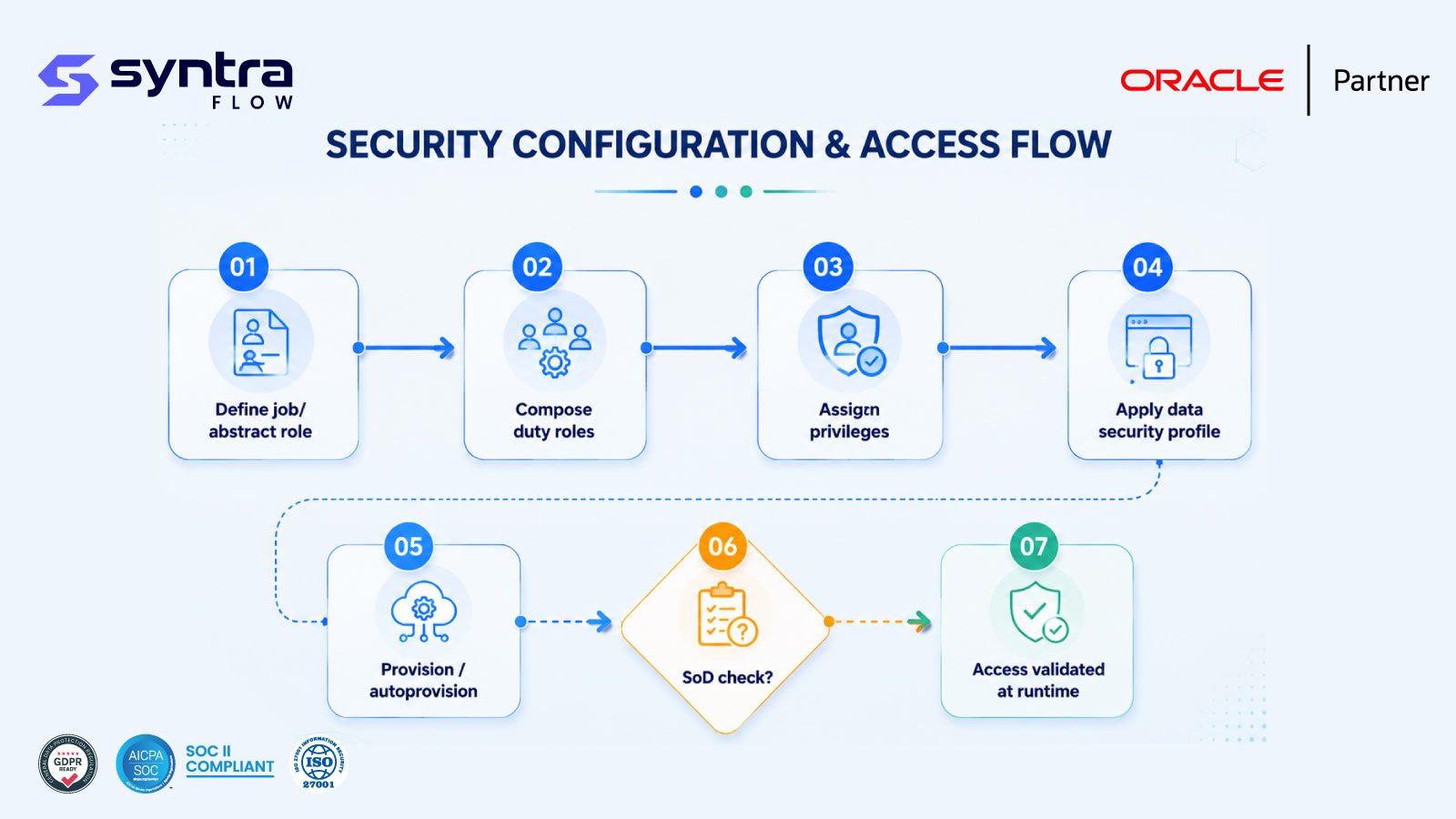
Access is built once as configuration and then applied continuously as people move through the organization — the sequence a security test needs to exercise end to end.
Security configuration & access flow
- Trigger: a new or copied role in the Security Console, or a worker's assignment attributes changing (hire, transfer, termination).
- Key steps: duty roles are added to the job role, privileges resolve from those duty roles, and a data security profile scopes which records the role can reach.
- Decision point: the role combination is checked against the SoD ruleset; a conflicting combination should be flagged or blocked, not silently granted.
- Exceptions: manual role requests, mitigating controls for an accepted conflict, and delegated administration scoped to a subset of the population.
- Expected output: a user whose menu, actions, and visible records match the role's intended design — no more, no less.
- Downstream impact: every transactional HCM process, including worker transactions, inherits whatever this flow produces.
[SyntraFlow — Security Console role comparison view: side-by-side duty roles, privileges, and data security policies for two role versions, illustrative only]
Common Security Testing Challenges
Security testing is harder than most HCM testing because a correct result is an absence — of an unauthorized action or record. Teams routinely underinvest here because a passing functional test can mask a failing security test underneath it.
Combinatorial role complexity
Job roles, duty roles, privileges, and data security profiles combine in ways impractical to test exhaustively by hand.
Negative testing is easy to skip
Proving a role cannot do something requires a deliberate negative case — teams under time pressure test the happy path and stop.
Data security is contextual
The same duty role behaves differently depending on the security profile applied, so a privilege test alone is not a data-access test.
Autoprovisioning rules are hard to reproduce
Testing every condition that grants or removes a role means engineering attribute combinations, not just clicking through the UI.
SoD conflicts hide across roles
A conflict often only appears when two reasonable roles are combined on one user — easy to miss without systematic analysis.
Test users need real role coverage
Testing with an admin account proves nothing about what an Employee, Manager, or HR Specialist role actually restricts.
What SyntraFlow Automates in HCM Security Testing
SyntraFlow drives role and privilege verification across real test-user personas, asserts data security scope, and checks proposed role changes against your SoD ruleset before they reach production.
Persona-based execution
Runs the same flow under Employee, Manager, HR Specialist, and custom personas, asserting each sees only what its role permits.
Positive and negative assertions
Confirms authorized actions succeed and unauthorized actions or records are correctly blocked or hidden.
Data security scope checks
Verifies a security profile's boundary — business unit, department, legal employer, supervisor hierarchy — is enforced, not just configured.
Pre-production SoD checks
Tests a proposed role change against your ruleset before go-live, so it never becomes an incident for continuous SoD monitoring to catch in production.
Autoprovisioning rule coverage
Exercises rule conditions across job, department, grade, and status changes to confirm roles are granted or removed correctly.
Dynamic test-user provisioning
The Oracle Data Vault provisions workers and role combinations that produce a specific access scenario reliably.
| Benefit | Manual approach | With SyntraFlow |
|---|---|---|
| Persona coverage | 1-2 accounts, often admin | Every relevant persona and role combination |
| Negative testing | Frequently skipped under time pressure | Built into every test case |
| SoD checks before go-live | Ad hoc spreadsheet review | Systematic pre-production ruleset check |
| Audit evidence | Collected inconsistently | Captured automatically for every run |
A note on capability. Persona-based execution, positive/negative assertions, self-healing execution, and evidence capture are current platform capabilities. Coverage mapped to your role catalog and SoD ruleset is configurable during onboarding; any tenant-specific extension is confirmed at assessment.
AI Testing Features for Security Coverage
AI-assisted analysis helps generate the combinations of role, duty role, and data scope that manual test design tends to under-cover, and highlights the access changes a role edit is likely to introduce.
Role change impact analysis
Flags which existing test cases and personas a proposed duty-role or privilege change affects.
Scenario generation from role catalog
Generates persona and boundary test variants from your actual role and data-security-profile definitions.
Conflict pattern detection
Surfaces role combinations resembling known SoD conflict patterns ahead of a full ruleset check.
Redwood-aware execution
Understands Security Console and Redwood pages semantically, so assertions keep working through redesigns.
Illustrative AI impact analysis — quarterly security regression cycle
Illustrative figures for a representative quarterly cycle — not a benchmark or committed outcome for any specific tenant.
32
Illustrative scenarios executed
96%
Illustrative pass rate
5
Illustrative access defects found
~65%
Illustrative time saved per cycle
Manual vs AI-Driven Security Testing
| Dimension | Manual testing | AI-driven testing |
|---|---|---|
| Persona/role combinations covered | Limited to a handful, time-permitting | Generated from the full role catalog |
| Impact of a role change | Assessed by memory or tribal knowledge | Mapped to affected tests automatically |
| SoD conflict pattern review | Manual spreadsheet cross-check | Pattern-flagged ahead of ruleset validation |
| Response to Redwood page changes | Scripts break, require rewrite | Self-heals against the redesigned page |
Oracle HCM Security Test Scenarios
32 Oracle Fusion HCM security scenarios spanning roles, duty roles, privileges, data security, provisioning, autoprovisioning, the Security Console, SoD, and access validation. Test IDs use the HC-SEC prefix.
| ID | Scenario | Preconditions | Expected result | Pri | Auto |
|---|---|---|---|---|---|
| HC-SEC-001 | Assign job role via Security Console | Admin assigns role to test user | Correct duty roles & privileges inherited | H | Y |
| HC-SEC-002 | Autoprovision role on hire | New hire matches rule condition | Role granted automatically at hire | H | Y |
| HC-SEC-003 | Autoprovision role removal on termination | Worker terminated | Role revoked automatically | H | Y |
| HC-SEC-004 | Copy delivered role to custom role | Role copied in Security Console | Duty roles inherited match source | H | Y |
| HC-SEC-005 | Add duty role to custom job role | Duty role added and role regenerated | New privileges available to role holders | H | Y |
| HC-SEC-006 | Remove privilege from duty role | Privilege removed and role regenerated | Function no longer accessible | H | Y |
| HC-SEC-007 | Data security restricts to own business unit | Security profile scoped by BU | Other-BU records not visible | H | Y |
| HC-SEC-008 | Manager sees only direct reports | Line manager role, supervisor hierarchy set | Non-report records not visible | H | Y |
| HC-SEC-009 | HR Specialist scoped to department | Security profile scoped by department | Other-department records not visible | M | Y |
| HC-SEC-010 | Area of Responsibility data role scoping | AoR assigned to HR representative | Access limited to AoR population | M | Y |
| HC-SEC-011 | Security profile scoped by legal employer | Multi-legal-employer tenant | Cross-legal-employer access denied | M | Y |
| HC-SEC-012 | Security profile scoped by person type | Profile restricts to employee vs. contingent | Out-of-scope person type excluded | M | Y |
| HC-SEC-013 | SoD conflict detected on role combination | Two conflicting roles assigned to one user | Conflict flagged by SoD ruleset check | H | Y |
| HC-SEC-014 | SoD conflict blocked at provisioning | Provisioning enforces preventive control | Assignment blocked or requires approval | H | P |
| HC-SEC-015 | What-if SoD simulation on proposed role | New role modeled before assignment | Simulation surfaces conflicts pre-assignment | H | Y |
| HC-SEC-016 | Sensitive field masking for national ID | Role without unmask privilege | Field displayed masked | H | Y |
| HC-SEC-017 | Duty role inherited through multiple job roles | User holds two job roles sharing a duty role | Privilege granted once, no duplication error | M | Y |
| HC-SEC-018 | Function security present, data security absent | Privilege granted, no matching data role | Page visible, no records returned | M | Y |
| HC-SEC-019 | Employee cannot view coworker compensation | Employee (self-service) role only | Access denied to other worker's pay data | H | Y |
| HC-SEC-020 | Employee role limited to self-service | Employee abstract role only | Only own-record actions available | H | Y |
| HC-SEC-021 | Manager role limited to direct reports | Line Manager role only | Non-report actions unavailable | H | Y |
| HC-SEC-022 | HR admin denied cross-BU access without data role | Admin role without cross-BU data security | Access denied outside assigned BU | H | Y |
| HC-SEC-023 | Role mapping condition by grade/department | Autoprovisioning rule keyed on grade | Role granted only to matching grade | M | Y |
| HC-SEC-024 | Role revoked when mapping condition no longer met | Worker transferred out of qualifying department | Role automatically removed | M | Y |
| HC-SEC-025 | Custom duty role privilege added, simulated | Security Console role simulation run | Simulation matches actual granted access | M | Y |
| HC-SEC-026 | Security Console role comparison report | Two role versions compared | Report shows accurate delta | M | Y |
| HC-SEC-027 | User & role search returns correct assignments | Security Console user search | Search matches actual provisioned roles | M | Y |
| HC-SEC-028 | Delegated administration scoped to one BU | Delegated admin role assigned | Admin cannot manage outside scoped BU | M | P |
| HC-SEC-029 | Public person search excludes restricted fields | General search vs. restricted profile search | Sensitive fields absent from public results | M | Y |
| HC-SEC-030 | Global HR vs. Talent role separation | User holds view-only Talent role | Edit actions unavailable, view only | L | Y |
| HC-SEC-031 | Role/privilege set unchanged after quarterly update | Post-update tenant, delivered roles | Prior access assertions reproduce | H | Y |
| HC-SEC-032 | SoD ruleset re-validated before production migration | Custom role change staged for migration | No new conflicts before promotion | H | Y |
Pri = priority (H/M/L). Auto = automation candidate (Y suitable · P partly, needs role/data setup). Steps summarised; full step detail ships in the downloadable test pack.
Regression Testing for HCM Security
Every custom duty role edit, privilege addition, data security profile change, or autoprovisioning rule update is a candidate for regression, because access changes compound — a small privilege addition on a shared duty role can widen access across every job role that inherits it. Security defects are usually invisible until an audit or incident surfaces them.
The Oracle Regression Testing Tool re-runs the persona and access assertions in this page's scenario set whenever a role, duty role, privilege, or security profile changes, so a change is verified against every persona it touches, not just the one it was made for.
| Change event | Risk to security | Recommended regression scope |
|---|---|---|
| Custom duty role or privilege edit | Access widens or narrows unexpectedly | Role comparison + persona access cases |
| Data security profile change | Scope boundary shifts | Boundary and cross-scope test cases |
| New role or role hierarchy change | New SoD conflict introduced | Full SoD ruleset re-check pre-production |
Quarterly Oracle Release Testing for Security
Oracle's quarterly updates periodically touch delivered job roles, duty roles, and privileges, or change Security Console behavior. Because most tenants extend delivered roles rather than replace them, a quarterly change to a delivered duty role can flow straight into a custom role without anyone editing it.
Oracle Release Intelligence reviews the release notes for changes touching HCM roles, duties, and privileges, maps them to your custom role catalog, and recommends the specific security tests to re-run rather than the full 32-scenario pack every cycle.
- 1.Analyses release notes for changes to delivered roles and privileges.
- 2.Maps those changes to your custom roles and security profiles.
- 3.Identifies which personas and processes are affected.
- 4.Recommends the specific security tests to run.
Redwood UI Considerations for Security Testing
Redwood redesigns the Security Console and self-service pages a persona uses to prove its access boundary. The underlying role, duty role, privilege, and data security model does not change with a Redwood rollout, but selector-based automation built against the old pages breaks as soon as the layout changes.
SyntraFlow's Oracle Redwood UI Testing approach understands Redwood pages semantically, so persona access assertions keep running through a UI redesign — which matters most here, where a broken test can silently mask a real access defect rather than a cosmetic one.
HCM Security Testing Best Practices
Test with real persona accounts, never an admin account, to prove what a role actually restricts.
Write a negative test case for every positive one — access denied matters as much as access granted.
Test data security scope boundaries explicitly, not just the function security that gets you to the page.
Run a full SoD ruleset check on any new role or hierarchy change before it goes near production.
Cover autoprovisioning both directions — the grant on qualifying conditions and the revocation when they stop.
Compare role definitions across environments before migration, not after a defect surfaces in production.
Re-run the security regression pack every quarterly update, scoped by release impact.
Capture access-decision evidence automatically so audit sign-off does not rely on memory.
SyntraFlow Advantages for HCM Security
Persona-first testing
Every scenario runs as the actual role, not an administrator proxy.
Pre-production SoD gate
Role changes checked before they can reach continuous monitoring as an incident.
Config-to-test traceability
Tests tied to the role, duty role, and profile definitions that drive them.
Audit-grade evidence
Every access decision timestamped and retained automatically.
Related Pages
HCM security connects to broader HCM testing, release management, and governance. Go deeper on adjacent topics:
Oracle HCM Testing Tool ⭐
The HCM testing hub.
Oracle Worker Testing →
A role-gated transaction this page secures.
Segregation of Duties (SoD) →
Continuous production SoD monitoring.
Oracle Config Intelligence →
Configuration drift detection across environments.
HCM Configuration Migration →
Migrate and validate HCM setup, including security.
Oracle HCM Test Cases →
The broader HCM scenario catalog.
Oracle HCM UAT Checklist →
Sign-off checklist for HCM releases.
Regression Testing Tool →
Re-run security assertions on every change.
Release Intelligence →
Quarterly update impact on roles and access.
Oracle Documentation References
- Oracle Fusion Cloud HCM: Securing HCM
- Oracle Fusion Cloud HCM: Implementing Global Human Resources
- Oracle Fusion Applications: Security Reference for Human Capital Management
- Oracle Fusion Cloud Applications: Using the Security Console
Frequently Asked Questions
What does Oracle HCM security testing actually cover?
▼
The access-control model itself — job and abstract roles, the duty roles and privileges they inherit, data security profiles, provisioning and autoprovisioning, and SoD conflicts across role combinations. It is distinct from testing a specific HCM transaction, which depends on this model but is tested separately.
How does HCM Security Testing relate to Oracle SoD monitoring?
▼
They cover the same risk at different stages. Security testing validates that a role or privilege change does not introduce a segregation-of-duties conflict before it reaches production — a pre-production gate on the design. Oracle Fusion Segregation of Duties (SoD) then continuously monitors live user-role assignments, catching conflicts that emerge as people are hired, transferred, or reassigned after go-live.
How does this relate to Oracle Config Intelligence?
▼
A security role, its duty-role composition, and its data security profile are configuration artifacts, the same as any other HCM setup. Oracle Config Intelligence compares that configuration across environments and flags drift, and Oracle HCM Configuration Migration applies that to HCM setup migration, so a role that tested clean does not silently diverge in production.
How is autoprovisioning tested?
▼
Autoprovisioning grants or removes a role automatically based on worker attributes such as job, department, or grade. Testing it means engineering assignment changes that match and don't match each rule condition, confirming the role is granted and — just as importantly — removed once the condition no longer applies.
Why is negative testing so important for security?
▼
A positive test proves a role can do what it should. Only a negative test proves it cannot do what it shouldn't — and that absence is the actual control most teams under time pressure skip.
Does Redwood change how security testing is executed?
▼
Redwood redesigns the Security Console and self-service pages security tests interact with, breaking selector-based automation even though the underlying role model is unchanged. SyntraFlow understands Redwood pages semantically and self-heals, so assertions keep running through UI redesigns.
How do you automate Oracle HCM security testing?
▼
SyntraFlow runs test flows as real persona accounts — Employee, Manager, HR Specialist, and custom roles — asserting what each can and cannot do. It provisions the workers each scenario needs, checks proposed role changes against your SoD ruleset, and captures evidence for every run.
How often should HCM security be regression tested?
▼
On every quarterly update, and after any change to a custom duty role, privilege, data security profile, or autoprovisioning rule. Access defects are typically invisible until an audit, so retesting after these events is the only reliable way to catch drift early.
Close the Gaps in Your HCM Access Controls
Identify over-privileged roles, catch SoD conflicts before they reach production, and keep security regression current through every Oracle quarterly update with SyntraFlow. See it run against role scenarios like yours.