Oracle AI for Fusion ERP
Oracle has been embedding AI capabilities across Fusion Cloud ERP for several release cycles — in financials, procurement, expenses, and project management. This page explains where Oracle ERP AI actually functions inside core processes today, the roles and configuration it depends on, and the risks organizations need to validate before relying on AI-influenced outcomes in financial and operational data.
This is a capability-and-risk overview, not a functional test-scenario library. For the broader AI agent and Agent Studio concepts referenced below, see Oracle AI Agents and Oracle AI Features. For the deep, module-by-module functional test coverage of Payables, Receivables, Procurement, and Order Management, see the Oracle ERP Testing Tool hub.
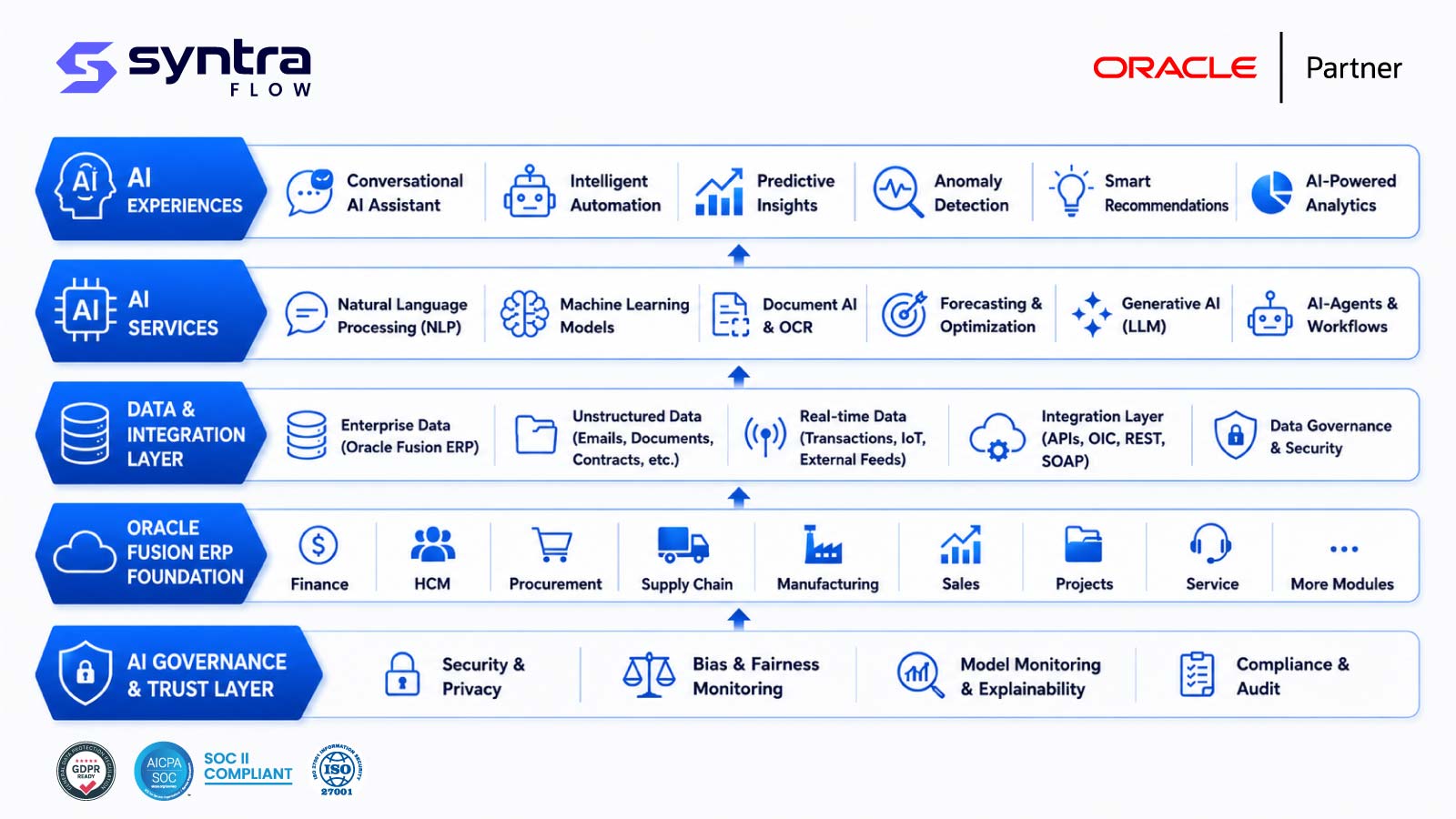
Where AI Shows Up Across Fusion ERP
AI in Oracle Financials and adjacent ERP modules generally falls into a small number of capability categories: pattern recognition on transaction data (anomaly and duplicate detection), classification and recommendation (coding, categorization, matching suggestions), document intelligence (extracting structured data from invoices, receipts, and contracts), and forecasting (cash, spend, and project outcomes). None of these replace the underlying control framework — they sit in front of it, offering suggestions or flags that a person or a downstream rule still has to accept, reject, or act on.
| ERP area | Example AI capability | Key risk to validate |
|---|---|---|
| Financials / GL | Anomaly detection in journal and transaction data | False positives/negatives skew close review effort |
| Accounts Payable | AI-assisted invoice coding and duplicate detection | Wrong account/segment suggestion accepted without review |
| Accounts Receivable | Predictive cash application and collections prioritization | Misapplied cash or mis-prioritized collections outreach |
| Procurement | Spend classification and supplier/catalog recommendations | Category mis-mapping distorts spend analytics and sourcing |
| Expenses | Receipt data extraction and policy-violation flagging | Extraction errors or missed policy flags reach approval |
| Projects | Predictive cost, schedule, and margin-risk signals | Overreliance on a forecast that hasn't been back-tested |
Financials AI
Across Oracle Fusion Financials, AI capability is concentrated on surfacing exceptions and patterns a person would otherwise have to find manually: anomaly detection in transaction data, unusual-variance flags on account balances, and pattern-based prioritization of items for close review. These capabilities are additive to the existing control framework — they change what gets attention first, not what the underlying accounting rules allow.
The practical question for a finance organization is not whether the AI is "accurate" in the abstract, but whether its flags align with what the organization actually considers risky, and whether staff still exercise judgment rather than rubber-stamping a suggestion. That behavioral risk — silent over-trust in an AI flag or AI silence — is often bigger than any single model-accuracy question.
Accounts Payable AI
AI in Oracle Financials Payables commonly shows up as AI-assisted invoice coding recommendations (suggesting a distribution account or expense category from invoice text and history), intelligent document recognition on scanned or emailed invoices, and duplicate-invoice detection that goes beyond exact-match rules to catch near-duplicates. Each of these sits upstream of the validation and hold logic that already governs whether an invoice can be accounted and paid.
The functional mechanics of invoice validation, holds, matching, and distributions — including the full negative and boundary test-case libraries — are covered in depth on the Oracle ERP Testing Tool content, including the Oracle Payables Testing Tool. What's specific to AI here is a narrower question: is the coding suggestion consistent with GL segment rules and chart-of-accounts setup, and is the person accepting it actually reviewing it rather than clicking through.
Accounts Receivable AI
On the receivables side, AI capability centers on predictive cash application — matching incoming payments to open invoices using patterns beyond exact remittance data — and on collections prioritization, which ranks past-due accounts by predicted payment likelihood or risk. Both are recommendation layers on top of the existing cash-application and collections workflow, not replacements for it.
The risk to watch is misapplied cash that an automated match accepts with too much confidence, or a collections ranking that deprioritizes an account a human reviewer would have flagged. As with AP, the deep AR functional test scenarios — matching rules, deductions, write-offs — live on the Oracle ERP Testing Tool vertical; this page is concerned with the AI layer's behavior and the review discipline around it.
General Ledger AI
At the ledger level, AI in Oracle Financials is largely about anomaly detection in journal entries and account balances — flagging entries that deviate from historical posting patterns, unusual account combinations, or balance movements that fall outside an expected range. This is a detective control layered on top of the chart of accounts, segment validation, and period-close process, not a change to how journals are actually posted or approved.
Because these flags feed into close review and reconciliation prioritization, an inaccurate or noisy flag set has a real cost: reviewers either chase false positives or, worse, start ignoring the flags altogether. Validating flag quality against known-good and known-bad journal patterns is a reasonable ongoing exercise, separate from testing the GL posting and segment-validation rules themselves.
Procurement AI
In Oracle Procurement, AI capability commonly appears as spend classification (mapping free-text or supplier-invoice spend into category structures), catalog and supplier recommendations, and requisition-line suggestions drawn from purchasing history. These influence what a requester sees and what category a spend transaction is tagged with, which in turn feeds sourcing analytics and, indirectly, GL mapping.
A mis-classified spend category doesn't just distort a dashboard — it can propagate into budget checking, approval routing, and account derivation if those are configured to key off category. Requisition and PO functional mechanics, approval hierarchies, and matching are covered in the ERP Testing Tool's procurement content; here the concern is whether the AI-driven classification and recommendations hold up against your actual category tree and supplier master, not generic training data.
Expenses AI
Oracle Expenses is one of the more visible surfaces for embedded AI: receipt image capture and data extraction, automatic expense-type categorization, and policy-violation flagging (out-of-policy amounts, missing itemization, duplicate submissions) at the point of entry rather than only at audit. These capabilities speed up submission but shift some judgment calls earlier in the process.
The risk profile is twofold: extraction errors that misstate an amount or date before a human catches it, and policy-flag gaps that let a violation pass silently because the AI didn't recognize the pattern. Both are worth validating against your actual expense policy configuration, not just against Oracle's default rule set.
Project Management AI
In Oracle Project Management, AI capability trends toward predictive signals on cost, schedule, and margin risk — surfacing projects likely to run over budget or slip schedule based on burn rate, resourcing, and historical project patterns. These are directional indicators, not the underlying cost-collection, billing, or revenue-recognition mechanics, which remain governed by project plan types, rate schedules, and billing rules.
A predictive risk score is only as useful as its track record on your own project portfolio. Treat early forecasts as an observed trend to monitor rather than a confirmed, tested control, and validate them against actual outcomes over a few project cycles before project managers start acting on the score alone.
Risk and Controls
AI capability inside ERP introduces a control question that's different from traditional functional risk: the logic producing a suggestion, flag, or forecast is probabilistic and can change behavior between releases without a corresponding change to your configuration. That makes a handful of risk categories specific to the AI layer, on top of — not instead of — existing ERP controls.
Silent over-trust
Staff accept AI suggestions (coding, matching, categorization) without the review step the process assumes still happens.
Drift between releases
A quarterly update can change how a recommendation or flag behaves without an explicit configuration change on your side.
Segregation of duties
Who can accept, override, or dismiss an AI-generated recommendation needs the same role scrutiny as any manual override.
Auditability of AI-influenced entries
Auditors and controllers need to know when a transaction was AI-suggested versus manually entered, and who confirmed it.
Data quality dependency
Classification and forecasting quality depends on clean historical data — legacy mis-codings can compound in future suggestions.
False confidence in forecasts
Predictive cash, cost, or margin signals can be treated as fact well before they've been validated against real outcomes.
Roles and Configuration Dependencies
AI features in Fusion ERP don't operate independently of security and configuration — they depend on both, and a change to either can change what the AI does or who sees its output.
| Dependency | Why it matters for AI behavior |
|---|---|
| Job and duty roles | Determine who can view, accept, override, or dismiss an AI suggestion or flag |
| Chart of accounts / segment rules | Coding recommendations must resolve to valid, currently-enabled account combinations |
| Category and catalog structures | Spend classification accuracy depends on how well your category tree is maintained |
| Tolerance and policy configuration | Policy-flagging AI (expenses, invoices) is only as good as the policy rules it's checked against |
| Feature opt-ins | Many AI capabilities are opt-in per release and may not be active in every environment |
| Business unit / ledger setup | Historical data used for pattern-based suggestions is typically scoped by BU or ledger |
Business Processes Affected
AI capability touches process steps rather than replacing entire processes. Invoice-to-pay is affected at coding and duplicate-checking, not at approval routing or payment execution. Order-to-cash is affected at cash application and collections prioritization, not at billing or revenue recognition. Procure-to-pay is affected at spend classification and catalog recommendation, not at PO approval or receipt matching. Record-to-report is affected at anomaly flagging during close review, not at journal posting or consolidation rules.
Understanding exactly which step is AI-influenced — and which steps remain governed entirely by existing configuration and workflow rules — is what determines where validation effort should actually go. Testing an AI-influenced step requires checking the suggestion against your configuration; testing an unaffected step is ordinary functional regression testing, already covered on the Oracle ERP Testing Tool pages.
Recommended Validation Scenarios
These are examples of what AI-specific validation looks like in ERP — checking an AI output against configuration and expected behavior, not re-running the full functional test suite. For the methodology behind validating Oracle AI more broadly, including how to structure this kind of testing, see Oracle AI Testing.
Validate an AI-suggested invoice coding recommendation against GL segment rules and confirm it resolves to a valid, enabled account combination.
Compare AI-flagged duplicate invoices against known true and near-duplicate pairs to check false-positive and false-negative rates.
Verify predictive cash-application matches against a set of payments with ambiguous or partial remittance data, confirming matches are correct before auto-application.
Test AI spend-classification output against your actual procurement category tree, not a generic taxonomy, across a representative sample of invoices and requisitions.
Check expense policy-violation flags against your configured policy rules using deliberately out-of-policy and edge-case submissions.
Re-run anomaly-detection flags on GL journal data after a quarterly update to confirm flag behavior hasn't silently changed.
Related Oracle AI Pages
Oracle AI for ERP connects to the broader Oracle AI picture and to SyntraFlow's deep ERP functional testing content.
Oracle AI ⭐
The Oracle AI content hub.
Oracle AI Agents →
Agents and AI Agent Studio explained.
Oracle AI Features →
Embedded and generative AI capability by module.
Oracle AI Testing →
A methodology for validating Oracle AI outputs.
Oracle AI Release Intelligence →
Tracking AI-related changes across quarterly updates.
Oracle ERP Testing Tool →
Full functional test coverage for AP, AR, Procurement, and Order Management.
Frequently Asked Questions
What does Oracle ERP AI actually do inside Fusion Financials?
▼
It mostly adds a recommendation or detection layer on top of existing processes — surfacing anomalies, suggesting invoice coding, extracting document data, or ranking collections and forecast risk. It does not replace the underlying validation, approval, or posting rules that already govern Fusion ERP transactions.
Is AI in Oracle Financials the same across every module?
▼
No. Capability categories differ by module — anomaly detection in the general ledger, coding and duplicate detection in Payables, predictive cash application in Receivables, spend classification in Procurement, and predictive risk signals in Projects. Each depends on different configuration and historical data.
How is this page different from the Oracle ERP Testing Tool content?
▼
The Oracle ERP Testing Tool content covers deep, functional test-scenario libraries for AP, AR, Procurement, and Order Management — holds, matching, distributions, approvals. This page focuses specifically on where AI influences those processes and what's specific to validating AI behavior, not general functional testing.
Does AI in Oracle ERP replace segregation of duties or approval controls?
▼
No. AI suggestions and flags are additive to the existing control framework. Segregation of duties, approval hierarchies, and hold logic remain governed by roles and configuration; the relevant AI-specific question is who can accept or override an AI recommendation, and whether that's scoped correctly.
Who should be involved in validating Oracle AI for ERP?
▼
Functional consultants who own configuration, finance and procurement process owners who understand expected outcomes, security teams who manage role access to AI features, and testing teams who validate that behavior matches expectations. It's rarely a single owner's responsibility.
Can AI recommendations in Oracle Financials change after a quarterly update?
▼
It's a reasonable expectation to plan for, since AI-driven features can be adjusted or opted into as part of Oracle's release cycle. Treat any AI-influenced process as a candidate for release-aware regression review — see Oracle AI Release Intelligence for how to track this.
Where do AI agents fit into Oracle ERP AI?
▼
AI agents are a distinct, broader concept from the embedded recommendation and detection features described on this page — they can take multi-step actions rather than just surfacing a suggestion. See Oracle AI Agents for what agents are and how Agent Studio fits in.
How does SyntraFlow relate to testing Oracle ERP AI?
▼
SyntraFlow helps organizations assess and validate Oracle Fusion ERP processes, and the SyntraFlow roadmap can support connecting release intelligence with test planning for AI-influenced areas like AP coding or GL anomaly flags. Coverage of any specific AI capability is confirmed at assessment rather than assumed. See Oracle AI Testing for the underlying methodology.
Assess Your Oracle ERP AI Exposure
SyntraFlow can be configured to help you map where AI influences your Fusion ERP processes and connect that map to a validation plan. Talk to us about what that could look like for your environment.