Oracle HCM UAT Checklist
User acceptance testing is the point where the business formally accepts that Oracle HCM works as required — and the point where an implementation, upgrade, or quarterly update either earns sign-off or stalls. An HCM UAT cycle carries a distinct weight: get payroll or security wrong and the impact lands on every worker's pay and access on day one. A cycle that lacks clear ownership, entry and exit criteria, evidence, and a defect process does not produce acceptance; it produces a backlog of unanswered questions at go-live.
This page is a practical planning and sign-off resource for Oracle HCM UAT. It provides the governance structure, readiness checks, a role-based checklist, a RACI matrix, and entry and exit criteria you need to run a controlled, auditable cycle — with dedicated attention to payroll parity, security and segregation-of-duties sign-off, and Redwood UI readiness. It sits under the Oracle HCM Testing Tool hub and governs how UAT is executed — not the detailed scenarios themselves.
What UAT Means for Oracle HCM
User acceptance testing for Oracle HCM is the controlled cycle in which business users — not consultants or the system integrator — execute end-to-end human capital management processes against agreed requirements and formally accept the result. It confirms that worker hire and lifecycle events, compensation, absence, benefits, payroll, and self-service transactions behave as the business expects across its own legal employers, business units, and roles, using production-like configuration and data.
UAT is a governance event as much as a testing event. Its purpose is to reach a defensible sign-off: a decision, backed by evidence, that HCM is fit to go live or to absorb a change. That requires structure around the testing — defined scope, a ready environment, prepared worker data, assigned users, controlled execution, a defect process, payroll and security validation, and a documented acceptance. Without that structure, "UAT passed" means little to an auditor, a controller, or a go-live steering committee.
The people who depend on UAT governance are the HCM business lead who owns acceptance, the payroll lead who signs off on gross-to-net accuracy, the security lead who signs off on role design and segregation of duties, the test lead who manages execution and defects, and the functional and integration leads who resolve issues. This page gives each of them a shared checklist and a shared definition of "done".
Scope note. This page covers UAT planning, governance, and sign-off — readiness, ownership, execution controls, and business acceptance. It does not list detailed test scenarios or their automation suitability; the scenario catalogue, with test IDs and expected results, lives on the Oracle HCM Test Cases page. Use this checklist to run the cycle; use the test-case library to populate what you execute inside it. This page also sits within the broader Oracle HCM Testing Tool program.
Why UAT Governance Matters
An HCM UAT cycle that is executed without governance produces the same symptoms every time: ambiguous pass rates, defects with no owner, an environment that drifts from production, and a sign-off nobody is comfortable putting their name to. In HCM specifically, the two failure modes with the highest cost are an unreconciled payroll run and a security model nobody validated. The risks a governed cycle is designed to prevent:
| Governance gap | What goes wrong | Business impact | Governance control |
|---|---|---|---|
| Scope not agreed | Users test the wrong processes or miss critical ones | Coverage gaps surface after go-live | Signed scope and traceability to requirements |
| Environment not ready | Config or patch level differs from production | Results do not reproduce at go-live | Environment readiness sign-off before entry |
| Worker data not prepared | Missing assignments, grades, or legal employers block cases | Cycle stalls; users lose confidence | Test-data readiness checklist and provisioning |
| No clear ownership | Defects and decisions have no accountable owner | Issues linger; sign-off slips | RACI matrix across the UAT lifecycle |
| Weak entry criteria | Cycle starts before it is ready | Wasted effort re-running blocked cases | Formal entry gate before execution begins |
| No exit definition | "Done" is a matter of opinion | Go-live decision made on incomplete data | Objective exit criteria agreed up front |
| Payroll not reconciled | Gross-to-net and costing not tied out before go-live | Workers paid incorrectly on the first live run | Payroll parity as a dedicated exit condition |
| Security & SoD not validated | Roles grant excess access or conflicting duties | Audit findings and compliance exposure at go-live | Role and segregation-of-duties sign-off before go-live |
The rest of this page turns each of these controls into concrete, ownable checklist items. A useful companion is the detailed HCM security testing guidance for the role and segregation-of-duties scenarios UAT users will most often encounter, and the payroll testing scenario set that underpins parity sign-off.
The Oracle HCM UAT Governance Flow
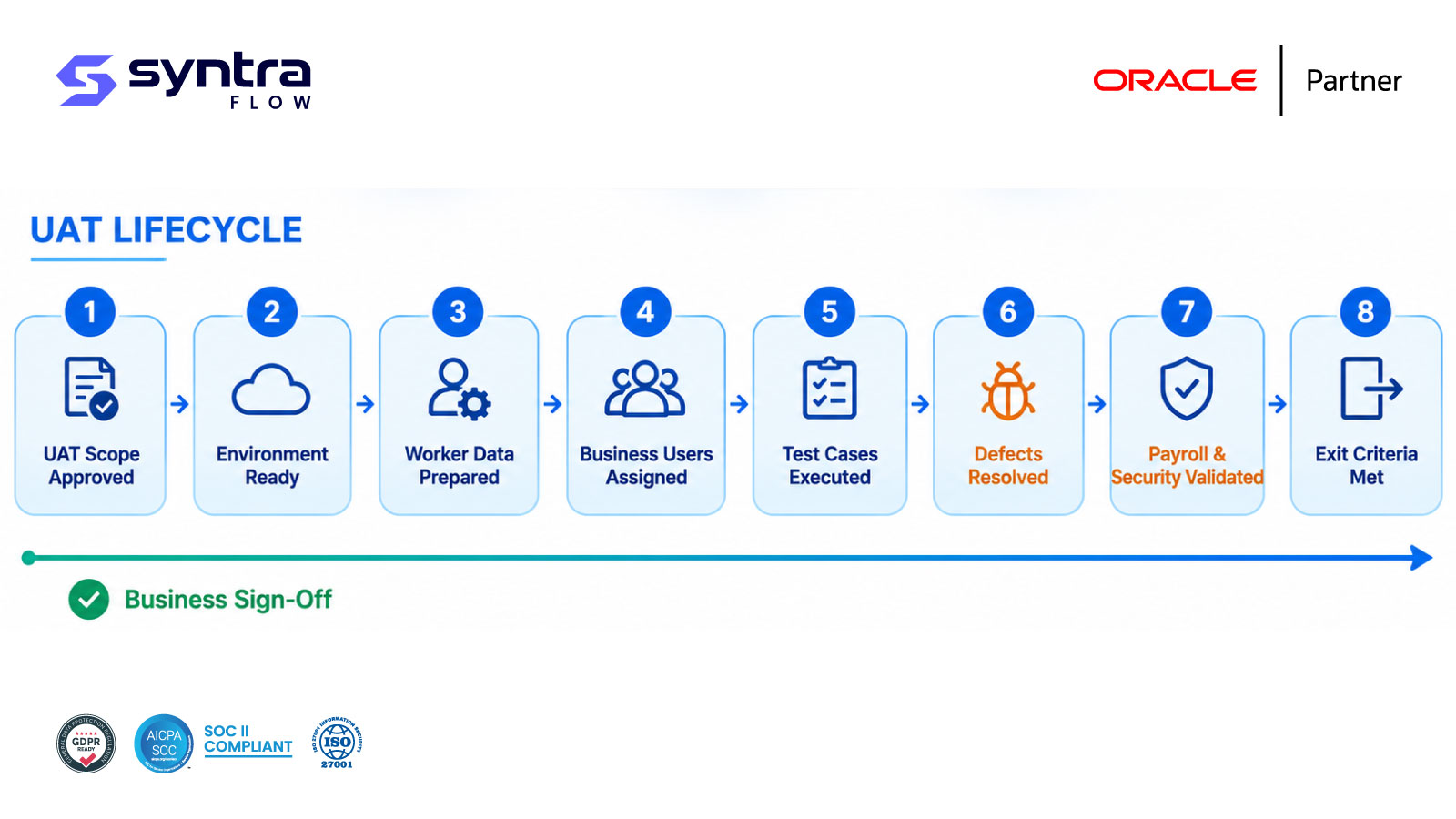
A governed HCM UAT cycle moves through a fixed sequence of gates. Each gate is a decision, not a formality — the cycle does not advance until the prior gate is satisfied and evidenced.
UAT lifecycle
- Scope approved: in-scope processes, legal employers, and worker populations are agreed and traced to requirements before anything is built.
- Environment & data ready: the UAT tenant matches production configuration and patch level, and worker, assignment, and payroll data needed to exercise every case is provisioned.
- Users assigned: named business testers hold the correct roles and understand their assigned processes.
- Execution & defects: cases are run, results and evidence captured, and defects triaged by severity with clear owners.
- Payroll & security validated: gross-to-net results are reconciled and role and segregation-of-duties sign-off is obtained ahead of the exit gate.
- Sign-off: the HCM business lead, payroll lead, and security lead accept the outcome, and the evidence pack is stored for audit.
Suggested visual: a gated swimlane of the nine UAT stages with the accountable owner on each gate, for the web team to produce.
UAT Entry Criteria
Execution does not begin until every entry condition is met and evidenced. Starting UAT early is the most common cause of a cycle collapsing into rework — and in HCM, starting payroll testing before element setup is frozen is the single most common cause of a parity result nobody trusts. Each criterion below is a gate the test lead confirms before opening the cycle.
| Entry criterion | Why it gates entry | Confirmed by |
|---|---|---|
| Scope approved | Defines what will and will not be tested | HCM Business Lead |
| Configuration frozen | Prevents results shifting mid-cycle | Oracle Functional Lead |
| Worker & assignment data loaded | Legal employer, grade, and position data must be present | Test Lead |
| Critical integrations available | Payroll interface and benefits carrier flows must be live | Integration Lead |
| Test users created | Roles must exist to execute cases | IT Support |
| Open defects reviewed | No blocking defect carried into the cycle | Test Lead |
| UAT cases approved | Cases reflect agreed requirements | HCM Business Lead |
| Expected payroll results documented | Parity results can be judged against a baseline | Payroll Lead |
| Security role matrix approved | Roles and SoD rules are settled before access is granted | Security Lead |
The Oracle HCM UAT Checklist
The centrepiece of this resource: a role-based checklist grouped by readiness and process area, with dedicated groups for payroll validation, security and SoD, Redwood UI readiness, and go-live. Each item names an owner, the evidence required, a status placeholder, and the sign-off it feeds. Statuses show Pending as a neutral starting value — update each to In Progress, Passed, Failed, or Blocked as the cycle runs.
Owners: HCM = HCM Business Lead · FUN = Oracle Functional Lead · TST = Test Lead · INT = Integration Lead · PAY = Payroll Lead · SEC = Security Lead · IT = IT Support.
Governance & Planning
| Checklist item | Owner | Evidence required | Status | Sign-off requirement |
|---|---|---|---|---|
| UAT scope agreed and traced to requirements | HCM | Approved scope document | Pending | HCM Business Lead |
| UAT plan, schedule, and cycles defined | TST | Signed UAT plan | Pending | Test Lead |
| Roles, responsibilities, and RACI published | TST | Distributed RACI matrix | Pending | HCM Business Lead |
| Entry and exit criteria agreed | HCM | Criteria sign-off record | Pending | Steering committee |
Environment Readiness
| Checklist item | Owner | Evidence required | Status | Sign-off requirement |
|---|---|---|---|---|
| UAT tenant patch level matches production | IT | Environment version report | Pending | IT Support |
| Configuration frozen for the cycle | FUN | Change-freeze notice | Pending | Functional Lead |
| Environment access confirmed for all testers | IT | Access confirmation log | Pending | IT Support |
| Refresh and backup schedule agreed | IT | Refresh plan | Pending | Test Lead |
Configuration Readiness
| Checklist item | Owner | Evidence required | Status | Sign-off requirement |
|---|---|---|---|---|
| Enterprise structures (legal employers, business units, departments) confirmed | FUN | Enterprise structure export | Pending | Functional Lead |
| Grade, position, and job structures configured | FUN | Position/grade listing | Pending | HCM Business Lead |
| Approval rules (BPM workflow) configured for HR transactions | FUN | Approval rule export | Pending | Functional Lead |
Master Data Readiness (Workers & Assignments)
| Checklist item | Owner | Evidence required | Status | Sign-off requirement |
|---|---|---|---|---|
| Worker records and assignments loaded and active | TST | Worker/assignment data extract | Pending | HCM Business Lead |
| Legal employer and payroll relationship assignments correct | PAY | Payroll relationship extract | Pending | Payroll Lead |
| Person and assignment statuses reflect representative production scenarios | HCM | Status coverage matrix | Pending | HCM Business Lead |
Worker Lifecycle & Employment Events
| Checklist item | Owner | Evidence required | Status | Sign-off requirement |
|---|---|---|---|---|
| Hire, rehire, and global transfer transactions complete correctly | HCM | Completed transaction evidence | Pending | HCM Business Lead |
| Promotion, transfer, and termination transactions process correctly | HCM | Employment event evidence | Pending | HCM Business Lead |
| Manager and employee self-service transactions route and complete correctly | FUN | Self-service transaction log | Pending | Test Lead |
Detailed worker lifecycle scenarios are catalogued on the Oracle Worker Testing page.
Security & Role Readiness
| Checklist item | Owner | Evidence required | Status | Sign-off requirement |
|---|---|---|---|---|
| Job and duty roles reviewed and mapped to responsibilities | SEC | Role mapping document | Pending | Security Lead |
| Segregation-of-duties conflicts identified and resolved | SEC | SoD conflict report | Pending | Security Lead |
| Data access (areas of responsibility) validated for each tester role | SEC | Access validation log | Pending | Security Lead |
| Security role sign-off completed before go-live | SEC | Signed role/SoD acceptance | Pending | Security Lead |
Role design and segregation-of-duties scenarios are catalogued in detail on the Oracle HCM Security Testing page.
Integration Readiness
| Checklist item | Owner | Evidence required | Status | Sign-off requirement |
|---|---|---|---|---|
| HCM Data Loader (HDL) and inbound file interfaces validated | INT | HDL load results | Pending | Integration Lead |
| Payroll interface and third-party benefits interfaces connected | INT | Connectivity test log | Pending | Integration Lead |
| Inbound and outbound extracts reconcile end to end | INT | Extract reconciliation log | Pending | Test Lead |
Payroll Validation
| Checklist item | Owner | Evidence required | Status | Sign-off requirement |
|---|---|---|---|---|
| Gross-to-net results match the legacy or parallel-run baseline (payroll parity) | PAY | Parity comparison worksheet | Pending | Payroll Lead |
| Payroll flow (calculation, prepayments, costing, payment) completes without error | PAY | Payroll flow run results | Pending | Payroll Lead |
| Retroactive pay and element entries calculate correctly | PAY | Retro calculation evidence | Pending | Payroll Lead |
| Payroll register and costing reconcile to the general ledger | PAY | Payroll-to-GL reconciliation worksheet | Pending | Payroll Lead |
| Payroll reconciliation and parity sign-off completed before go-live | PAY | Signed payroll acceptance record | Pending | Payroll Lead |
Payroll calculation scenarios are catalogued on the Oracle Payroll Testing page, and payroll run and flow orchestration scenarios on the Oracle Payroll Flow Testing page. Because a mispaid workforce is one of the highest-visibility failures an implementation can produce, payroll parity is treated as a dedicated, high-stakes checklist group rather than a line item buried under invoicing or reporting.
Redwood UI Readiness
| Checklist item | Owner | Evidence required | Status | Sign-off requirement |
|---|---|---|---|---|
| Redwood page layouts validated for in-scope worker and manager self-service flows | FUN | Layout validation evidence | Pending | Functional Lead |
| Redwood navigation, personalization, and quick actions confirmed against requirements | HCM | Navigation walkthrough evidence | Pending | HCM Business Lead |
| Functional parity confirmed against the prior UI for affected transactions | TST | Parity comparison evidence | Pending | Test Lead |
Redwood layout and transaction scenarios are catalogued on the Oracle Redwood UI Testing page.
Performance & Operational Readiness
| Checklist item | Owner | Evidence required | Status | Sign-off requirement |
|---|---|---|---|---|
| Peak-volume scenarios (mass hire, open enrollment, payroll run) complete within acceptable response times | TST | Response time observation log | Pending | Test Lead |
| Scheduled process and ESS job run times align with production expectations | FUN | Job run-time log | Pending | Functional Lead |
This is a check that the HCM implementation performs acceptably for real business volumes under UAT conditions — a business-readiness observation made during normal test execution, not a substitute for dedicated software load or stress testing, which is a separate discipline outside the scope of this checklist.
Reporting
| Checklist item | Owner | Evidence required | Status | Sign-off requirement |
|---|---|---|---|---|
| Standard HCM reports return expected results | HCM | Report output samples | Pending | HCM Business Lead |
| Headcount and payroll cost reports reconcile | PAY | Reconciled report evidence | Pending | Payroll Lead |
Reconciliation
| Checklist item | Owner | Evidence required | Status | Sign-off requirement |
|---|---|---|---|---|
| Payroll-to-GL reconciliation completed | PAY | Reconciliation worksheet | Pending | Payroll Lead |
| Worker and headcount counts reconcile to the source system | HCM | Headcount tie-out | Pending | HCM Business Lead |
| Interface totals reconcile end to end | INT | Interface reconciliation log | Pending | Integration Lead |
Defect Management & Regression Tie-In
| Checklist item | Owner | Evidence required | Status | Sign-off requirement |
|---|---|---|---|---|
| Defects logged with severity and owner | TST | Defect register | Pending | Test Lead |
| Severity-1 and -2 defects triaged and tracked | TST | Triage decision log | Pending | HCM Business Lead |
| Fixes retested and affected regression scope re-run | TST | Retest and regression evidence | Pending | Test Lead |
Regression is not a separate afterthought — every configuration or payroll fix made mid-cycle should trigger a targeted re-run of affected cases through the Oracle Regression Testing Tool before the defect is closed, so a fix in one area is not allowed to silently break another.
Go-Live Checklist
| Checklist item | Owner | Evidence required | Status | Sign-off requirement |
|---|---|---|---|---|
| Cutover plan and go-live sequence confirmed | HCM | Approved cutover plan | Pending | HCM Business Lead |
| Payroll cutover sequence and first live run validated | PAY | Cutover payroll run evidence | Pending | Payroll Lead |
| Production security roles provisioned and validated | SEC | Production role provisioning log | Pending | Security Lead |
| Hypercare support model and escalation path defined | TST | Hypercare plan | Pending | Test Lead |
| Go-live readiness decision documented | HCM | Go/no-go minutes | Pending | Steering committee |
Exit Criteria Verification
| Checklist item | Owner | Evidence required | Status | Sign-off requirement |
|---|---|---|---|---|
| All critical scenarios executed and passed | TST | Execution summary | Pending | HCM Business Lead |
| No open severity-1 defects remain | TST | Defect status report | Pending | Steering committee |
| Residual risks documented and accepted | HCM | Risk acceptance record | Pending | Payroll Lead |
Sign-Off
| Checklist item | Owner | Evidence required | Status | Sign-off requirement |
|---|---|---|---|---|
| Evidence pack assembled and stored | TST | Consolidated evidence pack | Pending | Test Lead |
| Business acceptance formally recorded | HCM | Signed acceptance form | Pending | HCM Business Lead |
| Payroll sign-off on parity and reconciliation | PAY | Payroll acceptance record | Pending | Payroll Lead |
| Security sign-off on roles and segregation of duties | SEC | Security acceptance record | Pending | Security Lead |
| Go-live readiness decision documented | HCM | Go/no-go minutes | Pending | Steering committee |
This checklist covers 55 items across 16 readiness and process groups. The detailed test scenarios each item exercises are catalogued on the HCM Test Cases page.
UAT RACI Matrix
Clear ownership is the single biggest predictor of a UAT cycle finishing on time. This RACI maps each activity in the lifecycle to the seven core HCM UAT roles. R = Responsible, A = Accountable, C = Consulted, I = Informed.
| Activity | HCM Business Lead | Oracle Functional Lead | Test Lead | Integration Lead | Payroll Lead | Security Lead | IT Support |
|---|---|---|---|---|---|---|---|
| Define UAT scope | A | C | R | C | C | C | I |
| Approve entry criteria | A | C | R | I | C | C | I |
| Prepare UAT environment | I | C | C | C | I | I | A |
| Freeze configuration | I | A | C | I | C | I | R |
| Provision worker & payroll test data | C | C | A | C | C | I | R |
| Assign business testers | A | I | R | I | C | C | I |
| Configure roles & access | C | C | I | I | I | A | R |
| Execute test cases | A | C | R | C | C | I | I |
| Test payroll interfaces & parity | C | C | C | C | A | I | I |
| Validate security & SoD | C | C | C | I | I | A | C |
| Triage defects | C | R | A | C | C | C | I |
| Resolve configuration defects | I | A | C | C | C | I | R |
| Reconcile payroll & GL | C | C | C | C | A | I | I |
| Verify exit criteria | A | C | R | C | C | C | I |
| Assemble evidence pack | C | I | A | I | C | C | I |
| Business sign-off & go/no-go | R | C | C | I | A | A | I |
UAT Phases & Readiness Areas
Each readiness area in the checklist maps to a phase of the cycle. Treating them as sequential gates — rather than parallel guesses — is what keeps an HCM UAT controlled, especially where payroll and security carry the most risk.
UAT strategy
Define the overall approach — cycle count, scope boundaries, and how the model scales between a full implementation and a scoped quarterly-update cycle.
Scope confirmation
Agree the in-scope processes, legal employers, worker populations, and integrations, and trace each to a requirement so coverage is defensible rather than assumed.
Environment readiness
Confirm the UAT tenant matches production patch level and configuration, then freeze it so results stay reproducible for the full cycle.
Configuration readiness
Verify enterprise structures, grades, positions, and approval rules reflect the intended production configuration.
Worker data readiness
Provision worker, assignment, and payroll relationship data mapped to each case, so no scenario is blocked for want of a fixture.
Security & role readiness
Validate job and duty roles, resolve segregation-of-duties conflicts, and confirm data access before testers or production users are provisioned.
Integration readiness
Confirm HDL, payroll interface, and benefits interfaces are connected and validated before execution begins.
Test-case readiness
Confirm the UAT case library is approved, traceable to requirements, and mapped to provisioned test data before the cycle opens.
Execution
Run cases against agreed expected results and capture consistent, audit-grade evidence for every outcome.
Defect triage
Log each defect with severity and an accountable owner, and triage by severity against the exit gate.
Regression
Re-run affected cases after fixes or configuration changes to confirm no new issue was introduced.
Payroll reconciliation
Tie out gross-to-net parity, payroll register, and costing to the general ledger before exit criteria are assessed.
Redwood UI readiness
Confirm layouts, navigation, and functional parity for in-scope self-service and transactional pages.
Performance readiness
Observe response times for peak-volume HCM scenarios during execution as a business-readiness check.
Evidence
Assemble a complete, traceable evidence pack that ties each result to its case, tester, and supporting artefact.
Exit criteria
Check exit criteria objectively against agreed thresholds, documenting any residual risk carried into go-live.
Sign-off
Record formal business, payroll, and security acceptance against the evidence pack, not against a verbal assurance.
Go-live readiness
Confirm the cutover sequence, provision production roles, hand open items to hypercare, and retain the evidence pack for audit.
For the detailed worker lifecycle scenarios these phases exercise, see Oracle Worker Testing, and for role design and access scenarios, Oracle HCM Security Testing.
UAT Exit Criteria
Exit criteria define "done" objectively, so the go-live decision rests on evidence rather than sentiment. Every criterion below must be satisfied, or explicitly waived with documented risk acceptance, before sign-off.
| Exit criterion | Definition of met | Verified by |
|---|---|---|
| Critical scenarios passed | All high-priority cases executed with a pass | Test Lead |
| No open severity-1 defects | Zero blocking defects remain open | Test Lead |
| Severity-2 accepted or resolved | Each is fixed or formally accepted | HCM Business Lead |
| Payroll parity confirmed | Gross-to-net results reconciled to baseline | Payroll Lead |
| Security & SoD validated | Roles and SoD conflicts reviewed and accepted | Security Lead |
| Interfaces reconciled | Inbound/outbound totals agree | Integration Lead |
| Business users signed off | Acceptance recorded per area | HCM Business Lead |
| Evidence stored | Complete pack retained for audit | Test Lead |
| Production-readiness risks documented | Residual risks logged and accepted | Steering committee |
The HCM UAT Checklist & Sign-Off Workbook
Everything on this page is available as a structured workbook you can adapt to your own implementation or upgrade. The Oracle HCM UAT Checklist and Sign-Off Workbook turns the governance model here into a working artefact your team can populate cycle by cycle.
The workbook includes tabs for:
- • Scope confirmation
- • RACI matrix
- • Entry criteria
- • Environment readiness
- • Worker data readiness
- • Security & SoD
- • Payroll validation
- • Test execution
- • Defects
- • Reconciliation
- • Exit criteria
- • Go-live checklist
- • Sign-off
Each tab carries the owner, evidence, and sign-off structure used throughout this page, so a cycle produces an audit-ready record by the time it reaches acceptance. Request the workbook and a walkthrough of how it maps to your Oracle configuration:
Request the UAT WorkbookHow SyntraFlow Supports Oracle HCM UAT
SyntraFlow gives an HCM UAT cycle the structure this page describes — a managed test library, guided execution, and audit-grade evidence — so governance is enforced by the platform rather than by spreadsheets.
UAT test-library management
Organise HCM UAT cases by process area and cycle, versioned and traceable to requirements.
Guided execution
Business testers follow step-by-step cases with expected results in view, reducing ambiguity in what "passed" means.
Automated prerequisite checks
Confirm environment, worker data, and role readiness before a cycle opens, so entry criteria are enforced not assumed.
Evidence capture
Timestamped screenshots and execution traces retained automatically as audit-grade evidence for every result.
Defect traceability
Link each defect to the case, evidence, and owner, so triage and retest are always tied to a specific result.
Regression execution
Re-run affected cases after fixes with the Oracle Regression Testing Tool, scoped to what actually changed.
Dashboards
Real-time view of execution progress, pass rates, and open defects for the steering committee.
Business-process reporting
Report coverage by HCM process rather than by script, so gaps are visible to the business.
Sign-off packs & audit history
Assemble the acceptance pack and retain a full audit trail of who tested, approved, and signed off what.
A note on capability. Test-library management, guided execution, evidence capture, defect traceability, and audit history are current platform capabilities. Automated prerequisite checks and business-process dashboards are configurable to your environment during onboarding, and some UAT-specific reporting formats are on the roadmap rather than live. Payroll parity comparison and security/SoD conflict detection are validated against your own configuration and evidence during the cycle, not asserted as an automated guarantee. Scope for your cycle is confirmed at assessment rather than assumed here.
UAT for Oracle Quarterly Updates
UAT is not only an implementation event. Every Oracle quarterly update is a change that warrants a scoped acceptance cycle — but re-running a full HCM UAT four times a year is neither practical nor necessary, particularly given the payroll and security stakes involved. The governance model on this page scales down cleanly to an update cycle when the scope is narrowed to what actually changed.
SyntraFlow Release Intelligence narrows an update UAT to the affected processes:
- 1.Analyses the Oracle release notes for changes touching HCM, payroll, and security.
- 2.Maps those changes to your configuration and business processes.
- 3.Recommends the specific UAT cases the business should re-accept, including any payroll or role-impacting changes.
- 4.Prioritises the cycle by risk so effort lands where it matters.
- 5.Retains the evidence and sign-off for each update as an audit record.
Pair release-scoped analysis with the Oracle Regression Testing Tool so the re-acceptance cycle is executed, not just planned.
Related Oracle HCM Pages
UAT governance sits above the detailed testing work. Go deeper on the scenarios and processes it accepts:
Oracle HCM Testing Tool ⭐
The HCM testing hub.
Oracle HCM Test Cases →
The scenario catalogue UAT executes.
Worker Testing →
Hire, transfer, and termination events.
Payroll Testing →
Gross-to-net calculation scenarios.
Payroll Flow Testing →
Payroll run and flow orchestration.
HCM Security Testing →
Role design and SoD scenarios.
Redwood UI Testing →
Layout and navigation scenarios.
Regression Testing Tool →
Re-running affected cases after change.
Frequently Asked Questions
What is the purpose of UAT for Oracle HCM?
▼
UAT is the controlled cycle in which business users execute end-to-end HCM processes — worker lifecycle events, absence, benefits, payroll, and self-service — against agreed requirements and formally accept the result. Its purpose is a defensible sign-off — a decision, backed by evidence, that Oracle HCM is fit to go live or to absorb a change — rather than simply confirming that the software runs.
How is this UAT checklist different from HCM test cases?
▼
This page governs how UAT is planned, executed, and signed off — readiness, ownership, entry and exit criteria, and evidence. The detailed scenarios, with test IDs and expected results, live on the HCM Test Cases page. Use this checklist to run the cycle; use the test-case library to populate what you execute inside it.
Who should own Oracle HCM UAT sign-off?
▼
The HCM business lead owns overall business acceptance, the payroll lead owns sign-off on gross-to-net parity and reconciliation, and the security lead owns sign-off on roles and segregation of duties. The test lead is responsible for running the cycle and assembling evidence, but acceptance is a business decision — it should never sit with the system integrator or the test team alone.
What are the entry criteria for HCM UAT?
▼
Scope approved, configuration frozen, worker and assignment data loaded, critical integrations (payroll interface, benefits carriers) available, test users created, UAT cases approved, expected payroll results documented, and the security role matrix approved. Each is a gate the test lead confirms and evidences before opening the cycle, because starting early is the most common cause of rework.
What exit criteria should end an HCM UAT cycle?
▼
Critical scenarios passed, no open severity-1 defects, severity-2 defects accepted or resolved, payroll parity confirmed, security and SoD validated, interfaces reconciled, business users signed off, evidence stored, and production-readiness risks documented. Any criterion not met must be explicitly waived with documented risk acceptance before sign-off.
What does payroll validation involve during HCM UAT?
▼
Payroll validation confirms gross-to-net results reconcile against a legacy or parallel-run baseline (payroll parity), that the payroll flow — calculation, prepayments, costing, and payment — completes without error, that retroactive pay and element entries calculate correctly, and that the payroll register and costing reconcile to the general ledger. Because a mispaid workforce is one of the most visible failures an implementation can produce, payroll is treated as a dedicated checklist group with its own sign-off rather than a line item under general testing.
What does security and SoD validation involve during HCM UAT?
▼
Security validation confirms job and duty roles are mapped correctly to responsibilities, that segregation-of-duties conflicts are identified and resolved, and that data access (areas of responsibility) matches each tester's intended role. It concludes with a formal security sign-off before go-live, separate from general business acceptance, because incorrect role design is both an audit finding and a data-exposure risk if it reaches production unchecked.
Does this checklist cover performance or load testing?
▼
This checklist includes a brief performance and operational readiness check — confirming that peak-volume HCM scenarios such as mass hire, open enrollment, or a payroll run complete within acceptable response times during normal UAT execution. That is a business-readiness observation, not a substitute for dedicated software load or stress testing, which is a separate discipline outside the scope of UAT governance.
Why does Redwood UI readiness need its own checklist group?
▼
Redwood page layouts, navigation, and personalization change how workers and managers interact with self-service transactions, even when the underlying business logic is unchanged. Validating layout, navigation, and functional parity as its own readiness area catches usability and workflow issues that a purely functional pass/fail test can miss, before those issues reach the broader workforce.
How does regression testing tie into HCM UAT?
▼
Every configuration or payroll fix made mid-cycle should trigger a targeted re-run of affected cases before the related defect is closed, so a fix in one area is not allowed to silently break another. The Oracle Regression Testing Tool supports that re-run, and the same regression scope is reused to shorten UAT for the next quarterly update.
What belongs on the go-live checklist after HCM UAT sign-off?
▼
The go-live checklist confirms the cutover plan and sequence, validates the payroll cutover and first live run, provisions and validates production security roles, defines the hypercare support model and escalation path, and documents the final go/no-go decision. It is the bridge between a signed-off UAT cycle and a production launch that behaves the way UAT predicted.
How does HCM UAT apply to Oracle quarterly updates?
▼
Every quarterly update is a change that warrants a scoped acceptance cycle, but re-running a full HCM UAT four times a year — including a full payroll parity check — is impractical. The same governance model scales down when scope is narrowed to the processes, payroll elements, and roles the update actually affects, which is where release-impact analysis earns its place in the cycle.
Run a Controlled, Auditable Oracle HCM UAT
Take the governance model on this page into your next implementation or quarterly-update cycle — with a managed test library, enforced readiness checks, dedicated payroll and security sign-off, and audit-grade evidence. See how SyntraFlow structures HCM UAT for a business like yours.