Oracle Worker Testing
The Worker record is the person-level master record in Oracle Fusion Cloud HR — identity, personal information, and every hire, rehire, termination, and transfer event a person goes through over their working life. When this record or its effective-dated history breaks, the damage doesn't stay contained: payroll, benefits, absence, and reporting all read from it.
This page is a practical guide to testing worker creation, hire and rehire transactions, termination, global and local transfer, effective-dated corrections and updates, personal information, and worker relationships. It sits under the Oracle HCM Testing Tool hub and focuses on the person-level record — not the legal work-relationship container covered on the Oracle Employment Testing page.
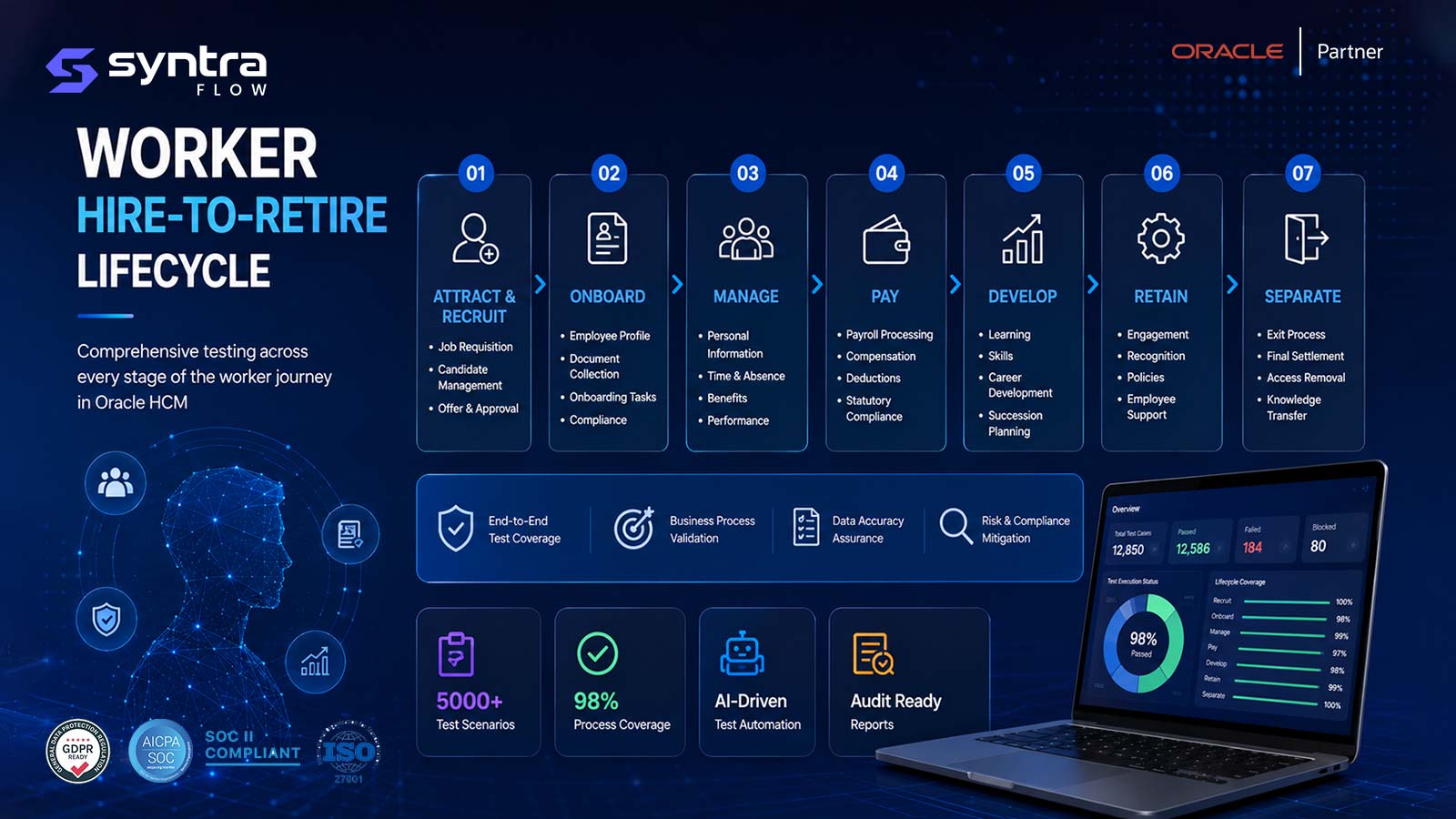
What Is Worker Testing in Oracle HCM?
In Oracle Fusion Cloud HR, a worker is the person object created the moment someone is added as an employee, contingent worker, pending worker, or non-worker. Every subsequent change to that person — a name update, a hire, a transfer, a termination, a rehire — is captured as a date-tracked row against the same person record. Worker testing validates that these transactions execute correctly and that the resulting effective-dated history stays internally consistent over time.
This matters because the worker record is upstream of almost everything else in HCM. A malformed hire, a transfer that leaves a gap in the date-track, or a termination that doesn't reverse cleanly will surface downstream in assignment, payroll, and benefits long after the original transaction — often at the worst possible time, such as a payroll run or an audit.
Scope note. This page covers the person-level master record: identity, personal information, hire and rehire events, termination, global and local transfer, and effective-dated worker history. The legal work-relationship container — legal employer, business unit, and concurrent employment across multiple relationships — is covered on Oracle Employment Testing. Job- and position-level assignment attributes are covered on Oracle Assignment Testing and Oracle Position Testing. Use this page for the person; use those pages for the legal and organizational context around the person.
Why Worker Testing Matters
Worker transactions are irreversible in a practical sense — you can correct a record, but you cannot un-happen a payroll run that used bad data, or un-send a benefits notice triggered by an incorrect termination date. HR operations, payroll, and compliance teams all depend on the worker record being right the first time and staying right through every subsequent change.
Effective dating adds a layer most other Oracle Fusion objects don't have. A single worker can carry dozens of date-tracked rows across a multi-year career, and a defect introduced by one bad correction can silently distort every report and payroll calculation that reads "as of" a date touching that row. Testing has to validate not just the transaction, but the shape of the history it leaves behind.
The Oracle Worker Lifecycle Process Flow
A worker's record moves through a recurring set of transaction types, each of which writes one or more new effective-dated rows against the same person.
Worker lifecycle stages
- Trigger: HR user action in the Person Management work area, a bulk load, or a REST call against the Workers resource.
- Key validations: mandatory legislative attributes present, duplicate-person check cleared, effective date sequencing intact, correction vs. update mode applied as intended.
- Decision point: whether a change is a correction to an existing effective-dated row or an update that creates a new date-track segment.
- Expected output: a person record whose effective-dated history is complete, non-overlapping, and queryable "as of" any date in the worker's career.
- Downstream impact: assignment, payroll, benefits, and absence all read the worker record — see Oracle Payroll Testing for the payroll-side effects of hire and termination events.
This process forms part of the complete Oracle Hire-to-Retire (H2R) lifecycle, spanning from recruiting through to final separation and reporting.
Common Worker Testing Challenges
Worker testing is harder than it looks because most defects don't show up in the transaction itself — they show up in the history the transaction leaves behind, or in a downstream process reading the wrong effective-dated row.
| Risk | Example | Potential impact | Mitigation via testing |
|---|---|---|---|
| Correction/update confusion | A correction is applied when an update was intended | Loss of prior-period history | Assert row count and date boundaries after every change |
| Overlapping effective-dated rows | A transfer leaves two open-ended rows | Ambiguous "as of" query results | Validate non-overlapping date ranges on every transaction |
| Duplicate person created | Rehire creates a new person instead of reusing the old one | Fragmented service history, benefits and reporting errors | Negative test on the duplicate-check step of hire and rehire |
| Termination not reversible | Reversing a termination leaves the assignment inconsistent | Worker stuck between active and terminated status | Test reversal before and after the effective date passes |
| Global transfer legislative gap | Legislative data group not fully populated for the new country | Payroll or statutory reporting failure at target country | Validate required legislative attributes per target LDG |
| Silent behaviour change | A quarterly update alters hire or termination validation | Undetected control or data-quality drift | Release-aware regression on worker transactions |
| Bulk-load data quality | HDL/HSDL load skips or misdates a segment | History gaps that surface weeks later | Post-load effective-date reconciliation tests |
| Personal data drift | Name or identifier change not reflected downstream | Compliance and payroll mismatches | Cross-check personal information against dependent records |
What SyntraFlow Automates for Worker Testing
SyntraFlow drives worker transactions through the UI and REST, then asserts the resulting effective-dated history — not just that the transaction submitted.
Pre-built worker scenario packs
Starter cases for hire, rehire, termination, and transfer that you extend to your own legislative and role configuration.
Effective-date assertions
Checks row count, date boundaries, and correction-vs-update outcomes after every transaction, not just the visible field values.
Self-healing execution
Playwright-based runs that re-anchor when Oracle changes Person Management or Redwood pages.
Dynamic test data
Provisions workers in the right starting status — active, terminated, on leave — so each scenario begins from a valid precondition.
API and UI parity
Runs the same scenario through the Workers REST resource and the UI, then confirms both produce identical history.
Evidence capture
Timestamped screenshots and record snapshots retained per run for audit and defect triage.
| Benefit | Manual approach | With SyntraFlow |
|---|---|---|
| Effective-date verification | Manually inspect date-tracked rows in the UI | Automated row-count and boundary assertions |
| Regression after an update | Re-run the full worker pack by hand | Release-scoped subset selected automatically |
| Test data setup | Manually create workers in each starting status | Provisioned on demand per scenario |
| Redwood page changes | Scripts break and require rework | Self-healing execution continues running |
| Evidence for audit | Screenshots captured ad hoc | Captured automatically for every run |
540+
Worker scenarios executed (illustrative)
97%
Pass rate on a stable release (illustrative)
18
Effective-date defects found (illustrative)
~65%
Regression time saved (illustrative)
[SyntraFlow — Worker Test Scenario Execution dashboard view, illustrative]
AI Testing Features for Worker Scenarios
Effective-dated worker data is a strong fit for AI-assisted test generation because the valid variations — boundary dates, correction vs update, legislative combinations — are large but structured.
AI impact analysis — illustrative quarterly-update regression cycle
Illustrative example for a typical quarterly-update cycle, not a benchmark from a named customer.
| Dimension | Manual testing | AI-driven testing |
|---|---|---|
| Boundary date coverage | Limited to the cases a tester thinks of | Generated systematically from configured effective-date rules |
| Legislative combinations | Tested for one or two countries at a time | Generated per legislative data group in scope |
| Regression scope after an update | Whole pack re-run regardless of what changed | Scoped to the scenarios the release actually touches |
| Page-change resilience | Scripts fail on the first Redwood redesign | Self-healing selectors adapt to layout changes |
A note on capability. Pre-built worker cases, self-healing execution, and effective-date assertions are current platform capabilities. AI-generated scenario variants for a specific legislative or role configuration are configurable during onboarding. Broader autonomous scenario discovery is on the roadmap and is confirmed at assessment rather than assumed here. Learn more on the SyntraFlow AI testing features page.
Oracle Worker Test Scenarios
A representative set of 32 Oracle Fusion worker scenarios spanning creation, hire, rehire, termination, global and local transfer, effective dating, personal information, worker relationships, and full lifecycle regression. Test IDs use the HC-WRK prefix.
| ID | Scenario | Preconditions | Expected result | Pri | Auto |
|---|---|---|---|---|---|
| HC-WRK-001 | Create worker with mandatory identity attributes | Person-number auto-generation enabled | Worker record created; person number assigned | H | Y |
| HC-WRK-002 | Create worker triggering potential-duplicate check | Existing record with matching name/DOB/national ID | Duplicate-person warning shown before save | H | Y |
| HC-WRK-003 | Create worker missing mandatory legislative attribute | Required field enforced by legislation rules | Save blocked with validation error | M | Y |
| HC-WRK-004 | Hire new employee into a legal employer | Business unit and default assignment values configured | Person, work relationship, and assignment created; status Active | H | Y |
| HC-WRK-005 | Hire with a future-dated start | Hire date later than system date | Record created as a pending worker until start date | M | Y |
| HC-WRK-006 | Hire a contingent (non-employee) worker | Contingent worker type enabled | Work relationship type set to contingent worker | M | Y |
| HC-WRK-007 | Hire blocked by missing mandatory hire flexfield | Mandatory descriptive flexfield on hire flow | Save blocked until required value entered | M | Y |
| HC-WRK-008 | Rehire former employee reusing person record | Terminated worker with existing person number | Original person ID reused; prior history preserved | H | Y |
| HC-WRK-009 | Rehire attempted inside a rehire restriction period | Rehire eligibility waiting period configured | System warns or blocks rehire per configured rule | M | Y |
| HC-WRK-010 | Rehire with updated personal information | Former worker's stored details are outdated | New details captured without corrupting prior rows | M | Y |
| HC-WRK-011 | Terminate active worker with a future date | Worker has an active work relationship | Work relationship end-dated; status Terminated on that date | H | Y |
| HC-WRK-012 | Reverse a termination before its effective date | Termination processed but not yet effective | Work relationship restored to Active; history consistent | H | Y |
| HC-WRK-013 | Terminate for cause with immediate effect | Termination reason code set to involuntary | Relationship ends immediately; reason captured for reporting | H | Y |
| HC-WRK-014 | Verify termination reason and category values | Multiple termination reason codes configured | Correct reason/category recorded per code | M | Y |
| HC-WRK-015 | Global transfer to a legal employer in another country | Target legal employer in a different country | New work relationship created; prior one end-dated | H | Y |
| HC-WRK-016 | Global transfer with a legislative data group change | Source and target legislative data groups differ | Legislative data captured correctly for target country | H | Y |
| HC-WRK-017 | Future-dated global transfer later corrected | Global transfer scheduled ahead of effective date | Correction applied without breaking date sequence | M | P |
| HC-WRK-018 | Local transfer between departments, same legal employer | Same legal employer, different department | Assignment updated; work relationship unchanged | H | Y |
| HC-WRK-019 | Local transfer with a position and grade change | Target position carries a different grade | Position, grade, and step attributes update correctly | M | Y |
| HC-WRK-020 | Local transfer effective mid pay-period | Transfer date inside an open payroll period | Effective date splits correctly for downstream processes | M | P |
| HC-WRK-021 | Correct a past-dated worker record | Existing effective-dated row contains an error | Correction overwrites row; no new date-track segment | H | Y |
| HC-WRK-022 | Update creating a new future-dated row | Worker has an active current record | New row created; prior row end-dated the day before | H | Y |
| HC-WRK-023 | As-of-date query returns correct historical values | Multiple date-tracked changes on file | Query returns the record valid on that date | H | Y |
| HC-WRK-024 | Update legal name with an effective date | Worker record active | Name change effective-dated; prior name retained | M | Y |
| HC-WRK-025 | Update national identifier with format validation | Legislative data group enforces an identifier format | Value validated against format rule before save | M | Y |
| HC-WRK-026 | Update home and mailing address independently | Worker has more than one address type on file | Each address type updates with its own effective date | L | Y |
| HC-WRK-027 | Add an emergency contact relationship | Worker record active | Relationship record created and linked to the person | M | Y |
| HC-WRK-028 | Update a relationship type with an effective date | Existing relationship record on file | Status updated; prior status retained in history | L | Y |
| HC-WRK-029 | Correct an incorrectly entered relationship record | Relationship entered in error | Record corrected without orphaning dependent data | L | Y |
| HC-WRK-030 | End-to-end hire-to-termination lifecycle regression | New hire progressed through transfer and termination | Effective-dated history consistent at every stage | H | Y |
| HC-WRK-031 | Suspend and reinstate a worker on unpaid leave | Worker approved for a leave of absence | Relationship reflects suspended status, no full termination | M | Y |
| HC-WRK-032 | Quarterly-update regression across the worker lifecycle | Post-update test tenant | Hire, transfer, rehire and termination results reproduce | H | Y |
Pri = priority (H/M/L). Auto = automation candidate (Y suitable · P partly, needs downstream coordination). Steps summarised; full step detail ships in the Oracle HCM Test Cases library.
Regression Testing for Worker Transactions
Worker records accumulate history, so a regression suite has to prove that new transactions don't corrupt old ones — a transfer today must not change how a hire from two years ago is reported. That makes worker regression fundamentally different from testing a stateless transaction.
The Oracle Regression Testing Tool re-runs the worker scenario pack against a stable baseline after any configuration or code change, comparing effective-dated outcomes row for row rather than just checking that each transaction completed without error.
Worker Testing and Oracle Quarterly Releases
Oracle's quarterly updates can alter hire, termination, or transfer validation, add new mandatory attributes, or change how a Person Management page behaves — often without a corresponding change on your side. Because worker data underpins payroll and compliance reporting, an unnoticed change here carries outsized risk.
Rather than re-running every worker scenario on every release, Oracle Release Intelligence maps the release notes to worker-related configuration and recommends the specific scenarios worth re-testing before the update reaches production.
Redwood UI Considerations for Worker Testing
Redwood redesigns of Person Management change page layout and interaction patterns for hire, transfer, and termination flows, even when the underlying worker logic is unchanged. Selector-based automation built against the classic pages breaks on the first Redwood rollout for that flow.
See Oracle Redwood UI Testing for how self-healing execution keeps worker scenarios running through a Redwood transition without a rewrite.
Worker Testing Best Practices
Assert the resulting effective-dated rows, not just that the transaction submitted successfully.
Test correction and update modes separately — they leave different history behind.
Cover both the transaction and its reversal, such as a termination reversed before it takes effect.
Test rehire against a real terminated person record, not a fresh create.
Validate global transfers against the target legislative data group's mandatory attributes.
Keep worker-level tests scoped to the person; verify legal-employer and concurrent-employment behaviour separately.
Validate through both the UI and the Workers REST resource to catch integration-path divergence.
Re-run the worker pack on every quarterly update, scoped by release impact.
SyntraFlow Advantages for Worker Testing
Effective-date aware
Assertions built around date-tracked history, not just field values.
Pre-built scenario packs
Hire, rehire, termination, and transfer cases ready to extend.
Self-healing on Redwood
Worker scenarios keep running through Person Management redesigns.
Release-scoped regression
Re-tests only the worker scenarios a given update actually touches.
Related Oracle HCM Pages
Worker testing connects to the rest of the HCM suite. Go deeper on adjacent topics:
Oracle HCM Testing Tool ⭐
The HCM testing hub.
Employment Testing →
Legal employer and concurrent employment.
Assignment Testing →
Job, grade, and assignment attributes.
Position Testing →
Position structures and incumbency.
Payroll Testing →
Downstream payroll effects of hire and termination.
Recruiting Testing →
Upstream candidate-to-hire flow.
Oracle HCM Test Cases →
The broader HCM scenario library.
Oracle HCM UAT Checklist →
Sign-off checklist for HCM releases.
Regression Testing Tool →
Baseline comparison across releases.
Release Intelligence →
Quarterly update impact analysis.
Redwood UI Testing →
Self-healing across UI redesigns.
AI Testing Features →
How SyntraFlow's AI capabilities work.
Oracle documentation references
- Oracle Fusion Cloud HCM: Implementing Global Human Resources
- Oracle Fusion Cloud HCM: Using Global Human Resources
- Oracle Fusion Cloud HCM: HCM Common Objects
- Oracle Fusion Cloud HCM: REST API for HCM (Workers resource)
Frequently Asked Questions
What does "Worker" mean in Oracle HCM, and how is it different from Employment?
▼
Worker is the person-level master record — identity, personal information, and the hire, rehire, termination, and transfer events that happen to that person over time. Employment is the legal work-relationship container attached to that person — the legal employer, business unit, and any concurrent employment across multiple relationships. See Oracle Employment Testing for that side of the model.
What is the difference between a correction and an update to a worker record?
▼
A correction overwrites the currently effective row in place, with no new date-track segment created — used to fix an entry error. An update creates a new effective-dated row starting on a given date while preserving the prior row for history before that date. Testing both modes separately is essential because they leave different history behind.
What should hire testing cover beyond the happy path?
▼
Beyond a clean hire, cover future-dated starts, contingent-worker hires, missing mandatory attributes, and duplicate-person detection. Each of these represents a real production scenario, and a hire defect is expensive because it propagates into assignment and payroll immediately.
How does rehire testing differ from a new-hire test?
▼
A rehire must reuse the former worker's existing person number and preserve their prior service history rather than creating a new person record. Testing needs to confirm the system correctly matches the returning worker, applies any rehire eligibility rules, and merges updated personal information without corrupting the historical record.
What is the difference between a global transfer and a local transfer?
▼
A local transfer moves a worker within the same legal employer — a department, position, or grade change. A global transfer moves a worker to a legal employer in a different country, which typically requires a new legislative data group and produces a new work relationship. They carry different testing requirements because a global transfer touches statutory data a local transfer does not.
Why does effective dating matter so much for worker testing?
▼
Nearly every downstream process — payroll, benefits, absence, reporting — reads the worker record "as of" a specific date. If a transaction leaves overlapping or gapped effective-dated rows, any process querying a date inside that gap gets the wrong answer, often silently.
How do you automate Oracle worker testing?
▼
SyntraFlow provisions workers in the required starting status, drives the hire, rehire, termination, or transfer transaction through the UI and the Workers REST resource, then asserts the resulting effective-dated rows rather than just the on-screen confirmation. It self-heals when Oracle changes Person Management pages and captures evidence for every run.
How often should worker scenarios be regression tested?
▼
On every Oracle quarterly update, and after any change to legislative data groups, mandatory flexfields, rehire rules, or hire/termination configuration. Because worker data feeds payroll and compliance reporting directly, testing after these events protects against drift that would otherwise surface downstream.
Does Redwood affect worker testing?
▼
Yes. Redwood redesigns of Person Management change the hire, transfer, and termination page layouts, which breaks selector-based automation even though the underlying worker logic is unchanged. See Oracle Redwood UI Testing for how self-healing execution handles this.
Strengthen Your Oracle Worker Test Coverage
Identify gaps in your hire, rehire, termination, and transfer test suite, automate effective-date assertions, and prepare for Oracle quarterly updates with SyntraFlow. See it run against worker scenarios like yours.