Oracle HCM Testing Tool
The Oracle HCM Testing Tool from SyntraFlow gives Oracle ERP, HR and payroll teams a single, autonomous way to validate Oracle Fusion Cloud Human Capital Management — from recruiting and hire through assignment, payroll, time, benefits, talent and, eventually, termination. HCM is the system that pays people correctly and on time, keeps them compliant with local labor law, and records the employment facts every other Oracle process depends on. An untested change here does not stay contained to one screen — it can miscalculate a paycheck, expose data to the wrong role, or break a workflow relied on by every worker in the organization.
Testing Oracle HCM is hard because it is both deeply interconnected and legislatively fragmented: a worker's assignment drives their payroll eligibility, their payroll drives their absence balances, and every one of those calculations can differ by country, legal employer, and collective agreement. This page is the master hub for every Oracle HCM testing topic — it explains the Hire-to-Retire lifecycle, maps full coverage across all sixteen HCM testing areas, and links you to the dedicated page for each one rather than repeating them here.
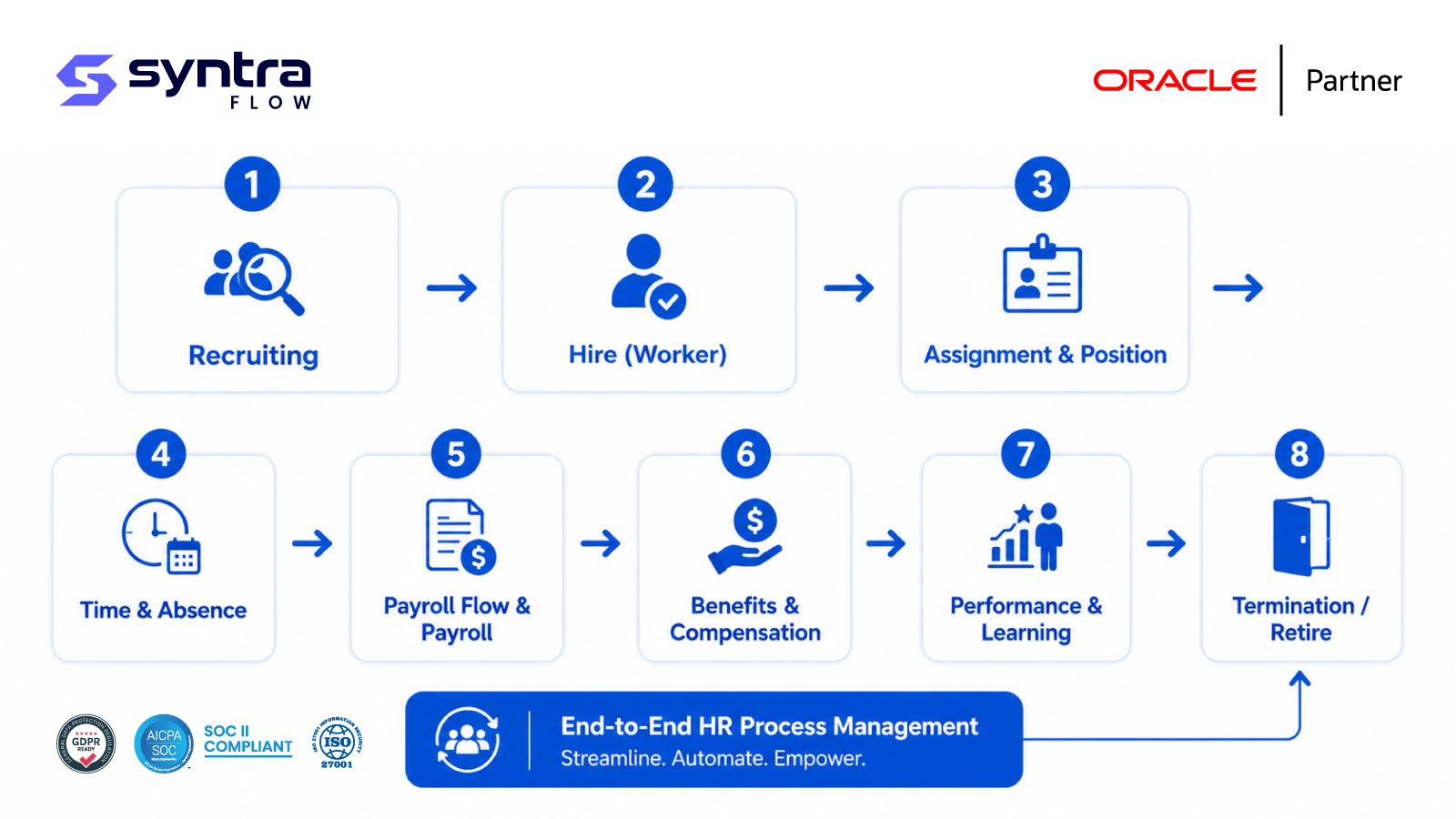
The Complete Hire-to-Retire (H2R) Lifecycle
Oracle Fusion Cloud HCM is organized around a single continuous lifecycle — Hire-to-Retire (H2R) — that follows a worker from the moment they are sourced through every employment event until they eventually leave the organization. Each stage of H2R feeds the next: a candidate becomes a worker, a worker holds one or more assignments against a position, an assignment determines payroll and time eligibility, payroll and time results flow into total rewards, and performance and learning records accumulate across the whole tenure. Testing any one HCM module in isolation misses the defects that only appear at these hand-offs.
Underneath every stage sits HCM Security — the role-based access model, data roles, and segregation-of-duties controls that determine who can see and change what. Security is not a stage in the sequence; it governs the entire lifecycle, which is why it is tested as its own discipline rather than folded into any single module.
This lifecycle framing matters for how testing should be scoped. A test plan organized purely by Oracle module — one suite for Payroll, another for Absence, another for Benefits — will pass each module in isolation while still missing the defect that only appears when a mid-cycle assignment change fails to propagate into an already-open payroll flow, or when a position reclassification silently changes a worker's benefit eligibility. Testing H2R as a connected lifecycle, not sixteen independent screens, is what closes that gap. The sixteen pages linked from this hub each go deep on one stage; this page is where the end-to-end view lives.
Oracle Hire-to-Retire (H2R) process flow
This diagram is illustrative of the process sequence, not a reproduction of any specific Oracle screen. It reflects the typical order in which these stages occur for a single worker; concurrent workers move through the same lifecycle continuously and at different points at any given moment.
Why Oracle HCM Testing Quality Matters
HCM defects are unusually visible and unusually costly because the system touches every employee, every pay period, and — for multinational organizations — dozens of legal jurisdictions at once. A pricing error in a sales order affects one customer; a payroll calculation error can affect an entire legal employer's workforce in a single run, and it typically isn't caught until pay day.
| Risk | How it happens in Oracle HCM | Business impact |
|---|---|---|
| Payroll miscalculation | Element eligibility, rate or formula change goes untested | Underpaid or overpaid workers; statutory penalties |
| Compliance failure | Local legislative rule for tax, leave or reporting misconfigured | Regulatory fines and audit findings |
| Broken assignment/position logic | Position hierarchy or assignment change disrupts downstream flows | Payroll, time and reporting all inherit the error |
| Security/SoD gap | Role or data role change grants unintended access | Exposed compensation or personal data; audit failure |
| Erosion of employee trust | Repeated pay, benefits or time errors reach workers directly | Lower engagement, HR helpdesk load, attrition risk |
Multi-country, multi-legislation complexity compounds all of this. A global enterprise may run dozens of legislative data groups, each with its own tax rules, statutory absence entitlements, and reporting formats — and a single Oracle quarterly update can touch several of them at once. Manual regression across that footprint does not scale; it is either done selectively (leaving gaps) or it consumes the payroll and HR teams' capacity every quarter. Retroactive changes make this worse: a late-arriving assignment correction or a backdated compensation change can trigger a retroactive payroll recalculation that ripples across multiple prior pay periods, and every one of those recalculations needs to be verified, not assumed correct.
Employee trust is the quieter cost. Payroll and benefits are among the few enterprise systems that touch every worker personally, every pay cycle. A worker who receives a wrong paycheck, an incorrect leave balance, or a benefits enrollment error does not experience it as a "system defect" — they experience it as the organization failing to do something basic and personal correctly. Repeated errors of this kind measurably erode confidence in HR and in the broader Oracle rollout, well beyond whatever the direct financial cost of the error was.
Because payroll accuracy, statutory compliance and employee trust all depend on the same underlying configuration, HCM testing quality is not a QA nicety — it is a direct control against financial, legal and reputational exposure.
How SyntraFlow Automates Oracle HCM Testing
SyntraFlow replaces brittle scripts and manual payroll parallels with an AI testing platform purpose-built for Oracle Fusion Cloud HCM. Each capability applies directly to the modules in the cluster below.
AI Test Generation
Generates HCM test cases from your configuration — assignment structures, payroll elements, absence plans, eligibility rules — instead of hand-scripting each one.
Self-Healing on Redwood
When Oracle changes a Redwood HR, payroll or benefits page, SyntraFlow re-anchors automatically so the suite keeps running. See Redwood UI Testing.
Quarterly Release Regression
Narrows regression to the HCM components an Oracle quarterly update actually touches, rather than re-running everything. See Oracle Release Intelligence.
Multi-Legislation Coverage
Runs the same test intent across legislative data groups and legal employers, so a single scenario validates consistently across countries.
End-to-End Automation
Runs full H2R chains — hire to assignment to payroll to benefits — not isolated screens, catching hand-off defects unit tests miss. See Oracle Test Automation Tool.
Regression Testing
Purpose-built regression suites for HCM that re-validate prior behavior after every configuration or release change. See Regression Testing Tool.
Evidence & Reporting
Timestamped, audit-grade evidence for payroll parallels, compliance sign-off and release readiness reviews.
Security & SoD Validation
Tests role and data-role behavior alongside functional flows, working with segregation-of-duties analysis. See Segregation of Duties.
AI Testing Features
The broader SyntraFlow AI capability set applied across every module in the HCM cluster. See AI testing features.
A note on capability scope: AI test generation, self-healing and release-aware regression are current SyntraFlow capabilities. Coverage depth for a given legislative data group or module depends on your tenant's configuration and is scoped during assessment — this page describes the platform's design intent, not a guarantee of out-of-the-box coverage for every country or custom element.
In practice, most teams adopt SyntraFlow module by module rather than all sixteen HCM areas at once — often starting with Payroll and Assignment, since defects there have the widest blast radius, then extending into Time and Absence, and finally into Total Rewards and Talent as confidence and configuration coverage grow. Each module page in the cluster below describes its own scenarios, risks and automation approach in detail; this hub is the map, not the manual.
The Complete Oracle HCM Testing Cluster
Every Oracle HCM function has a dedicated testing guide. They are organized below by the part of the Hire-to-Retire lifecycle they cover — core worker data, payroll and time, total rewards, talent, security, and the test-asset resources that tie the suite together. Sixteen pages in total: four in Core HR, four in Payroll & Time, two in Total Rewards, three in Talent, one in Security, and two supporting resources. Together they give full coverage of the lifecycle diagrammed above, without duplicating detail that belongs on each module's own page.
Core HR
Worker Testing
Person and worker records — new hire creation, personal data changes and the master data every other HCM process relies on.
Explore worker testing →Employment Testing
Work relationships, employment terms and legal employer transactions that formalize how a worker is engaged.
Explore employment testing →Assignment Testing
The assignment record that drives payroll, time and reporting eligibility — job, grade, manager and business unit changes.
Explore assignment testing →Position Testing
Position hierarchies, incumbency and headcount rules that structure the organization independently of any one worker.
Explore position testing →Payroll & Time
Payroll Testing
Element entries, calculation results, retroactive pay and statutory deductions — the accuracy of every paycheck.
Explore payroll testing →Payroll Flow Testing
The flow orchestration — calculation, validation, prepayments and costing tasks — that sequences a payroll run end to end.
Explore payroll flow testing →Time and Labor Testing
Time entry, rules-based calculation and approval — the source data that payroll and costing depend on.
Explore time and labor testing →Absence Management Testing
Absence plans, accrual rules and balances — statutory and discretionary leave that must reconcile against payroll.
Explore absence management testing →Total Rewards
Benefits Testing
Enrollment, life events and eligibility rules across benefit plans, validated against the elections workers actually make.
Explore benefits testing →Compensation Testing
Salary structures, compensation plans and workforce compensation cycles that determine pay changes and awards.
Explore compensation testing →Talent
Recruiting Testing
Requisitions, candidate pipelines and offer-to-hire — the entry point of the H2R lifecycle before a worker record exists.
Explore recruiting testing →Performance Management Testing
Goal plans, review cycles and ratings — talent processes that consume assignment data and feed compensation.
Explore performance management testing →Learning Testing
Learning assignments, completions and compliance training tied to a worker's role, position or certification requirement.
Explore learning testing →Security
Resources
Oracle HCM Test Cases
A structured test-case catalogue spanning core HR, payroll, time, total rewards and talent. Use it to plan or benchmark your test suite.
Explore the HCM test-case library →Oracle HCM UAT Checklist
A UAT planning and sign-off resource with RACI, entry/exit criteria and a grouped readiness checklist for HCM cycles.
Explore the HCM UAT checklist →Why Enterprises Choose SyntraFlow for Oracle HCM
How SyntraFlow compares to the ways Oracle HCM is typically tested today.
| Capability | SyntraFlow | Generic automation | Manual / Excel | Selenium |
|---|---|---|---|---|
| Oracle-native HCM knowledge | Yes | Partial | Manual | No |
| Multi-legislation payroll coverage | Yes | No | Manual | No |
| Self-healing on Redwood | Yes | No | N/A | No |
| Release-aware regression | Yes | No | No | No |
| Cross-module H2R chains | Yes | No | No | No |
| Maintenance burden | Low | High | Very high | Very high |
Oracle HCM is one cluster within the complete Oracle ERP footprint. Workers, positions and payroll costing frequently connect into Oracle Financials — expense approvals, project labor costs and payroll accounting all cross the boundary. The Oracle ERP Testing Tool is the top-level hub across every pillar; from there you can reach the broader Oracle Test Automation Tool platform, the Oracle Release Intelligence engine that scopes quarterly regression, and the full set of SyntraFlow AI testing features that apply across HCM and beyond.
Because the same underlying platform capabilities — AI test generation, self-healing, release intelligence, evidence and reporting — power every pillar, adopting SyntraFlow for HCM does not mean starting over when you later extend into Financials, Procurement, Order Management or Projects. The test assets, data patterns and release-impact mapping built for HCM carry the same operating model across the rest of the Oracle ERP Testing Tool.
Frequently Asked Questions
What is Oracle HCM testing and what does this hub cover?
▼
Oracle HCM testing validates Oracle Fusion Cloud Human Capital Management across the full Hire-to-Retire lifecycle — recruiting, worker and employment records, assignment and position, payroll and time, benefits and compensation, performance and learning, and the security model that governs all of it. This hub links to the sixteen dedicated pages that cover each function in depth.
What is the Hire-to-Retire (H2R) lifecycle?
▼
Hire-to-Retire is the end-to-end sequence a worker moves through in Oracle HCM: recruiting, hire, assignment and position, time and absence, payroll, total rewards, and talent processes, ending in termination or retirement. Attrition then feeds future recruiting, closing the loop. Security governs every stage rather than sitting in the sequence itself.
Which Oracle HCM modules does SyntraFlow test?
▼
SyntraFlow covers Worker, Employment, Assignment and Position testing in Core HR; Payroll, Payroll Flow, Time and Labor and Absence Management in Payroll & Time; Benefits and Compensation in Total Rewards; Recruiting, Performance Management and Learning in Talent; and HCM Security. Each has a dedicated page linked from the cluster above.
How does SyntraFlow handle multi-country and multi-legislation payroll testing?
▼
SyntraFlow is designed to run the same test intent — for example, a payroll calculation scenario — consistently across multiple legislative data groups and legal employers, rather than requiring a separate manually scripted suite per country. Depth of coverage for a specific country's statutory rules is scoped to your tenant configuration during assessment.
How often should Oracle HCM be tested given quarterly updates?
▼
At minimum on every Oracle quarterly update, and after any change to assignment structures, payroll elements, absence plans, or security roles. SyntraFlow's Release Intelligence narrows each cycle's regression to the HCM components actually affected, making quarterly testing practical rather than a recurring multi-week effort.
Does SyntraFlow support Oracle Redwood for HCM?
▼
Yes. SyntraFlow understands Redwood HR, payroll and benefits pages semantically rather than by fixed selectors, so HCM tests keep running through Redwood redesigns. See Redwood UI Testing for more detail.
How does SyntraFlow test HCM security and segregation of duties?
▼
SyntraFlow validates role-based access and data-role behavior alongside functional test flows, so an access defect is caught as part of normal testing rather than a separate audit exercise. It works alongside dedicated segregation-of-duties analysis — see Oracle Fusion Segregation of Duties — and the module-level HCM Security Testing page.
What's the difference between Assignment and Position testing?
▼
An assignment is the record that ties a specific worker to a job, grade, manager and business unit, and it drives payroll and time eligibility. A position is a structural definition of a role within the organization's hierarchy, independent of any one worker. See Assignment Testing and Position Testing for the distinct scenarios each covers.
How does this HCM cluster relate to the rest of the Oracle ERP Testing Tool?
▼
HCM is one pillar within the complete Oracle ERP footprint SyntraFlow supports. Payroll costing and labor charges frequently connect into Financials, and worker records feed project and procurement approvals elsewhere in the suite. Start from the Oracle ERP Testing Tool hub to see every pillar SyntraFlow covers.
What testing resources are available beyond the module pages?
▼
Two dedicated resources support planning and sign-off: Oracle HCM Test Cases, a structured catalogue spanning the whole cluster, and the Oracle HCM UAT Checklist, which provides RACI, entry/exit criteria and a grouped readiness checklist for acceptance cycles.
Can SyntraFlow test integrations between HCM and Payroll or Time and Labor?
▼
Yes. SyntraFlow's end-to-end automation is designed to run chained scenarios that cross module boundaries — for example, a time entry that flows into a payroll run, or an assignment change that alters absence accrual — rather than testing each module as an island. This is what catches hand-off defects that per-module testing alone misses.
Who uses the Oracle HCM Testing Tool?
▼
HR and payroll operations leads, Oracle ERP and QA managers, HCM functional consultants, test leads, compliance and audit teams, CIOs, and system integrators — anyone accountable for pay accuracy, compliance and data integrity across Oracle Fusion quarterly releases.
Make Oracle HCM Testing Autonomous
See how the Oracle HCM Testing Tool validates every worker record, payroll run, benefit election and access control across the Hire-to-Retire lifecycle — with audit-grade evidence and a fraction of the manual effort. This page is your hub; the next step is a working demo against scenarios like yours.