Oracle Performance Management Testing
Oracle Performance Management drives goals, performance documents, ratings, feedback, talent review, and calibration for every worker in the organization — and its outputs feed directly into compensation and succession decisions. When a rating calculation, a workflow step, or a calibration adjustment behaves incorrectly, the effect is not cosmetic: it changes what a worker is paid, promoted for, or recognized against.
This page is a practical guide to testing Oracle Fusion Cloud Performance Management — goal setting and alignment, performance document workflows, self- and manager evaluations, rating models, feedback, talent review meetings, and calibration sessions. It sits under the Oracle HCM Testing Tool hub alongside recruiting, compensation, and learning testing.
What Is Oracle Performance Management in Oracle HCM Cloud?
Oracle Performance Management is the Talent Management capability in Oracle Fusion Cloud HCM that manages the full performance cycle for a worker population: setting and aligning goals, capturing ongoing feedback, running performance documents through self- and manager evaluation, computing ratings against a configured rating model, and rolling results up into talent review and calibration. Each of these is a distinct configuration area with its own templates, eligibility rules, and workflow tasks.
Goals can be set by the worker, cascaded by a manager, aligned to organization objectives, or mass-assigned to an eligible population. Performance documents are generated from templates for annual, mid-year, or probationary cycles and route through configured sections and tasks. Reviews capture self-evaluation, manager evaluation, and — where matrix management or additional participants are configured — multiple independent inputs. Ratings are calculated from section weights against a defined rating model, with distribution guidelines and manual override options. Feedback lets workers request or give feedback outside the formal cycle, which can surface inside a performance document. Talent review places workers on a performance/potential grid and can feed succession planning. Calibration lets HR and management normalize ratings across managers and teams before results are finalized.
The teams that depend on this process working correctly are line managers and workers who use it every cycle, HR business partners who configure templates and rating models, and compensation teams who consume the final ratings. Its upstream dependency is worker and position data from Global Human Resources; its downstream dependency is the compensation cycle that reads finalized ratings.
Scope note. This page covers the performance cycle itself — goals, documents, reviews, ratings, feedback, talent review, and calibration. Compensation worksheets and budget pools that are driven by finalized performance ratings are covered on Oracle Compensation Testing, and course and certification assignments that are driven by development plans are covered on Oracle Learning Testing. Here we focus on the goal, document, rating, and calibration mechanics that produce those downstream inputs.
Why Testing Performance Management Matters
Performance ratings are a compensation and career input, not an internal reporting artifact. A defect in goal alignment, rating calculation, or calibration propagates into pay decisions and talent moves that are hard to unwind after the cycle closes.
| Business impact | Example | Risk if untested |
|---|---|---|
| Compensation accuracy | Overall rating feeds the compensation worksheet | Wrong rating drives wrong pay recommendation |
| Manager trust | Manager evaluation section fails to save | Lost work; adoption resistance |
| Cycle timeliness | Documents stuck in an approval task | Missed HR-mandated close date |
| Rating fairness | Calibration adjustment overwrites without audit trail | Disputed rating; no defensible record |
| Succession readiness | Talent review box placement not saved | Inaccurate succession pipeline |
| Regulatory / audit exposure | No evidence of who changed a rating and why | Weak audit trail in a pay-equity review |
The Oracle Performance Management Process Flow
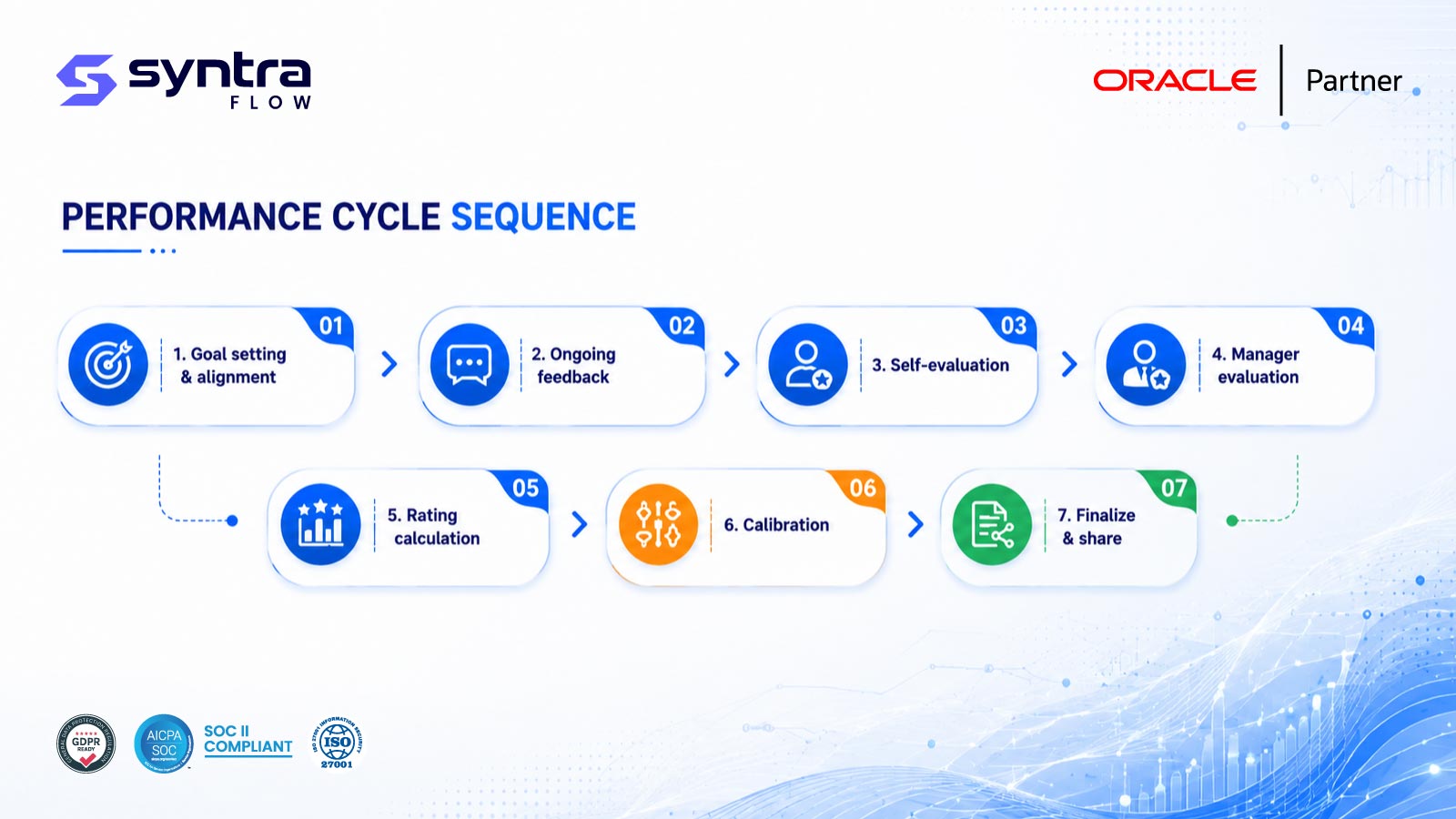
A performance cycle runs through a sequence of configured tasks, from goal setting through calibration and finalization.
Performance cycle sequence
- Trigger: a performance document generated from a template for an eligible worker population, on an HR-defined cycle date.
- Key steps: goals set or cascaded, feedback requested or given throughout the period, self-evaluation and manager evaluation sections completed, competency and goal ratings rolled into an overall rating.
- Decision point: calibration may adjust individual ratings before the document is finalized, with the original and adjusted values both retained.
- Exceptions: matrix-managed workers route to a second manager or additional participants; excluded workers (new hires, leave of absence) do not receive a document.
- Expected output: a finalized, shared performance document with an overall rating.
- Downstream impact: finalized ratings feed the compensation cycle and can inform talent review and succession planning.
This process forms part of the complete Oracle Hire-to-Retire (H2R) lifecycle, spanning recruiting through retirement. See the Oracle HCM Testing Tool hub for how performance management connects to the rest of H2R.
Common Testing Challenges
Performance management is configuration-heavy and workflow-heavy at the same time, which creates a wide surface for defects to hide.
Template and section complexity
Goal, competency, and questionnaire sections each carry independent weighting and calculation rules that interact.
Multi-party workflow
Self-evaluation, manager evaluation, second-manager, and HR tasks must route and lock in the correct sequence.
Rating calculation logic
Overall ratings roll up from weighted sections, and manual overrides must not silently discard the calculated value.
Calibration and audit
Adjustments during calibration must be traceable back to the original rating for every affected worker.
Eligibility and population changes
New hires, transfers, and leave changes mid-cycle affect who receives a document and when.
Cycle timing pressure
HR-mandated close dates leave little room to discover a workflow or calculation defect late in the cycle.
Risks and Testing Mitigations
| Risk | Impact | Mitigation via testing |
|---|---|---|
| Overall rating miscalculated | Wrong compensation input | Assert calculated rating against expected weights |
| Section not routed to manager | Evaluation never completed | Workflow-path testing for every task transition |
| Override not audited | No defensible record of change | Verify original and adjusted value both persist |
| Eligible worker excluded | Missed review; compliance gap | Eligibility-profile test cases at the boundary |
| Calibration skews distribution | Unfair or non-compliant rating spread | Test rating-distribution guideline enforcement |
| Talent review data lost | Inaccurate succession pipeline | Verify box placement persists after meeting close |
| Quarterly update changes behaviour | Silent drift in ratings or workflow | Release-aware regression on the full cycle |
What SyntraFlow Automates in Performance Management Testing
SyntraFlow drives goals, documents, reviews, and calibration through the Oracle UI, then asserts the exact rating and workflow outcome — not just that a page loaded.
Pre-built cycle scenarios
A starter pack covering goals, documents, reviews, and calibration that you extend to your templates.
Workflow-path execution
Drives each task in sequence — self-evaluation, manager evaluation, second manager, HR review — end to end.
Rating-level assertions
Verifies the calculated overall rating, not just that a document reached a "complete" status.
Dynamic test data
Provisions eligible workers, goal plans, and templates via SyntraFlow AI testing features so each scenario starts from known-good data.
Self-healing execution
Playwright-based runs that re-anchor when Oracle changes performance document or Redwood pages.
Evidence capture
Timestamped screenshots and rating logs retained as audit-grade evidence for every run.
[SyntraFlow — Performance Document Test Execution view]
Illustrative placeholder: this page has no live screenshot assets.
120+
Illustrative scenarios executed
~92%
Illustrative pass rate
8
Illustrative defects surfaced
-60%
Illustrative cycle-test time saved
Dashboard figures are illustrative only and do not represent a specific customer result.
Automation Benefits
| Benefit | Manual approach | With SyntraFlow |
|---|---|---|
| Cycle coverage | Spot-checked, time-boxed before go-live | Full goal-to-calibration path exercised |
| Rating verification | Visual review of a sample of documents | Calculated rating asserted for every case |
| Regression after update | Re-run manually, often skipped under time pressure | Release-scoped pack re-run automatically |
| Evidence for audit | Ad hoc notes or none | Screenshot and result log per run |
AI Testing Features for Performance Management
AI assistance targets the parts of performance testing that change most often between cycles and releases: scenario generation, impact analysis, and page adaptation.
AI-assisted scenario generation
Generates goal, rating, and calibration variants from your template and rating-model configuration.
Release-impact analysis
Maps a quarterly update to the performance templates and rating rules it actually touches.
Redwood-aware self-healing
Re-anchors goal and performance document pages semantically when Oracle redesigns them.
Manual vs AI-Driven Testing
| Dimension | Manual testing | AI-driven testing |
|---|---|---|
| Scenario design | Written by hand per template change | Generated from configuration and prior cases |
| Regression scope | Full re-test or best guess | Scoped to release-impacted areas |
| Page-change resilience | Scripts break on UI redesign | Self-healing on Redwood changes |
| Execution speed at volume | Constrained by tester availability | Parallel execution across scenarios |
Illustrative AI Impact: Quarterly Regression Effort
Illustrative comparison for a quarterly performance-cycle regression pack; actual effort depends on template count and scenario scope.
A note on capability. Pre-built scenarios, workflow-path execution, self-healing, and evidence capture are current platform capabilities. AI-assisted scenario generation and release-impact scoping are configurable during onboarding to your templates and rating models. Any tenant-specific extension beyond this is confirmed at assessment rather than assumed here.
Typical Oracle Performance Management Test Scenarios
A representative set of 28 Oracle Fusion performance management scenarios spanning goals, documents, reviews, ratings, feedback, talent review, and calibration. Test IDs use the HC-PRF prefix.
| ID | Scenario | Preconditions | Expected result | Pri | Auto |
|---|---|---|---|---|---|
| HC-PRF-001 | Generate annual performance document from template | Template configured, eligibility profile assigned | Document generated for eligible worker | H | Y |
| HC-PRF-002 | Worker sets an individual performance goal | Goal plan open, manage-goals access granted | Goal saved with target and weight | H | Y |
| HC-PRF-003 | Manager cascades organization goal to direct reports | Org goal published, cascade enabled | Cascaded goals created and linked to parent | H | Y |
| HC-PRF-004 | Worker aligns goal to a published organization goal | Organization goal visible in goal library | Alignment link established and visible | M | Y |
| HC-PRF-005 | Mass-assign goals to eligible population | HR mass goal assignment task configured | Goals created for all eligible workers | H | Y |
| HC-PRF-006 | Update goal progress and status mid-cycle | Existing goal in "In Progress" status | Progress percentage and status updated | M | Y |
| HC-PRF-007 | Worker completes self-evaluation section | Document in self-evaluation task | Ratings and comments saved, section submitted | H | Y |
| HC-PRF-008 | Manager completes evaluation section | Document routed to manager evaluation task | Manager ratings and comments recorded | H | Y |
| HC-PRF-009 | Competency section evaluated against profile | Competency model assigned to template | Competency ratings captured per proficiency scale | H | Y |
| HC-PRF-010 | Multi-participant matrix review input | Additional reviewers configured on template | Each participant's input captured separately | M | Y |
| HC-PRF-011 | Second manager evaluation for matrix-managed worker | Worker has a second reporting line | Second manager section completes independently | M | Y |
| HC-PRF-012 | Overall performance rating calculated | Section ratings and weights entered | Overall rating computed per calculation rule | H | Y |
| HC-PRF-013 | Manual override of calculated overall rating | Override privilege granted to role | Overall rating replaced, original value retained | M | Y |
| HC-PRF-014 | Rating model boundary values accepted | Rating scale with defined minimum/maximum | Boundary ratings accepted, out-of-range rejected | H | Y |
| HC-PRF-015 | Rating distribution guideline warning | Distribution guideline configured | Warning shown when guideline exceeded | M | P |
| HC-PRF-016 | Document routed through approval workflow | Approval rule configured on template | Task routed to next approver in sequence | H | Y |
| HC-PRF-017 | Document shared with worker after finalization | Document reaches Share task | Worker can view finalized ratings and comments | H | Y |
| HC-PRF-018 | Worker requests feedback from a colleague | Feedback request feature enabled | Request routed; response captured on profile | M | Y |
| HC-PRF-019 | Give unsolicited feedback note | Ongoing feedback feature enabled | Feedback note created, visible per privacy setting | M | Y |
| HC-PRF-020 | Feedback surfaces within performance document | Feedback exists for the review period | Feedback visible in evaluation section | M | Y |
| HC-PRF-021 | Talent review: place worker on performance/potential grid | Talent review meeting configured | Worker placed on 9-box grid | H | Y |
| HC-PRF-022 | Talent review: update box placement mid-meeting | Meeting in progress, facilitator role active | Placement change saved with reason | M | Y |
| HC-PRF-023 | Flag succession candidate from talent review | Succession/talent pool configured | Worker flagged and added to talent pool | M | P |
| HC-PRF-024 | Calibration session: adjust individual rating | Calibration session open, ratings pre-loaded | Adjusted rating recorded with justification | H | Y |
| HC-PRF-025 | Calibration: normalize ratings across teams | Multiple managers' ratings loaded into session | Distribution normalized per calibration rules | H | P |
| HC-PRF-026 | Calibration adjustment audit trail retained | Ratings adjusted during calibration | Original and adjusted values both retained | H | Y |
| HC-PRF-027 | Performance document eligibility exclusion | Worker meets exclusion criteria (new hire, LOA) | Document not generated for excluded worker | M | Y |
| HC-PRF-028 | Quarterly-update regression on full performance cycle | Post-update tenant | Goal-to-calibration path reproduces prior results | H | Y |
Pri = priority (H/M/L). Auto = automation candidate (Y suitable · P partly, needs role or meeting-facilitation setup). Steps summarised; full step detail ships in the downloadable test pack.
Regression Testing the Performance Cycle
Performance management touches templates, rating models, eligibility profiles, and workflow rules that all change over time — through HR configuration updates, org restructures, and Oracle's own quarterly releases. Any of these can shift how a goal, rating, or calibration adjustment behaves without anyone noticing until the cycle is already running.
The Oracle Regression Testing Tool re-runs the goal-to-calibration scenario pack after configuration changes and before each cycle opens, so a template or rating-model edit is validated before workers and managers depend on it.
Quarterly Oracle Release Testing
Oracle's quarterly updates can change performance document pages, rating behaviour, or talent review features through feature opt-ins and Redwood redesigns. Because ratings feed compensation, a silent change here is a control gap, not a cosmetic one.
Rather than re-testing every scenario on every release, Oracle Release Intelligence analyses the release notes for changes touching goals, performance documents, ratings, and calibration, maps them to your configuration, and recommends the specific scenarios from the HC-PRF pack to re-run before the next cycle opens.
Redwood UI Considerations
Redwood redesigns the goal, performance document, and talent review pages workers and managers interact with every cycle. Selector-based test scripts tend to break on these redesigns even when the underlying rating logic is unchanged, which is a particular risk for a process that runs on a fixed HR calendar.
See Oracle Redwood UI Testing for how SyntraFlow understands Redwood pages semantically so goal, evaluation, and calibration assertions keep running through UI redesigns.
Performance Management Testing Best Practices
Assert the calculated overall rating value, not just document completion status.
Test every workflow task transition — self, manager, second manager, HR — end to end.
Verify calibration adjustments retain the original rating alongside the adjusted one.
Cover eligibility boundaries — new hires, transfers, and leave — not just the standard population.
Test rating-model boundaries at the minimum and maximum of the scale.
Include matrix-managed and second-manager scenarios, not only single-manager cases.
Validate talent review box placement persists correctly after the meeting closes.
Run the full cycle pack before each performance period opens, not only at go-live.
Re-test after every Oracle quarterly update, scoped by release impact.
Keep template, rating-model, and eligibility test data separate from production configuration.
SyntraFlow Advantages
Full-cycle coverage
Goals through calibration exercised end to end, not only individual screens.
Rating-accurate assertions
Verifies the calculated value, catching rollup and override defects manual review misses.
Redwood-ready
Self-healing execution keeps cycle testing working through UI redesigns.
Audit-ready evidence
Every run retains screenshots and rating logs for HR and compensation audit.
Related Oracle HCM Testing Pages
Performance management connects to the rest of the Hire-to-Retire lifecycle. Go deeper on adjacent topics:
Oracle HCM Testing Tool ⭐
The Hire-to-Retire testing hub.
Oracle Compensation Testing →
Worksheets and budgets driven by ratings.
Oracle Learning Testing →
Courses assigned from development plans.
Oracle Recruiting Testing →
The lifecycle stage before onboarding.
Oracle HCM Test Cases →
The broader HCM test case catalog.
Oracle HCM UAT Checklist →
Sign-off checklist for HCM go-lives.
Oracle Documentation References
For configuration and process detail beyond the scope of this testing guide, consult Oracle's own documentation set:
- Oracle Fusion Cloud HCM: Implementing Goal Management
- Oracle Fusion Cloud HCM: Implementing Performance Management
- Oracle Fusion Cloud HCM: Using Performance Management
- Oracle Fusion Cloud HCM: Implementing Talent Management Base
Frequently Asked Questions
What does Oracle Performance Management Testing cover?
▼
It covers the full performance cycle in Oracle HCM Cloud: goal setting and alignment, performance document generation and workflow, self- and manager evaluation, rating calculation, feedback, talent review, and calibration. It does not cover the compensation worksheets or learning assignments that consume the finalized ratings — those are separate pages.
Is Oracle Performance Management Testing the same as Oracle Performance Testing?
▼
No. This page covers HCM talent and performance-review functional testing — goals, ratings, and calibration. Oracle Performance Testing is a separate topic covering software load and scalability testing of the Oracle application itself. The two serve unrelated audiences, so they are kept as distinct pages.
How is goals testing different from performance document testing?
▼
Goals testing covers setting, cascading, aligning, and mass-assigning goals — often standalone activities that run throughout the year. Performance document testing covers the template-driven workflow that evaluates those goals alongside competencies and questionnaires, produces a rating, and routes through approval and sharing.
What ratings and calibration scenarios should be tested?
▼
At minimum: rating-model boundary values, overall rating calculation from weighted sections, manual overrides with audit trail, distribution-guideline enforcement, and calibration adjustments that retain both the original and adjusted rating. Talent review box placement is closely related and should be tested alongside calibration.
How does performance management testing relate to compensation testing?
▼
Finalized performance ratings are a direct input to the compensation cycle, but the worksheet and budget-pool mechanics themselves are a separate concern. See Oracle Compensation Testing for how ratings translate into pay recommendations.
How does performance management testing relate to learning testing?
▼
A performance document may identify a development need, but the resulting course and certification assignments are managed and tested separately. See Oracle Learning Testing for development-plan-driven learning scenarios.
How do you automate Oracle Performance Management testing?
▼
SyntraFlow provisions eligible workers, goal plans, and templates, drives each workflow task from goal setting through calibration, and asserts the exact calculated rating and workflow outcome. It self-heals when Oracle changes performance document or Redwood pages, and captures evidence for every run.
Does Redwood change performance management testing?
▼
Redwood redesigns the goal, performance document, and talent review pages, which can break selector-based automation even when the underlying rating logic is unchanged. SyntraFlow understands Redwood pages semantically and self-heals, so cycle testing keeps running through UI redesigns.
How often should the performance review cycle be regression tested?
▼
Before every performance period opens, after any template, rating-model, or eligibility-profile change, and after every Oracle quarterly update. Because ratings drive compensation, a missed regression cycle can surface only after pay recommendations have already been made.
What test data does performance management testing need?
▼
Each scenario needs workers matched to specific eligibility, template, and rating-model conditions — a matrix-managed worker, a boundary rating, a new hire mid-cycle. SyntraFlow provisions this data so scenarios produce the intended outcome reliably rather than depending on hand-built fixtures.
Strengthen Your Oracle Performance Management Test Coverage
Identify gaps in your goal-to-calibration test suite, automate high-risk rating scenarios, and prepare for Oracle quarterly updates with SyntraFlow. See it run against performance cycle cases like yours.