Oracle Recruiting Testing
Oracle Recruiting (formerly Oracle Recruiting Cloud) manages the entire pre-hire funnel — from opening a requisition through sourcing candidates, scheduling interviews, extending an offer, and converting an accepted offer into a new hire. Every stage carries its own validation rules, approval routing, and integration points, and a defect at any stage either blocks a requisition from filling or lets an unqualified action slip through unnoticed.
This page is a practical guide to testing the recruiting funnel itself — requisitions, candidates, interviews, offers, and the hire transaction that hands a candidate to Oracle Global HR. It sits under the Oracle HCM Testing Tool hub and stops at the moment of hire — what happens to the worker record afterward is covered on the Oracle Worker Testing and Oracle Employment Testing pages.
What Is Oracle Recruiting Testing?
Oracle Recruiting testing verifies the behaviour of the candidate-facing and recruiter-facing processes that take an open position from a requisition to a signed offer. That includes requisition creation and approval, candidate application and screening, interview scheduling and feedback, offer generation and approval, and the hire action that creates a new worker record. It also covers internal mobility, where an existing worker applies to and moves into a different position, and external applicant flows through career sites and job boards.
Recruiting sits upstream of the rest of Hire-to-Retire. It reads from position management, grade and compensation structures, and security configuration; it writes forward into Global Human Resources the moment a candidate is hired. A defect anywhere in the funnel either stalls a requisition that the business needs filled, or produces a new hire record with incorrect assignment, compensation, or start data that then has to be corrected downstream.
The teams affected are talent acquisition and recruiters running the day-to-day funnel, hiring managers approving requisitions and offers, HR business partners who inherit the resulting hire, and candidates themselves — whose experience of the application and offer process is a direct reflection of the tenant's configuration quality.
Scope note. This page covers the pre-hire recruiting funnel only — requisition through offer acceptance and the hire transaction. Once a candidate is hired and a worker record exists, ongoing employment changes, assignments, and terminations are covered on Oracle Worker Testing and Oracle Employment Testing. This process forms part of the complete Oracle Hire-to-Retire (H2R) lifecycle.
Why Recruiting Testing Matters
Recruiting is the entry point to the entire employee lifecycle, and it is one of the most visible processes to people outside the organization — candidates. Defects here have both operational and reputational cost.
| Risk | Example | Potential impact | Mitigation via testing |
|---|---|---|---|
| Requisition approval stalls | Approval routes to a vacant or wrong role | Open position stays unfilled | Approval routing test per position type |
| Candidate data loss | Application or resume attachment not saved | Lost applicant; poor candidate experience | End-to-end application submission test |
| Duplicate candidate records | Same person applies via two channels | Fragmented candidate history; compliance risk | Duplicate-detection scenario testing |
| Interview scheduling conflict | Double-booked interviewer or room | Rescheduling churn; delayed decisions | Calendar/availability integration testing |
| Offer approval bypassed | Offer sent before compensation sign-off | Unauthorized compensation commitment | Offer approval workflow test |
| Incorrect hire data | Offer terms don't carry to the hire transaction | Wrong pay or assignment on day one | Offer-to-hire data integrity test |
| Internal mobility conflict | Internal candidate hired without manager notification | Employee relations issue | Internal candidate workflow testing |
| Career site defect | External job posting fails to display or apply | Reduced applicant volume | External career site regression testing |
| Silent behaviour change | Quarterly update alters requisition or offer rules | Undetected process drift | Release-aware regression on recruiting |
| Compliance gap | EEO/OFCCP-relevant data not captured | Regulatory exposure | Compliance field and disclosure testing |
The Oracle Recruiting Process Flow
Recruiting runs as a sequence of stage-gated steps, each with its own configuration, approvals, and data capture. A complete test suite validates the transition between every stage, not just the individual screens.
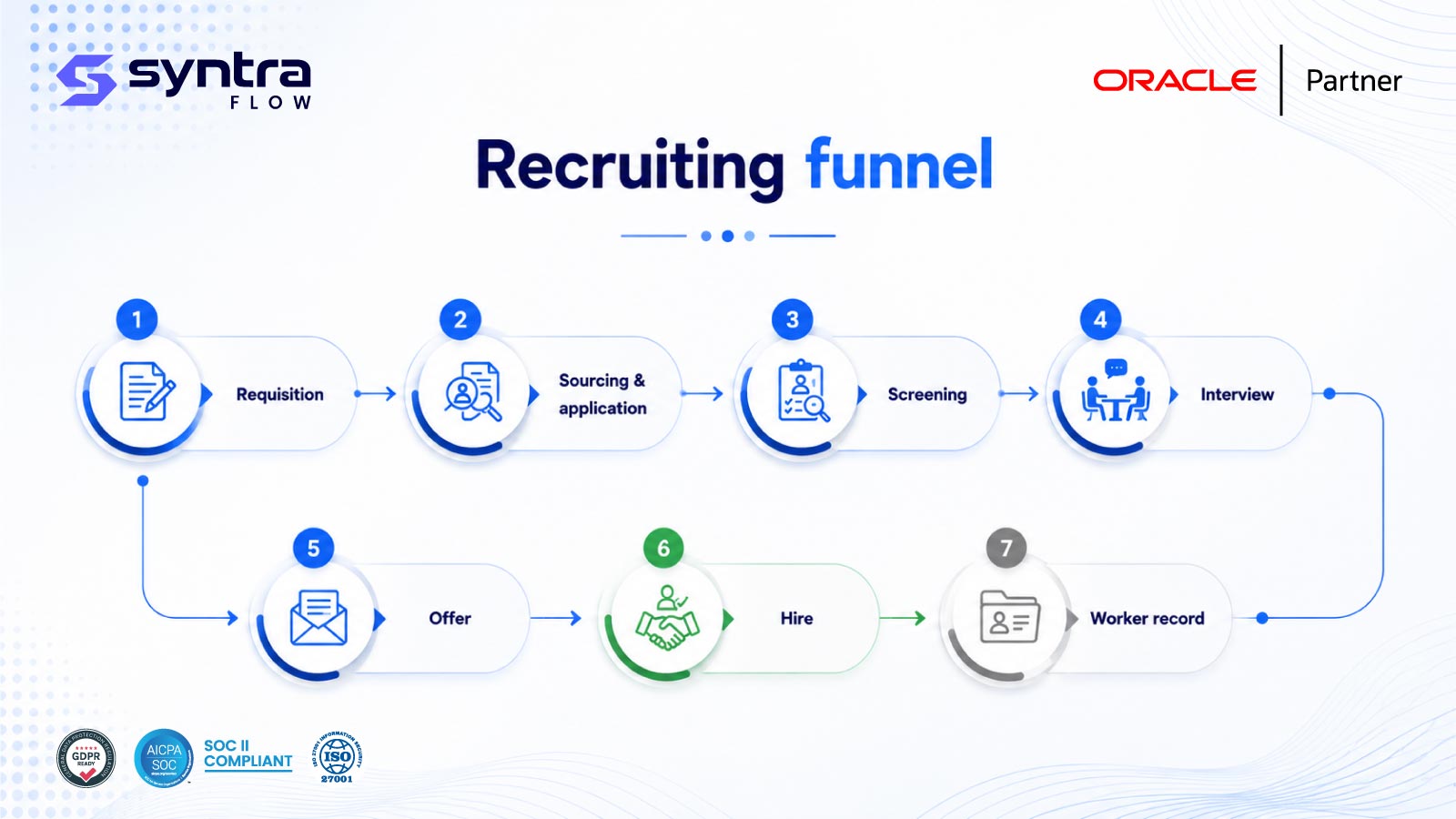
Recruiting funnel
- Requisition: created against a position or job, routed for approval, then posted internally and/or externally.
- Sourcing & application: candidates apply through the career site, a job board, agency referral, or internal mobility; profiles are created or matched to existing candidate records.
- Screening: recruiters and hiring managers move candidates through pipeline stages, apply disposition codes, and run any configured assessments.
- Interview: interviews are scheduled, feedback is collected from interviewers, and the panel decision is recorded.
- Offer: an offer is generated from approved compensation, routed through offer approval, and extended to the candidate for acceptance.
- Hire: an accepted offer is converted into a hire transaction, creating the person and worker records in Global HR.
- Downstream handoff: from this point, assignment changes, employment events, and terminations are Worker and Employment Testing concerns, not Recruiting.
Illustrative diagram — actual requisition, approval, and offer stages depend on tenant configuration.
Common Recruiting Testing Challenges
Recruiting is harder to test than most HCM processes because it spans two very different user populations — internal recruiters/hiring managers and external candidates — plus a set of integrations that many other HCM modules don't have.
| Challenge | Why it's hard | Testing implication |
|---|---|---|
| External-facing career site | Candidate UX is public and unauthenticated | Test as an anonymous external applicant, not just internally |
| Multi-stage approval routing | Requisition and offer approvals vary by position, grade, and org | Combinatorial routing scenarios, not one path |
| Interview scheduling integration | Calendar and availability checks often involve external tools | Integration testing beyond the Oracle UI |
| Offer-to-hire data carry-forward | Compensation, assignment, and start data must transfer intact | Field-level comparison between offer and resulting hire |
| Internal vs external candidate paths | Internal mobility uses different visibility and approval rules | Separate test paths per candidate type |
| Candidate duplicate management | The same person may apply multiple times over months | Test matching/merge logic, not just fresh applications |
| Quarterly update volatility | Recruiting UI and rules change frequently across releases | Release-scoped regression, see below |
Recruiting Risk Register
| Risk | Impact | Mitigation via testing |
|---|---|---|
| Requisition approval misroutes | Positions stay open, missed hiring targets | Approval-chain scenarios by position/org |
| Offer sent with stale compensation | Incorrect or unauthorized offer terms | Compensation source validation before offer |
| Hire fails to create worker record | New employee has no system access day one | Offer-to-hire transaction verification |
| Career site posting errors | Reduced candidate volume, brand impact | External posting and application regression |
| Internal mobility visibility gap | Current manager not informed per policy | Internal-candidate notification testing |
What SyntraFlow Automates in Recruiting Testing
SyntraFlow drives the requisition-through-hire funnel across recruiter, hiring-manager, and candidate views, then asserts the data that actually matters — not just that a page loaded.
Pre-built recruiting cases
A starter pack covering requisition, candidate, interview, offer, and hire scenarios you extend to your configuration.
AI-assisted generation
Generates funnel variants — approval routes, offer combinations, internal vs external candidate paths — from your setup.
Self-healing execution
Playwright-based runs that re-anchor when Oracle changes requisition, candidate, or offer pages, including Redwood redesigns.
Dynamic test data
Provisions requisitions, candidate profiles, and offer records so tests produce the specific pipeline stage each case needs.
Offer-to-hire assertions
Verifies compensation, assignment, and start data carry correctly from the accepted offer into the hire transaction.
Candidate-view coverage
Runs application and offer-acceptance flows from the external candidate perspective, not only the recruiter console.
Evidence capture
Timestamped screenshots and execution traces retained as audit-grade evidence for every requisition and offer test run.
Release-impact selection
Runs the recruiting subset a given release actually affects, rather than the full pack every quarter.
Cross-module continuation
Hands off validated hire data as the entry condition for Worker and Employment test packs.
Automation Benefits
| Benefit | Manual approach | With SyntraFlow |
|---|---|---|
| Funnel coverage | Testers spot-check a few requisitions | Full requisition-to-hire pack run consistently |
| Offer accuracy checks | Manual field-by-field comparison | Automated offer-to-hire data assertions |
| Candidate-view testing | Often skipped due to setup effort | Repeatable external-candidate flows |
| Regression after updates | Re-tested manually, if time allows | Release-scoped automated regression |
| Evidence for audit | Screenshots collected ad hoc | Captured automatically for every run |
AI Testing Features for Recruiting
AI narrows what to re-test after a change and keeps recruiting automation running through Oracle's frequent UI updates.
[SyntraFlow — Recruiting requisition-to-hire test run view]
30
Scenarios executed
94%
Pass rate (illustrative)
4
Defects found (illustrative)
~60%
Regression time saved (illustrative)
AI impact analysis — quarterly update regression (illustrative)
Illustrative comparison for a quarterly update cycle; actual effort depends on tenant configuration and recruiting suite scope.
Manual vs AI-Driven Recruiting Testing
| Dimension | Manual testing | AI-driven testing |
|---|---|---|
| Scenario generation | Hand-written per requisition type | Generated from configuration and prior coverage |
| UI change resilience | Scripts break on page redesign | Self-healing selectors re-anchor automatically |
| Release regression scope | Full re-test or risky guesswork | Scoped to what the release actually touches |
| Offer-to-hire validation | Manual field comparison | Automated data-integrity assertions |
| Evidence for audit | Assembled after the fact | Captured continuously during execution |
A note on capability. Pre-built recruiting cases, self-healing execution, and evidence capture are current platform capabilities. Coverage scoped to your specific requisition types, approval chains, and offer templates is configurable during onboarding. Deeper candidate-communication or assessment-vendor integrations are confirmed at assessment rather than assumed here.
Typical Oracle Recruiting Test Scenarios
A representative set of 30 Oracle Fusion Recruiting scenarios spanning requisitions, candidates, interviews, offers, hire, internal mobility, and external applicants. Test IDs use the HC-REC prefix.
| ID | Scenario | Preconditions | Expected result | Pri | Auto |
|---|---|---|---|---|---|
| HC-REC-001 | Create requisition from an approved position | Position exists and is vacant | Requisition created in draft status | H | Y |
| HC-REC-002 | Requisition approval routing by grade | Multi-step approval configured | Routes to correct approver chain | H | Y |
| HC-REC-003 | Requisition rejected and returned to originator | Approver rejects with comment | Status returns to draft with reason | M | Y |
| HC-REC-004 | Requisition posted to internal career site | Requisition approved | Visible to eligible internal candidates | H | Y |
| HC-REC-005 | Requisition posted to external career site | External posting enabled | Visible and applicable by anonymous user | H | Y |
| HC-REC-006 | Requisition headcount fully filled auto-closes | Openings = hires completed | Requisition status changes to filled | M | Y |
| HC-REC-007 | External candidate submits new application | Anonymous candidate, open requisition | Candidate profile and application created | H | Y |
| HC-REC-008 | Resume/attachment upload during application | File attached at submission | Attachment stored and retrievable by recruiter | H | Y |
| HC-REC-009 | Duplicate candidate application detected | Same email applies twice | Matched to existing candidate profile | H | Y |
| HC-REC-010 | Candidate pipeline stage progression | Recruiter moves candidate forward | Stage updates; history logged | H | Y |
| HC-REC-011 | Candidate disqualification with reason code | Recruiter disqualifies candidate | Status and reason recorded; notification sent | M | Y |
| HC-REC-012 | Internal candidate applies via mobility | Active worker, eligible position | Application created with internal flag | H | Y |
| HC-REC-013 | Internal mobility manager notification | Internal candidate reaches interview stage | Current manager notified per policy | M | Y |
| HC-REC-014 | Interview scheduling with multiple interviewers | Panel interview configured | All interviewers invited; calendar updated | H | Y |
| HC-REC-015 | Interview reschedule after conflict | Interviewer declines original slot | New slot confirmed; candidate notified | M | Y |
| HC-REC-016 | Interview feedback submission | Interview completed | Feedback captured and visible to recruiter | H | Y |
| HC-REC-017 | Missing interview feedback blocks progression | Feedback required before offer stage | Progression blocked until feedback logged | M | Y |
| HC-REC-018 | Offer generated from approved compensation | Compensation approved for candidate | Offer created with correct terms | H | Y |
| HC-REC-019 | Offer approval workflow routing | Offer above delegation threshold | Routes to required approver level | H | Y |
| HC-REC-020 | Offer letter generation and delivery | Offer approved | Letter generated and sent to candidate | H | Y |
| HC-REC-021 | Candidate accepts offer online | Offer delivered to candidate portal | Status updates to accepted | H | Y |
| HC-REC-022 | Candidate declines offer with reason | Offer delivered to candidate | Status updates; requisition reopens for sourcing | M | Y |
| HC-REC-023 | Offer revision after candidate negotiation | Recruiter edits pending offer | Revised offer re-routes for approval | M | Y |
| HC-REC-024 | Offer expiration without response | Response deadline configured | Offer expires; status updates automatically | L | Y |
| HC-REC-025 | Accepted offer converts to hire transaction | Offer status accepted | Hire transaction created with offer data | H | Y |
| HC-REC-026 | Offer-to-hire compensation data integrity | Hire transaction generated | Salary/grade match the accepted offer exactly | H | Y |
| HC-REC-027 | Hire creates person and worker record | Hire transaction submitted | New person/worker record exists in Global HR | H | Y |
| HC-REC-028 | Internal mobility hire updates existing worker | Internal candidate hired into new role | Existing worker record updated, not duplicated | H | Y |
| HC-REC-029 | Recruiting-to-Global-HR handoff timing | Hire effective-dated in the future | Worker record activates on the correct date | M | Y |
| HC-REC-030 | Quarterly-update regression on requisition-to-hire | Post-update tenant | All prior results reproduce | H | Y |
Pri = priority (H/M/L). Auto = automation candidate (Y suitable). Steps summarised; full step detail is scoped during onboarding.
Recruiting Regression Testing
Recruiting configuration changes often — new requisition templates, revised approval chains, updated offer letter templates, or a new career-site theme. Each of these is a regression trigger, and because recruiting touches candidates directly, an untested change can affect people outside the organization before anyone inside notices.
SyntraFlow's Oracle Regression Testing Tool re-runs the requisition-to-hire pack after configuration changes and quarterly updates, scoping execution to the recruiting scenarios a given change actually touches rather than the full suite every time.
Requisition template or approval chain change
Offer letter template or offer approval change
Career site theme, branding, or posting rule change
Security role or hiring-manager delegation change
Recruiting & Oracle Quarterly Releases
Oracle's quarterly updates frequently touch Recruiting — new candidate-experience features, requisition workflow changes, offer-page redesigns, and opt-in functionality that can shift default behaviour. Because recruiting is candidate-facing, an update that breaks the application or offer flow is visible externally, not just to internal users.
Rather than re-testing the entire funnel every quarter, Oracle Release Intelligence analyses the release notes for Recruiting-relevant changes, maps them to your requisition types and offer templates, and recommends the specific scenarios from the test scenario table above to prioritize before the update reaches production.
Redwood UI Considerations for Recruiting
Oracle has moved requisition management, candidate profile, and offer pages toward the Redwood design system, and the external career site experience is a frequent target of Redwood-driven refreshes. These redesigns can change page structure and component behaviour without altering the underlying recruiting logic — which breaks selector-based automation even when nothing functionally changed.
SyntraFlow's Oracle Redwood UI Testing approach interprets Redwood pages semantically rather than by fixed selectors, so requisition, candidate, and offer test cases keep running through UI redesigns instead of failing on the first page change.
Oracle Recruiting Testing Best Practices
Test the full requisition-to-hire chain, not isolated screens.
Cover both internal mobility and external applicant paths separately.
Test the career site as an anonymous external user, not only as a recruiter.
Verify offer-to-hire data integrity field by field, especially compensation.
Test approval routing for every position type and delegation scenario.
Confirm duplicate-candidate matching before assuming a clean database.
Re-run the funnel pack on every quarterly update, scoped by release impact.
Coordinate with Worker and Employment Testing so hire data is validated end to end.
Capture evidence of offer approval and acceptance for compliance records.
Re-test after any change to offer templates, letters, or approval thresholds.
SyntraFlow Advantages for Recruiting Testing
Funnel-wide coverage
Requisition, candidate, interview, offer, and hire tested as one connected chain.
Candidate-view testing
Exercises the external application and offer-acceptance experience, not just the recruiter console.
Self-healing on Redwood
Requisition and offer page redesigns don't break existing test cases.
Clean hand-off to hire
Validated hire data feeds directly into Worker and Employment test packs.
Related Oracle HCM Pages
Recruiting connects to the rest of the Hire-to-Retire lifecycle. Go deeper on adjacent topics:
Oracle HCM Testing Tool ⭐
The Hire-to-Retire testing hub.
Worker Testing →
What happens after a candidate is hired.
Employment Testing →
Assignment and employment record changes.
Performance Management Testing →
Goals, reviews, and ratings after onboarding.
Oracle HCM Test Cases →
Broader HCM test case catalog.
Oracle HCM UAT Checklist →
UAT readiness checklist for HCM.
Oracle Regression Testing Tool →
Scoped regression after every change.
Oracle Release Intelligence →
Quarterly update impact analysis.
Oracle Redwood UI Testing →
Testing through Oracle's Redwood redesigns.
Oracle documentation references: Oracle Fusion Cloud Recruiting: Using Oracle Recruiting; Oracle Fusion Cloud HCM: Implementing Recruiting; Oracle Fusion Cloud Global Human Resources documentation library.
Frequently Asked Questions
What does Oracle Recruiting testing cover?
▼
It covers the pre-hire funnel: requisition creation and approval, candidate application and screening, interview scheduling and feedback, offer generation and approval, and the hire transaction that converts an accepted offer into a worker record. It does not cover post-hire employment changes.
Where does Recruiting testing end and Worker Testing begin?
▼
The boundary is the hire transaction. The moment a candidate is hired and a worker record is created in Global HR, ownership passes to Oracle Worker Testing and Oracle Employment Testing. Recruiting testing stops at confirming the hire transaction produced correct data.
How is internal mobility different from external hiring for testing purposes?
▼
Internal mobility applies different visibility rules, current-manager notifications, and often different approval chains than an external requisition. It also updates an existing worker record rather than creating a new one, so testing must confirm no duplicate record is created.
Why test the career site as an external candidate?
▼
Recruiters and hiring managers see the internal console, but candidates interact with the public, unauthenticated career site. A defect visible only from that anonymous view — a broken apply button, a failed upload — is invisible to internal testing unless it is specifically exercised from the candidate's perspective.
What is the most common recruiting defect to test for?
▼
Offer-to-hire data mismatches — where compensation, grade, or assignment data agreed at offer stage does not carry correctly into the hire transaction. Because this data feeds a new employee's first paycheck and assignment, it is high-impact and worth prioritizing.
How do you automate Oracle Recruiting testing?
▼
SyntraFlow provisions requisitions and candidate data, drives the funnel through recruiter, hiring-manager, and candidate views, then asserts requisition status, approval routing, and offer-to-hire data integrity. It self-heals when Oracle changes requisition or offer pages and captures evidence for every run.
Does Redwood affect Recruiting testing?
▼
Yes. Requisition, candidate, and offer pages — plus the external career site — are frequent targets of Redwood redesigns. SyntraFlow interprets these pages semantically rather than by fixed selectors, so tests keep running through UI changes. See Oracle Redwood UI Testing.
How often should Recruiting be regression tested?
▼
On every Oracle quarterly update, and after any change to requisition templates, approval chains, offer templates, or career site configuration. Because recruiting is candidate-facing, untested changes can affect people outside the organization before an internal user notices.
Does Recruiting testing cover compliance data such as EEO fields?
▼
Test scope should include the capture and storage of any compliance-relevant fields configured for your tenant, such as voluntary self-identification data collected during application. Confirm your specific regulatory requirements during onboarding, since these vary by country and industry.
What test data does Recruiting testing need?
▼
Each scenario needs data engineered for its outcome — an open requisition at a specific approval stage, a candidate profile with attachments, an offer within or beyond a delegation threshold. SyntraFlow provisions requisitions, candidates, and offers so tests reliably produce the intended stage rather than relying on hand-built fixtures.
Strengthen Your Oracle Recruiting Test Coverage
Identify gaps in your requisition-to-hire test suite, automate high-risk offer and approval scenarios, and prepare for Oracle quarterly updates with SyntraFlow. See it run against recruiting scenarios like yours.