Oracle Procurement Test Cases
A structured catalogue of Oracle Fusion Cloud Procurement test cases, organised by process area — from requisition and self-service shopping through catalog, purchase orders, agreements, sourcing, supplier qualification, receiving and approvals. Use this page as the navigation hub for building a Procurement test library: skim a category, review representative test cases, then follow the link to the detailed page for full coverage.
This is a catalogue and starting point, not a deep single-topic guide. Each category below summarises what it covers, shows a handful of high-value cases, and links to the child page where that area is tested in full. The hub for all of Procurement testing is the Oracle Procurement Testing Tool.
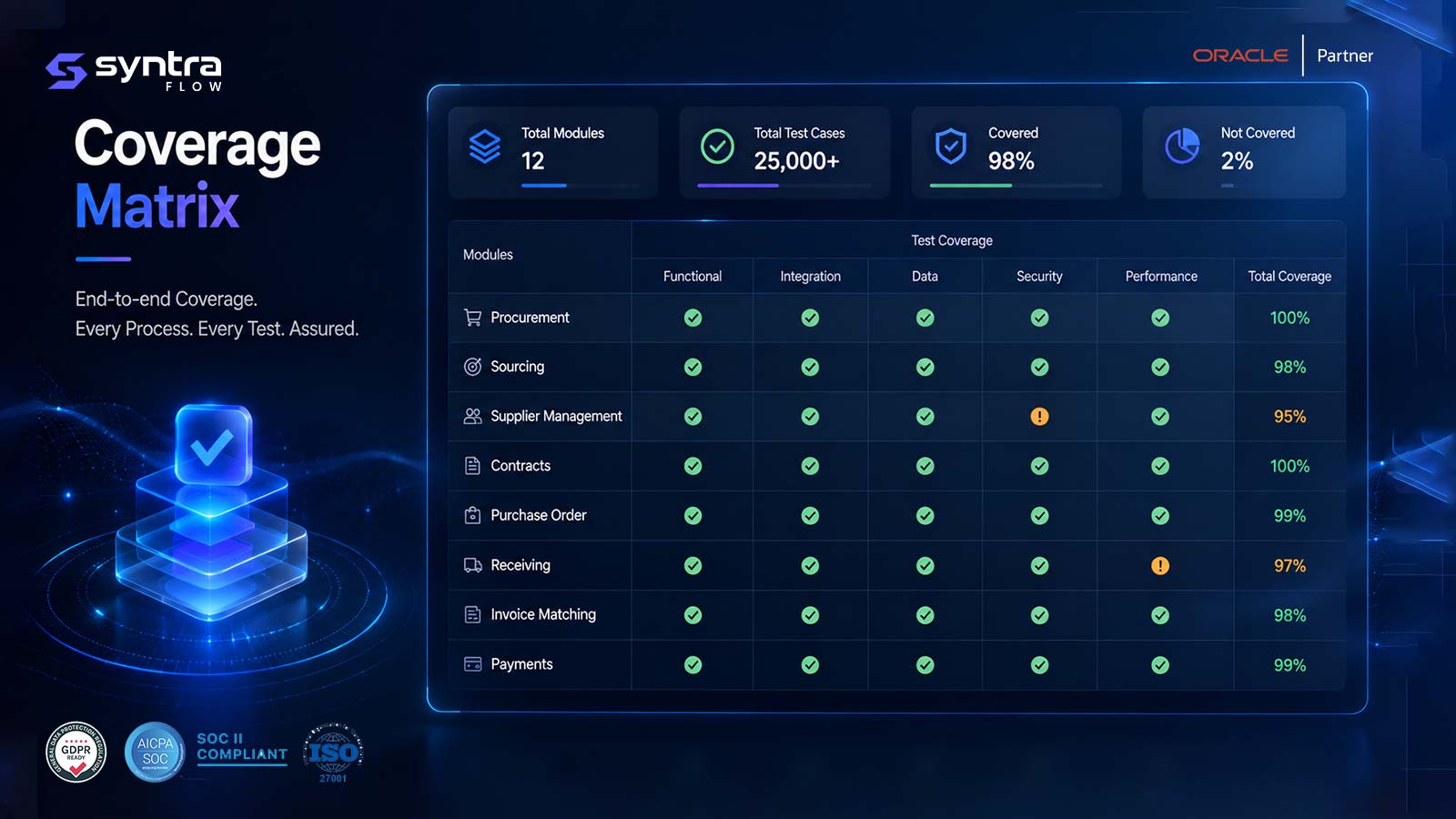
How to Use This Procurement Test-Case Catalogue
Procurement in Oracle Fusion is a chain of dependent processes: a need becomes a requisition, the requisition is approved and sourced, a purchase order or release is created against an agreement, the order is approved and sent to the supplier, goods or services are received, and the receipt feeds Payables for matching. A test library that mirrors that chain is far easier to maintain than a flat list of scripts, because each test maps to a process the business actually runs.
Every category on this page uses a consistent test-ID prefix (for example PR-REQ for requisitions or PR-PO for purchase orders) so you can trace a defect back to a process. The representative cases shown are a subset; the linked child pages carry the full scenario sets, boundary cases, and step detail. Treat this page as the index to your Procurement test suite.
Scope note. This catalogue summarises each area and points to its detailed page. For requisition specifics see Requisition Testing; for order mechanics see Purchase Order Testing; and for the full flow through receipt, matching and payment see Oracle P2P End-to-End Testing.
How to Structure a Procurement Test Library
A durable Procurement test library is organised by process area, not by tester or by release. Group cases under the same areas Oracle uses — requisition, self-service, catalog, purchase order, agreement, sourcing, supplier, receiving, approval — and give each a stable ID prefix. This keeps coverage visible (you can see which processes are thinly tested), makes regression selection precise, and lets new cases slot in without renumbering the whole suite.
Organise by process area
One category per Oracle Procurement process, each with its own ID prefix. Coverage gaps become obvious at a glance.
Stable, traceable IDs
Prefix + sequence (PR-PO-001). IDs never change, so defect and evidence links stay valid across releases.
Layer positive and negative
Every process gets both a clean pass case and the failure cases that must raise the right block, hold or error.
Tag priority and automation
Mark each case with a priority and whether it is an automation candidate, so cycles can be scoped by risk.
Parameterise test data
Keep suppliers, items, amounts, tolerances and dates as data, not hard-coded, so cases reuse across environments.
Map cases to configuration
Link each case to the setup that drives it — approval rules, tolerances, budgetary control — so a config change re-points exactly the right tests.
Positive vs Negative, Functional vs Integration
A Procurement test library needs a deliberate mix of test types. Positive cases prove the process works on clean data; negative cases prove the controls fire on bad data. Functional cases exercise one process in isolation; integration cases prove the hand-offs between processes — and out to Payables, Inventory and supplier systems — hold. A suite that is all positive-functional will pass happily while real risks — an approval that never escalates, a punchout that returns a wrong price, a receipt tolerance that never blocks — go untested.
| Test type | What it proves | Procurement example | Why it matters |
|---|---|---|---|
| Positive (pass) | Clean data completes the process | Approved requisition sources to a PO | Confirms the happy path still works |
| Negative (fail) | Bad data raises the correct control | Over-receipt beyond tolerance is blocked | Controls are only real if they fire |
| Boundary | Behaviour at exact thresholds | Requisition amount exactly at an approval tier | Defects hide at the edges |
| Functional | A single process in isolation | Charge account defaults from the item category | Pinpoints where a defect lives |
| Integration | Hand-off between processes / systems | Receipt drives 3-way match in Payables | Most defects appear at the seams |
| Regression | Prior behaviour survives a change | Re-run pack after a quarterly update | Catches silent Oracle drift |
| Role-based | Access and privilege enforced | Only a buyer can approve a purchase order | Protects segregation of duties |
Priority Classification & Regression Selection
Not every case runs every cycle. Classify each by priority so you can run a smoke pack daily, a core pack per sprint, and the full library at release. Regression selection then becomes a question of which processes a given change actually touches — a tolerance change re-runs receiving and matching boundary cases, an approval-rule change re-runs requisition and PO routing cases, a quarterly update re-runs the release-scoped subset.
| Priority | Meaning | Typical Procurement cases | Run cadence |
|---|---|---|---|
| High (H) | Spend control or fulfilment-blocking | Requisition/PO approval, budgetary control, receiving | Every cycle + smoke |
| Medium (M) | Important but not fulfilment-blocking | Agreement releases, sourcing award, catalog price | Per sprint / per release |
| Low (L) | Edge cases and cosmetic behaviour | Content-zone display, delegation FYI routing | Full-library / release |
Release Intelligence can narrow the regression scope to what a specific Oracle update changed in your tenant, and Configuration Intelligence maps cases to the setup that drives them so a config change re-points the right subset.
The Procurement Test-Case Catalogue by Category
The sections below walk the Procurement process chain. Each category gives a short summary, a table of representative test cases with their preconditions and expected results, and a link to the page where that area is tested in full. Test IDs are category-prefixed and priority (H/M/L) and automation candidacy (Y suitable, P partly, N manual) are shown per case.
Together these tables list more than sixty representative Oracle Fusion Procurement test cases — a starting index, not the complete suite. The full step detail ships in the downloadable test library described further down.
Demand: Requisitions, Self-Service & Catalog
Requisitions PR-REQ
Requisitions are where demand enters Procurement — catalog and non-catalog lines, charge-account defaulting, budgetary control, and the approval that gates sourcing. These cases confirm requisitions save balanced, default the right accounts, and check funds before they become orders. Full detail lives on the Requisition Testing page.
| Test ID | Process | Scenario | Preconditions | Expected Result | Pri | Auto |
|---|---|---|---|---|---|---|
| PR-REQ-001 | Catalog requisition | Create requisition from a catalog item | Preparer role, catalog item exists | Requisition saved with item price/UOM | H | Y |
| PR-REQ-002 | Non-catalog line | Enter a non-catalog requisition line | Category and charge account available | Line saved with category and account | H | Y |
| PR-REQ-003 | Charge-account default | Account derived from item/category rules | Account derivation rules configured | Correct charge account defaulted | M | Y |
| PR-REQ-004 | Budgetary control | Requisition exceeds available funds | Budgetary control / encumbrance on | Funds check fails; reservation blocked | H | Y |
| PR-REQ-005 | Submit for approval | Submit requisition to approval workflow | Approval rules active | Routed per amount hierarchy | H | Y |
| PR-REQ-006 | Requisition to PO | Approved requisition is auto-sourced | Blanket/agreement source assigned | PO or order line created from req | H | Y |
Self-Service Procurement PR-SSP
Self-service is the requester-facing shopping experience — carts, punchout, smart forms and personal preferences that feed the requisition. These cases confirm a shopping cart becomes a valid requisition and that punchout content returns correctly. The full scenario set lives on the Self-Service Procurement Testing page.
| Test ID | Process | Scenario | Preconditions | Expected Result | Pri | Auto |
|---|---|---|---|---|---|---|
| PR-SSP-001 | Shopping cart checkout | Add local-catalog items and check out | Requester role, catalog available | Requisition created from cart | H | Y |
| PR-SSP-002 | Punchout catalog | Punchout to supplier site, return cart | Punchout catalog configured | Items returned with price and UOM | H | P |
| PR-SSP-003 | Smart form request | Submit a smart-form non-catalog request | Smart form published to user | Requisition line created per form | M | Y |
| PR-SSP-004 | Requisition preferences | Deliver-to and account defaults applied | Preferences set for the user | Defaults populate on new lines | M | Y |
| PR-SSP-005 | Approval from cart | Checkout triggers approval routing | Approval rule for the BU | Requisition routed correctly | M | Y |
Procurement Catalog PR-CAT
The catalog is the content layer that requesters shop — local catalogs, punchout definitions, category browsing and content zones. These cases confirm content loads, maps to the right categories, and reflects price changes. Full detail is on the Procurement Catalog Testing page.
| Test ID | Process | Scenario | Preconditions | Expected Result | Pri | Auto |
|---|---|---|---|---|---|---|
| PR-CAT-001 | Local catalog upload | Upload catalog content via file | Catalog admin role, valid file | Items available to shop | H | Y |
| PR-CAT-002 | Category browsing | Item appears under its browsing category | Category hierarchy defined | Item shown under correct category | M | Y |
| PR-CAT-003 | Punchout definition | Configure and reach a punchout catalog | Supplier punchout details entered | Punchout reachable and mapped | M | P |
| PR-CAT-004 | Content zone by BU | Informational content shown to the right BU | Content zone configured | Correct content visible by BU | L | Y |
| PR-CAT-005 | Catalog price update | Update a catalog price and re-shop | Existing catalog line | New price reflected in the cart | M | Y |
Purchasing: Purchase Orders & Agreements
Purchase Orders PR-PO
The purchase order is the committed spend document — created directly or from a requisition, approved, changed, and cancelled, with encumbrance where budgetary control applies. These cases cover creation, sourcing from a requisition, approval, change orders and cancellation. Full coverage is on the Purchase Order Testing page.
| Test ID | Process | Scenario | Preconditions | Expected Result | Pri | Auto |
|---|---|---|---|---|---|---|
| PR-PO-001 | Create standard PO | Create PO with lines, schedules, distributions | Supplier and site active | PO saved in Incomplete, balanced | H | Y |
| PR-PO-002 | PO from requisition | Auto-create PO from approved requisition | Requisition sourced to supplier | PO created; requisition referenced | H | Y |
| PR-PO-003 | PO approval | Submit PO for approval routing | PO approval rules active | Approved / routed by amount | H | Y |
| PR-PO-004 | Change order | Revise price or quantity on approved PO | Change order allowed | Revision created; re-approval if needed | H | Y |
| PR-PO-005 | PO funds reservation | Approve a PO that exceeds available funds | Encumbrance / budgetary control on | Funds reservation fails on approve | H | Y |
| PR-PO-006 | PO cancellation | Cancel a PO line with no receipt | No downstream receipt or invoice | Line cancelled; encumbrance released | M | Y |
Purchase Agreements PR-PA
Agreements pre-negotiate terms — blanket purchase agreements with priced lines, contract purchase agreements for terms only, and the releases and price breaks that draw against them. These cases cover BPA and CPA creation, releases, price breaks and amount limits. Full detail is on the Purchase Agreement Testing page.
| Test ID | Process | Scenario | Preconditions | Expected Result | Pri | Auto |
|---|---|---|---|---|---|---|
| PR-PA-001 | Blanket agreement | Create and approve a BPA with catalog lines | Supplier active, lines priced | BPA saved and approved | H | Y |
| PR-PA-002 | Contract agreement | Create a CPA (terms, no lines) | Supplier active | CPA available for referencing on POs | M | Y |
| PR-PA-003 | Release against BPA | Create a release order from the agreement | Approved BPA exists | Release consumes agreement amount | H | Y |
| PR-PA-004 | Price break | Quantity crosses a price-break tier | Price breaks configured on line | Correct tier price on release | M | Y |
| PR-PA-005 | Amount limit | Release exceeds the agreement amount limit | Amount limit set on agreement | Over-limit release blocked or warned | M | Y |
Sourcing, Qualification & Suppliers
Sourcing PR-SRC
Sourcing runs competitive events — RFQs and auctions where suppliers are invited, respond, and lines are awarded into agreements or orders. These cases cover negotiation creation, supplier invitation and response, award and the hand-off to an agreement. Full detail is on the Sourcing Testing page.
| Test ID | Process | Scenario | Preconditions | Expected Result | Pri | Auto |
|---|---|---|---|---|---|---|
| PR-SRC-001 | Create negotiation | Create an RFQ or auction in draft | Category manager role | Negotiation saved in draft | M | Y |
| PR-SRC-002 | Invite suppliers | Add and notify invited suppliers | Qualified suppliers exist | Invitations issued to suppliers | M | P |
| PR-SRC-003 | Supplier response | Supplier submits a quote/bid | Negotiation published and open | Response recorded against lines | M | P |
| PR-SRC-004 | Award negotiation | Award lines to one or more suppliers | Responses received | Award decision created and saved | H | Y |
| PR-SRC-005 | Award to agreement | Generate agreement/PO from award | Award completed | BPA or PO created from award | M | Y |
Supplier Qualification PR-SQ
Qualification assesses suppliers before and during their lifecycle — questionnaires, evaluations, scoring, and expiry that triggers re-qualification. These cases cover initiating a qualification, questionnaire response, scoring and outcome. Full detail is on the Supplier Qualification Testing page.
| Test ID | Process | Scenario | Preconditions | Expected Result | Pri | Auto |
|---|---|---|---|---|---|---|
| PR-SQ-001 | Initiate qualification | Start a qualification for a supplier | Qualification area defined | Qualification created and issued | M | Y |
| PR-SQ-002 | Questionnaire response | Supplier answers the questionnaire | Questionnaire assigned to supplier | Responses captured for evaluation | M | P |
| PR-SQ-003 | Evaluation & scoring | Evaluator scores a submitted response | Response submitted | Score and outcome recorded | M | P |
| PR-SQ-004 | Qualification expiry | Expired qualification is flagged | Qualification with an end date | Supplier flagged for re-qualification | L | Y |
| PR-SQ-005 | Assessment outcome | Approve or reject the qualification | Scoring complete | Supplier status updated per outcome | M | Y |
Suppliers PR-SUP
Suppliers are the master data every order depends on — registration, approval, sites, duplicate prevention and inactivation. These cases confirm a supplier can be onboarded, spend-authorised and scoped to a BU, with duplicates caught at entry. Full detail is on the Supplier Testing page.
| Test ID | Process | Scenario | Preconditions | Expected Result | Pri | Auto |
|---|---|---|---|---|---|---|
| PR-SUP-001 | Supplier registration | Prospective supplier self-registers | Registration flow enabled | Registration submitted for approval | M | P |
| PR-SUP-002 | Supplier approval | Approve a registered supplier | Approval rules configured | Supplier created, spend-authorised | H | Y |
| PR-SUP-003 | Supplier site | Add a procurement/pay site for a BU | Supplier active | Site active, assignable to the BU | H | Y |
| PR-SUP-004 | Duplicate supplier | Register a supplier matching an existing one | Matching name or tax ID exists | Duplicate warned or blocked | H | Y |
| PR-SUP-005 | Supplier inactivation | Inactivate a supplier with open POs | Open transactions exist | Existing retained; new sourcing blocked | M | Y |
Fulfilment & Control: Receiving & Approvals
Receiving PR-RCV
Receiving records what actually arrived against a PO, applying over-receipt tolerance and inspection routing, and feeds the quantity that Payables matches. These cases cover standard receipts, tolerance blocks, inspection, returns and corrections. Full coverage is on the Receiving Testing page.
| Test ID | Process | Scenario | Preconditions | Expected Result | Pri | Auto |
|---|---|---|---|---|---|---|
| PR-RCV-001 | Standard receipt | Receive against a PO schedule | Approved PO with open quantity | Receipt recorded; quantity updated | H | Y |
| PR-RCV-002 | Over-receipt tolerance | Receive quantity above the tolerance | Over-receipt tolerance configured | Blocked or held per tolerance rule | H | Y |
| PR-RCV-003 | Inspection routing | Receive under an inspection routing | Routing set to standard/inspection | Held for inspection, then accepted | M | Y |
| PR-RCV-004 | Return to supplier | Return a received quantity | Prior receipt exists | Return recorded; quantity reduced | M | Y |
| PR-RCV-005 | Receipt correction | Correct an erroneous receipt quantity | Receipt exists | Corrected; downstream balances adjust | M | Y |
Procurement Approvals PR-AWF
Approval workflow routes requisitions and orders to the right approvers by amount, category and hierarchy, with auto-approval, rejection and delegation paths. These cases cover requisition and PO routing, thresholds, rejection and delegation. Full detail is on the Procurement Approval Workflow Testing page.
| Test ID | Process | Scenario | Preconditions | Expected Result | Pri | Auto |
|---|---|---|---|---|---|---|
| PR-AWF-001 | Requisition routing | Amount-based approval routing | Approval rules and hierarchy set | Correct approvers in sequence | H | Y |
| PR-AWF-002 | PO routing | PO routed by amount and category | PO approval rules configured | Approved / escalated correctly | H | Y |
| PR-AWF-003 | Auto-approve threshold | Document below the approval threshold | Auto-approve rule set | Approved without routing | M | Y |
| PR-AWF-004 | Reject & resubmit | Approver rejects an in-flight requisition | Approval in progress | Returned to preparer; audit logged | M | Y |
| PR-AWF-005 | Delegation / vacation | Vacation delegation reroutes approval | Delegation rule active | Routed to the delegate correctly | L | P |
Integrations & Security
Integrations PR-INT
Integrations bring demand in and push orders out through FBDI, REST, punchout cXML and B2B/OIC — the paths that bypass the UI and therefore its controls. These cases confirm imported and API-created documents follow the same rules as UI entry. There is no separate child page; this area is covered within the requisition, order and supplier pages above.
| Test ID | Process | Scenario | Preconditions | Expected Result | Pri | Auto |
|---|---|---|---|---|---|---|
| PR-INT-001 | Requisition import | Bulk-load requisitions via FBDI | Template populated and loaded | Requisitions imported and validated | H | Y |
| PR-INT-002 | PO via REST | Create a purchase order via REST API | API credentials and payload | PO created; matches UI rules | M | Y |
| PR-INT-003 | Punchout cXML | cXML round-trip with a supplier site | Punchout configured | Cart returned and mapped correctly | M | P |
| PR-INT-004 | PO outbound | Transmit PO to supplier via B2B/OIC | Integration flow active | PO transmitted; acknowledgment processed | M | P |
Security & Roles PR-SEC
Security and role testing proves data access is scoped to the right business units, privileges gate sensitive actions, and segregation of duties holds across request, approve and buy. These cases cover BU data access, SOD conflict, privilege gating and audit trail. There is no separate child page; role-based cases run alongside the process pages above.
| Test ID | Process | Scenario | Preconditions | Expected Result | Pri | Auto |
|---|---|---|---|---|---|---|
| PR-SEC-001 | BU data access | Procurement role scoped to one BU | Data scope provisioned on role | Only permitted BU is visible | H | Y |
| PR-SEC-002 | SOD conflict | Same user requisitions and approves | SOD policy defined | Conflict prevented or flagged | H | P |
| PR-SEC-003 | Privilege gating | Non-buyer attempts PO approval | Role without the privilege | Action denied | H | P |
| PR-SEC-004 | Audit trail | Requisition/PO changes captured for audit | Auditing enabled | Who / what / when recorded | M | Y |
Pri = priority (H/M/L). Auto = automation candidate (Y suitable · P partly, needs role/data setup · N manual). These sixty-plus rows are representative; the downloadable library carries the full step detail per case.
Test Data, Evidence, Automation & Role Coverage
Beyond the scenarios themselves, four dimensions determine whether a Procurement test library is trustworthy and maintainable: the data each case needs, the evidence each run produces, which cases are worth automating, and whether every role that touches Procurement is covered.
Test-data requirements
Each case needs data engineered to produce a specific outcome — an active supplier and site, a catalog or agreement line, a requisition amount at an approval tier, a receipt above tolerance, a funds shortfall. Parameterise this data so the same case runs across environments without rework.
Evidence requirements
Every run should retain timestamped screenshots, the document status or block reason, and an execution trace, tied to the test ID. Audit-grade evidence turns a green result into proof a control fired — essential for SOX and internal audit sign-off.
Automation suitability
Deterministic, data-driven cases (requisition, PO, receiving, approval) automate well and are marked Y. Cases needing supplier-side action or manual review (punchout, sourcing response, SOD) are partial (P). Flag each case so cycles run the right mix.
Role-based coverage
Run the same scenario under each role that touches it — requester, buyer, approver, receiver — and assert who can request, approve, order and receive. Role coverage protects segregation of duties and becomes critical after any security-role change.
SyntraFlow's Oracle Data Vault provisions the suppliers, items, agreements and purchase orders each case needs, so tests produce the intended outcome reliably rather than depending on hand-built fixtures.
Release-Based Maintenance of the Library
A Procurement test library is a living asset: Oracle's quarterly updates, Redwood redesigns, and your own configuration changes all age it. Rather than re-running everything or, worse, letting the library drift out of date, maintain it against the events that actually change Procurement behaviour.
| Change event | Risk to Procurement | Recommended regression scope |
|---|---|---|
| Oracle quarterly update | Requisition, sourcing or approval logic changes | Release-scoped full library |
| Redwood UI rollout | Shopping, requisition and PO pages redesigned | UI-facing cases across all categories |
| Approval-rule change | Routing and thresholds shift | PR-AWF + requisition/PO routing cases |
| Tolerance change | Receipt and price thresholds shift | PR-RCV + boundary cases |
| Budgetary-control change | Funds checks and encumbrance behave differently | PR-REQ + PR-PO funds cases |
| Security-role change | Who can request, approve, order or receive changes | PR-SEC + role-based cases |
| New BU / catalog / agreement | Setup gaps create new blocks | Cross-BU + configuration cases |
| Integration / API change | Imported data diverges from UI controls | PR-INT + parity cases |
Release Intelligence maps each Oracle update to the cases it affects, and Configuration Intelligence flags setup drift between environments before it corrupts a result.
How SyntraFlow Operationalises the Procurement Test Library
SyntraFlow turns this catalogue into a running, reusable, evidence-producing suite — categorised, parameterised, and mapped to your releases and configuration.
Pre-built reusable cases
A starter library across every Procurement category — requisition to receipt — that you extend to your catalogs, agreements and approval rules rather than scripting from zero.
Test-case categorisation
Cases organised by process area with stable ID prefixes, so coverage gaps and regression scope are visible at a glance.
Test-data parameterisation
Suppliers, items, amounts, tolerances and dates held as data so one case runs across environments; the Oracle Data Vault provisions what each needs.
Reusable components
Shared building blocks — login, shop, requisition, approve, receive — composed into many cases, so a change is made once.
Automated execution
Playwright-based runs that self-heal when Oracle changes the shopping, requisition or Redwood pages, keeping assertions working across updates.
Evidence capture
Timestamped screenshots, status and block logs and execution traces retained as audit-grade evidence for every run.
Defect traceability
Failures link case, evidence and the process area, so a defect traces straight back to the test and the step that found it.
Release & config mapping
Each case maps to the release and configuration that drive it, so a change re-points exactly the right subset.
Dashboard reporting
Coverage, pass rate and evidence roll up by category and priority for a clear view of Procurement test health.
A note on capability. Pre-built categorised cases, parameterised data, automated self-healing execution, evidence capture and dashboard reporting are current platform capabilities. Coverage scoped to your specific catalogs, agreements, approval rules and integrations is configurable during onboarding. Deeper release and configuration mapping to a specific tenant is confirmed at assessment rather than assumed here — roadmap items are not presented as live.
The Oracle Fusion Procurement Test Case Library
Everything summarised on this page is available as a structured Excel workbook — the Oracle Fusion Procurement Test Case Library. It expands the representative cases here into a full, maintainable suite with a tab per process area: requisition, self-service, catalog, purchase order, agreement, sourcing, supplier qualification, supplier, receiving, approval, integrations and security.
Each tab carries, per test case: priority, preconditions, the specific test data required, step-by-step actions, expected results, automation status, evidence to capture, the owning role, the execution cycle it belongs to, and a defect reference field. It is designed to be adopted directly as your Procurement test library and then automated with SyntraFlow.
Request the Procurement Test Case Library and a short walkthrough of how it maps to your Oracle configuration and release cadence.
Request the Procurement Test Case LibraryRelated Oracle Procurement Pages
Every category on this page has a detailed home. Explore the full Procurement suite:
Oracle Procurement Testing Tool ★
The Procurement testing hub.
Oracle ERP Testing Tool →
The platform overview.
Requisition Testing →
Demand entry and sourcing.
Self-Service Procurement Testing →
Carts, punchout and smart forms.
Procurement Catalog Testing →
Catalogs, content and browsing.
Purchase Order Testing →
Order creation, change and approval.
Purchase Agreement Testing →
Blanket and contract agreements.
Sourcing Testing →
RFQs, auctions and awards.
Supplier Qualification Testing →
Questionnaires and scoring.
Supplier Testing →
Onboarding and master data.
Receiving Testing →
Receipts, tolerance and returns.
Procurement Approval Workflow Testing →
Routing and approval rules.
P2P End-to-End Testing →
Procure-to-pay across modules.
Release Intelligence →
Quarterly-release impact mapping.
Configuration Intelligence →
Config drift across environments.
Oracle Data Vault →
Provisioning test data per case.
Frequently Asked Questions
What is an Oracle Procurement test case?
▼
An Oracle Procurement test case is a defined check on one Procurement behaviour — for example that a requisition over budget fails a funds check, or that an over-receipt beyond tolerance is blocked. Each case has an ID, preconditions, steps, an expected result, a priority, and an automation flag, so it can be run repeatably and traced to a defect.
How should I structure a Procurement test library?
▼
Organise it by Oracle process area — requisition, self-service, catalog, purchase order, agreement, sourcing, supplier qualification, supplier, receiving and approval — and give each a stable ID prefix. Layer positive and negative cases into every area and tag each with a priority and automation flag. This keeps coverage visible and regression selection precise.
How many Procurement test cases do I actually need?
▼
There is no fixed number — coverage should follow risk. Every high-priority control (approval routing, budgetary control, receiving tolerance) needs positive, negative and boundary cases; lower-risk areas need fewer. The sixty-plus cases catalogued here are a representative starting index across all categories, which most organisations then extend to their own configuration.
What is the difference between positive and negative Procurement cases?
▼
A positive case proves a process completes on clean data — an approved requisition sources to a PO. A negative case proves the control fires on bad data — an over-receipt beyond tolerance is blocked. A library heavy on positive cases will pass while real control gaps go untested, so both types belong in every process area.
How do I prioritise Procurement test cases?
▼
Rate each case High, Medium or Low by spend and fulfilment risk. High cases — approval routing, budgetary control, the receiving flow — run every cycle and in the smoke pack. Medium cases run per sprint or release; low cases run in the full library. Priority drives which subset executes when, so you are not forced to run everything every time.
Which Procurement test cases are worth automating?
▼
Deterministic, data-driven, frequently-run cases automate best — requisition, purchase order, receiving and approval cases marked Y in the catalogue. Cases needing supplier-side action or human review, such as punchout, sourcing responses and some segregation-of-duties checks, are partial (P) and may keep a manual step. Flag suitability per case so cycles run the right blend.
What test data do Procurement test cases need?
▼
Each case needs data engineered to produce a specific outcome — an active supplier and site, a catalog or agreement line, a requisition amount at an approval tier, a receipt above tolerance, a funds shortfall. Parameterising this data lets one case run across environments. SyntraFlow's Oracle Data Vault provisions the underlying suppliers, items, agreements and purchase orders on demand.
What evidence should each Procurement test capture?
▼
Each run should retain timestamped screenshots, the document status or block reason, and an execution trace, all tied to the test ID. That turns a green result into proof the control actually fired — which is what SOX and internal audit require for sign-off. Evidence should be produced automatically so it is complete and consistent across every run.
How do I cover roles and segregation of duties?
▼
Run the same scenario under each role that touches it — requester, buyer, approver, receiver — and assert who can request, approve, order and receive. Include explicit SOD cases, such as the same user both requisitioning and approving, to confirm the conflict is prevented or flagged. Role coverage becomes critical after any security-role change.
When should I re-run Procurement regression tests?
▼
On every Oracle quarterly update and Redwood rollout, and after any change to approval rules, tolerances, budgetary control, security roles, or a new business unit, catalog or agreement — plus after production defect fixes. Scope the re-run to the processes each change affects rather than running the whole library, so regression stays targeted and fast.
How does the library stay current with Oracle updates?
▼
Maintain it against change events, not on a fixed calendar. SyntraFlow Release Intelligence maps each Oracle quarterly update to the cases it affects, and Configuration Intelligence flags setup drift between environments. Together they tell you which subset of the library to re-run after a given change, so the library ages gracefully instead of drifting out of date.
What is functional versus integration testing in Procurement?
▼
Functional testing exercises one Procurement process in isolation — a charge account defaulting from a category, for example — and pinpoints where a defect lives. Integration testing exercises the hand-offs, such as a requisition sourcing to a PO, a receipt driving a 3-way match in Payables, or a punchout returning a cart. Most real defects appear at these seams, so both are needed.
How does Procurement testing connect to Payables?
▼
Procurement produces the purchase order and receipt that Payables matches an invoice against, so a defect in PO pricing or receiving quantity surfaces later as a matching hold. Testing the two together — the procure-to-pay seam — catches these before they block an invoice. The full cross-module flow is covered on the P2P End-to-End Testing page.
Do the test IDs on this page stay stable?
▼
Yes — that is the point of the prefix-plus-sequence convention. Once assigned, an ID such as PR-PO-002 never changes, so defect links, evidence and traceability stay valid across releases even as new cases are added. New cases take the next sequence number in their category rather than forcing a renumber of the suite.
How do I get the full Procurement Test Case Library?
▼
The full Oracle Fusion Procurement Test Case Library is an Excel workbook with a tab per process area, each carrying priority, preconditions, test data, steps, expected results, automation status, evidence, owner, execution cycle and a defect reference. Request it through a short demo, where the team also shows how it maps to your configuration and release cadence.
Build Your Oracle Procurement Test Library Faster
Start from a pre-built, categorised set of Oracle Fusion Procurement test cases, parameterise the data, automate execution, and map every case to your releases and configuration with SyntraFlow.