Oracle AI Agent Marketplace
An Oracle AI agent marketplace is a distribution and catalog model for pre-built AI agents that Fusion customers can discover, enable, and run inside their own environment rather than building every agent from scratch. In practice it combines two supply sources — agents Oracle ships as part of the applications, and agents authored by partners or a customer's own teams — surfaced through a browsable catalog and enabled through a controlled install path.
This page explains how a marketplace-style catalog works conceptually, how Oracle-built and partner-built agents differ, and — most importantly — the governance, testing, security, and licensing gates a pre-built agent should pass before it touches production. It sits under the Oracle AI hub and assumes you already know what an agent is; for that foundation, start with Oracle AI Agents.
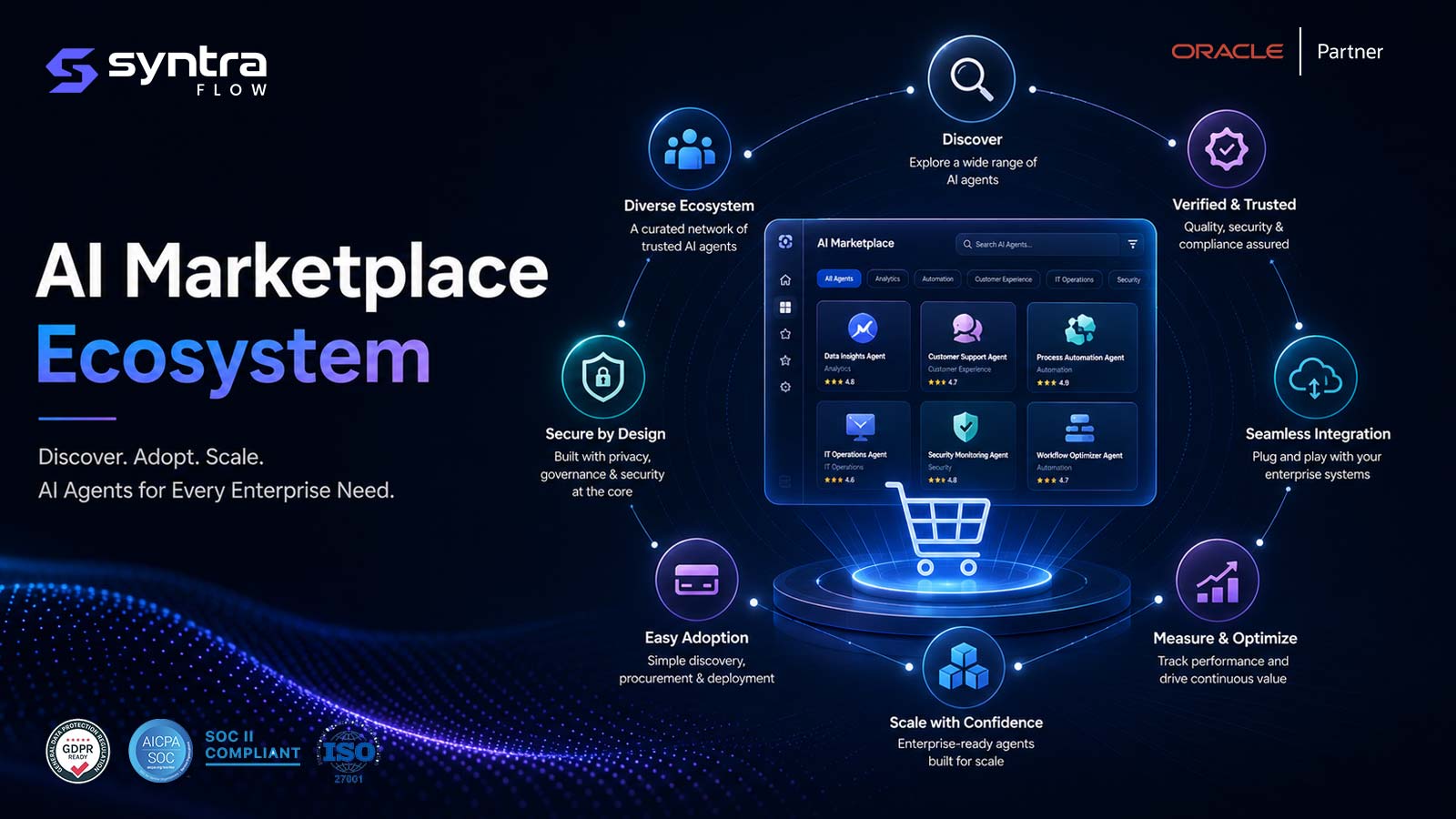
What an Oracle AI Marketplace Model Looks Like
The idea behind an Oracle AI marketplace is straightforward: instead of every customer designing the same Payables invoice-handling agent or the same candidate-screening agent independently, common agent patterns are packaged once and made available for reuse. A catalog exposes those packaged agents — their purpose, the business object and process they act on, the actions they can take, and the permissions they require — so a customer can evaluate an agent before enabling it.
Oracle already ships specific agents as part of Fusion — for example a Ledger Agent in ERP and an Applicant Screening AI Agent in HCM — and provides the AI Agent Studio together with the Agentic Applications Builder for authoring custom agents. A marketplace-style distribution layer is the natural next step on top of that foundation: a place to publish, discover, and enable both Oracle-delivered agents and agents built by others. Where a broader catalog of agents by module and business process is useful for planning, the Oracle AI agent directory is the companion reference.
Naming note. This page describes the marketplace as a concept — a distribution and catalog pattern. We deliberately do not name a specific Oracle marketplace product, quote pricing, or list partner names, because those specifics change and much of the catalog direction is not a confirmed Oracle commitment. Treat any packaging, pricing, or availability detail as something to confirm directly with Oracle for your edition and region.
Oracle-Built Agents vs Partner-Built Agents
A marketplace typically carries agents from two sources, and the distinction matters because it changes who owns the logic, how the agent is supported, and how much scrutiny it deserves before you enable it. Oracle-built agents are embedded in and maintained by the applications; partner-built and customer-built agents are third-party code that runs against your data and should be treated as a supply-chain surface, not a trusted default.
| Dimension | Oracle-built agents | Partner / third-party agents |
|---|---|---|
| Author & ownership | Oracle, delivered with Fusion | Partner or your own team, authored in Agent Studio |
| Maintenance & updates | Follows the Oracle quarterly cycle | Owned by the publisher; cadence varies |
| Support path | Oracle Support channels | The publisher, per their terms — confirm before relying on it |
| Data & privilege scope | Scoped to delivered roles and business objects | Must be reviewed; may request broad object or REST access |
| Transparency of logic | Documented behaviour, but still needs validation in your config | Varies; prompts and tool calls may be opaque |
| Pre-production scrutiny | Test against your data and quarterly changes | Full security review plus functional and workflow testing |
| Risk posture | Lower, but not zero — behaviour can drift on updates | Higher — treat as untrusted until reviewed and tested |
The specific agents named above (a Ledger Agent, an Applicant Screening AI Agent) are examples confirmed on Oracle quarterly-update material; other agent types should be referred to by capability and business process rather than an assumed product name.
Enabling a Marketplace Agent — the Governance Gate
Enabling a pre-built agent is not the same as installing an app from a consumer store. Because an agent can read business data and, in many cases, take actions, the enable step should be a controlled gate rather than a one-click toggle. A sound sequence looks like this:
Enablement sequence
- Evaluate in the catalog: read the agent's stated purpose, the business object and process it acts on, the actions it can take, and the roles or privileges it requests.
- Assign an owner: a named business and technical owner accountable for the agent's behaviour, not just whoever clicked enable.
- Review access: confirm the agent's roles, data scope, and any REST or interoperability exposure are least-privilege for the job.
- Enable in a non-production pod first: never enable a new agent directly in production.
- Test behaviour: run functional, workflow, human-approval, and response-validation checks against your own data and configuration.
- Approve and promote: a documented approval — with human-in-the-loop controls set — before the agent is enabled in production.
- Monitor after go-live: keep an audit trail of the agent's actions and watch for drift on each Oracle quarterly update.
The recurring theme is that enabling is a decision, not a default. Every step above is a place where a partner agent that requests too much access, behaves unexpectedly on your data, or lacks a human-approval gate should be stopped before it reaches live transactions.
Governance Considerations for a Catalog of Agents
A marketplace multiplies the number of agents in play, so governance has to scale with it. The questions that matter are less about any single agent and more about the operating model around the whole catalog: who is allowed to enable an agent, who owns it once it is live, how changes are approved, and how the agent's actions are recorded.
- •Ownership. Every enabled agent — Oracle-built or partner-built — has a named accountable owner.
- •Approval. Enabling and changing an agent goes through a defined approval, not an ad-hoc toggle.
- •Change management. When a marketplace agent is updated by its publisher, that update is treated as a change to be reviewed and re-tested.
- •Human-in-the-loop. Agents that act on financial or people data have explicit approval gates for consequential actions.
- •Auditability. The agent's decisions and actions are logged so they can be reviewed after the fact.
This page keeps governance at the catalog level; agent-specific approval, ownership, and change-control controls are covered in depth on Oracle AI agent governance. If you are assembling multi-step agentic processes rather than single agents, agentic applications adds the workflow dimension.
Testing a Marketplace Agent Before Production
A pre-built agent that works in a vendor demo has not been tested against your configuration, your data, your roles, or your quarterly patch level. Enabling it without testing transfers the publisher's assumptions straight into your live environment. Before an agent goes live, it should pass — at minimum — functional, workflow, human-approval, and response-validation checks, plus a regression pass after each Oracle update.
Because agents are driven by prompts and can call APIs and take actions, testing them is broader than clicking through a UI. Prompt behaviour, workflow branching, API exposure, and the correctness of the agent's responses all need coverage. The discipline and the test types involved are the subject of Oracle AI testing, which is the right place to design the actual test plan for any agent you enable from a catalog.
Quarterly change is the other half of the picture. A marketplace agent that behaved correctly last quarter can drift when Oracle updates the underlying pages, APIs, or models. Pairing catalog agents with Oracle AI release intelligence keeps the impact of each quarterly update visible, so you re-test the agents a change actually affects instead of guessing.
Security Review of Third-Party Agents
A partner agent enabled from a marketplace is, in security terms, third-party code running against your enterprise data — a supply-chain risk surface that deserves the same seriousness you would apply to any external integration. The convenience of a catalog does not lower the bar; if anything it raises it, because agents can hold privileges and take actions on their own.
Third-party agent security checklist
- Least privilege: the agent's roles and data scope are the minimum needed, not broad convenience access.
- Business-object scope: confirm which objects the agent can read and write, and that nothing sensitive is in reach by default.
- REST / MCP / A2A exposure: understand every interface the agent uses to reach data or other agents, and lock down anything unnecessary.
- Data leakage: check what the agent sends to external models or endpoints and whether that is acceptable for your data classification.
- Human-approval gates: consequential actions require a person to approve, not the agent acting unattended.
- Audit trail: the agent's actions are logged and attributable for later review.
This is a summary; the full agent-level access-control model — agent roles and privileges, business-object scoping, interface exposure, and agent audit — is treated in depth on Oracle AI agent security. Any partner agent should clear that review before it is enabled anywhere near production.
Licensing Considerations
Licensing for marketplace agents is an area to approach with care, because terms vary by agent source, by Oracle edition, and over time — and this page cannot substitute for Oracle's own commercial terms. What we can say is generic and directional, not a commitment on Oracle's behalf.
In general, Oracle-delivered agents tend to be tied to the applications and entitlements you already hold, while partner-built agents may carry their own commercial terms or usage metrics. Agents that call large language models can also incur usage-based costs, and Oracle has signalled flexibility in the models an agent can use. None of that should be assumed for your situation.
The practical guidance is simple: confirm licensing, usage metrics, and any model-consumption costs directly with Oracle and the agent's publisher before you commit, and factor them into the same governance gate that covers security and testing. A catalog listing is not evidence that an agent is included in your existing entitlements.
Marketplace Roadmap — Observed Direction
The following is an observed direction of travel, not a confirmed Oracle roadmap commitment. Verify specifics with Oracle before planning around any of it.
- →More delivered agents over time. Oracle has been expanding embedded agents across ERP and HCM in successive quarterly updates; a growing library of pre-built agents is a reasonable expectation.
- →Author-and-publish tooling. With AI Agent Studio and the Agentic Applications Builder already available for authoring, distribution of those agents is a natural adjacent capability.
- →Interoperability standards. REST access for agents and MCP / A2A interoperability point toward agents that can be composed and shared rather than locked to one context.
- →Model flexibility. Signalled flexibility in the underlying models an agent uses suggests a catalog would need to accommodate multiple model choices.
Whatever the exact shape, the governance, testing, security, and licensing gates described above become more important as the number of available agents grows, not less. A larger catalog is a larger attack and drift surface.
How SyntraFlow Helps
SyntraFlow helps organizations assess and govern the agents they enable from an Oracle catalog — it does not replace Oracle's marketplace or take ownership of your governance decisions. The role is to give you evidence before an agent goes live and after each Oracle update.
- •SyntraFlow can be configured to test a pre-built agent against your own data, roles, and configuration before it is promoted to production.
- •SyntraFlow helps organizations assess a third-party agent's behaviour, access scope, and human-approval gates as part of an enablement review.
- •SyntraFlow can connect release intelligence with test planning, so agents affected by an Oracle quarterly update are re-tested rather than assumed safe.
- •The SyntraFlow roadmap can support building a repeatable governance gate around catalog agents — evaluate, review, test, approve, monitor.
SyntraFlow's own testing engine is a separate capability from Oracle's AI agents; it is what SyntraFlow uses to exercise and validate the Oracle agents you enable. To scope a catalog-governance approach for your estate, book an assessment below.
Frequently Asked Questions
What is an Oracle AI agent marketplace?
▼
It is a distribution and catalog model for pre-built AI agents — a place to discover, evaluate, and enable agents inside your Oracle Fusion environment instead of building each one from scratch. A catalog typically carries both Oracle-delivered agents and agents authored by partners or your own teams. We describe it as a concept here rather than naming a specific product, because packaging and availability vary and should be confirmed with Oracle.
How are Oracle-built and partner-built agents different?
▼
Oracle-built agents are embedded in and maintained by Fusion, follow the quarterly cycle, and are supported through Oracle. Partner-built and customer-built agents are authored in AI Agent Studio, owned and supported by their publisher, and should be treated as third-party code — reviewed and tested before you rely on them. Both still need validation against your own configuration.
Can I enable a marketplace agent straight into production?
▼
You should not. Enabling an agent is a governance decision, not a one-click install. Evaluate it in the catalog, assign an owner, review its access, enable it in a non-production pod, test its behaviour, then approve and promote with human-approval gates set. Enabling directly in production skips every control that protects your live data.
How do I test a pre-built agent before it goes live?
▼
Run functional, workflow, human-approval, and response-validation checks against your own data, roles, and patch level, and add a regression pass after each Oracle update. Because agents are prompt-driven and can call APIs and take actions, coverage is broader than a UI click-through. The test types involved are set out on Oracle AI testing.
Are third-party agents a security risk?
▼
Treat them as one. A partner agent is third-party code running against your data, so it warrants a supply-chain-style review: least-privilege roles, business-object scope, REST/MCP/A2A exposure, data leakage to external models, human-approval gates, and an audit trail. The full agent-level model is on Oracle AI agent security. Clear that review before enabling anything near production.
How is a marketplace agent licensed?
▼
Licensing varies by agent source, Oracle edition, and over time, so confirm it directly with Oracle and the agent's publisher — a catalog listing is not evidence an agent is included in your entitlements. Generally, Oracle-delivered agents tend to align with the applications you hold, while partner agents may carry their own terms, and model-consuming agents can incur usage costs. This is directional, not a commitment on Oracle's behalf.
Is there a confirmed Oracle marketplace roadmap?
▼
The direction described on this page is observed, not a confirmed Oracle commitment. Expanding delivered agents, author-and-publish tooling via AI Agent Studio, and interoperability through REST and MCP/A2A all point toward a distribution model — but verify specifics, timing, and availability with Oracle before planning around them.
How does SyntraFlow help with catalog agents?
▼
SyntraFlow helps organizations assess and govern the agents they enable. SyntraFlow can be configured to test a pre-built agent against your own data and configuration before promotion, help assess its access scope and approval gates, and connect release intelligence with test planning so agents affected by a quarterly update get re-tested. It does not replace Oracle's marketplace or own your governance decisions.
Govern the Agents You Enable
Put a governance, security, and testing gate around the Oracle AI agents you adopt from a catalog — before they touch production, and after every quarterly update. Book an assessment to scope it for your Fusion estate.