Oracle AI for Fusion HCM
Oracle has been embedding AI into Fusion Cloud HCM across recruiting, talent, learning, workforce management, and employee help desk processes — AI-assisted candidate screening, skills-based recommendations, generative summarization, and anomaly detection are now part of how work gets done. That shift changes what "correct" means for HR: the question is no longer only whether a transaction processed, but whether an AI-influenced recommendation was reasonable, explainable, and free of bias.
This page maps where Oracle's own AI touches core Fusion HCM processes, the risks each use case introduces — including bias and fairness in hiring, promotion, and performance decisions — and how that differs from general HCM functional testing. For a broad introduction to Oracle's AI agents and features, see Oracle AI Agents and Oracle AI Features; this page focuses on HCM.
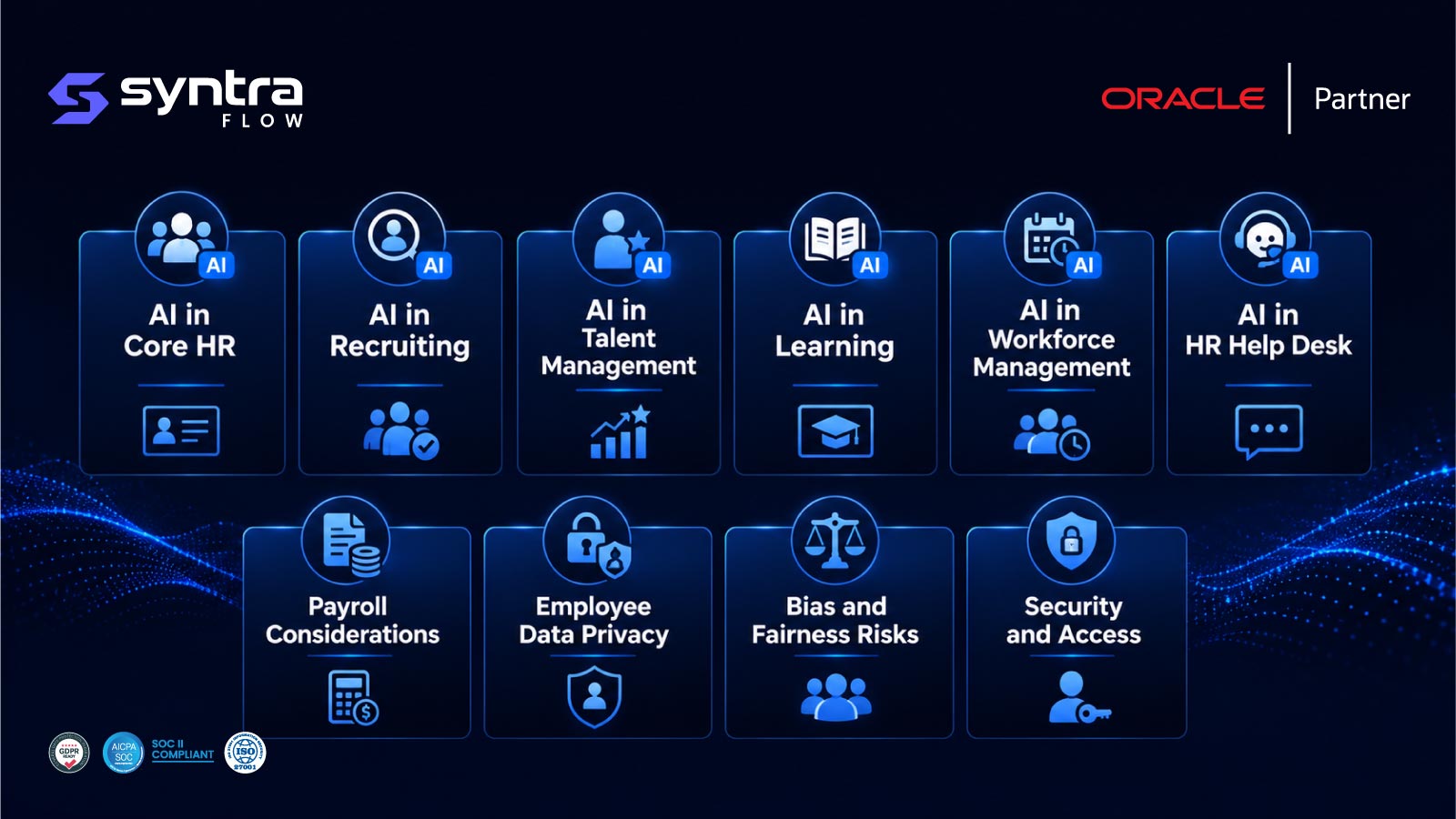
AI in Core HR
Core HR is the system of record most other HCM AI draws on. Oracle's embedded AI features here lean assistive: inferring or suggesting skills from a worker's job history and profile data, generating natural-language summaries of a worker record, and powering conversational self-service for common questions.
Because Core HR data feeds recruiting, talent, learning, and workforce AI downstream, incomplete worker data has an outsized effect — an AI-inferred skill or summary is only as reliable as the underlying record. This page treats Core HR as the data foundation for the AI use cases below, not a separate risk category.
AI in Recruiting
Recruiting is where Oracle HCM AI is most visible today: AI-assisted candidate screening against a requisition's requirements, skills-based candidate-to-job matching, generative drafting of job descriptions and outreach messages, and ranked or scored candidate shortlists intended to help recruiters prioritize review.
These are also the capabilities that carry the highest fairness stakes in the whole HCM AI surface — a screening or ranking model that under-recommends candidates from a demographic group has direct legal and reputational exposure. See Bias and Fairness Risks below rather than assuming a ranked shortlist is neutral because it's AI-generated.
AI in Talent Management
Talent management is where AI moves from screening people into work to making recommendations about people already inside the organization — a more sensitive use case. Categories include skills-based recommendations for succession planning and internal mobility, generative assistance drafting or summarizing performance feedback, and suggested performance ratings based on goals, feedback, and historical data.
Suggested ratings and succession recommendations sit at the center of the bias discussion below, because they influence pay, promotion, and career trajectory directly. Talent AI outputs should be treated as a starting point for a manager's judgment, not a determination — and that distinction needs to hold up in practice, not just in policy.
AI in Learning
Learning is a lower-stakes but still meaningful area of Oracle HCM AI: personalized learning-path recommendations built from a worker's inferred skills gaps and role, AI-assisted search and discovery across a learning catalog, and generative summarization of course descriptions.
Because learning recommendations feed the same skills data used by talent and recruiting AI, a systematic gap in what one group is recommended to learn can compound into a skills-inventory gap that later disadvantages that group in mobility or succession recommendations — a second-order fairness risk worth tracking, not dismissing as low-stakes.
AI in Workforce Management
Workforce management AI focuses on pattern detection and forecasting rather than individual judgment calls: anomaly detection across time and absence entries (unusual clock patterns, excessive overtime, absence clustering), labor demand forecasting, and suggested schedule optimizations based on historical demand and coverage.
These are decision-support signals for a scheduler or manager, not automatic actions — a flagged absence pattern or overtime anomaly should route to a human for review, not trigger an automatic disciplinary or pay action. Testing should confirm that boundary holds, not assume it.
AI in HR Help Desk
Employee-facing conversational AI is one of the fastest-moving parts of Oracle HCM AI: generative chat agents that answer policy questions, triage and route HR service requests, and draft case responses for an HR team to review before sending. General agent architecture is covered on Oracle AI Agents; this section focuses on HR help desk specifics.
The core risk is currency and accuracy: a generative answer about leave policy, benefits eligibility, or pay is only useful if it reflects the current, tenant-specific configuration. A wrong policy answer from an AI agent carries the same downstream risk as a wrong answer from an HR representative, and should be validated with the same seriousness after every configuration or release change.
Payroll Considerations
Payroll is the area where AI framing needs the most precision. Oracle HCM AI capability here is best understood as decision support and anomaly detection layered on top of payroll processing — flagging unusual gross-to-net variances or outlier pay changes for a payroll analyst to investigate.
Important distinction. AI-assisted anomaly detection does not change how payroll is calculated, and does not change who is accountable for payroll accuracy. Payroll calculation remains governed by configured elements, formulas, balances, and statutory rules — deterministic, rule-based processing, not a generative or probabilistic output. An AI flag is an input to human review, not a substitute for it.
Payroll accuracy testing therefore remains a functional testing discipline in its own right — validating elements, formulas, balances, and statutory calculations — not replaced by AI anomaly detection. The functional payroll and HCM test-scenario library lives on Oracle HCM Testing Tool; this page's payroll focus is narrower — confirming anomaly-detection signals are reliable decision support, not the underlying payroll math.
Employee Data Privacy
HCM AI features tend to draw on a wider slice of employee data than the transaction they support strictly requires — a skills inference might reference performance history, a succession recommendation might draw on compensation and tenure, a help-desk agent might need benefits and leave visibility. That breadth makes the features useful, and raises the privacy stakes.
Specific risks to govern: data minimization (does the AI feature need the data it's configured to access), purpose limitation (is AI-inferred data — a predicted skills gap, a flagged anomaly — used only for its intended purpose), retention of inferences that weren't previously stored anywhere, and cross-border handling where AI processing may route data differently than the underlying transaction.
These risks compound with the security risks below — a privacy gap is very often an access-scoping gap — so the two should be assessed together.
Bias and Fairness Risks
Bias and fairness are the most consequential risk category specific to HCM AI, and deserve direct treatment rather than a passing mention. Unlike a payroll calculation error, a biased AI-influenced people decision can be legal, reputational, and hard to detect after the fact — the harm shows up as a pattern across many decisions, not one obviously wrong transaction.
Hiring and promotion recommendations. AI-assisted candidate screening, ranking, and succession or promotion recommendations are typically influenced, directly or indirectly, by historical hiring and advancement data. If that history reflects past bias — under-representation of a group in a role, uneven advancement rates — a model tuned against it can reproduce or amplify the same pattern, even without a protected characteristic as an explicit input. This is a disparate-impact risk: the outcome pattern matters, not just the stated inputs.
Performance rating suggestions. Generative or analytics-assisted suggested ratings and feedback summaries introduce a subtler risk: anchoring. A manager shown a suggested rating tends to adjust toward it rather than starting from a blank assessment, even when instructed to treat it only as a starting point. If underlying feedback quality differs across groups — some employees historically receiving sparser or vaguer written feedback — a suggestion generated from that data can inherit and reinforce the disparity through the manager's anchored judgment.
Mitigating these risks combines governance and testing. On governance: keep a human decision-maker genuinely in the loop with a real ability to override; document why a recommendation was accepted or overridden; review outcomes for disparate impact on a recurring cadence, not only at rollout. On testing: run controlled comparisons — sets varying only in protected-characteristic-correlated attributes — against screening, ranking, and rating-suggestion outputs, and treat a skewed pattern as a defect, not an edge case.
Bias testing differs from the deep HCM process-testing scenarios already covered on Oracle HCM Testing Tool — that library validates transactions and configuration; bias testing validates that AI-influenced recommendations don't produce systematically unfair outcomes across groups, a distinct discipline covered on Oracle AI Testing.
Security and Access
AI features and agents operating inside HCM need their own access footprint, deserving the same scrutiny as a human role. A recruiting AI feature reading candidate data, a talent AI feature reading compensation data, or a help-desk agent reading benefits records is, in effect, a new identity with a data access scope that needs to be defined, reviewed, and tested — not assumed safely limited by default.
Key questions: does the AI feature's actual data access match its configured scope; is every AI-driven read and write logged distinctly enough for an audit; does a role or security change correctly propagate to what an AI agent can see and do; and does segregation-of-duties analysis account for AI agents as actors, not just human users.
Security and access testing for HCM AI overlaps closely with existing HCM security testing discipline. See Oracle HCM Security Testing for role and data-security testing depth, and general Oracle AI security and governance context on Oracle AI Agents.
HCM AI Capability and Risk by Area
Where AI touches each HCM area and the primary risk to validate. Risk type is called out explicitly because bias/fairness risk needs a different testing approach than accuracy or privacy risk.
| HCM area | Example AI capability | Key risk to validate | Risk type |
|---|---|---|---|
| Core HR | Skills inference, record summaries | Downstream AI inherits incomplete or stale data | Accuracy |
| Recruiting | AI-assisted candidate screening and ranking | Disparate outcomes across demographic groups | Bias / fairness |
| Talent management | Succession recommendations, suggested ratings | Skewed promotion/rating patterns; manager anchoring | Bias / fairness |
| Learning | Personalized learning-path recommendations | Uneven development recommendations across groups | Bias / fairness |
| Workforce management | Anomaly detection, demand forecasting | False positives triggering action without human review | Process / accuracy |
| HR help desk | Generative policy Q&A, case triage | Stale or incorrect answers after config/release change | Accuracy |
| Payroll | Anomaly detection in payroll data | Flag treated as calculation, not a review signal | Process / accountability |
| Cross-cutting | AI agents reading HCM data across modules | AI data access exceeds configured scope | Security / privacy |
Recommended Testing Scenarios for HCM AI
General AI testing methodology is covered on Oracle AI Testing. The scenarios below show how it applies inside HCM.
Disparate-impact testing on candidate ranking
Run controlled candidate sets varying only in protected-characteristic-correlated attributes through screening and ranking, comparing outcome distributions, not individual results.
Suggested-rating override integrity
Confirm a manager's override of an AI-suggested rating or feedback draft is preserved through calibration, not silently reverted.
Payroll anomaly-detection signal quality
Validate anomaly flags against known payroll scenarios for false-positive/negative rates, confirming flags route to human review.
Help-desk agent answer currency
Re-validate AI help-desk responses against current policy and configuration after every release or config change.
AI data-access scope regression
After a role or configuration change, confirm each AI feature's actual data access still matches its intended scope.
Learning-recommendation access boundaries
Confirm AI-driven learning recommendations don't expose an employee to data outside their own access scope.
Where SyntraFlow fits. SyntraFlow's core product is Oracle Fusion test automation, not an AI model evaluation platform. SyntraFlow can be configured to test the functional HCM processes AI features sit on top of — access, data flow, downstream transactions — and can connect release intelligence with test planning so a quarterly update touching HCM AI gets flagged for review. Tenant-specific scope is confirmed at assessment, not assumed here.
Staying Current as Oracle HCM AI Evolves
Oracle's quarterly updates continue to extend AI capability inside Fusion HCM, and changed AI behavior in one release can shift the risk picture on this page — a newly AI-enabled screening step, expanded data scope, or a changed suggestion model for ratings. Tracking what actually changed, per release, keeps the scenarios above current.
See Oracle 26A HCM quarterly update coverage for a released example, and Oracle AI Release Intelligence for how AI-specific release changes are tracked across the vertical.
Frequently Asked Questions
What AI capabilities does Oracle offer within Fusion HCM?
▼
Known categories span recruiting (AI-assisted screening and matching), talent management (skills-based recommendations, suggested ratings), learning (personalized recommendations), workforce management (anomaly detection, demand forecasting), HR help desk (generative Q&A, case triage), and payroll (anomaly detection). Coverage varies by module and expands each quarterly update.
Does AI change how payroll is calculated in Oracle HCM?
▼
No. Payroll calculation remains governed by configured elements, formulas, balances, and statutory rules — deterministic processing, not a generative output. Oracle's AI capability in payroll is anomaly detection that flags unusual patterns for a payroll analyst to review, not something that changes calculation logic or accountability.
Can Oracle HCM AI recommendations be biased?
▼
Yes — a genuine risk to plan for. AI-assisted candidate screening, ranking, succession recommendations, and suggested ratings can reflect or amplify historical hiring and advancement patterns even without a protected characteristic as an explicit input. Disparate-impact testing and human review are the primary mitigations.
Who is accountable for a biased AI-influenced hiring or promotion decision?
▼
The organization making the decision remains accountable, not the AI feature — why genuine human-in-the-loop review, documented override rights, and recurring disparate-impact monitoring matter. An AI recommendation is an input, not the decision itself.
What employee data privacy risks come with Oracle HCM AI?
▼
AI features often draw on a wider slice of employee data than the transaction they support, and can generate new inferences that weren't previously stored anywhere. Key risks are data minimization, purpose limitation, inference retention, and cross-border handling.
How should I test Oracle HCM AI outputs?
▼
Combine disparate-impact testing on screening and ranking outputs, signal-quality testing on anomaly detection, answer-currency testing on help-desk agents, and access-scope regression testing whenever roles or configuration change. General methodology is on Oracle AI Testing.
Does SyntraFlow test Oracle's HCM AI features?
▼
SyntraFlow can be configured to test the functional HCM processes AI features sit on top of, and can connect release intelligence with test planning so AI-relevant changes get flagged. Tenant-specific AI output testing scope is confirmed at assessment, not assumed here.
How often should HCM AI capabilities be retested?
▼
At minimum after every quarterly update touching an AI-enabled HCM process, and after any change to configuration, role, or data scope an AI feature depends on. Bias monitoring should also run on a recurring cadence, since drift can emerge gradually rather than at a single change event.
Assess Your Oracle HCM AI Risk Surface
Understand where AI touches your Fusion HCM processes, where bias, privacy, and access risks concentrate, and how release-aware testing helps you stay ahead of Oracle's quarterly AI changes.