Oracle Absence Management Testing
Absence Management is where Oracle decides how much vacation and sick time a worker has, how it accrued, whether it carries into next year, and whether a request against a holiday-calendar date is even valid. Get the plan design or the balance math wrong and workers see the wrong entitlement, managers approve requests that shouldn't clear, and payroll inherits a number nobody trusts.
This page is a practical guide to testing absence plan design and balance mechanics in Oracle Fusion Cloud HCM — accrual rules, carry-forward caps, balance calculation, holiday calendars, and the approval workflow that governs absence requests. It sits under the Oracle HCM Testing Tool hub alongside the other modules in the Hire-to-Retire lifecycle.
What Is Oracle Absence Management Testing?
Oracle Fusion Cloud HCM models leave through absence types — Vacation, Sick, and any other category an enterprise defines — each optionally attached to an absence plan. Accrual plans build a balance over time using configured accrual rules and bands, often stepped by length of service or full-time-equivalent. Qualification plans grant entitlement outright, with no periodic accrual. A worker is enrolled into a plan through an eligibility profile, and from that point every accrual run, absence request, and plan-year rollover changes the number the worker sees on their balance.
Testing this module means testing the arithmetic and the rules behind it: does the accrual rate step up correctly at the right tenure band, does a balance prorate correctly for a mid-year hire or a part-time assignment, does the carry-forward rule cap or expire unused days at plan-year rollover, does a requested date range correctly exclude a holiday-calendar date, and does the approval workflow route the request to the right manager or delegate before the balance is touched. Each of these is a distinct point of failure, and each behaves differently depending on plan configuration.
This process forms part of the complete Oracle Hire-to-Retire (H2R) lifecycle, sitting between core worker data and the downstream modules that consume an approved absence.
Scope note. This page covers absence plan design and balance mechanics — accrual, carry-forward, holiday calendars, balance calculation, and approval. Time-card capture and shift or overtime mechanics are covered on Oracle Time and Labor Testing. How an unpaid absence is deducted in a pay run is covered on Oracle Payroll Testing. Here we focus only on how absence balances are built, held, and consumed.
Why Testing Absence Management Matters
An absence balance is effectively a liability, an entitlement promise, and an input into a manager's approval decision, all at once. When accrual, carry-forward, or holiday-calendar logic is wrong, the error rarely announces itself — a worker's balance is simply a little off, an approval clears a request it shouldn't have, or a carried-over balance quietly exceeds its cap. None of that trips an obvious error message; it surfaces months later as a dispute, an audit finding, or a payroll correction.
The stakeholders who depend on this working correctly are broad: workers who plan time off around a balance they trust, managers who approve requests believing the balance shown is current, HR and compliance teams accountable for statutory leave entitlement, and finance teams who report accrued leave liability. Absence Management testing protects all four by verifying the plan rules produce the balance and approval outcome they were configured to produce — not an approximation of it.
Entitlement accuracy
Workers and managers act on the balance shown — it has to be the correct one.
Liability reporting
Accrued leave is a recognised liability; miscalculated balances misstate it.
Compliance exposure
Statutory carry-forward and entitlement rules vary by jurisdiction and must hold precisely.
The Oracle Absence Management Process Flow
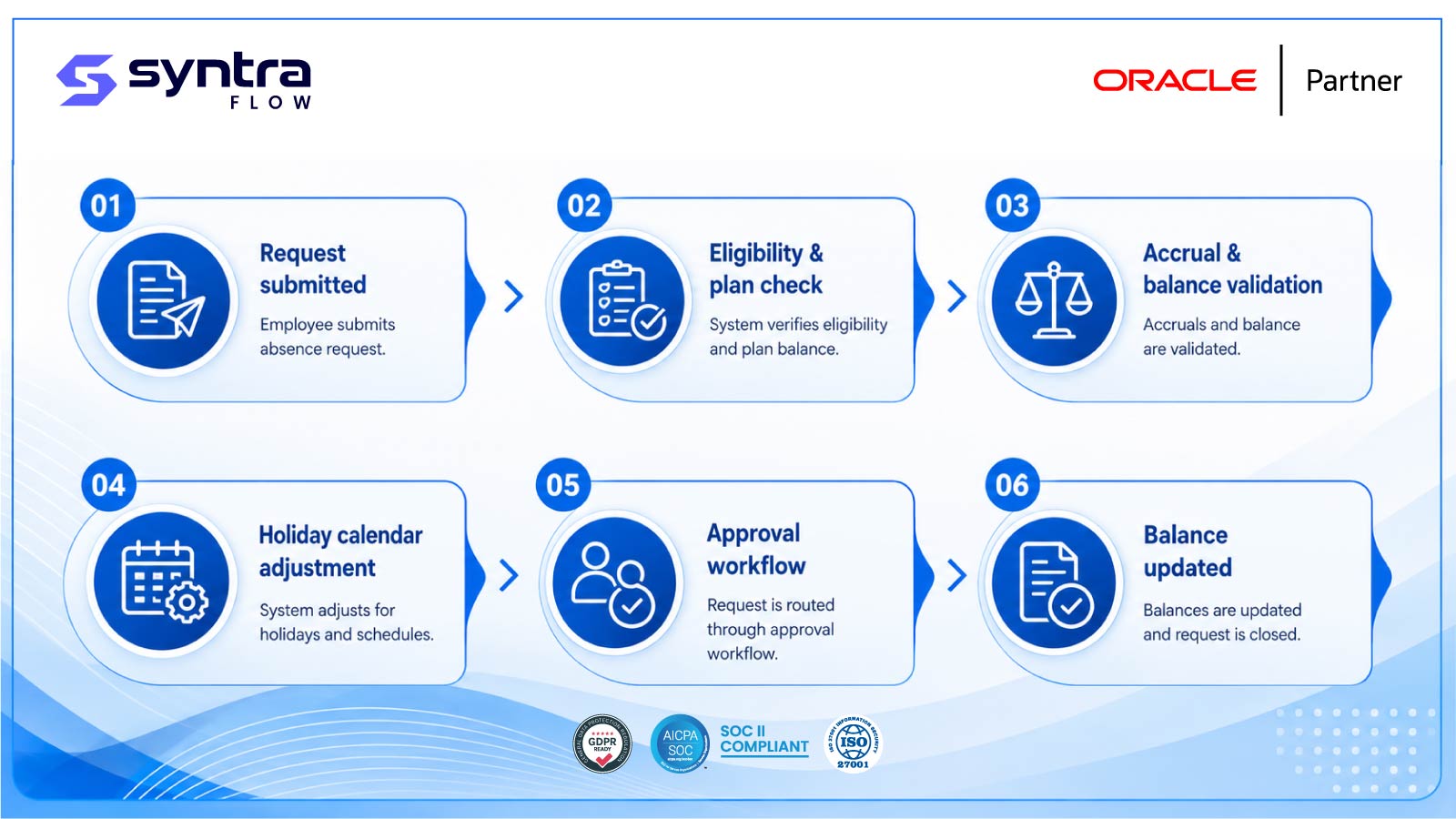
An absence request touches plan eligibility, balance and accrual logic, the holiday calendar, and an approval workflow before the balance is finally updated — and in most enterprises, before anything downstream is notified.
Absence request sequence
- Trigger: a worker or manager submits an absence request in self-service, or a request is created through an integration.
- Key checks: plan enrollment and eligibility, sufficient balance (or negative-balance rule), the requested duration net of holiday-calendar exclusions.
- Decision point: the request routes to the worker's manager or a configured delegate; escalation applies if the approval SLA is breached.
- Expected output: an approved, rejected, or cancelled absence record, with the plan balance recalculated to match.
- Downstream impact: approved absence feeds time capture on Time and Labor and, where unpaid, the pay run tested on Payroll.
Suggested visual: a swimlane diagram of the request-to-balance-update sequence with the approval and holiday-exclusion branches, for the web team to produce.
Common Absence Management Testing Challenges
Absence balances are the product of several independent rules working together — accrual rate, tenure band, ceiling, carry-forward cap, holiday calendar, and proration. A defect in any one is invisible until the specific combination of conditions that exposes it occurs.
| Risk | Impact | Mitigation via testing |
|---|---|---|
| Accrual rate or band miscalculated | Under- or over-entitlement; payroll and audit exposure | Test every accrual band and its boundary |
| Carry-forward cap not enforced | Balance exceeds cap into the new plan year | Boundary test at, below and above the cap |
| Holiday not excluded from duration | Worker overcharged for the absence taken | Test requests spanning holiday-calendar dates |
| Approval routed incorrectly | Requests stall, or clear without proper authority | Test standard, delegate and escalation paths |
| Balance shown to worker is stale | Worker requests against an incorrect balance | Compare self-service balance to plan calculation |
| Negative balance not prevented | Absence granted beyond entitlement | Negative test at and beyond a zero balance |
| Proration rule wrong | Under- or over-accrual for new hires or part-time staff | Test proration at varied start dates and FTE |
| Retroactive edit not recalculated | Balance stays stale after a correction | Test retroactive edits and confirm recalculation |
| Redwood UI breaks the request flow | Workers or managers cannot submit or approve | Redwood-aware execution of the full request flow |
| Quarterly update shifts accrual behaviour | Undetected drift in entitlement or workflow | Release-scoped regression on absence scenarios |
What SyntraFlow Automates in Absence Management Testing
SyntraFlow drives absence requests, accrual runs, and approvals across self-service, batch, and API, then asserts the exact balance value — not just that a page loaded.
Pre-built absence cases
A starter pack of accrual, carry-forward, and approval scenarios you extend to your plan configuration.
Plan-aware test generation
Generates accrual band, ceiling, and carry-forward boundary variants directly from your plan setup.
Self-healing execution
Playwright-based runs that re-anchor when Oracle changes the absence or Redwood pages.
Dynamic test data
Provisions workers at the tenure, FTE, and enrollment state each scenario needs to trigger.
Balance-level assertions
Verifies the exact balance figure against the expected calculation, not just that a request went through.
UI + batch + API
Runs absence scenarios through self-service, scheduled processes, and REST, and confirms they agree.
Evidence capture
Timestamped screenshots and balance logs retained as audit-grade evidence for every run.
Release-impact selection
Runs the absence subset a given release actually affects.
Configuration-aware testing
Ties each test to the accrual rule or plan setting that drives it, so a config change re-points the right tests.
| Benefit | Manual approach | With SyntraFlow |
|---|---|---|
| Accrual band coverage | Spot-checked for a few tenure bands | Every band and boundary tested each cycle |
| Carry-forward validation | Recalculated by hand in spreadsheets | Executed automatically against configured caps |
| Holiday calendar coverage | Tested for one legal entity, if at all | Run across every relevant calendar and entity |
| Balance evidence for audit | Ad hoc screenshots, inconsistent | Timestamped evidence captured on every run |
| Approval path coverage | Standard path only; delegation rarely tested | Standard, delegate and escalation paths all covered |
| Regression after Oracle updates | Re-tested manually, often skipped under pressure | Release-scoped automated regression pack |
[SyntraFlow — Absence balance test run view, illustrative]
AI Testing Features for Absence Management
AI-assisted testing targets the scenarios most likely to hide a defect — accrual boundaries, carry-forward caps, and holiday-calendar edge cases — instead of re-running the same happy path every cycle.
240+
Absence scenarios executed
96%
Pass rate on regression pack
18
Defects found pre-production
~70%
Regression time saved
Illustrative figures for a representative quarterly cycle, not a specific customer result.
AI impact analysis — quarterly regression effort
Illustrative comparison for a representative absence regression pack across one Oracle quarterly update cycle.
| Dimension | Manual testing | AI-driven testing |
|---|---|---|
| Accrual scenario generation | Limited to a handful of hand-built cases | Boundary and band variants generated from plan config |
| Test data setup | Built by hand per scenario | Provisioned to match plan, tenure and FTE needed |
| Balance assertion | Visual check against a calculator | Exact balance value asserted against expected result |
| Carry-forward cap coverage | Often skipped due to effort | Systematically tested at, below and above the cap |
| Maintenance after page changes | Scripts break and need rewriting | Self-healing execution re-anchors to Redwood pages |
| Release-impact targeting | Full manual re-test, or none | Only affected scenarios re-run per release analysis |
A note on capability. Pre-built absence cases, self-healing execution, and evidence capture are current platform capabilities. Coverage scoped to your specific plans, accrual bands, and holiday calendars is configurable during onboarding, using the SyntraFlow AI testing features. Any tenant-specific extension is confirmed at assessment rather than assumed here.
Oracle Absence Management Test Scenarios
A representative set of 28 Oracle Fusion absence management scenarios — accrual, carry-forward, balance calculation, holiday calendars, and approval workflow. Test IDs use the HC-ABS prefix.
| ID | Scenario | Preconditions | Expected result | Pri | Auto |
|---|---|---|---|---|---|
| HC-ABS-001 | Vacation absence type & plan configuration | Type "Vacation" defined, accrual plan attached | Type displays correctly; plan linked | H | Y |
| HC-ABS-002 | Sick leave absence type configuration | Type "Sick" defined with entitlement rule | Type available; correct entitlement applied | H | Y |
| HC-ABS-003 | Worker auto-enrollment into accrual plan | New hire matches eligibility profile | Worker enrolled automatically | H | Y |
| HC-ABS-004 | Standard periodic accrual calculation | Worker at standard tenure band | Accrual posts at configured rate each period | H | Y |
| HC-ABS-005 | Tenure-based accrual band step-up | Worker crosses a service-length threshold | Accrual rate steps up from the anniversary date | H | Y |
| HC-ABS-006 | Prorated accrual for mid-period new hire | Worker hired mid accrual period | Accrual prorated for the partial period worked | H | Y |
| HC-ABS-007 | Prorated accrual for part-time FTE | Worker assignment FTE below 1.0 | Accrual prorated by assignment FTE | M | Y |
| HC-ABS-008 | Accrual ceiling / maximum balance enforcement | Balance approaches the configured ceiling | Further accrual suppressed at the ceiling | H | Y |
| HC-ABS-009 | Carry-forward within cap at rollover | Balance below carryover cap at plan-year end | Full remaining balance carried forward | H | Y |
| HC-ABS-010 | Carry-forward capped at configured maximum | Balance exceeds carryover cap at plan-year end | Excess balance forfeited or paid out per rule | H | Y |
| HC-ABS-011 | Carried-forward balance expiration | Carried-over days unused past expiration date | Expired days removed from available balance | M | Y |
| HC-ABS-012 | Opening balance calculation for new plan year | Plan year rolls over | Opening balance equals prior close plus carryover | H | Y |
| HC-ABS-013 | Balance deduction after approved absence | Absence request approved | Available balance reduced by absence duration | H | Y |
| HC-ABS-014 | Projected balance with future-dated request | Pending future absence request exists | Projected balance reflects committed, untaken days | M | Y |
| HC-ABS-015 | Negative balance prevention | Request exceeds available balance; overdraft disallowed | Request blocked or flagged for review | H | Y |
| HC-ABS-016 | Negative balance permitted within limit | Plan configured to allow bounded overdraft | Request approved; balance negative within limit | M | Y |
| HC-ABS-017 | Vacation request spanning a public holiday | Requested range includes a holiday-calendar date | Holiday day excluded from absence duration | H | Y |
| HC-ABS-018 | Absence duration across differing holiday calendars | Worker transferred between legal entities | Duration recalculated using the new legal employer's calendar | M | Y |
| HC-ABS-019 | Half-day / partial-day absence duration | Request submitted with a partial-day duration unit | Balance deducted by the correct partial-day amount | M | Y |
| HC-ABS-020 | Standard manager approval of absence request | Request submitted to line manager | Request routed, approved, balance updated | H | Y |
| HC-ABS-021 | Approval delegation while manager unavailable | Manager delegate configured | Request routed to delegate; approval processed | M | Y |
| HC-ABS-022 | Multi-level approval escalation on SLA breach | Approval not actioned within configured SLA | Request escalates per workflow rule | M | P |
| HC-ABS-023 | Absence request rejection | Manager rejects the request | Balance unaffected; worker notified | H | Y |
| HC-ABS-024 | Absence cancellation after approval | Approved future-dated absence cancelled | Balance restored; status updated | H | Y |
| HC-ABS-025 | Retroactive absence date correction | Approved absence date range corrected after the fact | Balance recalculated to reflect the adjustment | M | Y |
| HC-ABS-026 | Sick leave certification requirement enforcement | Sick absence exceeds the configured certification threshold | Request flagged pending certification evidence | M | P |
| HC-ABS-027 | Batch accrual and balance recalculation at volume | Scheduled process runs for the full worker population | All balances updated accurately at volume | H | Y |
| HC-ABS-028 | Absence create/read parity — UI vs REST API | Absence created through an integration | API result matches self-service UI balance and status | M | Y |
Pri = priority (H/M/L). Auto = automation candidate (Y suitable · P partly, needs role/data setup). Steps summarised; full step detail ships in the downloadable test pack.
Regression Testing for Absence Management
Absence plans rarely stay static — accrual bands are re-tiered, carryover caps change with policy updates, new holiday calendars are added for expanding entities, and approval hierarchies shift as the organization is restructured. Each of these is a regression trigger, because the same worker and the same request can produce a different balance outcome after the change.
A dedicated absence regression pack — re-run through the Oracle Regression Testing Tool — re-executes the accrual, carry-forward, and approval scenarios that depend on the changed configuration, rather than re-testing everything or nothing. That keeps balance-affecting changes visible before they reach a live pay period.
Absence Management & Oracle Quarterly Releases
Oracle's quarterly updates can touch absence accrual formulas, plan enrollment logic, the approval workflow, or the Redwood absence pages — sometimes through an explicit feature opt-in, sometimes as a byproduct of an unrelated change. Because a balance error is a silent one, absence is a module where undetected release drift is especially costly.
Rather than re-testing every plan and scenario on every update, Oracle Release Intelligence analyses the quarterly release notes for changes touching absence and accrual, maps them to your specific plans and calendars, and recommends the targeted scenarios to re-run — so testing effort tracks actual risk rather than a fixed calendar date.
Redwood UI Considerations for Absence Requests
Oracle has redesigned the absence request, approval, and balance-display pages onto the Redwood visual framework. The underlying accrual and approval logic doesn't necessarily change with the redesign, but selector- and layout-based test automation breaks the moment page structure shifts — which is exactly when balance-sensitive testing matters most.
SyntraFlow's execution understands Redwood pages semantically, covered in depth on Oracle Redwood UI Testing, so absence request and approval assertions keep running through a UI redesign rather than failing on the first changed field.
Absence Management Testing Best Practices
Assert the exact balance value, not just that a request was submitted.
Test every accrual band and tenure threshold, including the day it steps up.
Test carry-forward at, below, and above the cap — boundaries hide defects.
Cover holiday-calendar exclusion for every legal entity in scope, not just one.
Test standard, delegate, and escalation approval paths separately.
Include proration cases for new hires, part-time FTE, and mid-year transfers.
Validate through self-service, batch accrual runs, and REST consistently.
Re-run the absence regression pack after every plan or calendar change.
Capture balance evidence automatically for audit and liability sign-off.
Coordinate with Time and Labor and Payroll testing rather than duplicating it.
SyntraFlow Advantages
Plan-aware coverage
Test generation tied to your actual accrual bands and caps.
Redwood resilience
Self-healing execution survives absence page redesigns.
Release-scoped regression
Re-tests only what a quarterly update actually touches.
Audit-ready evidence
Balance and approval evidence captured on every run.
Related Oracle HCM Testing Pages
Oracle HCM Testing Tool ⭐
The Hire-to-Retire testing hub.
Time and Labor Testing →
Time-card capture, shift and overtime mechanics.
Payroll Testing →
Pay run processing, including unpaid-absence deduction.
Benefits Testing →
Enrollment, eligibility and life-event processing.
Oracle HCM Test Cases →
Broader HCM scenario catalog.
Oracle HCM UAT Checklist →
Sign-off checklist for HCM releases.
Oracle Documentation References
- Oracle Fusion Cloud HCM: Implementing Absence Management
- Oracle Fusion Cloud HCM: Implementing Global Human Resources
- Oracle Fusion Cloud HCM: Using Absence Management
- Oracle Fusion Cloud HCM: Absence Management REST API documentation library
Frequently Asked Questions
What does Oracle Absence Management testing cover?
▼
It covers absence plan design and balance mechanics — accrual rules and bands, carry-forward caps, opening and available balance calculation, holiday-calendar exclusions, and the approval workflow that governs vacation and sick leave requests. It does not cover time-card capture or unpaid-absence payroll deduction, which have their own testing pages.
How is absence management testing different from time and labor testing?
▼
Absence management testing focuses on leave-type plan design and balance mechanics — accrual, carry-forward, and approval. Time-card capture, shift patterns, and overtime calculation are a separate concern, covered on Oracle Time and Labor Testing. The two modules interact but are tested against different rules.
Does absence testing cover how unpaid leave is deducted in payroll?
▼
No. Absence testing confirms the balance and approval outcome are correct. How an approved unpaid absence is converted into a pay-run deduction is tested on Oracle Payroll Testing, which owns the element and pay-run mechanics.
How are accrual rates and bands tested?
▼
Each accrual band is tested with a worker positioned at, just below, and just above its tenure or service threshold, confirming the rate applied and the date it changes. Proration is tested separately for mid-period new hires and part-time assignments, since both alter the accrual amount without changing the rate itself.
What should carry-forward testing include?
▼
Test a balance below the carryover cap (fully carried forward), a balance above the cap (excess forfeited or paid out per policy), and, where configured, the expiration of carried-over days after their grace period. These boundary cases are where carry-forward defects concentrate.
How does holiday calendar testing work for absence requests?
▼
A request spanning a holiday-calendar date should have that date excluded from the deducted duration. This is tested per legal entity, since different entities can use different holiday calendars, and should also be tested when a worker transfers between entities with different calendars mid-year.
How do you test absence approval workflows?
▼
Test the standard manager path, the delegate path when a manager is unavailable, and escalation when a request is not actioned within its SLA. Rejection and cancellation are tested separately to confirm the balance is left untouched or correctly restored in each case.
How often should absence management be regression tested?
▼
On every Oracle quarterly update, and after any change to accrual bands, carry-forward caps, holiday calendars, or approval hierarchy. Because balance errors are silent, testing after these events is what catches drift before it reaches a live pay period.
Does Redwood change absence management testing?
▼
Redwood redesigns the absence request, approval, and balance-display pages, which breaks selector-based automation even when the underlying accrual logic is unchanged. SyntraFlow understands Redwood pages semantically and self-heals, keeping balance assertions running through UI redesigns.
How does SyntraFlow generate absence test data?
▼
Test workers are provisioned at the tenure, FTE, and enrollment state each scenario needs — for example, a worker one day short of an accrual band step-up, or one day into a new plan year — so tests reliably produce the specific balance condition being verified.
Strengthen Your Oracle Absence Management Test Coverage
Identify gaps in your accrual, carry-forward and approval test coverage, and prepare for Oracle quarterly updates with SyntraFlow. See it run against absence scenarios like yours.