Oracle Assignment Testing
A worker's assignment is the record that ties employment to a specific grade, department, manager, job, salary and location at a point in time. Every grade change, transfer, promotion, and off-cycle salary update touches this record — and each one is effective-dated, often approval-routed, and expected to flow correctly into payroll, compensation and reporting.
This page is a practical guide to testing ongoing assignment-attribute changes for a worker who is already hired and active — grade, department, manager, job, and single-field salary updates, plus the transfer and promotion transactions built from them. It sits under the Oracle HCM Testing Tool hub.
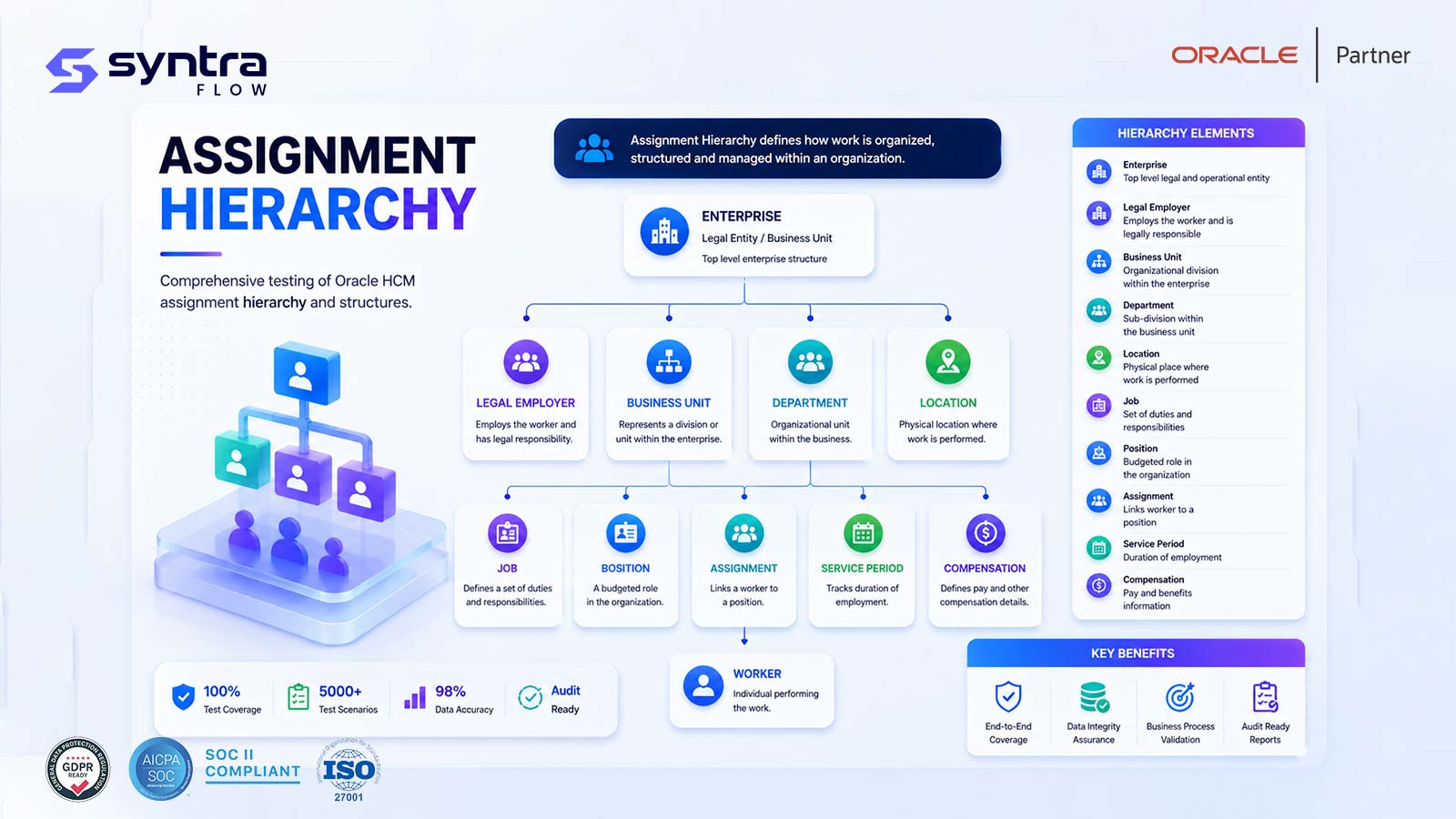
What Is Assignment Testing in Oracle HCM?
In Oracle Fusion Cloud HCM, the assignment is the effective-dated record that connects a worker to a job, position, grade, department, manager, location, and assignment-level salary. Assignment testing verifies the transactions that change these attributes over the course of employment — Change Job, Change Manager, Transfer, Promote, and direct salary or grade updates initiated by HR or through manager and employee self-service.
Each of these transactions is date-tracked: Oracle creates a new dated row on the assignment rather than overwriting history, so the same worker carries a chain of grade, department, manager, job and salary changes over their employment. Testing has to confirm not just that a change saves, but that it saves with the right effective date, respects approval routing where configured, and produces the correct downstream effect on org charts and payroll.
The teams that depend on this working correctly are HR business partners processing transfers and promotions, payroll teams relying on assignment data for the next pay run, and compensation teams who need an accurate salary history. A defect here rarely stays contained — a wrong effective date or a manager change that doesn't cascade correctly can misstate pay or corrupt the org hierarchy reporting relies on.
Scope note. This page owns ongoing assignment-attribute changes — grade, department, manager, job, and salary updates, plus transfers and promotions — for a worker whose worker and employment record already exists. It does not cover new hires or employment creation; see Oracle Worker Testing and Oracle Employment Testing for those. Salary is covered here only at the assignment-record field level — a single off-cycle change and its effective-dating, proration, and grade-range validation. Salary-value testing at the compensation-cycle level — merit matrices, bonus worksheets, budget pools — belongs to Oracle Compensation Testing; this page does not duplicate compensation-cycle scenarios.
Why Testing Assignment Changes Matters
Assignment changes sit at the intersection of pay, reporting lines, and access — a defect can misstate compensation, break the org chart, or route an approval to the wrong person. The risks specific to assignment testing:
| Risk | Example | Potential impact | Testing response |
|---|---|---|---|
| Wrong effective date | Promotion saved with today's date, not the agreed date | Misstated pay period; retro correction needed | Effective-date assertion on every change type |
| Salary outside grade range | New salary exceeds grade-rate maximum unflagged | Pay policy breach; audit finding | Boundary test against grade-rate min/mid/max |
| Manager cascade error | Direct reports silently reassigned on a manager's own transfer | Broken org chart; wrong approval routing | Explicit cascade behaviour test per configuration |
| Approval bypass | Promotion applies before required sign-off completes | Unauthorised pay change; control failure | Verify change held pending approval |
| Correction vs new row confusion | A correction creates an extra date-tracked row instead of replacing one | Inflated history; incorrect point-in-time reporting | Explicit correction and update-in-place cases |
| Position/incumbency drift | Transfer leaves the old position showing an incumbent | Headcount and budget reporting errors | Verify position vacancy on transfer completion |
| Payroll costing mismatch | Department transfer doesn't update cost center allocation | Labor cost booked to wrong cost center | Costing outcome checked post-transfer |
| Retroactive change gap | Backdated change doesn't flag prior processed pay periods | Underpayment or overpayment goes unnoticed | Retro-pay flag verification on backdated cases |
| Silent behaviour change | A quarterly update alters assignment validation rules | Undetected control drift | Release-aware regression on assignment changes |
The Oracle Assignment Change Process Flow
An assignment change can be initiated by HR, a manager, or the worker (where self-service is enabled), and follows a common effective-dated, approval-aware path regardless of whether it's a grade update, a transfer, or a promotion.
Assignment change flow
Initiate change (grade, dept, manager, job, salary, transfer, promotion)
Set effective date & reason
Approval routing (if configured)
Assignment record updated (new dated row)
Downstream sync: payroll, position, org chart, compensation
- Trigger: HR-initiated change, manager self-service, or employee-initiated request where enabled.
- Key validations: effective date logic, grade-rate range checks, position vacancy/incumbency rules, required-field and approval-role checks.
- Decision point: whether the change requires approval, and whether it is an update-in-place, a correction, or a new dated row.
- Exceptions: backdated changes intersecting an already-processed payroll period; multiple changes on the same effective date.
- Expected output: a new or corrected assignment row with the correct grade, department, manager, job, salary and date.
- Downstream impact: payroll picks up the new salary and cost allocation; the org chart and position reflect the change.
Assignment changes are one stage in the broader employment lifecycle. This process forms part of the complete Oracle Hire-to-Retire (H2R) lifecycle, which spans everything from worker creation through separation.
Common Assignment Testing Challenges
Assignment testing is harder than it looks — correctness often lives in effective-dating and configuration, not the visible field values:
- •Distinguishing an update-in-place from a correction, and from a genuinely new date-tracked row — testers often can't tell which happened from the UI alone.
- •Promotions and transfers bundle multiple field changes — grade, job, salary, department — into one transaction, so a defect in any single field is easy to miss.
- •Approval workflow configuration varies by change type and business unit, so the same transaction can be auto-applied in one context and held for sign-off in another.
- •Backdated changes intersect payroll periods already processed, and testing must confirm the retro-pay flag behaves as expected rather than silently under- or over-paying.
- •Manager-change cascade rules — whether a manager's own transfer reassigns their direct reports — are configuration-dependent and easy to test incorrectly.
- •Position-based organizations add incumbency and vacancy rules, so transfers and promotions must be verified against the position record too.
Assignment Testing Risks & Mitigation
| Risk | Impact | Mitigation via testing |
|---|---|---|
| Grade/salary mismatch | Worker paid outside approved grade band | Boundary tests at grade-rate min, mid, and max |
| Uncaptured approval bypass | High-value promotion applies without sign-off | Negative test on missing/incomplete approval |
| Cross-legal-employer transfer gap | New assignment context created incorrectly | Dedicated cross-LE and cross-country transfer cases |
| Conflicting same-date changes | Two transactions on one effective date collide | Explicit conflict/sequencing test case |
| Audit trail gaps | History cannot reconstruct who changed what, when | Verify full date-tracked history retrieval |
What SyntraFlow Automates for Assignment Testing
SyntraFlow drives grade, department, manager, job, salary, transfer and promotion transactions end-to-end and asserts the resulting assignment state — not just that the transaction submitted.
Pre-built assignment cases
A starter pack covering grade, department, manager, job, salary, transfer and promotion scenarios you extend to your configuration.
Effective-date assertions
Confirms the change lands with the correct effective date, and that correction vs new-row behaviour matches expectation.
Self-healing execution
Re-anchors when Oracle changes the assignment or Redwood pages, so grade and salary field assertions keep working.
Dynamic test data
Provisions active workers, grades, departments, positions and managers that produce the specific scenario each test needs.
Downstream verification
Checks that position incumbency, cost allocation, and org-chart reporting reflect the change, not just the assignment page.
Release-impact selection
Runs the assignment-change subset a given quarterly release actually affects.
Automation Benefits
| Benefit | Manual approach | With SyntraFlow |
|---|---|---|
| Effective-date coverage | Spot-checked, easy to miss boundary dates | Every case asserts the resulting effective date |
| Test data setup | Hand-built workers, grades, positions per cycle | Provisioned automatically for the scenario needed |
| Redwood page changes | Scripts break, require rework | Self-healing execution adapts automatically |
| Downstream checks | Often skipped due to time pressure | Position, costing and org-chart checks included |
| Regression after updates | Full manual re-test or none at all | Release-scoped, targeted re-execution |
Illustrative Test Execution Dashboard
30+
Assignment scenarios executed per cycle
~96%
Pass rate on a stable configuration
4
Effective-date defects surfaced pre-release
~75%
Regression time reduced vs manual execution
Illustrative figures for a representative assignment-testing cycle, not a specific customer benchmark.
AI Testing Features for Assignment Changes
AI-assisted testing targets the parts of assignment testing that are hardest to keep current by hand — effective-date variants, grade-range boundaries, and approval-path combinations.
Scenario generation
Generates grade, salary-boundary and combined promotion/transfer variants from your grade rates and org structure.
Change impact analysis
Flags which assignment cases are affected when grade rates, approval rules, or org structures change.
Semantic self-healing
Understands Redwood assignment pages by meaning, so page redesigns don't break grade or salary field checks.
Evidence capture
Retains timestamped screenshots and the resulting assignment state for every run as audit-ready evidence.
[SyntraFlow — Assignment Change Test Run view, illustrative]
Manual vs AI-Driven Assignment Testing
| Dimension | Manual testing | AI-driven testing |
|---|---|---|
| Effective-date boundary coverage | Limited to a few hand-picked dates | Systematic boundary and mid-period variants |
| Grade-range validation | Occasional spot check | Min/mid/max checked per grade automatically |
| Redwood page changes | Breaks scripted steps, needs rework | Self-heals against semantic page structure |
| Regression scope after update | Re-test everything, or skip and hope | Targeted to what the release actually changed |
Illustrative quarterly regression effort
Illustrative comparison for a full grade/department/manager/job/salary/transfer/promotion regression pack; actual effort depends on scope and configuration.
A note on capability. Pre-built assignment cases, self-healing Redwood execution, and evidence capture are current platform capabilities. AI-generated scenario variants scoped to your specific grade structure, approval rules, and org design are configurable during onboarding. Broader autonomous scenario discovery beyond what's confirmed at assessment should be treated as roadmap, not an assumed live capability.
Oracle Assignment Testing Scenarios
A representative set of 30 Oracle Fusion assignment scenarios spanning grade, department, manager, job, and salary field changes, transfers, promotions, and the effective-dating and integration mechanics behind them. Test IDs use the HC-ASG prefix.
| ID | Scenario | Preconditions | Expected result | Pri | Auto |
|---|---|---|---|---|---|
| HC-ASG-001 | Grade step increase within same job | Worker active; grade has step progression rule | Assignment updated to new grade/step | H | Y |
| HC-ASG-002 | Grade change validated against grade-rate range | Grade rate has min/mid/max configured | Salary within range, or exception raised | H | Y |
| HC-ASG-003 | Grade downgrade without job change | Approved demotion request | Assignment updated, grade lowered, history retained | M | Y |
| HC-ASG-004 | Department transfer within same business unit | Target department active | Department updated; cost center unchanged | H | Y |
| HC-ASG-005 | Department transfer changes cost center allocation | Target department maps to a different cost center | Costing updated for future payroll runs | H | Y |
| HC-ASG-006 | Department transfer across legal employer | Target department under a different legal employer | New assignment context created per LE rules | H | P |
| HC-ASG-007 | Manager reassignment for a single worker | New manager's assignment is active | Reporting line and org chart updated | H | Y |
| HC-ASG-008 | Manager change cascade to direct reports | Worker being changed is themselves a manager | Reports' manager field behaves per configured rule | M | Y |
| HC-ASG-009 | Manager change rejects inactive/terminated manager | Target manager's assignment is inactive | Validation error blocks save | H | Y |
| HC-ASG-010 | Lateral job change, same grade | New job maps to the current grade profile | Job updated; grade and salary unchanged | M | Y |
| HC-ASG-011 | Job change combined with grade change | New job maps to a different grade | Job and grade updated in one transaction | H | Y |
| HC-ASG-012 | Job change updates job family/profile attributes | New job has different job profile values | Assignment reflects new job profile attributes | M | Y |
| HC-ASG-013 | Off-cycle salary increase (single field update) | Assignment salary basis exists | Salary field updated, effective-dated, no comp cycle triggered | H | Y |
| HC-ASG-014 | Off-cycle salary decrease | Approved salary reduction with reason | Salary updated; reason and audit trail recorded | M | Y |
| HC-ASG-015 | Salary change prorated mid-pay-period | Change effective mid-period | Proration calculated correctly across the period split | H | Y |
| HC-ASG-016 | Salary change validated against grade-rate range | Grade rate min/max configured | Out-of-range salary flagged or requires override | H | Y |
| HC-ASG-017 | Lateral transfer with no grade or salary change | Same grade/job, new department | Only department and manager fields updated | M | Y |
| HC-ASG-018 | Cross-business-unit transfer | Target business unit active; worker eligible | New BU context applied correctly to assignment | H | Y |
| HC-ASG-019 | Cross-country transfer with currency change | Target country uses a different payroll currency | Salary currency and basis updated appropriately | H | P |
| HC-ASG-020 | Transfer with position change | Target position vacant and active (position-based org) | Assignment linked to new position; incumbency updated | H | Y |
| HC-ASG-021 | Promotion: grade, job and salary changed together | Promotion approved with all three field changes | All fields updated atomically on one effective date | H | Y |
| HC-ASG-022 | Promotion requiring multi-level approval | Approval hierarchy configured for promotions | Change held pending approval; applies only after sign-off | H | Y |
| HC-ASG-023 | Promotion effective-dated in the future | Future effective date entered | Change queued; not applied until effective date reached | M | Y |
| HC-ASG-024 | Backdated assignment change (retroactive) | Effective date falls in the past | Retroactive change flags dependent payroll periods correctly | H | P |
| HC-ASG-025 | Correction vs update-in-place of an assignment change | Existing dated assignment change record | Correction replaces the row; update creates a new dated row | H | Y |
| HC-ASG-026 | Multiple assignment changes on the same effective date | Two changes submitted for one worker, same date | Sequencing or conflict handled per configured rule | M | P |
| HC-ASG-027 | Assignment change cancellation / reversal | Pending or recently applied change exists | Change reversed; prior values restored; audit logged | M | Y |
| HC-ASG-028 | Bulk assignment change via HCM Data Loader | Valid HDL assignment-change file prepared | Records loaded; exceptions reported per row | H | Y |
| HC-ASG-029 | Assignment change via REST API | Valid API payload with effective date | API result matches UI-driven change outcome | M | Y |
| HC-ASG-030 | Assignment change audit history retained | Multiple changes applied over time on one assignment | Full date-tracked history retrievable and accurate | H | Y |
Pri = priority (H/M/L). Auto = automation candidate (Y suitable · P partly, needs role/data or configuration setup). Steps summarised; a broader scenario catalog is available on Oracle HCM Test Cases.
Regression Testing for Assignment Changes
Assignment logic depends on grade rates, approval rules, position structures and org design — any of which can change independently of an Oracle update, silently altering what a promotion or transfer produces.
Re-running the full assignment pack after every configuration change is expensive and rarely sustained. SyntraFlow's Oracle Regression Testing Tool scopes regression to the scenarios a specific change actually touches — grade-rate edits re-run salary boundary cases, approval-rule changes re-run promotion and transfer cases, and org restructures re-run manager and department cases.
Quarterly Oracle Release Testing for Assignment Changes
Oracle's quarterly updates can touch assignment pages, validation rules, and approval behaviour through feature opt-ins, Redwood redesigns, or deprecated options — often without any explicit change on your part. Because grade, salary and manager changes affect pay, an undetected shift here is a control gap.
SyntraFlow's Oracle Release Intelligence analyses each update for changes touching assignment transactions, maps them to your grade, approval and org configuration, and recommends the specific HC-ASG scenarios to re-run before the update reaches production.
Redwood UI Considerations for Assignment Testing
Redwood redesigns the Change Job, Transfer and Promote pages, and how managers and employees interact with assignment self-service. Selector-based automation tends to break on these redesigns even when the underlying grade or salary validation logic hasn't changed.
See Oracle Redwood UI Testing for how SyntraFlow's semantic, self-healing approach keeps assignment field assertions running through page changes rather than failing on the first layout update.
Assignment Testing Best Practices
Assert the resulting effective date on every change, not just that the transaction submitted.
Test salary changes at the grade-rate minimum, midpoint, and maximum boundaries.
Cover correction and update-in-place separately — they leave different history behind.
Test manager-change cascade behaviour explicitly against your configured rule.
Verify position incumbency and vacancy after every transfer in position-based orgs.
Include backdated and future-dated cases in every promotion and transfer pack.
Test approval routing for both the happy path and the missing-approval negative case.
Validate downstream costing and payroll impact, not just the assignment page.
Re-run the assignment pack after grade-rate, approval-rule, or org-structure changes.
Keep salary-value and compensation-cycle testing separate from assignment field mechanics.
SyntraFlow Advantages for Assignment Testing
Oracle-native scenarios
Pre-built grade, department, manager, job, salary, transfer and promotion cases, not generic UI recordings.
Self-healing on Redwood
Assignment field assertions keep running through Oracle UI redesigns.
Release-aware regression
Scoped re-testing tied to what a quarterly update or config change actually affects.
Audit-ready evidence
Timestamped evidence for every grade, salary, and manager change tested.
Related Oracle HCM Pages
Assignment testing connects to the rest of the Hire-to-Retire suite. Go deeper on adjacent topics:
Oracle HCM Testing Tool ⭐
The Hire-to-Retire testing hub.
Oracle Worker Testing →
Person and worker record fundamentals.
Oracle Employment Testing →
Hire and employment record creation.
Oracle Position Testing →
Position structures and incumbency.
Oracle Compensation Testing →
Compensation cycles, merit and bonus.
Oracle HCM Test Cases →
Broader HCM scenario catalog.
Oracle HCM UAT Checklist →
Sign-off checklist for HCM releases.
Oracle Regression Testing Tool →
Scoped regression across Oracle Fusion.
SyntraFlow AI Testing Features →
The platform capabilities behind this page.
Oracle Documentation References
- Oracle Fusion Cloud HCM: Implementing Global Human Resources
- Oracle Fusion Cloud HCM: Using Global Human Resources
- Oracle Fusion Cloud HCM: Administering Global Human Resources Approval Transactions
- Oracle Fusion Cloud HCM: HCM Data Loader Business Objects reference
Frequently Asked Questions
What is an assignment in Oracle Fusion HCM, and what does assignment testing cover?
▼
The assignment is the effective-dated record linking a worker to a job, position, grade, department, manager, location and salary. Assignment testing covers the transactions that change these attributes over time — grade, department, manager, job and salary updates, transfers, and promotions — for a worker who is already hired and active.
How is assignment testing different from worker or employment testing?
▼
Worker and employment testing cover creating the person and employment record — the hire itself. Assignment testing assumes that record already exists and focuses on ongoing changes to it. See Oracle Worker Testing and Oracle Employment Testing for the hire-side scenarios.
Where does compensation testing take over from assignment testing on salary?
▼
This page covers assignment-record salary field mechanics — a single off-cycle change, its effective date, proration and grade-range validation. Salary-value testing at the compensation-cycle level, including merit matrices and bonus worksheets, is covered on Oracle Compensation Testing and is not duplicated here.
What grade, department, manager, and job changes should be tested?
▼
At minimum: grade changes validated against grade-rate ranges, department transfers within and across business units and legal employers, manager reassignment and cascade behaviour, and job changes both lateral and combined with a grade change. Each should be tested for the field update itself and any downstream effect on costing, org chart, or position.
How do you test transfers versus promotions?
▼
Transfers typically change department, manager, or business unit with grade and salary unchanged, while promotions bundle grade, job and salary changes together, often with mandatory approval. Test each field independently first, then test the combined transaction to confirm all fields update atomically on the same effective date.
Why does effective-dating matter for assignment change testing?
▼
Every assignment change is effective-dated, and Oracle keeps a date-tracked history rather than overwriting values. A wrong effective date misstates pay for a period or corrupts point-in-time reporting, so every test case should assert the resulting effective date, not just that the change was accepted.
How do you test correction vs update-in-place changes?
▼
A correction replaces an existing dated row without adding a new one; an update-in-place or future change creates a new date-tracked row. Test both explicitly and verify the resulting history — a correction that accidentally adds a row inflates the assignment history and skews point-in-time reporting.
How does SyntraFlow automate assignment change testing?
▼
SyntraFlow provisions the workers, grades, departments and positions each scenario needs, drives the Change Job, Transfer and Promote transactions, and asserts the resulting assignment state — effective date, grade, salary and downstream position or costing impact. Execution self-heals against Redwood page changes, and evidence is captured for every run.
How often should assignment testing be regressed?
▼
On every Oracle quarterly update, and after any change to grade rates, approval rules, org structure, or position configuration. Because assignment changes affect pay and reporting lines directly, testing after these events catches drift before it reaches a real transfer or promotion.
Does Redwood change assignment testing?
▼
Redwood redesigns the Change Job, Transfer and Promote pages, which can break selector-based automation even when the underlying grade or salary validation is unchanged. SyntraFlow's semantic approach to Redwood UI testing keeps assignment field assertions running through those redesigns.
Strengthen Your Oracle Assignment Test Coverage
Identify gaps in your grade, transfer and promotion test suite, automate high-risk effective-dating scenarios, and prepare for Oracle quarterly updates with SyntraFlow. See it run against assignment cases like yours.