Oracle Position Testing
A position in Oracle Fusion HCM is the seat in the org chart — a defined slot with a hierarchy, a headcount limit, a hiring status, and, in many enterprises, an approved budget. Every hire, transfer, and reorganization eventually touches a position, and when the position record is wrong, the error propagates to every incumbent assigned to it.
This page is a practical guide to testing the position management model itself — hierarchy, headcount, synchronization to incumbent assignments, hiring restrictions, budgeted positions, and vacancy tracking. It sits under the Oracle HCM Testing Tool hub.
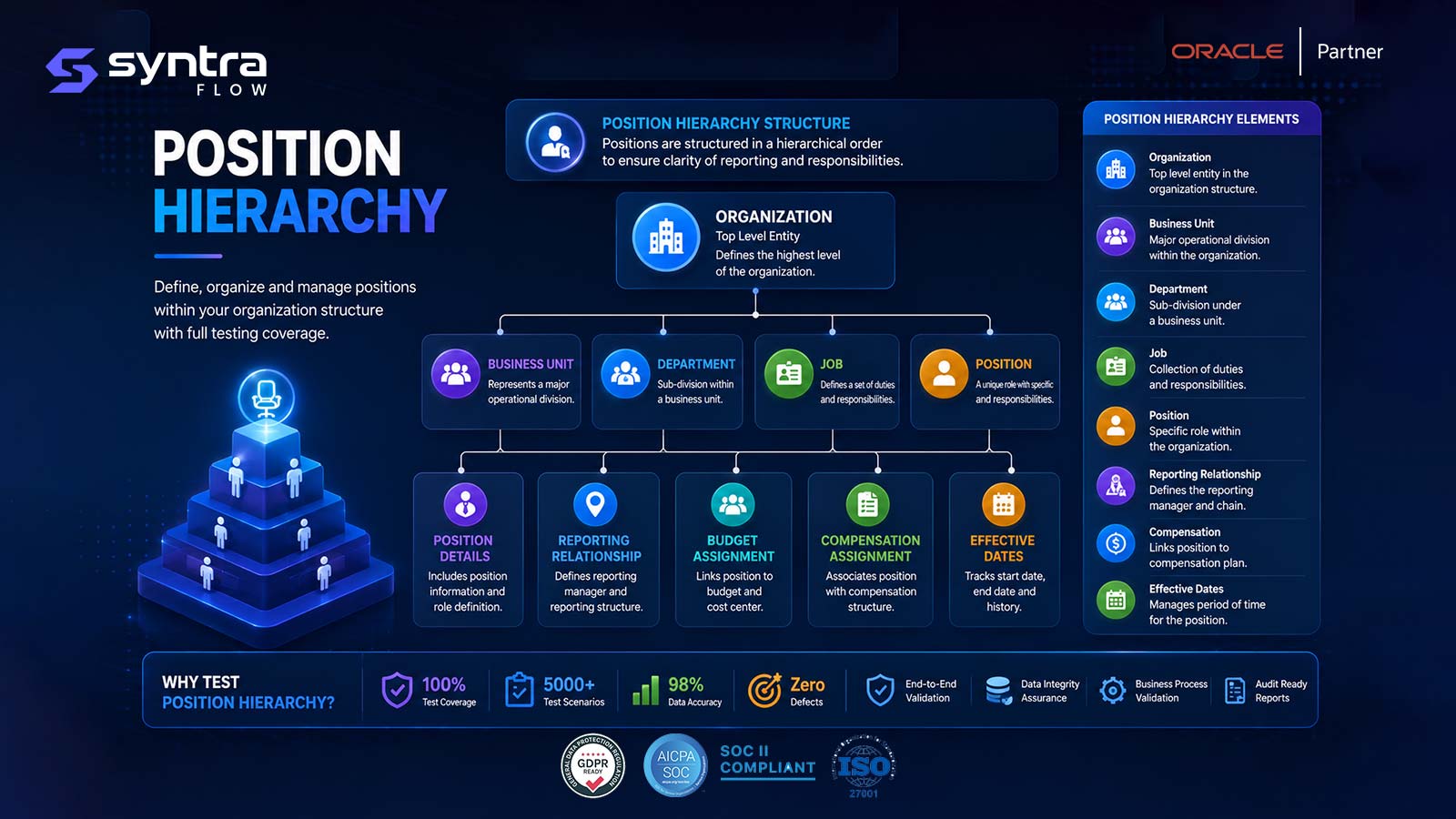
What Is Position Management in Oracle Fusion HCM?
Oracle Fusion HCM separates the position from the worker assignment that fills it. A position is a defined organizational slot — tied to a business unit, department, job, grade, and location — that can exist and carry attributes whether or not anyone is currently in it. It is the structural building block enterprises use to control organization design, headcount, and budget independently of who happens to be employed at any given moment.
Each position carries a set of attributes that drive downstream behaviour: a place in the position hierarchy (its reporting line to a parent position), a headcount or full-time-equivalent (FTE) limit that caps how many incumbents can occupy it, a hiring status that governs whether it is open for recruitment, and — where the enterprise uses position-level budgeting — an approved budgeted position record. When a worker is hired or transferred into the position, Oracle can synchronize the position's attributes onto the worker's assignment, and when the last incumbent leaves, the position becomes vacant again rather than disappearing.
Position testing verifies that this model behaves correctly under change: that hierarchies stay consistent, headcount limits are enforced, synchronization propagates the right attributes at the right time, hiring restrictions actually block hiring when they should, budgeted-position controls are respected, and vacancy status is reported accurately for workforce planning.
Scope note. This page covers the position object — hierarchy, headcount, synchronization, hiring restrictions, and budget. It is distinct from Oracle Assignment Testing, which covers what happens when an individual worker's assignment record changes — the job, position, grade, or manager it points to. The two are closely related: a position change often triggers an assignment change through synchronization, but the test scope is different. Foundational worker and employment record testing is covered separately on Oracle Worker Testing and Oracle Employment Testing.
Why Position Testing Matters
Positions sit upstream of nearly every workforce decision. Recruiting checks position hiring status before opening a requisition. Compensation and budgeting teams size their plans against approved headcount and budgeted position counts. Org-design and workforce-planning teams read the position hierarchy to understand span of control and reporting structure. When the position model is wrong, none of those downstream processes can be trusted, even if they are individually well tested.
The failure modes are also difficult to spot casually. A broken position hierarchy link doesn't throw an error — it just quietly produces an org chart or approval routing that is wrong. A headcount limit that silently stops enforcing doesn't block a bad hire; it lets one through. A synchronization rule that fails to propagate a department change leaves an incumbent's assignment out of step with their position, which surfaces later as a reporting or payroll discrepancy that is hard to trace back to its source.
Position management also forms part of the complete Oracle Hire-to-Retire (H2R) lifecycle: a position must exist and be open before a worker can be hired into it, and its status and budget continue to constrain that worker's employment throughout their tenure. See the Oracle HCM Testing Tool hub for how position testing fits alongside worker, employment, and assignment testing across the full H2R chain.
Workforce planning
Headcount and vacancy data drives staffing decisions.
Budget control
Budgeted positions gate hiring against approved spend.
Org governance
Hierarchy underpins reporting lines and approvals.
Compliance & audit
Hiring restrictions enforce approval and policy controls.
The Oracle Position Management Process Flow
A position moves through a predictable sequence from creation to vacancy, with hierarchy, headcount, and budget attributes governing what happens at each step.
Position lifecycle sequence
- Create: business unit, department, job, grade, location, position type (single or multiple incumbent), and its parent in the position hierarchy are defined.
- Constrain: headcount/FTE limit and hiring status (active, frozen, or otherwise restricted) determine whether and how much the position can be filled.
- Budget: where position budgeting is used, the position is tied to an approved budgeted headcount and amount for a budget period.
- Fill: a hire or transfer assigns a worker to the position; synchronization propagates position attributes onto the assignment.
- Maintain: subsequent position changes (department, hierarchy, headcount, budget) trigger synchronization to every current incumbent, per the sync configuration in effect.
- Vacate: when the last incumbent terminates or transfers out, the position reverts to vacant and remains available for workforce and recruiting reporting.
Common Position Testing Challenges
Position defects rarely surface as an error message. They surface as a wrong org chart, a hire that shouldn't have been possible, or a headcount report that doesn't reconcile. The risks below are specific to the position management model.
| Risk | Impact | Mitigation via testing |
|---|---|---|
| Circular or broken hierarchy | Org chart and approval routing become invalid | Negative tests on circular reparenting |
| Headcount limit not enforced | Over-hiring against an approved slot | Boundary hire tests at and beyond max headcount |
| Synchronization gap | Incumbent assignment drifts from position record | Assert assignment attributes after every position change |
| Hiring restriction bypass | Hire proceeds against a frozen or inactive position | Negative hire tests against restricted status |
| Budget overrun | Hiring exceeds approved position budget | Over-budget hire tests with approval routing |
| Vacancy misreporting | Workforce plans built on inaccurate vacancy data | Vacant-status reconciliation after every exit |
| Mass update cascade failure | Bulk position change only partially applies | Volume tests on bulk position updates |
| Date-effective conflict | Future-dated change applies at the wrong time | Effective-date boundary tests |
| Silent quarterly-update drift | Sync or hierarchy behaviour changes unnoticed | Release-aware regression on position scenarios |
[SyntraFlow — Position Hierarchy & Headcount view, illustrative]
How SyntraFlow Automates Position Testing
SyntraFlow drives position create, update, hierarchy, and hire actions across the UI and API, then asserts the specific outcome — headcount enforced, hierarchy consistent, synchronization propagated — not just that the transaction saved.
Pre-built position cases
A starter pack covering hierarchy, headcount, sync, hiring restrictions, budget, and vacancy — extend to your own position types.
Hierarchy consistency checks
Validates reporting lines and reparenting outcomes, including negative tests for circular structures.
Headcount boundary testing
Exercises hires at, below, and above the configured headcount or FTE limit.
Synchronization assertions
Confirms incumbent assignment attributes match the position after every relevant change, on the correct effective date.
Dynamic test data
Provisions positions, hierarchies, and incumbents that produce the specific condition each test needs.
Self-healing execution
Re-anchors when Oracle changes position or hire pages, so hierarchy and headcount assertions keep running.
Evidence capture
Timestamped screenshots and execution logs retained as audit-grade evidence for every position test run.
Release-impact selection
Runs the position subset a given release or configuration change actually affects.
Full AI testing suite
Position testing runs alongside the broader SyntraFlow AI testing features used across the Oracle Fusion estate.
| Benefit | Manual approach | With SyntraFlow |
|---|---|---|
| Hierarchy validation | Visual spot-check of the org chart | Automated reporting-line assertion for every node |
| Headcount boundary coverage | A handful of scenarios, if any | Full boundary matrix executed every cycle |
| Sync verification | Manually compare position and assignment screens | Attribute-level comparison asserted automatically |
| Regression after update | Re-run whatever time allows | Release-scoped position pack re-run in full |
AI-Driven Position Testing Capabilities
Position scenarios multiply quickly once hierarchy depth, headcount limits, and budget rules are combined. AI-assisted generation and impact analysis keep coverage proportionate to what actually changed.
Illustrative quarterly regression effort — position test pack
Illustrative example figures for a quarterly update cycle, not a specific customer result.
| Dimension | Manual testing | AI-driven testing |
|---|---|---|
| Scenario generation | Written by hand per release | Generated from position configuration and prior coverage |
| Hierarchy edge cases | Often skipped under time pressure | Systematically included (circular, orphaned, deep chains) |
| Release impact | Re-test everything or guess what changed | Scoped to what the release notes actually touch |
| Redwood page changes | Scripts break, need manual rework | Self-healing execution re-anchors automatically |
240+
Illustrative position scenarios executed
93%
Illustrative first-pass execution rate
~70%
Illustrative regression time reduction
A note on capability. Pre-built position cases, self-healing execution, and evidence capture are current platform capabilities. AI-generated scenario variants scoped to your specific hierarchy depth, headcount rules, and budget configuration are configurable during onboarding. Any tenant-specific extension — such as custom hiring-status values or a bespoke budgeting integration — is confirmed at assessment rather than assumed here.
Oracle Position Test Scenarios
A representative set of 26 Oracle Fusion position scenarios spanning hierarchy, headcount, synchronization, hiring restrictions, budgeted positions, and vacancy. Test IDs use the HC-POS prefix. A broader catalog covering the full HCM cluster lives on Oracle HCM Test Cases.
| ID | Scenario | Preconditions | Expected result | Pri | Auto |
|---|---|---|---|---|---|
| HC-POS-001 | Create new position with valid attributes | BU, department, job, grade defined | Position created and active | H | Y |
| HC-POS-002 | Assign position to a parent in the hierarchy | Parent position exists | Position correctly linked in hierarchy | H | Y |
| HC-POS-003 | Reparent an existing position | Position moved to a new parent | Hierarchy reflects the new reporting line | H | Y |
| HC-POS-004 | Prevent circular hierarchy assignment | Position set as its own ancestor | Save blocked with a validation error | H | Y |
| HC-POS-005 | Multi-level hierarchy renders correctly | Five-level position tree exists | Full depth displays with correct order | M | Y |
| HC-POS-006 | Configure headcount / FTE limit on a position | Position type single or multiple incumbent | Max headcount saved and enforced | H | Y |
| HC-POS-007 | Hire within available headcount | Current incumbents < max headcount | Hire succeeds; incumbent count increments | H | Y |
| HC-POS-008 | Hire attempt at maximum headcount | Incumbents = max headcount | Hire blocked or flagged per configuration | H | Y |
| HC-POS-009 | Headcount decrements after termination | Sole incumbent terminated | Count decrements; position becomes vacant | H | Y |
| HC-POS-010 | Fractional FTE accumulation across incumbents | Multiple part-time incumbents on one position | Total FTE calculated correctly against limit | M | Y |
| HC-POS-011 | Assignment sync on new hire | Worker hired into a position | Job, department, grade, location sync from position | H | Y |
| HC-POS-012 | Assignment sync on position attribute update | Position department changed | Incumbent assignment updates per sync rule | H | Y |
| HC-POS-013 | Manual assignment override vs sync precedence | Assignment manually edited, then position changes | Correct precedence applied per configuration | M | Y |
| HC-POS-014 | Future-dated position change propagation | Position change dated ahead | Sync applies only on the effective date | M | Y |
| HC-POS-015 | Sync consistency across multiple incumbents | Multi-incumbent position updated | All incumbent assignments sync consistently | M | Y |
| HC-POS-016 | Hire attempt against a frozen position | Hiring status set to frozen | Hire blocked with restriction message | H | Y |
| HC-POS-017 | Hire attempt against an inactive position | Position end-dated / inactive | Position not selectable for hire | H | Y |
| HC-POS-018 | Hiring restriction lifted, re-hire permitted | Frozen position reactivated | Hire now proceeds normally | M | Y |
| HC-POS-019 | Hire against a non-budgeted position | Position lacks approved budget | Hire blocked pending budget approval | H | Y |
| HC-POS-020 | Budgeted position amount validation | Position linked to a defined budget amount | Budget-vs-actual validated at hire | H | Y |
| HC-POS-021 | Hire that would exceed position budget | Proposed hire cost > approved budget | Blocked or routed for override approval | H | P |
| HC-POS-022 | Budget worksheet reflects position budget | Budgeted positions exist in the period | Worksheet count and amount reconcile | M | Y |
| HC-POS-023 | Vacant position flagged correctly | Position has zero incumbents | Position reported as vacant | H | Y |
| HC-POS-024 | Vacancy aging / time-to-fill tracking | Position vacant beyond a defined threshold | Vacancy duration reported accurately | M | Y |
| HC-POS-025 | Vacant position linked to open requisition | Recruiting requisition references the position | Requisition status reflects vacancy correctly | M | Y |
| HC-POS-026 | Mass update across a set of positions | Bulk attribute change submitted | All positions updated; sync cascades correctly | M | Y |
Pri = priority (H/M/L). Auto = automation candidate (Y suitable · P partly, needs approval-routing setup). Steps summarised; full step detail ships in the downloadable test pack.
Position Regression Testing
Position records are touched by an unusually wide set of changes: department restructures, grade or job catalog updates, hierarchy reorganizations, headcount planning cycles, and budget approvals all modify positions directly or indirectly. Any one of these can shift hierarchy links, headcount availability, or synchronization outcomes for every current incumbent.
Re-testing the full position pack after every such change is rarely practical by hand. SyntraFlow's Oracle Regression Testing Tool re-runs the position scenarios a given change actually touches, so hierarchy and headcount integrity is verified without re-executing the entire suite on every update.
| Change event | Risk to position data | Recommended regression scope |
|---|---|---|
| Org restructure | Hierarchy links shift across departments | Hierarchy + sync cases |
| Headcount planning cycle | Position headcount limits change | Headcount boundary cases |
| Budget approval cycle | Budgeted position amounts change | Budgeted-position cases |
| Security-role change | Who can create/edit positions changes | Role-based access cases |
| Sync configuration change | Which attributes propagate to assignment shifts | Synchronization cases |
Position Testing & Oracle Quarterly Releases
Oracle's quarterly updates periodically adjust position pages, hierarchy tools, and synchronization behaviour — sometimes through explicit feature opt-ins, sometimes through Redwood page redesigns or deprecated options. Because positions constrain hiring and budget, an undetected change here can silently open or close hiring paths that should be controlled.
Rather than re-testing every position scenario each quarter, SyntraFlow Release Intelligence narrows the work to what actually changed in your tenant:
- 1.Analyses Oracle release notes for changes touching position management, hierarchy, or synchronization.
- 2.Maps those changes to your position types, hierarchy structure, and budget configuration.
- 3.Identifies which position scenarios and downstream assignment processes are affected.
- 4.Recommends the specific position test cases to run before go-live.
- 5.Tracks execution evidence for audit and sign-off.
Redwood UI Considerations for Position Testing
Oracle's Redwood redesign reaches the position pages — Manage Position, the hierarchy tree view, and hire flows — which changes page structure and selectors even when the underlying hierarchy, headcount, and sync logic is unchanged. Selector-based automation written against the classic pages tends to break the moment a Redwood rollout touches these screens.
SyntraFlow's Oracle Redwood UI Testing approach understands Redwood pages semantically rather than by fixed selector, so position hierarchy, headcount, and hiring-restriction assertions keep running through UI redesigns instead of failing on the first layout change.
Position-specific Redwood risk areas: the hierarchy tree visualization, the headcount/FTE input controls on Manage Position, and the hiring-status indicator surfaced during the hire flow.
Position Testing Best Practices
Test hierarchy changes for consistency, not just successful save — verify the full reporting chain.
Always include a negative test for circular hierarchy assignment.
Test headcount at, one below, and one above the configured limit — boundaries are where enforcement gaps hide.
Assert synchronized assignment attributes explicitly rather than assuming the sync ran.
Cover both hiring restrictions being applied and being correctly lifted.
Test budgeted-position enforcement together with the approval routing it triggers, not in isolation.
Reconcile vacant-position reporting after every termination and transfer scenario.
Validate mass/bulk position updates at realistic volume, not single-record only.
Include future-dated position changes to confirm effective-dating applies correctly.
Re-run the position pack every quarterly update, scoped by release impact.
Position-model depth
Purpose-built coverage for hierarchy, headcount, and sync, not generic HR testing.
Self-healing on Redwood
Position pages keep working after UI redesigns.
Release-aware scope
Only re-test what a given update actually affects.
Audit-ready evidence
Every hierarchy and headcount assertion is captured and retained.
Related Oracle HCM Pages
Position testing connects to the rest of the Hire-to-Retire cluster. Go deeper on adjacent topics:
Oracle HCM Testing Tool ⭐
The HCM testing hub.
Oracle Worker Testing →
Core worker record testing.
Oracle Employment Testing →
Employment record lifecycle.
Oracle Assignment Testing →
What a worker's assignment points to.
Oracle HCM Test Cases →
The broader HCM scenario catalog.
Oracle HCM UAT Checklist →
Sign-off checklist for go-live.
Oracle Regression Testing Tool →
Release-scoped regression execution.
Oracle Release Intelligence →
Quarterly update impact analysis.
Oracle Redwood UI Testing →
Testing through Redwood redesigns.
Oracle documentation references: Oracle Fusion Cloud HCM — Implementing Global Human Resources; Oracle Fusion Cloud HCM — Using Global Human Resources; Oracle Fusion Cloud HCM — Workforce Structures documentation library.
Frequently Asked Questions
What is the difference between a position and an assignment in Oracle HCM?
▼
A position is a defined organizational slot that can exist whether or not anyone occupies it, carrying its own hierarchy, headcount, and budget. An assignment is the record that links a specific worker to a position (or job) and can be synchronized from it. Position testing covers the slot itself; assignment testing covers what an individual worker's record points to. See Oracle Assignment Testing for the latter.
What does position hierarchy testing need to cover?
▼
At minimum: creating a position with a valid parent, reparenting an existing position, preventing circular reporting structures, and confirming multi-level hierarchies display and resolve correctly for org charts and approval routing that depend on them.
How should headcount limits be tested?
▼
Test at the boundary: a hire when headcount is available should succeed, a hire exactly at the configured maximum should be blocked or flagged per configuration, and headcount should decrement correctly when an incumbent terminates or transfers out.
What is position synchronization and why does it need testing?
▼
Synchronization is the mechanism by which position attributes — job, department, grade, location — propagate onto an incumbent's assignment when the position changes. It needs testing because a sync gap leaves the assignment silently out of step with the position, which surfaces later as a reporting or payroll discrepancy.
What are hiring restrictions on a position?
▼
Hiring restrictions are position-level controls — such as a frozen or inactive hiring status — that determine whether recruiting or HR can hire into the position at all. Testing must confirm hires are blocked while a restriction is active and permitted once it is correctly lifted.
What is a budgeted position and how is it tested?
▼
A budgeted position is one linked to an approved headcount and budget amount for a period, used to gate hiring against approved spend. Testing confirms hires within budget proceed normally, hires that would exceed the budget are blocked or routed for override approval, and budget worksheets reconcile against actual position data.
How is a vacant position identified and tested?
▼
A position becomes vacant when its incumbent count drops to zero, typically after a termination or transfer. Testing confirms the position is correctly flagged vacant in reporting, vacancy duration is tracked accurately, and any linked recruiting requisition reflects the current vacancy status.
How does SyntraFlow automate Oracle position testing?
▼
SyntraFlow provisions positions and hierarchies that produce the specific condition each test needs, drives create, update, and hire actions through the UI, and asserts the exact outcome — hierarchy consistency, headcount enforcement, or synchronized assignment attributes — rather than just confirming the transaction saved.
How often should position testing be repeated?
▼
On every Oracle quarterly update, and after any org restructure, headcount planning cycle, budget approval cycle, or change to synchronization or hiring-status configuration. These events change position behaviour in ways that are easy to miss without targeted regression.
Does Redwood affect position testing?
▼
Yes. Redwood redesigns Manage Position, the hierarchy tree view, and hire pages, which can break selector-based automation even when the underlying hierarchy and headcount logic is unchanged. SyntraFlow understands Redwood pages semantically and self-heals so position assertions keep running through UI redesigns.
Strengthen Your Oracle Position Test Coverage
Identify gaps in your position hierarchy, headcount, and budget testing, automate high-risk hiring-restriction scenarios, and prepare for Oracle quarterly updates with SyntraFlow.