Oracle Employment Testing
Employment in Oracle Fusion Cloud HCM is the legal work relationship between a person and a legal employer — the container that carries hire, termination, and rehire events, and that determines which legal employer, business unit, and enterprise structure a period of work sits under. Get this container wrong and everything built on it — assignments, payroll, benefits eligibility, statutory reporting — inherits the error.
This page is a practical guide to testing employment records at the work-relationship level: legal employer and business unit assignment, enterprise structure validation, hire, end employment, rehire, and concurrent employment across multiple legal employers. It sits under the Oracle HCM Testing Tool hub and is one part of the complete Hire-to-Retire (H2R) lifecycle.
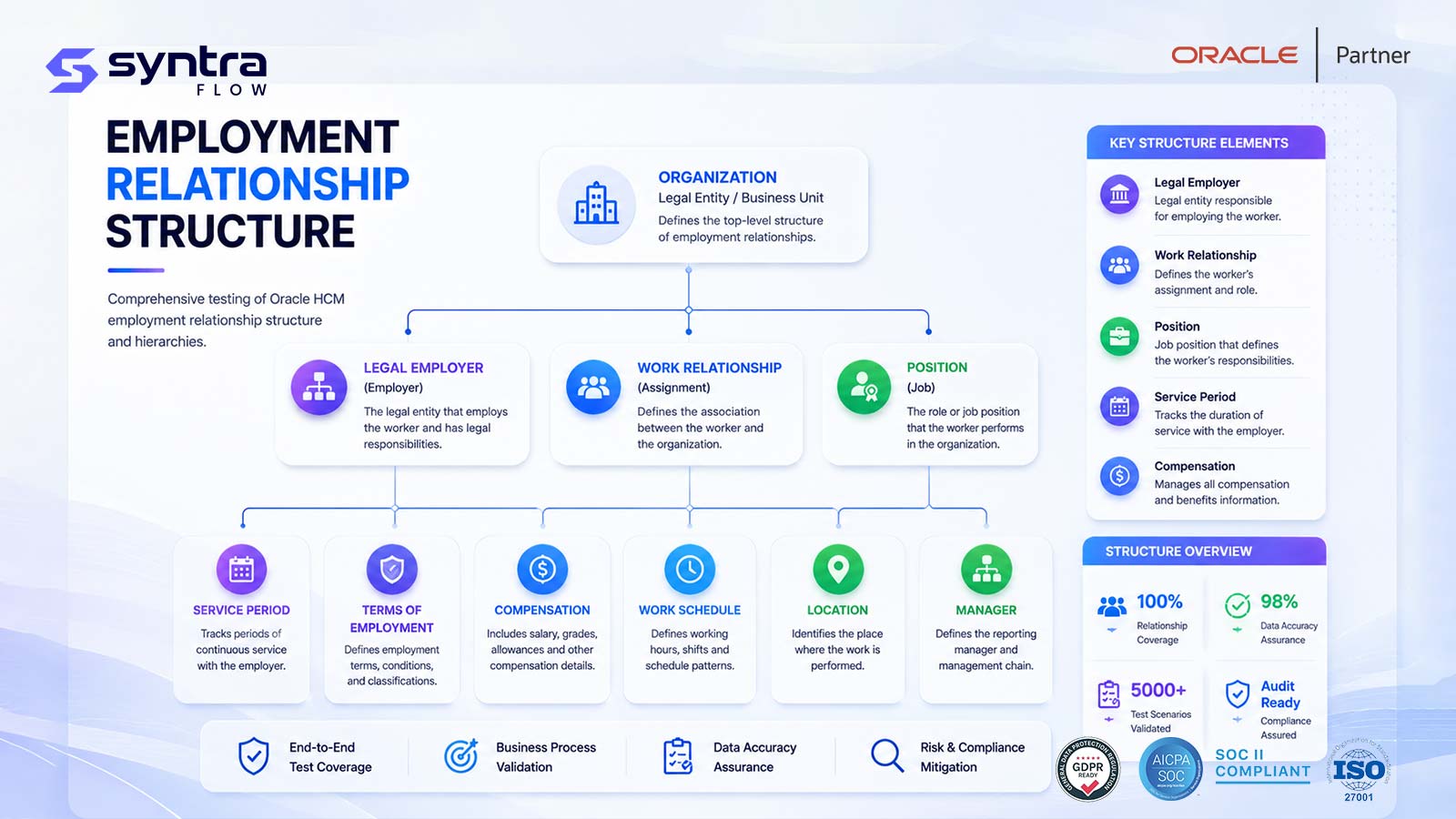
What Is Employment Testing in Oracle HCM?
Oracle Fusion Cloud HCM models a worker's employment across three layers: the person, the work relationship, and the assignment. The person record is the single global identity. Each work relationship links that person to a specific legal employer and worker type — employee, contingent worker, pending worker, or nonworker — and is the record that is hired, terminated, and rehired. One or more assignments then sit under a work relationship, carrying the job, position, department, and grade detail.
A work relationship cannot exist without a valid enterprise structure behind it. The legal employer is a legal entity classified for HR use, and every work relationship must resolve to one. The business unit — typically driven by the legal employer and department combination — controls transaction access and processing scope. Both trace back to the enterprise structure: enterprise, legal entities, payroll statutory units, legal employers, and business units, configured once and depended on by every hire that follows.
Employment testing verifies that this container behaves correctly under the events that change it: a new hire creating the first work relationship, an existing worker gaining a second work relationship at another legal employer (concurrent employment), a work relationship being ended, and a former worker being rehired — either back into the same legal employer or a different one within the enterprise.
Scope note. This page owns the legal work-relationship container: legal employer, business unit assignment, enterprise structures, concurrent employment across multiple legal employers, and the hire / end-employment / rehire events at the employment level. The person-level master record — identity, personal information, global and local transfer, and effective-dated worker history — is covered on Oracle Worker Testing. Assignment-level detail (job, position, grade, manager) is covered on Oracle Assignment Testing. This page does not repeat those scenarios.
Why Testing Employment Matters
Every downstream HCM and payroll process reads the work relationship before it reads anything else. Payroll relationships, benefits eligibility, absence entitlement, statutory reporting, and compensation eligibility are all derived from the legal employer and work relationship structure established at hire. A defect at this layer does not stay contained — it surfaces weeks later as a payroll relationship that never generated, a statutory report missing a worker, or a benefits enrollment window that never opened.
Concurrent employment adds further risk. Global organizations routinely have workers holding a substantive role at one legal employer and a secondary or advisory role at another. If the second work relationship is mis-configured, or if terminating one work relationship accidentally affects the other, the error touches pay, tax, and reporting for a worker who is otherwise still actively employed.
The Oracle Employment Process Flow
A work relationship moves through a small number of legal-status transitions, each triggered by a distinct HR action and each dependent on the enterprise structure resolving correctly.
Employment lifecycle
Hire
Work relationship created
Assignment(s) established
Active employment
End employment
Rehire (optional)
A single person can carry more than one active work relationship at once — each following this same flow independently against its own legal employer.
This process forms part of the complete Oracle Hire-to-Retire (H2R) lifecycle, which spans recruiting through hire, employment changes, compensation and benefits, payroll, and separation.
Common Employment Testing Challenges
Employment testing is harder than it looks because the legal employer and business unit are set once, quietly, and every later transaction assumes they were set correctly. The challenges teams run into most:
- •Enterprise structure setup — legal entities, payroll statutory units, legal employers, and business units — is rarely re-verified once configured, so drift between environments goes unnoticed until a hire fails.
- •Concurrent employment is under-tested because most test data represents a single work relationship per person, missing the interactions between two active relationships.
- •Ending the wrong work relationship, or ending one and accidentally affecting a concurrent relationship, is difficult to catch without a dedicated negative test.
- •Rehire logic differs depending on whether the person returns to the same legal employer or a different one within the enterprise, and whether rehire eligibility rules apply.
- •Bulk hire via HDL/HSDL and hire via REST can silently diverge from UI behaviour on enterprise-structure validation, especially after a quarterly update.
| Risk | Impact | Mitigation via testing |
|---|---|---|
| Hire assigns wrong legal employer | Wrong statutory unit; payroll and tax errors | Assert legal employer resolves correctly for every hire path |
| Business unit mis-derived | Transactions processed under wrong BU access | Validate BU derivation rules against legal employer/department |
| Duplicate work relationship created | Duplicate payroll relationship; reporting double-count | Negative test on same legal employer + worker type combination |
| Wrong work relationship terminated | Active worker's pay/access wrongly stopped | Concurrent employment isolation test on end employment |
| Rehire eligibility bypassed | Ineligible worker rehired against policy | Assert eligibility rule blocks rehire when flagged |
| Enterprise structure drift between environments | Test passes in one tenant, fails in production | Compare legal employer/BU setup across environments |
| Bulk hire diverges from UI hire | HDL-loaded workers have inconsistent structure | Run identical hire cases through UI, HDL, and REST |
| Silent behaviour change after update | Hire/termination rule shifts undetected | Release-aware regression on employment scenarios |
What SyntraFlow Automates
SyntraFlow drives hire, end employment, and rehire actions across the Redwood UI, HDL, and REST, then asserts the resulting work relationship, legal employer, and business unit state.
Pre-built employment cases
A starter pack of hire, termination, rehire, and concurrent-employment scenarios you extend to your enterprise structure.
Enterprise-structure aware data
Test data is provisioned against your actual legal employers and business units, not generic placeholders.
Self-healing execution
Playwright-based runs re-anchor when Oracle changes hire or termination pages, so employment assertions keep working.
Work-relationship-level assertions
Verifies the specific work relationship, legal employer, and status changed — not just that the transaction saved.
UI + HDL + REST parity
Runs the same hire and termination case through all three entry points and confirms consistent results.
Evidence capture
Timestamped screenshots and result logs retained for every hire, termination, and rehire run.
[SyntraFlow — Employment test case builder view, illustrative]
| Benefit | Manual approach | With SyntraFlow |
|---|---|---|
| Hire scenario coverage | Limited set, hand-scripted per legal employer | Pre-built pack extended to every legal employer |
| Concurrent employment testing | Often skipped — hard to set up by hand | Provisioned data supports multi-work-relationship cases |
| UI/HDL/REST consistency | Tested separately, if at all | Same case run across all three, compared automatically |
| Redwood page changes | Scripts break, require manual rework | Self-healing selectors keep tests running |
| Regression after update | Full manual re-run of hire/termination cases | Release-scoped subset re-run automatically |
AI Testing Features for Employment
AI assistance targets the parts of employment testing that are the most time-consuming to build by hand: scenario variation across legal employers and eligibility rule combinations.
AI-assisted scenario generation
Generates hire, termination, and rehire variants across your configured legal employers, worker types, and eligibility rules from your enterprise structure.
Impact analysis on structure changes
Flags which employment test cases are affected when a legal employer, business unit, or eligibility rule is added or changed.
Anomaly detection on results
Highlights hire or termination results that deviate from expected legal-employer or business-unit outcomes for review.
Natural-language scenario authoring
Describe an employment scenario in plain language; SyntraFlow drafts the executable test case for review. See the full set of SyntraFlow AI testing features.
Illustrative quarterly regression effort — employment scenarios
Illustrative figures for a representative HC-EMP regression pack of 28 scenarios across a mid-size enterprise structure. Actual effort depends on the number of legal employers and eligibility rules configured in your tenant.
| Dimension | Manual testing | AI-driven testing |
|---|---|---|
| Scenario coverage across legal employers | Limited to a few representative entities | Generated across all configured legal employers |
| Concurrent employment setup | Hand-built, time-consuming, often skipped | Provisioned automatically from enterprise structure |
| Change impact identification | Relies on tester recall of what's affected | Maps structure/rule changes to affected test cases |
| Redwood page resilience | Breaks on selector changes; manual fix | Self-heals against semantic page understanding |
A note on capability. Pre-built employment cases, self-healing execution, and UI/HDL/REST testing are current platform capabilities. AI-assisted scenario generation and change-impact mapping are configurable during onboarding against your enterprise structure. Any deeper predictive or generative capability beyond what's described here is roadmap, not a live feature, and would be confirmed at assessment rather than assumed.
Oracle Employment Test Scenarios
A representative set of 28 Oracle Fusion HCM employment scenarios covering legal employer and business unit resolution, hire, end employment, rehire, and concurrent employment. Test IDs use the HC-EMP prefix.
| ID | Scenario | Preconditions | Expected result | Pri | Auto |
|---|---|---|---|---|---|
| HC-EMP-001 | Hire new person creates work relationship and assignment | Valid legal employer, no prior person record | Person, work relationship, primary assignment created | H | Y |
| HC-EMP-002 | Hire resolves correct legal employer | Multiple legal employers configured | Work relationship linked to selected legal employer | H | Y |
| HC-EMP-003 | Hire into inactive/disabled legal employer | Legal employer end-dated or disabled | Hire blocked with validation error | H | Y |
| HC-EMP-004 | Hire assigns default business unit | BU derivation rule configured for legal employer | Correct default business unit set on assignment | H | Y |
| HC-EMP-005 | Hire with business unit override | User selects non-default valid BU | Assignment reflects overridden business unit | M | Y |
| HC-EMP-006 | Add concurrent work relationship, second legal employer | Existing active worker, different legal employer | Second work relationship created; original unaffected | H | Y |
| HC-EMP-007 | Add concurrent work relationship, same legal employer | Different worker type (e.g. contingent worker) | Second work relationship created under same legal employer | M | Y |
| HC-EMP-008 | Duplicate work relationship blocked | Same legal employer + worker type already exists | Creation blocked with validation error | H | Y |
| HC-EMP-009 | Legal employer reassignment restricted | Attempt casual edit of legal employer on active relationship | Change blocked or routed through correction only | M | Y |
| HC-EMP-010 | Enterprise structure validation on hire | Legal employer without valid payroll statutory unit | Hire blocked; setup error surfaced | H | Y |
| HC-EMP-011 | End employment, voluntary resignation with notice | Active work relationship, future termination date | Work relationship shows pending termination | H | Y |
| HC-EMP-012 | End employment, involuntary, immediate | Active work relationship, termination effective today | Work relationship and assignments end-dated immediately | H | Y |
| HC-EMP-013 | End employment isolates concurrent relationship | Person has two active work relationships | Only targeted work relationship ends; other remains active | H | Y |
| HC-EMP-014 | End employment cascades to assignments | Work relationship with multiple assignments | All assignments under that relationship end-dated | H | Y |
| HC-EMP-015 | End employment blocked on pending transaction | Unapproved transaction exists on work relationship | Termination blocked or flagged until resolved | M | P |
| HC-EMP-016 | Last work relationship ended sets person to terminated | Person has single active work relationship | Person-level status reflects terminated | H | Y |
| HC-EMP-017 | Rehire, same legal employer, within eligibility window | Terminated work relationship, eligible for rehire | Work relationship reactivated with prior history linked | H | Y |
| HC-EMP-018 | Rehire, different legal employer within enterprise | Former worker, new legal employer selected | New work relationship created, linked to same person | H | Y |
| HC-EMP-019 | Rehire blocked by ineligibility flag | Prior termination marked rehire-ineligible | Rehire attempt blocked or warned | M | Y |
| HC-EMP-020 | Rehire after long break preserves service history | Break exceeds configured service-reset threshold | Service dates handled per configured rule | M | Y |
| HC-EMP-021 | Concurrent employment payroll relationship validation | Two active work relationships, different legal employers | Separate payroll relationships created correctly | H | Y |
| HC-EMP-022 | Concurrent employment approval routing | Worker with two active work relationships | Approvals route per relevant work relationship's hierarchy | M | P |
| HC-EMP-023 | Business unit reassignment on department change | Department change triggers new BU derivation | Business unit updates per derivation rule | M | Y |
| HC-EMP-024 | Effective-dated correction of hire-date legal employer error | Incorrect legal employer entered at hire | Correction updates history without new work relationship | M | Y |
| HC-EMP-025 | Bulk hire via HDL validates enterprise structure | HDL file with legal employer and BU references | Loaded work relationships match UI-hire equivalents | H | Y |
| HC-EMP-026 | Hire via REST API matches UI behaviour | Identical hire payload submitted via REST | Same work relationship and structure result as UI | M | Y |
| HC-EMP-027 | Cross-legal-employer data access restriction | User role scoped to a single legal employer | Other legal employers' employment records not visible | H | P |
| HC-EMP-028 | Quarterly-update regression pack | Post-update tenant | All prior hire/termination/rehire results reproduce | H | Y |
Pri = priority (H/M/L). Auto = automation candidate (Y suitable · P partly, needs role/data setup). Steps summarised; full step detail is scoped during a test assessment.
Regression Testing for Employment
Employment records rarely change in isolation. A legal employer added for a new entity, a business unit derivation rule edited, or a rehire eligibility policy updated can each shift the outcome of a hire or termination that previously behaved correctly. Because these changes are configuration events rather than code changes, they are easy to miss without a standing regression pack.
The Oracle Regression Testing Tool re-runs the HC-EMP scenario pack against your current enterprise structure so that a hire, termination, or rehire that passed last quarter is proven to still pass today — not assumed to.
Employment Testing and Oracle Quarterly Releases
Oracle's quarterly updates can alter hire, termination, and rehire behaviour through new opt-in features, Redwood page redesigns, or changes to eligibility and validation rules — none of which require any action on your part to take effect. Because employment is the foundation every other HCM process is built on, an undetected change here has the widest blast radius in the cluster.
Rather than re-running every employment scenario on every release, Oracle Release Intelligence analyzes the release notes for changes touching work relationships, legal employer setup, or hire/termination/rehire logic, maps them to your configuration, and recommends the specific HC-EMP cases to re-run.
Redwood UI Considerations for Employment
Hire, termination, and rehire flows have moved to Redwood pages in Oracle Fusion Cloud HCM, changing the layout and interaction pattern of these transactions even where the underlying legal-employer and work-relationship logic is unchanged. Selector-based automation written against the previous UI breaks on a Redwood redesign regardless of whether the transaction itself still works correctly.
SyntraFlow's approach to Oracle Redwood UI Testing understands hire and termination pages semantically, so HC-EMP scenarios continue to execute through a Redwood rollout rather than failing on the first page change.
Employment Testing Best Practices
Test hire, termination, and rehire against every configured legal employer, not just the largest one.
Include at least one concurrent-employment case per quarterly regression cycle.
Verify that ending one work relationship never affects a concurrent relationship on the same person.
Test rehire both within the same legal employer and across a different one in the enterprise.
Validate hire and termination through UI, HDL, and REST for consistent enterprise-structure results.
Keep employment scenarios separate from assignment and worker scenarios so failures are unambiguous.
Re-verify enterprise structure setup across environments before trusting a passing test.
Re-run the employment pack every quarterly update, scoped by release impact.
The SyntraFlow Advantage
Purpose-built for testing Oracle Fusion HCM employment, not a generic UI automation tool retrofitted to it.
Enterprise-structure native
Test data and assertions built around your actual legal employers and business units.
Self-healing on Redwood
Hire and termination tests keep running through Oracle UI redesigns.
Release-aware regression
Scopes retesting to what a quarterly update actually changed.
Audit-grade evidence
Every hire, termination, and rehire run captures evidence automatically.
Related Oracle HCM Pages
Employment connects to the rest of the HCM suite. Go deeper on adjacent topics:
Oracle HCM Testing Tool ⭐
The HCM testing hub.
Oracle Worker Testing →
Person-level record and transfers.
Oracle Assignment Testing →
Job, grade, and manager detail.
Oracle Position Testing →
Position-based structures.
Oracle HCM Test Cases →
Broader HCM scenario library.
Oracle HCM UAT Checklist →
Sign-off readiness checklist.
Oracle Documentation References
- Oracle Fusion Cloud HCM: Implementing Global Human Resources
- Oracle Fusion Cloud HCM: Using Global Human Resources
- Oracle Fusion Cloud HCM: Implementing Enterprise Structures
- Oracle Fusion Cloud HCM: HCM Data Loader documentation library
Frequently Asked Questions
What is a work relationship in Oracle HCM, and why does it matter for testing?
▼
A work relationship is the legal link between a person and a specific legal employer, and it is the record that is hired, terminated, and rehired. Testing it matters because every downstream process — payroll relationships, statutory reporting, benefits eligibility — is derived from the legal employer and enterprise structure set on the work relationship at hire.
How is Employment testing different from Worker testing?
▼
Employment testing covers the legal work-relationship container — legal employer, business unit, enterprise structures, concurrent employment, and hire/end-employment/rehire events. Oracle Worker Testing covers the person-level master record: identity, personal information, and global or local transfer. A hire touches both, but each page tests a different layer of the same transaction.
What is the difference between legal employer and business unit for testing purposes?
▼
The legal employer is a legal entity classified for HR use and is what a work relationship is legally attached to. The business unit is a processing and access-control grouping, typically derived from the legal employer and department combination. Testing must verify both resolve correctly, since one drives statutory obligations and the other drives transaction access.
What test scenarios does concurrent employment require?
▼
At minimum: creating a second work relationship at a different legal employer, creating a second relationship at the same legal employer under a different worker type, confirming duplicate combinations are blocked, and confirming that ending one work relationship never affects the other active relationship on the same person.
How should rehire scenarios be tested?
▼
Test rehire back into the same legal employer, rehire into a different legal employer within the enterprise, and rehire blocked by an eligibility flag. Each path can differ in how prior service history and person-record linkage are handled, so treat them as distinct cases rather than variations of the same test.
What happens when you end employment for a worker with concurrent employment?
▼
Ending employment should terminate only the targeted work relationship and its assignments. Any other active work relationship for the same person, at a different legal employer or worker type, must remain unaffected. Person-level status only moves to terminated once every work relationship has ended.
How do enterprise structures affect employment testing?
▼
Every hire depends on a correctly configured enterprise, legal entities, payroll statutory units, legal employers, and business units. If that structure is incomplete or drifts between environments, hire and termination tests can pass in one tenant and fail in another, so structure validation should be tested alongside the transactions themselves.
How does SyntraFlow automate employment testing?
▼
SyntraFlow drives hire, end employment, and rehire actions through the UI, HDL, and REST, then asserts the resulting work relationship, legal employer, and business unit state against your enterprise structure. It self-heals when Oracle changes the Redwood pages and captures evidence for every run.
How often should employment testing be regressed?
▼
On every Oracle quarterly update, and after any change to legal employers, business unit derivation rules, or rehire eligibility policy. Because employment underlies every other HCM process, an undetected change here carries the widest downstream impact of any HCM regression trigger.
Does Redwood change employment testing?
▼
Yes — hire, termination, and rehire pages have moved to Redwood, changing layout and navigation even when the underlying work-relationship logic is unchanged. Selector-based automation typically breaks on that redesign. SyntraFlow's semantic understanding of Redwood pages keeps employment tests running through the rollout.
Strengthen Your Oracle Employment Test Coverage
Identify gaps in your hire, termination, and rehire test coverage, automate concurrent-employment scenarios, and prepare for Oracle quarterly updates with SyntraFlow. See it run against employment cases like yours.